Chinese govt – secret plans to take over the UK’s Hinkley nuclear project?

 Secret Chinese plans to take over nuclear power station Sam Coates, Deputy Political Editor | Robin Pagnamenta, Energy Editor May 13 2016, The Times, China is drawing up secret plans to build two nuclear reactors on the site of Hinkley Point in Somerset if the existing £21 billion deal collapses.
The Chinese government has a “plan B” to bypass EDF, the French energy giant responsible for the project. China believes that it can build its own reactors on a faster timetable than the project run by EDF, in which they have made an investment, according to Lord Howell of Guildford, the former energy secretary and father-in-law of George Osborne.
His statement will raise the pressure on the beleaguered Hinkley C project, which intends to…. (subscribers only) http://www.thetimes.co.uk/article/secret-china-plans-to-take-over-nuclear-power-station-z7qjn0cqk
Armenia might have stockpiles of radioactive trash
Armenia may have stockpiles of highly radioactive materials – Ex-CIA analyst http://en.azvision.az/Armenia_may_have_stockpiles_-37406-xeber.html#.VzWPutP6fH8
| Date: 12.05.16, Even talking about nuclear things is dangerously destabilizing, the former analyst at the CIA and the US Department of State, publicist Paul Goble exclusively told Trend May 12.
He was commenting on the statement earlier made by Armenia on possession of a nuclear weapon. “The Soviet Union had so many places where such things were kept that it is unlikely there isn`t some in Armenia,” he said. |
Small Modular Nuclear Reactors not economically viable, but being promoted anyway
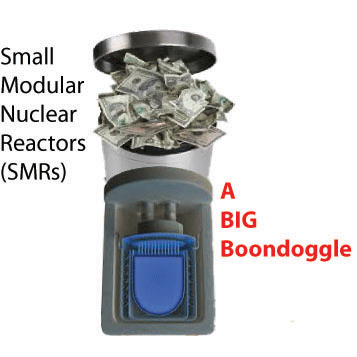 Small Modular Reactors Get Their First Chance In The US, MIT Technology Review, Richard Martin Editor 12 May 16 Small, modular reactors have long been viewed by many in the nuclear power industry as the most promising technology—indeed, as the only realistic path forward—for nuclear power in the United States. In a possible step forward for next-generation nuclear power, the Tennessee Valley Authority is applying for a permit to build one such reactor. Although the specific reactor technology has yet to be determined, the utility could have it running by the mid-2020s……..
The site chosen for the project, on the Clinch River, is notable in the checkered history of nuclear power in this country: it was to be the site of the Clinch River Breeder Reactor, on which more than $1 billion was spent in the 1970s and early 1980s. The project was finally killed by Congress in 1983, and many date the decline of the U.S. nuclear industry to its demise.
#Betrayal – Nuclear fiction can be closer to the truth
Europe’s nuclear power ending, renewable sources can take over
Nuclear power plants are exposed to big risks. Natural disasters, terrorism and technical defects can lead to significant damage. Despite worldwide increasing number of new nuclear power plants Europe could say goodbye to nuclear power. The only condition is to smartly use an arising gap
30 years after reactor accident in Chernobyl nuclear power is still one of the most important energy sources in Europe and the world. Neither mass protests since the 1970’s nor the disaster in Fukushima resulted in stopping energy generation from nuclear power. But energy landscape and attitude to different energy sources is changing in the last years.
The accidents in Fukushima and Chernobyl illustrated how vulnerable those power plants everywhere in the world are. Causes of these catastrophes can be technical or construction defects or human failure or natural disasters like tsunamis or earthquakes. Many reactors in Europe are classified as at risk. Just as little all causes of reactor accidents can be prevented as hard it is to repair the damages of a GAU. In both accidents all clear-up and dismantling operations are not finished, even not in Ukraine after 30 years.
Further causes of nuclear accidents
Further causes for nuclear accidents are less considered. More and more new forms of Islamist terrorism threaten the security of nuclear power plants in Europe. Being a worthy objective of hijacked planes is only one possible variant. In the environment of the latest terror attacks in Europe irregularities became known about a nuclear scientist and the Belgian power plants Doel and Tihange: Over three years a jihadist trained in Syria worked at the plant in Doel, a terrorist of the Paris attacks spied on the head of the nuclear power research centre.
In April 2016 German media reported on a computer virus which were discovered in the computer systems of the German nuclear power plant Gundremmingen. Even though no concrete consequences on the security could be identified so far this case shows the vulnerability of those systems. Terrorists can gain access to sensible areas and do damage through infiltrating the staff or the computer systems.
Especially the potential damage is enormous. Many European nuclear power plants are situated in densely populated areas und previous accidents show how difficult it is to stop a GAU. Millions of people could be affected by nuclear accidents or terroristic attacks on power plants in Europe.
No end in sight?
Besides all these dangers the problem of nuclear waste disposal remains. Still to the present day no final repository in the world could be found. But the steady growing mountain of waste threaten the health of the people and the environment. A nuclear phaseout seems to be the only logical step to a cleaner and safer world. But it’s not that easy to change the attitude……….
Resistance in the national states
So far it’s mainly the national governments who fight against the end of nuclear power in Europe. France argues that its historically grown grid with 19 nuclear power plants can’t be change from one day to another. However, Germany – comparable in population and economic power – is phasing out completely by 2022.
Also in smaller countries like Czech Republic, Slovakia or the Baltic countries nuclear power plays an important role in their energy mix. So their governments argue that a system conversion to renewables would be too costly for economic reasons. Furthermore, the social support in these countries for energy from wind and sun is missing……..
a different aspect is giving hope for a change. Nuclear power plants in Europe have a defined maximum operating period after which the plants have to be shut down. The dates for the shutdowns are already available for almost all plants.
This will allow to better plan the conversion. Since governments and EU commission know when new energy capacities will be demanded because a plant needs to be shut down renewable energies could be funded more aimed and integrated in the next 20 or 30 years……http://www.thenewfederalist.eu/nuclear-power-gap
1 This Month

of the week – Shut Down Drone Warfare!


Tell the Ukrainian Government to Drop Prosecution of Peace Activist Yurii Sheliazhenko

Petition to revoke the licensing of the Near Surface Nuclear Disposal Facility (NSDF) at Chalk River. https://www.ourcommons.ca/petitions/en/Petition/Details?Petition=e-7247
To see nuclear-related stories in greater depth and intensity – go to https://nuclearinformation.wordpress.com
-
Archives
- March 2026 (251)
- February 2026 (268)
- January 2026 (308)
- December 2025 (358)
- November 2025 (359)
- October 2025 (376)
- September 2025 (257)
- August 2025 (319)
- July 2025 (230)
- June 2025 (348)
- May 2025 (261)
- April 2025 (305)
-
Categories
- 1
- 1 NUCLEAR ISSUES
- business and costs
- climate change
- culture and arts
- ENERGY
- environment
- health
- history
- indigenous issues
- Legal
- marketing of nuclear
- media
- opposition to nuclear
- PERSONAL STORIES
- politics
- politics international
- Religion and ethics
- safety
- secrets,lies and civil liberties
- spinbuster
- technology
- Uranium
- wastes
- weapons and war
- Women
- 2 WORLD
- ACTION
- AFRICA
- Atrocities
- AUSTRALIA
- Christina's notes
- Christina's themes
- culture and arts
- Events
- Fuk 2022
- Fuk 2023
- Fukushima 2017
- Fukushima 2018
- fukushima 2019
- Fukushima 2020
- Fukushima 2021
- general
- global warming
- Humour (God we need it)
- Nuclear
- RARE EARTHS
- Reference
- resources – print
- Resources -audiovicual
- Weekly Newsletter
- World
- World Nuclear
- YouTube
-
RSS
Entries RSS
Comments RSS
 nuclear-news