Citizens’ Juries (IF FAIR AND TRANSPARENT) could help solve South Australia’s nuclear waste dilemma
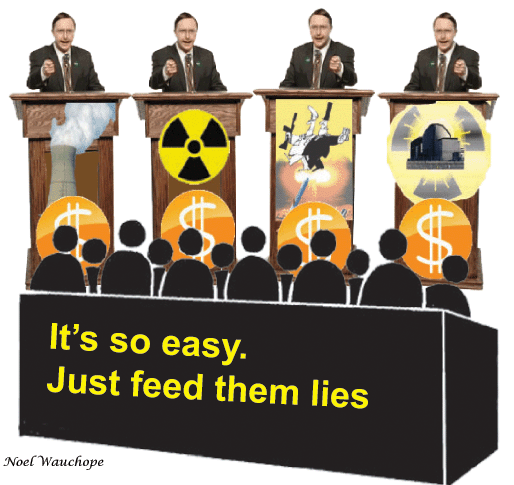 The role of Citizens’ Juries in decision-making on nuclear waste importation, Online opinion, By Noel Wauchope 13 May 2016 On May 10th South Australian Premier Jay Weatherill announced the process by which the state will decide whether or not to host a global nuclear waste import industry, as recommended by the Nuclear Fuel Cycle Royal Commission.
The first step will be to set up a “Citizens’ Jury” of 50 participants randomly selected from 25,000 invitees statewide, to be followed later by another one of 350 participants.
I think that Weatherill might have mistaken his terms here, as a Citizens’ Jury, by definition, means a group of 10 to 12 participants. The Weatherill plan sounds more like a “Deliberative Poll”, which involves a much larger group.
A properly constituted Citizens’ Jury can be a valuable process in participatory democracy. The group of 10 or 12 people serves as microcosm of the public. …… The process depends on having the oversight of a neutral but well informed advisory panel. Questions need to be framed in a way that does not risk influencing the response. Transparency is important, and complete audio or video recordings of all jury hearings should be publicly available, although the actual jury room deliberations should be private.
The citizen jury process can be an empowering one for the participants, and, as long as it is perceived to be fair and transparent, can be a valuable democratic option for assessing public opinion. It also has the advantage of being cost-effective.
The “Deliberative Poll” method is potentially another very useful form of participatory democracy. It is a lot more expensive, and more complicated. The biggest disadvantage of the Deliberative Poll method is probably its cost. Wikipedia notes:
“Imagine how much money is needed to pay for the trips, the hotel and the food for each participant, hiring the research crew and moderators, booking a venue, etc. Additional costs can include paying for participants’ compensation so that people that are randomly selected can put aside their duties to attend the events (i.e. hiring someone to milk a participant’s cow and providing child care”
Some critics insist that funding for either of these processes should not come from on single body.
“Multiple sources of funding help to ensure that the jury’s organisers are not seen as having a financial interest in producing a verdict that supports the interests of a single funding body. To maximise the scrutiny they provide, the two or more funders should have somewhat opposing interests regarding the subject likely to be under discussion.”……
In Japan, in 2012, a Deliberative Poll formed the guide to government decision-making. The Japanese government used the Center for Deliberative Democracy’s Deliberative Polling method to both inform participants and allow them to influence policymakers about the public’s will with regard to energy production issues. As a direct result of the deliberative polling process, Japan’s national government pledged to have zero percent dependency on nuclear energy after 2030. (This decision was overturned by a later government).
The South Australian government’s decision to start with a participatory democracy process is a welcome one, provided that it is done fairly and properly. Neither a Citizens Jury nor a Deliberative Poll can be a substitute for a fully democratic process like a referendum, but either could be a valuable contributor to a wider process of decision making. http://www.onlineopinion.com.au/view.asp?article=18230
Film star Michael Douglas disappointed in Obama’s sorry progress on nuclear disarmament
 Michael Douglas: Obama ‘a disappointment’ in creating nuclear-free world http://www.jpost.com/Breaking-News/Michael-Douglas-Obama-a-disappointment-in-creating-nuclear-free-world-453876 Douglas, a UN “messenger for peace,” wants President Barack Obama to issue a strong message against nuclear weapons when he visits Hiroshima in Japan later this month.
Douglas told reporters at the United Nations in Geneva, where nuclear negotiations have been stuck for 20 years, that the nuclear danger was greater than during the Cold War, largely due to a “huge escalation” in US-Russia tensions and increasing recklessness in their close-quarter contacts.
“There’s this kind of crazy tension between US and Russia. We have our issues but I don’t quite see that all of this posturing is helping anybody,” he said.
The number of weapons that are on trigger alert is frightening. So the time for somebody to possibly make a mistake and correct it is very very short.”
Douglas said he “found religion” in the anti-nuclear cause after the Three Mile Island nuclear accident in 1979, within days of the opening of his film The China Syndrome, which dealt with an emergency at a nuclear plant. Standing beside Joseph Cirincione, president of Ploughshares Fund, a global security organization, Douglas recalled Obama’s 2009 speech in Prague, where the president promised concrete steps towards a nuclear-free world.
“I think we could say he’s been a disappointment because there’s not been follow through, and I do hope now for his legacy as he begins to leave office, that he’s going to have something strong to say at Hiroshima.”
Cirincione said Obama had made good early progress on nuclear non-proliferation, but had made only modest cuts in arsenals and was leaving $1 trillion in new nuclear contracts in the pipeline for his successor.
“Every single weapon in the nuclear arsenal is now due for replacement or an upgrade. It’s a looming disaster,” he said. Douglas, 71, said he was also a friend of Donald Trump, but he was not confident the United States would make any advances in nuclear disarmament if Trump won the presidency.
South Africa: renewable energy growth, promise that nuclear development will be “corruption-free”
South Africa targets more renewable power, nuclear expansion to go ahead
*Renewable energy seen contributing 17,800 MW by 2030
* Nuclear expansion process to be affordable, above board
Africa’s most industrialised country has turned to solar and wind power to diversify its energy mix and help plug electricity shortages. The first 47 renewable energy independent power producers are due to be fully operational by July.
It also hopes to install 9,600 megawatts of nuclear power in the next 15 years to address chronic electricity shortages but the cost of the project estimated at about $100 billion has raised budgetary concerns.
Tina Joemat-Pettersson reaffirmed in parliament that the planned nuclear expansion would be “corruption free”, following concerns by opposition parties over the tender process and about the affordability of the project in a country whose economic growth has stagnated.
The department of energy would issue a request for proposal to confirm market appetite for the fleet of nuclear plants and help secure commercial and financial information for the government to make a final decision, she said.
“We will only implement what our country can afford,” Joemat-Pettersson said.
Forecasts for growth in South Africa have fallen to below 1 percent for 2016 as a global commodity slump drags on and rising inflation rates curb domestic spending.
Germany’s biggest power utility in financial problem about nuclear wastes costs
 Eon warns on capital raise to cover extra €2bn nuclear waste bill Guy Chazan in Berlin Ft.com 12 May 16 Shares in Eon, Germany’s biggest power producer, fell 5 per cent after it said it might have to raise capital to pay its share of the cost of storing Germany’s nuclear waste.
Eon has provisioned €8bn for waste storage, but under a proposal published by a government commission last month it would have to pay an extra €2bn into a special waste storage fund. Altogether, Germany’s four big utilities have been told they have to contribute a total of €23.3bn into the pool.
Michael Sen, Eon’s chief financial officer, said the company could pay the money, but doing so would reduce its equity capital and could hurt its credit rating.
He said Eon would be forced to postpone investments, cut more costs and potentially sell off marginal assets to cover the €10bn. A company presentation also said it could trigger unspecified “capital measures”.
Eon’s share price was trading down nearly 5 per cent at €8.14 on Wednesday……
The nuclear issue is just one of the problems weighing on Eon’s stock. Like its rival, RWE, Eon has been hit by Germany’s radical shift to renewables, which has squeezed electricity from fossil fuels out of the energy market.
It reported its biggest annual loss last year after writing down the value of its coal and gas-fired power plants by €8.8bn.
The company has responded by splitting itself in two: Eon is grouping its conventional power generation assets and energy trading in a new company, Uniper, while the new-look Eon will focus on renewables, networks and customer solutions. ……http://www.ft.com/cms/s/0/52d0c36e-173d-11e6-b8d5-4c1fcdbe169f.html?siteedition=uk#axzz48VIfeQb0
Head of Nebraska utility wants closing of uneconomic nuclear power station
Nebraska Utility Head Recommends Closing Nuclear Power Plant. abc news, By JOSH FUNK, ASSOCIATED PRESS OMAHA, Neb. — May 12, 2016 The head of a Nebraska utility recommended shutting down the nation’s smallest nuclear power plant by the end of the year, saying Thursday that it doesn’t make economic sense to keep it open.
Tim Burke, the president and CEO of the Omaha Public Power District, told the utility’s board that Fort Calhoun Nuclear Station isn’t financially sustainable……
Smaller nuclear plants, like Fort Calhoun, have the most difficult time competing on the price of power, especially if they have had serious safety problems, said Mark Cooper, who is a senior fellow for economic analysis with the Institute for Energy and the Environment atVermont Law School.
“The older, smaller reactors are really uneconomic,” Cooper said.
Adding to Fort Calhoun’s problems is a series of setbacks it has had in recent years.
The utility spent more than $140 million on repairs after flooding and a small fire damaged the plant in 2011. Fort Calhoun’s closure in April 2011 began with routine refueling maintenance, but massive flooding along the Missouri River that year and several safety and security violations forced it to remain closed.
Among the violations cited by regulators was the failure of a key electrical part during a 2010 test, a small electrical fire in June 2011, several security issues and deficiencies in flood planning that were discovered a year before the river spilled its banks.
It resumed operations in December 2013 after the utility hired Chicago-based Exelon, the largest U.S. operator of nuclear power plants, to run Fort Calhoun.http://abcnews.go.com/US/wireStory/nebraska-utility-head-recommends-closing-nuclear-power-plant-39071354
1 This Month


18 March Webinar @ 1 PM EST: An Assessment of SMR Projects: The Case of Canada
register for the zoom:
https://us02web.zoom.us/webinar/register/WN_o8BIIOUvQ2ONJR1nta65DQ#/registration


of the week – STOP SMALL MODULAR REACTORS IN CANADA
To see nuclear-related stories in greater depth and intensity – go to https://nuclearinformation.wordpress.com
-
Archives
- March 2026 (138)
- February 2026 (268)
- January 2026 (308)
- December 2025 (358)
- November 2025 (359)
- October 2025 (376)
- September 2025 (258)
- August 2025 (319)
- July 2025 (230)
- June 2025 (348)
- May 2025 (261)
- April 2025 (305)
-
Categories
- 1
- 1 NUCLEAR ISSUES
- business and costs
- climate change
- culture and arts
- ENERGY
- environment
- health
- history
- indigenous issues
- Legal
- marketing of nuclear
- media
- opposition to nuclear
- PERSONAL STORIES
- politics
- politics international
- Religion and ethics
- safety
- secrets,lies and civil liberties
- spinbuster
- technology
- Uranium
- wastes
- weapons and war
- Women
- 2 WORLD
- ACTION
- AFRICA
- Atrocities
- AUSTRALIA
- Christina's notes
- Christina's themes
- culture and arts
- Events
- Fuk 2022
- Fuk 2023
- Fukushima 2017
- Fukushima 2018
- fukushima 2019
- Fukushima 2020
- Fukushima 2021
- general
- global warming
- Humour (God we need it)
- Nuclear
- RARE EARTHS
- Reference
- resources – print
- Resources -audiovicual
- Weekly Newsletter
- World
- World Nuclear
- YouTube
-
RSS
Entries RSS
Comments RSS
 nuclear-news