Citizens’ Juries (IF FAIR AND TRANSPARENT) could help solve South Australia’s nuclear waste dilemma
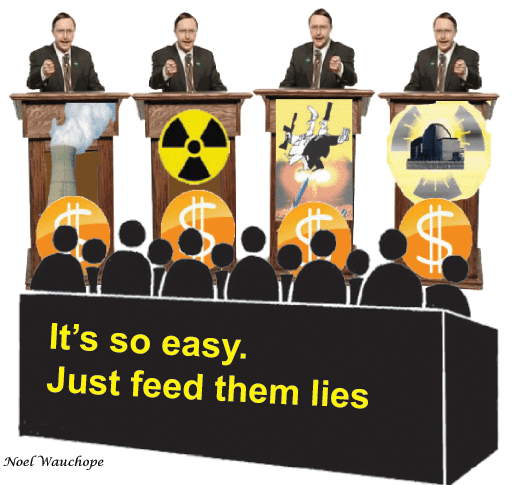 The role of Citizens’ Juries in decision-making on nuclear waste importation, Online opinion, By Noel Wauchope 13 May 2016 On May 10th South Australian Premier Jay Weatherill announced the process by which the state will decide whether or not to host a global nuclear waste import industry, as recommended by the Nuclear Fuel Cycle Royal Commission.
The first step will be to set up a “Citizens’ Jury” of 50 participants randomly selected from 25,000 invitees statewide, to be followed later by another one of 350 participants.
I think that Weatherill might have mistaken his terms here, as a Citizens’ Jury, by definition, means a group of 10 to 12 participants. The Weatherill plan sounds more like a “Deliberative Poll”, which involves a much larger group.
A properly constituted Citizens’ Jury can be a valuable process in participatory democracy. The group of 10 or 12 people serves as microcosm of the public. …… The process depends on having the oversight of a neutral but well informed advisory panel. Questions need to be framed in a way that does not risk influencing the response. Transparency is important, and complete audio or video recordings of all jury hearings should be publicly available, although the actual jury room deliberations should be private.
The citizen jury process can be an empowering one for the participants, and, as long as it is perceived to be fair and transparent, can be a valuable democratic option for assessing public opinion. It also has the advantage of being cost-effective.
The “Deliberative Poll” method is potentially another very useful form of participatory democracy. It is a lot more expensive, and more complicated. The biggest disadvantage of the Deliberative Poll method is probably its cost. Wikipedia notes:
“Imagine how much money is needed to pay for the trips, the hotel and the food for each participant, hiring the research crew and moderators, booking a venue, etc. Additional costs can include paying for participants’ compensation so that people that are randomly selected can put aside their duties to attend the events (i.e. hiring someone to milk a participant’s cow and providing child care”
Some critics insist that funding for either of these processes should not come from on single body.
“Multiple sources of funding help to ensure that the jury’s organisers are not seen as having a financial interest in producing a verdict that supports the interests of a single funding body. To maximise the scrutiny they provide, the two or more funders should have somewhat opposing interests regarding the subject likely to be under discussion.”……
In Japan, in 2012, a Deliberative Poll formed the guide to government decision-making. The Japanese government used the Center for Deliberative Democracy’s Deliberative Polling method to both inform participants and allow them to influence policymakers about the public’s will with regard to energy production issues. As a direct result of the deliberative polling process, Japan’s national government pledged to have zero percent dependency on nuclear energy after 2030. (This decision was overturned by a later government).
The South Australian government’s decision to start with a participatory democracy process is a welcome one, provided that it is done fairly and properly. Neither a Citizens Jury nor a Deliberative Poll can be a substitute for a fully democratic process like a referendum, but either could be a valuable contributor to a wider process of decision making. http://www.onlineopinion.com.au/view.asp?article=18230
No comments yet.
1 This Month

of the week – Shut Down Drone Warfare!


Tell the Ukrainian Government to Drop Prosecution of Peace Activist Yurii Sheliazhenko

Petition to revoke the licensing of the Near Surface Nuclear Disposal Facility (NSDF) at Chalk River. https://www.ourcommons.ca/petitions/en/Petition/Details?Petition=e-7247
To see nuclear-related stories in greater depth and intensity – go to https://nuclearinformation.wordpress.com
-
Archives
- April 2026 (103)
- March 2026 (251)
- February 2026 (268)
- January 2026 (308)
- December 2025 (358)
- November 2025 (359)
- October 2025 (376)
- September 2025 (257)
- August 2025 (319)
- July 2025 (230)
- June 2025 (348)
- May 2025 (261)
-
Categories
- 1
- 1 NUCLEAR ISSUES
- business and costs
- climate change
- culture and arts
- ENERGY
- environment
- health
- history
- indigenous issues
- Legal
- marketing of nuclear
- media
- opposition to nuclear
- PERSONAL STORIES
- politics
- politics international
- Religion and ethics
- safety
- secrets,lies and civil liberties
- spinbuster
- technology
- Uranium
- wastes
- weapons and war
- Women
- 2 WORLD
- ACTION
- AFRICA
- Atrocities
- AUSTRALIA
- Christina's notes
- Christina's themes
- culture and arts
- Events
- Fuk 2022
- Fuk 2023
- Fukushima 2017
- Fukushima 2018
- fukushima 2019
- Fukushima 2020
- Fukushima 2021
- general
- global warming
- Humour (God we need it)
- Nuclear
- RARE EARTHS
- Reference
- resources – print
- Resources -audiovicual
- Weekly Newsletter
- World
- World Nuclear
- YouTube
-
RSS
Entries RSS
Comments RSS
 nuclear-news
Leave a comment