Fukushima provides a perfect case study for the meltdown of truth. It is beyond reckless and immoral for governments and mainstream media to downplay and cover up such disasters……
Let us not forget that the global economy is ruled by those who control the money system….The way profits are extracted have nothing to do with a healthy environment and humanity
 Fukushima – the story continues... BY: ROGER METCALFE, BIZCOMMUNITY. South Africa, 29 Apr 16, The 5th anniversary of the meltdown of the Fukushima nuclear power plant on the east coast of Japan has come and gone, and, still the whole story hasn’t been told.
Besides Japanese pride, there are many reasons for the cover-up. Some include the 2020 Olympic Games, payment of compensation to victims and the negative impact on Japan’s economy.
Cracks starting to show
However, the smokescreen is beginning to show cracks, and the head of the Japanese nuclear regulatory authority Shinji Kinjo, has just admitted that they have anemergency on their hands. He also criticised Tepco (Tokyo Electric Power Company), the utility that runs Fukushima, saying: “Their sense of crisis is weak.”
Death and contamination
Currently if an unprotected person approaches the damaged Fukushima buildings, the radiation level is so high that death could occur in less than an hour. Entering the damaged building, even wearing protective gear, is out of the question, and three remote controlled robots have also failed, due to intense radiation.
Outside opinion
Mycle Schneider is a Paris-based nuclear energy consultant, and advisor to the European parliament on nuclear matters. He is also lead author of The World Nuclear Industry Status Reports and does not mince his words.
He says Japan’s escalating situation is: “Far worse than we truly know. There are hundreds of issues at stake here,” he told the Huffington Post UK.
“Whether it is meltdown temperature, radiation exposure, or the number of people exposed – all of these statistics are flawed. We don’t know anything yet.”
“This is far worse than what the general public are perceiving. At the moment we are facing the challenge to conquer denial. This is simply organised denial,” he said.
Pushing ahead with nuclear development
Yet, even as the Fukushima disaster continues to play out, Japan’s prime minister, Shinzo Abe, has reaffirmed his commitment to nuclear power and is pushing to restart other nuclear plants. With 70% of Japanese population opposed to nuclear energy, this proposal goes totally against public opinion. While many scientists and Greenpeace are alarmed by the continuing contamination of the atmosphere and of the Pacific Ocean, Abe insists that the situation at Fukushima is under control.
Morality and survival
Fukushima provides a perfect case study for the meltdown of truth. It is beyond reckless and immoral for governments and mainstream media to downplay and cover up such disasters. Besides being well researched on environmental crises, I have written many articles and have aired my views on radio several times.
Not wanting to be branded a ‘scare monger’, I’m beginning to shift focus from radiation damage to life, to the immorality and hypocrisy that lies behind such disasters.
With such disasters, truth is often the first casualty. Yet truth (in whatever form) is the key to health and survival, especially regarding unprecedented life-threatening disasters like Fukushima.
The South African scenario
South Africa is no different and we are witnessing the collapse of truth on many levels. Besides vested interests, there is no good reason for South Africa to even consider purchasing nuclear power. Our solar energy potential is one of the highest on the planet. And yet the issue of purchasing costly nuclear power plants is shrouded in secrecy.*……….
The dark side of capitalism
Let us not forget that the global economy is ruled by those who control the money system. Multinational corporations, including multi-trillion dollar nuclear industries, seek to monopolise control of the markets, such the energy sector. The way profits are extracted have nothing to do with a healthy environment and humanity.
This is the dark side of capitalism, working systematically to undermine democracy and common sense, as well as the environment and the health of humanity.
Hinkley nuclear project for UK and France political reasons: let’s stop pretending otherwise
The real point of this story is that nuclear power is not commercially viable but has become a state-sponsored technology. There is nothing wrong with state supported technology. But we could save a lot of time and money by not pretending that it is something else.

 Lets Stop Pretending Nuclear Power Is Commercially Viable http://oilprice.com/Alternative-Energy/Nuclear-Power/Lets-Stop-Pretending-Nuclear-Power-Is-Commercially-Viable.html By Leonard Hyman & William Tilles
Sat, 30 April 2016, First its new president, Jean-Bernard Levy, said French state utility EDF would delay a decision on its joint French-Chinese nuclear project in the UK, Hinkley Point. That was over a year ago. Then the CFO of EDF, Thomas Piquemal, quit reportedly because he opposed the project on fi-nancial grounds. That was a short time ago. Then after a leaked memos, the French gov-ernment just announced that EDF would be raising more money and the Hinkley decision would now come in September.
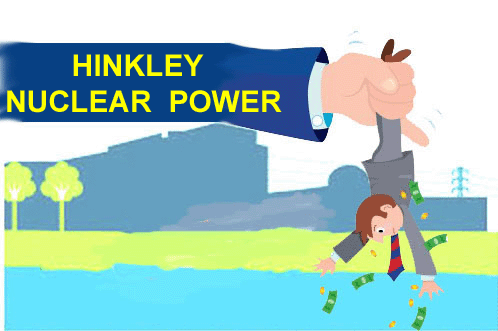
Now for the finances. These British nuclear units will cost roughly £18 billion ($27 billion). EDF has already sold a 35 percent share to the Chinese state nuclear company. However EDF still has to find more outside investors and get its ownership of the plant below 50 percent or it will have to consolidate Hinkley Point on its books and show all of the project’s debt on its own balance sheet.
If we were gamblers we would not wager that EDF will take the obvious first step towards restor-ing its financial health and cancels the Hinkley project. Of course, if David Cameron loses the Brexit vote (a referendum to take the UK out of the European Union) and is ejected from Number Ten Downing Street, a new Prime Minister might take a more skeptical view of Hinkley Point.
The real point of this story is that nuclear power is not commercially viable but has become a state-sponsored technology. There is nothing wrong with state supported technology. But we could save a lot of time and money by not pretending that it is something else.
Nuclear shipwreck still highly radioactive over 60 years later
Details Emerge from Cold War-Era Nuclear Shipwreck, New Historian, David DeMar May 01, 2016 More details have emerged regarding the wreck of the USS Independence, a US Navy vessel deliberately sacrificed in 1946 at the Bikini Atoll nuclear weapons tests at the very inception of the Cold War…….
NOAA and Boeing used a combination of high-resolution sonar imaging and an unmanned submersible known as “Echo Ranger” to locate and safely survey the still-irradiated wreck of the Independence. The resultant case study, plus newly declassified files on the Navy ship straight from the US National Archives, concerning its time as a nuclear weapons testbed, have been published in theJournal of Maritime Archaeology (JNA)……
merging documentary evidence with a study of the physical remains of a maritime archaeological site is a goal that can and should be pursued…….
The infamous tests at Bikini Atoll, The Bikini tests, conceived and undertaken just one year after dropping not one but two nuclear weapons on Japan, at Hiroshima and Nagasaki, to end the Second World War, was one of the most visible and noteworthy events to signal a fundamental shift in postwar history.
In one of the newly-declassified reports dating from the era, it was suggested that the awesome power of nuclear weaponry represented a new era where the utter destruction of man had become possible, scouring the Earth of nothing but vestigial traces of humanity. http://www.newhistorian.com/details-emerge-cold-war-era-nuclear-shipwreck/6397/
Climate change is already taking its toll
Jeff Masters: Food system shock: climate change’s greatest threat to civilization.
The greatest threat of climate change to civilization over the next 40 years is likely to be climate change-amplified extreme droughts and floods hitting multiple major global grain-producing “breadbaskets” simultaneously.
https://www.wunderground.com/blog/JeffMasters/food-system-shock-climate-changes-greatest-threat-to-civilization & http://www.environmentalhealthnews.org/t/-8878616388554072809
India heatwave: Train keeps city alive as cricket matches cancelled, farmers and animals suffer
In India, 330 million people across 10 states are in the grip of a crippling drought and heatwave.
Supplies are so depleted in one city that it is entirely reliant on drinking water delivered daily by train.
http://www.abc.net.au/news/2016-05-01/train-keeps-indian-city-alive-in-heatwave/7373546
Japan’s ex Prime Minister Kan honoured for his work to stop nuclear power
3/11 Prime Minister Kan recognized for efforts to phase-out nuclear power, Japan Times, 1 May 16 KYODO FRANKFURT – Former Prime Minister Naoto Kan was honored in Germany Saturday for his work to promote the phase-out of atomic power in Japan following the 2011 Fukushima nuclear crisis.
At a ceremony at Frankfurt City Hall, former German Environment Minister Juergen Trittin praised Kan as a “fighter” for his work on nuclear and renewable energy.
Kan received a certificate from a representative of EWS, a power company in Schoenau, southern Germany, on the initiative of citizens against nuclear power.
Kan, who led the former Democratic Party of Japan, was prime minister from June 2010 to September 2011. He was the man who had the misfortune of being in office when the unprecedented March 11, 2011, Great East Japan Earthquake, tsunami and nuclear disasters struck……http://www.japantimes.co.jp/news/2016/05/01/national/311-prime-minister-kan-recognized-efforts-phase-nuclear-power/#.VydmpNQrLMx
No to Nuclear Energy in Nigeria
Nigeria: Say No to Nuclear Energy in Nigeria AllAfrica, 1 May 16“…..Nigeria’s history of disaster management or maintenance culture in the past and the present has much to be desired of, so how can it want to project into a future of nuclear energy with all the attendant risk.
It does not take an expert in Nuclear energy to be able to state basic obvious facts that are glaring. Any major mishap involving radiation leaks from nuclear energy can lead to a disaster of catastrophic proportion that could lead to thousands of death, long term health problems, spikes in cancer incidents and birth defects. The devastation of a nuclear disaster in a highly populated country like Nigeria would send shock waves around the world. A breach in the nuclear containers of a nuclear reactor or a nuclear meltdown would release nuclear materials into the atmosphere and ground and could literally obliterate parts of the country and turn them into waste lands and “ghost lands”.
No matter how prepared even the extremely prepared and efficient countries are, in a case of a nuclear disaster they can only try to mitigate the damage, so what chance would Nigeria have if a nuclear melt down were to occur in the country. Even if the argument is that the likelihood of a nuclear disaster is minuscule, should Nigeria of today, the way it is, subject its people to that risk? The risk out weighs the benefit.
 Was it not in Koko, Delta State, that someone shipped in containers of nuclear waste?
Countries try to get rid of their radio-active waste, yet a Nigerian shipped it into his country and dumped it amongst his people. The community, struggling under their daily routine for survival did not sense the eminent danger and instead opened up the containers, used them to collect water and for other domestic use. By the time the government brought it to public knowledge, the people in the affected area of Koko had been exposed to radiation. When scientist came with Geiger counters to measure the amount of radiation in the area and also on the people, a lot of them did not understand what was going on and had little understanding of the dangers of nuclear radiation. Have the people of Koko been followed? Have longitudinal studies been done on their health status? Were children born in that area since the episode monitored? Is the soil in that area still being tested regularly or have the people of Koko been forgotten? These are but a few of the questions…….
Nigeria is blessed with sunshine; it can invest in solar energy. It has vast areas of empty flat land so it can invest in wind energy by using turbines……..http://allafrica.com/stories/201605010001.html
The Thorium Nuclear Dream – a critical assessment
 Thorium: new and improved nuclear energy? https://wiseinternational.org/nuclear-energy/thorium-new-and-improved-nuclear-energy
There is quite some – sometimes tiresome – rhetoric of thorium enthusiasts. Let’s call them thor-bores. Their arguments have little merit but they refuse to go away.
Here are some facts:
- There is no “thorium reactor.” There is a proposal to use thorium as a fuel in various reactor designs including light-water reactors–as well as fast breeder reactors.
- You still need uranium – or even plutonium – in a reactor using thorium. Thorium is not a fissile material and cannot either start or sustain a chain reaction. Therefore, a reactor using thorium would also need either enriched uranium or plutonium to initiate the chain reaction and sustain it until enough of the thorium has converted to fissile uranium (U-233) to sustain it.
- Using plutonium sets up proliferation risks. To make a “thorium reactor” work, one must (a) mix the thorium with plutonium that has been stripped of the highly radioactive fission products; (b) use the mixed-oxide thorium-plutonium fuel in a reactor, whereby the plutonium atoms fission and produce power while the thorium atoms absorb neutrons and are turned into uranium-233 (a man-made isotope of uranium that has never existed in nature); (c) strip the fission products from the uranium-233 and mix THAT with thorium in order to continue the “cycle”. In this phase, the U-233 atoms fission and produce power while the thorium atoms absorb neutrons and generate MORE uranium-233. And so the cycle continues, generating more and more fission product wastes.
- Uranium-233 is also excellent weapons-grade material. Unlike any other type of uranium fuel, uranium-233 is 100 percent enriched from the outset and thus is an excellent weapons-grade material and as effective as plutonium-239 for making nuclear bombs. This makes it very proliferation-prone and a tempting target for theft by criminal and terrorist organizations and for use by national governments in creating nuclear weapons.
- Proliferation risks are not negated by thorium mixed with U-238. It has been claimed that thorium fuel cycles with reprocessing would be much less of a proliferation risk because the thorium can be mixed with uranium-238. In fact, fissile uranium-233 must first be mixed with non-fissile uranium-238. If the U-238 content is high enough, it is claimed that the mixture cannot be used to make bombs with out uranium enrichment. However, while more U-238 does dilute the U-233, it also results in the production of more plutonium-239, so the proliferation problem remains.
- Thorium would trigger a resumption of reprocessing in the US. In most proposed thorium fuel cycles, reprocessing is required to separate out the U-233 for use in fresh fuel. Reprocessing chemically separates plutonium and uranium and creates a large amount of so-called low-level but still highly radioactive liquid, gaseous and solid wastes.
- Using thorium does not eliminate the problem of long-lived radioactive waste. Fission of thorium creates long-lived fission products including technetium-99 (half-life of over 200,000 years). Without reprocessing, thorium-232 is itself extremely long-lived (half-life of 14 billion years) and its decay products will build up over time in irradiated fuel. Therefore, in addition to all the fission products produced, the irradiated fuel is also quite radiotoxic. Wastes that pose long-term hazards are also produced at the “front end” of the thorium fuel cycle during mining, just as with the uranium fuel cycle.
- Attempts to develop “thorium reactors” have failed for decades. No commercial “thoriumreactor” exists anywhere in the world. India has been attempting, without success, to develop a thorium breeder fuel cycle for decades. Other countries including the US and Russia have researched the development of thorium fuel for more than half a century without overcoming technical complications.
- Fabricating “thorium fuel” is dangerous to health. The process involves the production of U-232 which is extremely radioactive and very dangerous in small quantities. The inhalation of a unit of radioactivity of thorium-232 or thorium-228 produces a far higher dose than the inhalation of uranium containing the same amount of radioactivity. A single particle in the lung would exceed legal radiation standards for the general public.
- Fabricating “thorium fuel” is expensive. The thorium fuel cycle would be more expensive than the uranium fuel cycle. Using a traditional light-water (once-through) reactor, thorium fuel would need both uranium enrichment (or plutonium separation) and thorium target rod production. Using a breeder reactor makes costly reprocessing necessary.
Australia’s nuclear submarine boondoggle – a crippling waste of tax-payers’ money
4. BUT WAIT THERE’S MORE So we spend $2,000 each. That just gets us the big lumps of steel. If you actually want to use them, you’re paying more. It could be another $2,000 to $4,000 per Australian….
OPTIONS The great thing about the way the acquisition will work is there should be the opportunity to cut back from 12 when the inevitable delays and cost blowouts happen. From here we can’t save the whole $2000 but maybe we can save some, for better uses.

 Sub standard: why the $2,000 we are each spending on submarines will probably be a terrible waste http://www.news.com.au/technology/innovation/design/sub-standard-why-the-2000-we-are-each-spending-on-submarines-will-probably-be-a-terrible-waste/news-story/6922de6f6a72657c669fdc1a1248916f APRIL 30, 2016, Jason Murphy news.com.au@jasemurphy AUSTRALIA is spending $50 billion to buy submarines. The biggest whack of money we’ve ever spent on a Defence project. It comes out at $2000 per person. And it’s probably a shocking idea.
1. STRATEGY The strategic rationale for submarines is that an island needs trade lanes to stay open. Yep, we do. But the kind of war where a country lays siege to another whole country — think German U-Boats blockading Britain — is no longer likely at all.
Our non-nuclear submarines would have been handy in the past. And the generals are always “fighting the last war” strategically. Which is fine. But it would be better if we didn’t have to give them $2000 to do so.
2. AVAILABILITY We are buying 12 boats. Except — here’s the thing — you can’t use them all at once. Subs need a lot of maintenance. Take the Collins Class submarines, of which we have six. Best-case scenario — if things are going splendidly — is they spend half the time in the water, half in maintenance. But those subs have big problems. Some recent years we’ve managed to have basically just one in the water on average.
3. COST BLOWOUTS The Joint Strike Fighter aircraft program, which we bought into, is now many billions of dollars over Budget. Possibly hundreds of billions (reports vary). And it is hardly alone.
We consistently underestimate how complex defence equipment is because we, naturally, compare it to a vehicle. But not only is our new submarine custom-made (unlike my station wagon) it is also cutting edge technology.
It has to do many things perfectly. A submarine is a fortress, an IT hub, a weapons system, a vehicle and a temporary home all in one. Making all the things fit in together is hard. (Recently Spanish submarine builders had to send their sub back to the drawing board after they accidentally made it 75 tons too heavy and it was going to sink.)
When you face the inevitable problems you can either compromise or just spend that bit more to make it work. And if you cut corners on Defence equipment, you risk losing personnel and very expensive equipment… So of course you spend a bit more. And that’s how such laughably enormous cost blowouts happen.
4. BUT WAIT THERE’S MORE So we spend $2,000 each. That just gets us the big lumps of steel. If you actually want to use them, you’re paying more. It could be another $2,000 to $4,000 per Australian over the next 45 years. All that maintenance is expensive. And so are the crews.
The Navy has had enormous problems actually finding and training crew for submarines. A cook on a submarine can be paid an amazing $200,000 per year. Other personnel get more. Living in a big steel tube for 80 days with only other men for company is rubbish, apparently.
5. ENOUGH IS ENOUGH! Australia is the 52nd biggest country in the world by population, 13th by size of economy, and sixth by land area. We spend 13th most on defence. And we are ramping up by $26 billion per year over the next 10 years.
It is a lot, given we have no land borders, the natural advantage of being surrounded by a giant moat, and are strategically not on the way to anywhere much (sorry NZ).
The main reason anyone would attack us is in the context of a global or regional conflict is we have a large military they might fear.
Our spending has an effect on our neighbours. Indonesia is not a rich country, but they have indicated they are also thinking about expanding their submarine fleet. Would limiting our spending help forestall a local arms race?
OPTIONS The great thing about the way the acquisition will work is there should be the opportunity to cut back from 12 when the inevitable delays and cost blowouts happen. From here we can’t save the whole $2000 but maybe we can save some, for better uses.
Nuclear disasters crippled the industry. the next one will kill it off quickly
Has the Chernobyl disaster affected the number of nuclear plants built?
Thirty years on from one of the worst radiation leaks in history, several countries have moved to phase out nuclear energy production altogether, and experts say another accident would kill the industry, Guardian, Charlotte Beale, Saturday 30 April 2016 “……..some of the change was directly down to the disaster in Ukraine. Italy, for example, voted in a referendum soon afterwards to stop producing nuclear energy. However, consultant nuclear engineer John Large says that regulations and transparency demands introduced in the wake of a 1979 meltdown at Three Mile Island in Pennsylvania actually had a bigger impact. “Fukushima will have the same effect,” he says.
The disaster in Japan prompted the German government to phase out its plants, with the last one closing in 2022. “Nuclear energy is failing because it is simply too expensive,” says Dr Paul Dorfman, senior research fellow at the Energy Institute, University College London. “If there’s another nuclear accident in the next five or 10 years, you can say goodbye to the industry.” http://www.theguardian.com/environment/2016/apr/30/has-chernobyl-disaster-affected-number-of-nuclear-plants-built
1 This Month


Tell the Ukrainian Government to Drop Prosecution of Peace Activist Yurii Sheliazhenko

Petition to revoke the licensing of the Near Surface Nuclear Disposal Facility (NSDF) at Chalk River. https://www.ourcommons.ca/petitions/en/Petition/Details?Petition=e-7247


of the week – STOP SMALL MODULAR REACTORS IN CANADA
To see nuclear-related stories in greater depth and intensity – go to https://nuclearinformation.wordpress.com
-
Archives
- March 2026 (212)
- February 2026 (268)
- January 2026 (308)
- December 2025 (358)
- November 2025 (359)
- October 2025 (376)
- September 2025 (258)
- August 2025 (319)
- July 2025 (230)
- June 2025 (348)
- May 2025 (261)
- April 2025 (305)
-
Categories
- 1
- 1 NUCLEAR ISSUES
- business and costs
- climate change
- culture and arts
- ENERGY
- environment
- health
- history
- indigenous issues
- Legal
- marketing of nuclear
- media
- opposition to nuclear
- PERSONAL STORIES
- politics
- politics international
- Religion and ethics
- safety
- secrets,lies and civil liberties
- spinbuster
- technology
- Uranium
- wastes
- weapons and war
- Women
- 2 WORLD
- ACTION
- AFRICA
- Atrocities
- AUSTRALIA
- Christina's notes
- Christina's themes
- culture and arts
- Events
- Fuk 2022
- Fuk 2023
- Fukushima 2017
- Fukushima 2018
- fukushima 2019
- Fukushima 2020
- Fukushima 2021
- general
- global warming
- Humour (God we need it)
- Nuclear
- RARE EARTHS
- Reference
- resources – print
- Resources -audiovicual
- Weekly Newsletter
- World
- World Nuclear
- YouTube
-
RSS
Entries RSS
Comments RSS
 nuclear-news