Idaho nuclear waste treatment plant runs into trouble
the DOE and Idaho Treatment Group have run into recent problems. A New Mexico waste repository where much of the waste needs to be sent remains closed after an accident last year. That means about
20,000 ready-to-ship containers of waste have stacked up, with nowhere to go.

 Looming deadline for nuclear waste plant, future in limbo , WT, By LUKE RAMSETH – Associated Press , April 24, 2016 IDAHO FALLS, Idaho (AP) – A darkened central control room with more than 25 computer screens watches over nearly everything occurring inside this radioactive waste treatment plant west of Idaho Falls.
The room is where employees at the Advanced Mixed Waste Treatment Project, or AMWTP, monitor and manipulate the facility’s dangerous waste treatment process from afar. Decades-old metal boxes and drums filled with radioactive waste travel through a series of conveyor belts and elevators. At various stages the waste is remotely sorted, repackaged, smashed up, and then packaged again. A final product of multiple 55-gallon drums is shipped on trucks to waste repositories located in New Mexico, Nevada and Utah.
The facility – which employs about 700 and has operated for more than a dozen years – is undergoing an approximately $10 million overhaul. Officials hope the new infrastructure will help finish the job of treating some 65,000 cubic meters of Idaho’s transuranic nuclear waste before a looming 2018 deadline.
Meanwhile, U.S. Department of Energy officials are pondering what to do with the specialized plant once its current mission is complete. One tentative post-2018 plan would mean shipping nuclear waste to the Idaho facility from DOE sites spread around the country. The waste would be treated and packaged here, then sent onward to a final resting place outside the state……
The AMWTP was built to treat 65,000 cubic meters of transuranic waste that was buried nearby in the Arco desert in the 1970s and ‘80s. It came from the now-closed Rocky Flats Plant near Denver, where nuclear weapon components were made.
Held in slowly deteriorating metal, wooden and fiberglass boxes and metal drums, the waste includes tools, rags, clothing, sludge and dirt – anything contaminated with a transuranic element, such as plutonium, during the weapon-making process.
Workers at the facility have been chipping away at the massive pile of waste for years. It’s a painfully slow process that since 2011 has been handled by Idaho Treatment Group. This summer a new government contractor, Fluor, will take over management of the job, along with other waste cleanup duties on the desert site.
Richardson said there are about 12,000 cubic meters still to get through. All the waste is supposed to be treated and shipped out of Idaho by the end of 2018 under a state deadline laid out in the 1995 Idaho Settlement Agreement with the DOE.
But the DOE and Idaho Treatment Group have run into recent problems. A New Mexico waste repository where much of the waste needs to be sent remains closed after an accident last year. That means about 20,000 ready-to-ship containers of waste have stacked up, with nowhere to go…….http://www.washingtontimes.com/news/2016/apr/24/looming-deadline-for-nuclear-waste-plant-future-in/
A solar-powered flight across the Pacific – the Solar Impulse 2 arrives in California
Solar-powered plane reaches California after journey across Pacific Mashable Australia, BY THE ASSOCIATED PRESS , 24 Apr 16, MOUNTAIN VIEW, Calif. — A solar-powered airplane landed in California on Saturday, completing a risky, three-day flight across the Pacific Ocean as part of its journey around the world.

Pilot Bertrand Piccard landed the Solar Impulse 2 in Mountain View, south of San Francisco, at 11:45 p.m. local time following a 62-hour, nonstop solo flight without fuel. The plane taxied into a huge tent erected on Moffett Airfield where Piccard was greeted by project’s team……..
The trans-Pacific leg was the riskiest part of the plane’s global travels because of the lack of emergency landing sites…….http://mashable.com/2016/04/24/solar-impulse-2-california/#gwzcbJ_OIkq3
USA Republicans now liking renewable energy – for financial, not climate, reasons
 Republicans Are Warming Up to Renewable Energy , Bloomberg, Joe Ryan April 21, 2016
- Some Republicans embrace renewables as Paris accord signed
-
They argue that jobs and cost cuts make renewables attractive
-
“……..The leading Republican candidates for president, Donald Trump and Sen. Ted Cruz, reject any role of humans in global warming, as do most party leaders. But a small and growing number of once-skeptical Republicans is embracing wind and solar. They see the clean energy sources delivering cheap electricity, bolstering America’s energy independence and fueling economic development in impoverished rural areas.
-
In turn, renewables are adding jobs in North Carolina, Georgia and Texas and other conservative states, creating a formidable clean-energy constituency in a party whose energy mantra was “drill, baby drill.”…..
- Past SupportSupport for clean energy is not new for all U.S. Republicans. Some conservative state lawmakers in Iowa, Texas and elsewhere have long promoted it. When he was governor of Texas, George W. Bush pushed through legislation requiring utilities to buy renewable power, leading to widespread development of wind farms.Republican enthusiasm is based largely on economics, not climate science, and does not necessarily translate into support for the Paris agreement or other efforts to curb greenhouse gases.
- Wind and solar farms are often built on farmland, which is typically flat, cheap and treeless. That has provided rental income for farmers and created a groundswell of construction jobs. Wind and solar companies employed nearly 300,000 people in the U.S. in 2015, roughly four times more than the coal industry. All of the top 10 wind-energy producing congressional districts are represented by Republicans, according to The American Wind Energy Association.“It gives us a real leg up on economic development,” said Iowa Governor Terry Branstad, a Republican whose state ranks third nationally in wind energy.A push for renewables, meanwhile, is bubbling up from within party ranks……..
-
Government Subsidies
Meanwhile, clean energy has become less reliant on the government subsidies that fueled its growth, making it a less problematic issue for Republicans.
The average long-term contract price for wind power paid by utilities has dropped 60 percent since 2009, falling in some instances below $20 per megawatt hour. Those prices, which include subsidies, are on par with off-peak power prices in some regions, BNEF analyst Nathan Serota said. The solar price drop has been even steeper, falling 65 percent with contracts as low as $37 per megawatt hour, Serota said.
A Texas Believer
Drew Darby, a Texas state Republican representative whose district encompasses nine counties at the edge of oil country, said the proliferation of cheap wind power since the state spent more than $7 billion on new transmission lines has made him a believer.
“Republicans all over the country ought to be paying attention to what Texas did,” Darby said in an interview……..http://www.bloomberg.com/news/articles/2016-04-20/party-of-drill-baby-drill-slowly-warming-to-wind-solar-power
Global nuclear salesmen still not happy with India’s Nuclear Liability Law
 Concern Over India’s Nuclear Liability Law Still Remains: French Firm EDF http://www.ndtv.com/india-news/concern-over-indias-nuclear-liability-law-still-remains-french-firm-edf-1398896
The fresh techno-commercial proposal will also take into account India’s concern over high per unit tariff, French government officials said.
“The French feel that there is a lot of ambiguity in Clause 46 and there is fear in the minds of suppliers. We have raised this issue both with NPCIL and the Department of Atomic Energy,” said a French official.
Last month, Nuclear Power Corporation of India Limited (NPCIL) had signed an agreement for building six European Pressurised Reactors (EPR) as against the earlier proposal of two such reactors.
The delay in the project, which was first signed in 2008, and concern over India’s liability law came in the wake of nuclear firms Areva and EDF merging their reactor businesses into a joint venture controlled by EDF, as part of a broad restructuring last year.
In 2014, the US too had raised similar concerns about Clause 46 in particular.
In April last year, Areva had also signed an agreement with NPCIL to expedite the programme.
“Things are unclear over how much insurance cover does supplier have to take. There is still a lot of ambiguity in this,” the French official said.
The French government officials said the liability issue is still “manageable” but pricing still remains a major hurdle.
While the cost of the electricity generated by Kudankulam Nuclear Power Project (KKNPP) Units I and II hovers between Rs. 3 to 3.50 per unit, for JNPP, it is expected to be Rs. 9.14 per unit. India is not ready to go beyond Rs. 6.50 per unit.
The intractable thousands of years problem of Chernobyl’s radioactive debris
 Ruined Chernobyl nuclear plant will remain a threat for 3,000 years @mattschodcnews BY MATTHEW SCHOFIELD mschofield@mcclatchydc.com , Miami Herald, 24 Apr 16,
 “…………When the steam burst through the roof of Reactor Number 4 in 1986, it took with it 5 percent of the enriched uranium. That means 10 tons vanished. It also means 95 percent, or 190 tons, remained. They’re still there.
After the blasted reactor partially collapsed into the nuclear material, it created a radioactive blob of uranium, concrete, steel and assorted junk weighing about 2,000 tons. Ideally, Ukraine would remove the material. Sergiy Parashyn grabs a pen and paper as he talks about the problems with that.
“We do not know how to do this,” he explains. “We do not have the technology to do this. It must be something new.”……
“One problem is that the material is decaying and is brittle, and when we cut it up to transport it to disposal bins, it will very likely fill the air with radioactive dust,” he explains. So the tractor has to be able to operate in a radioactive environment, it has to be able to control and eliminate any dust and it has to operate in an area that will not be at all safe for humans. “Maybe something like this would work, maybe it wouldn’t. We don’t know. That’s a problem.”
It’s a problem because while 5 percent of the radioactive material caused problems that continue 30 years later and will continue to cause problems for eons to come, the other 95 percent of the material could represent about 20 times the problems.
For instance, if mistakes are made and the brittle material is released into the atmosphere, they’re back to square one. If the material gets into the Pripyat River, it will flow into the Dnieper River. The Dnieper River is the water source for Kiev. The Dnieper is the primary water source for much of Ukraine.
This is why Ukrainian officials are counting on what they call a sarcophagus to contain the site, a massive structure that looks like a Quonset hut being assembled behind a wall that is intended to deflect radiation from the decaying plant from workers.
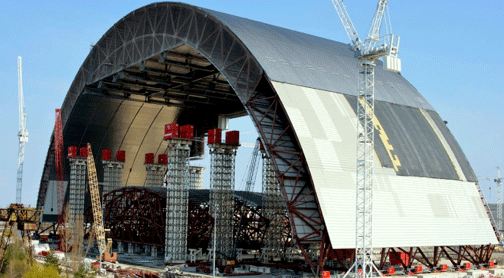
When finished, it will be rolled across the crumbling concrete of the surrounding ground to cover and further seal the dangerous reactor. The work is expected to be completed in 2018, though that is just a guess. It’s expected to last 100 years. It’s not nearly long enough.
Reactor Number 4 today is essentially an unplanned nuclear-waste dump. To serve in that role requires it to last for 3,000 years. That means the area surrounding Chernobyl will be safe to inhabit by people again in the year 4986.
How likely is that? To get an idea of what it means to contain and control a deadly and potentially devastating radioactive pile in Ukraine for 3,000 years, consider what the world looked like 3,000 years ago:……
Detlef Appel, a geologist who runs PanGeo, a Hamburg, Germany, company that consults on such nuclear storage issues, notes that 3,000 years probably isn’t long enough. He suggests that truly safe radioactive waste storage needs to extend a million years into the future. Think back to when man’s earliest relative began to walk the Earth.
“We can trust human endeavor, perhaps, for a few hundred years, though that is doubtful,” he said. “Storage implies a way to retrieve the materials. It requires trained personnel, maintenance, updating and security. Clearly, nothing man made is more than temporary, and therefore it isn’t adequate.”
Even the continents will have moved in a million years.
Tetiana Verbytska, an energy policy expert at the National Ecological Center of Ukraine, worries that people are far too easygoing about Chernobyl. Among government officials right now, mindful of the 30-year anniversary, there is a movement to shrink the radius of the highly contaminated no man’s land from 18 miles to 6.
“The move to reduce the highly contaminated zone has nothing to do with science and everything to do with public relations,” she says. “In Ukraine, each April we make wonderful speeches about our commitment to dealing with this problem, and the rest of each year we hope the problem will just go away.”
There are other reasons to worry. Ukraine is creaking under a civil war against insurgents backed by Russia and scraping by with an economy that in the decades since the collapse of the Soviet Union has been looted by a series of oligarchs. It doesn’t have the money to fund an educational system that can be expected to create legions of top scientists and engineers.
Officials speak very proudly of the new sarcophagus roof that is being put into place. But the finish date on that has been repeatedly backed up, and there’s no guarantee that its 2018 date won’t be moved again.
A variety of disasters could still strike. The site’s existing covering, built in haste after the accident, could collapse, shattering the brittle mix of radioactive materials below and sending nuclear dust into the atmosphere to mix with rain. There could be an earthquake. The entire site is fragile.
Olga Kosharna, the lead scientist at the Ukrainian Department of Energy and Nuclear Safety in Kiev who oversaw safety at Chernobyl in the 1990s, recalls walking the roof above the shattered reactor and being horrified to find holes that had been burned through the concrete.
The shoes she wore that day were highly contaminated and had to be destroyed.
Alexandre Polack, a spokesman for the European Union, notes in an email that the date to begin removing radioactive material from the site is still 20 to 30 years away. “The current shelter covering destroyed Reactor 4 was reinforced in recent years and seems stable,” he writes. “However it was built in haste after the accident and never intended as a long-term solution.”
Verbytska emphasizes that the mass of uranium debris inside Reactor Number 4 is now a mess that goes beyond human ability to clean up. Others dismiss the situation as a problem, but one that technology can fix.
“We don’t have the technology to fix the problem,” she says. “We don’t have the process to develop the technology to fix the problem, and we don’t have the money to support the process to develop the technology to fix the problem. The solutions for our Chernobyl problems are very much ‘seal it for now.’ We will have smart children and smart grandchildren who in 100 years or so will figure out what to do.”
After the disaster, radiation burned off the tops of the trees. Soviet officials ordered the trees cut down and buried deep. But they failed to properly encase the buried wood. As a new forest grew unchecked above the radioactive remains of the old forest, the new wood was also highly radioactive. The whole thing will have to be dug up and encased and buried again, properly. http://www.miamiherald.com/news/nation-world/world/article73405857.html
Michael Douglas wants presidential candidates to start talking about nuclear weapons.
Tribeca: Michael Douglas Calls for Presidential Candidates to Talk Nuclear Weapons http://www.hollywoodreporter.com/news/tribeca-2016-michael-douglas-nuclear-887171 The actor is working on a doc about a San Fernando Valley family who grew up near a Boeing plant which had a nuclear accident in the 1950s. “[It] basically poisoned the whole neighborhood. The whole family has thyroid cancer,” says Douglas. 4/23/2016 by Ashley Lee
At a 2016 Tribeca Film Festival discussion before the immersive closing-night film the bomb, Douglas said the world is “on the advent of a new Cold War advancement in nuclear weapons — the U.S. is talking about a trillion dollars to spend, the Russians have their new missiles out,” he explained. “It’s just very difficult to believe. … Maybe, just maybe, we can look at a new generation to look at what I think is the most serious issue that we have on the planet right now.”
Even more so, “we’ve got elections coming up this year. Once we get through these primaries and once more attention is brought to just how this arms race is continuing now, there should be a huge discussion coming this fall,” said the actor and longtime advocate of nuclear non-proliferation. “It looks like it’s gonna be [Donald] Trump and Hillary Clinton, with diametrically different opinions on this important issue — one who wants to nuke ‘em, and somebody else.”
Command & Control director Robert Kenner added, “If Donald Trump is the Republican nominee, I think there will be more discussion on nuclear weapons because he is the best argument for abolition that we can make.”
As seen in action flicks like Pacific Rim and Independence Day, Hollywood tends to portray nuclear weapons onscreen as the ultimate and necessary arsenal, and Douglas said that won’t change anytime soon. “Not in Hollywood — we’re based on a business of balances, commerce with filmmaking. Commerce has to win out,” said the actor. “Any movie where the message gets ahead of the drama … unless you’re doing documentaries, you can’t get ahead of yourself. They’re not interested.”
Still, Douglas said he’s working on a documentary “about a young man living in the San Fernando Valley who grew up near a Boeing plant which had a nuclear accident in the 1950s and basically poisoned the whole neighborhood. The whole family has thyroid cancer.”
The panel — also featuring Command & Control author Eric Schlosser, Emma Belcher of the MacArthur Foundation and the bomb filmmaker Smriti Keshari — discussed that nuclear weapons and climate change are the two most important global issues, and because of the visual proof of climate change that’s emerged, the world has begun responding with urgency.
“The terrifying thing about the nuclear issue is … you’re really gonna have to wait for a dirty bomb. It’s gonna make 9/11, Paris, Brussels, everything a miniscule amount before the amount of people who are going to be killed [by a nuclear bomb],” said Douglas. “The only optimism I see, is of these two major issues, the two most important in the world, we can eliminate nuclear weapons. It’s really easy. … We as humans can do something about it — we actually can, it’s within our grasp.”
Douglas began his activism against nuclear weapons after making The China Syndrome, James Bridges’ 1979 film co-starring Jane Fonda and Jack Lemmon about a cover-up of safety hazards at a nuclear power plant. To prepare for its finale, the shoot included consultations with General Electric quality assurance experts who “gave us a breakdown of the most logical accident that might happen at a power plant,” the actor and producer recalled. “That power plant was the ultimate villain — it’s a horror picture.
“Thirteen days after the movie came out, Three Mile Island happened in Pennsylvania,” said Douglas, as news outlets ran split-screen footage of the real-life tragedy and the film. “It was an epiphany for me, the closest thing to a religious experience I might have ever had.”
World record for wind power goes to Denmark, yet again

 Denmark just broke its own wind power record for the second year in a row http://inhabitat.com/denmark-breaks-its-own-wind-power-production-record-two-years-in-a-row/ by Cat DiStasio, 18 Apr 16, VIEW SLIDESHOW
This time last year, Denmark celebrated the world record achievement of generating 39.1 percent of the nation’s electricity from wind power in 2014. This means that, for two years running, Denmark has generated more electricity from wind power than any other country on Earth. Wind power also makes up a larger share of electricity sources there than in other nations. Essentially, Denmark is blazing the trail for other European countries to push forward with renewable energy projects.
Related: All Netherlands Railways trains will be 100% wind powered by 2018
“It’s not unusual that we have hours where the wind production is greater than the actual consumption. But in the western part of the country, it has sometimes been 16 percent more, and that illustrates that with a volatile electricity production, we are able to import and export across our borders,” Energinet’s Carsten Vittrup said in a statement. Indeed, wind power generation has been known to peak as high as140 percent of the country’s electricity needs on particularly windy days.
Danish parliament aims to get at least half of the country’s electricity from wind by 2020, and that seems easily achievable given the current upward trend. A corresponding goal is to rely on renewable energy for 90 percent of the electricity and heating throughout the nation, which also seems likely. Currently, Denmark is exporting some of its wind power to Norway, Sweden, and Germany, while buying hydropower from Norway and solar power from Germany. Mixing energy sources is important to ensure a consistent supply to the power grid, regardless of weather conditions, so coal and biomass power plants are still being used as a safety net. However, it’s logical to expect a decline in those sources as renewable methods continue to take over.
Impressive solar panel array on Port Alberni hospital, Vancouver Island, Canada

 Port Alberni hospital has Vancouver Island’s largest array of solar power Solar power could help with high hydro rates during peak hours on hot days By Liam Britten, CBC News Apr 23, 2016
Who loves the sun? — turns out West Coast General Hospital in Port Alberni does. That building is home to 400 solar panels — the largest power-generating array on Vancouver Island, in fact.
The panels will be doing their work in the weeks and months ahead to see how much money Island Health Authority can save by using the power of the sun.
- Thompson Rivers University puts energy into solar powered walkway
- Vancouver roofing company starts offering solar panel installation
- Nelson’s ‘community solar garden’ starts leasing panels
“When it’s really hot and sunny and we’re using a lot of power to keep the hospital cool, the rates get very high with BC Hydro,” Deanna Fourt, director of energy efficiency and conservation with Island Health Authority told All Points West host Robyn Burns.
“So it’s going to work very nicely with the solar. This is what we’re thinking, because it’s going to be offsetting those really high-rate days or high-rate times.”……..http://www.cbc.ca/news/canada/british-columbia/vancouver-island-solar-power-1.3550022
USA wind energy investment – over $128 Billion
 By staying on track to supply 20 percent of U.S. electricity by 2030, wind energy could support 380,000 well-paying jobs, according to the U.S. Department of Energy. That number could grow to 600,000 by supplying 35 percent by 2050
More Than $128 Billion Dollars Invested in U.S. Economy by New Wind Power Projects,Wind Systems, 25 Apr 16 Building new wind farms in the U.S. added $13 billion per year on average to the American economy over the past five years, according to information recently released by the American Wind Energy Association (AWEA).
“By building new wind farms across the country throughout the past decade, wind companies have invested $128 billion into the U.S. economy,” said Tom Kiernan, CEO of AWEA. “Over this time, wind has rapidly scaled-up. Now, there is enough wind power installed to reliably produce electricity for more than 19 million American homes. Continuing to invest in world-class wind resources here at home will help keep our lights on, grow state economies, and keep more money in the pockets of homeowners and businesses.”
Wind energy was the number-one source for new electric capacity additions in 2015 with 8,598 MW installed. That number translates to $14.7 billion dollars in wind project investments in one year — a 73-percent increase over the $8.5 billion invested in new projects in 2014 and a more than seven-fold increase over investments by wind in 2013……..
The new investment figures made by wind come shortly after a new accord that was announced by a bipartisan group of 17 governors who made the pledge to accelerate clean energy growth, including wind power, as a way to build “a new energy future.” The accord said that creating this new energy path will result in a “more durable and resilient infrastructure and [will] enable economic growth while protecting the health of our communities and natural resources.”
Wind power costs two-thirds less than it did six years ago because of American innovation and improved domestic manufacturing, with more than 500 factories across 43 states building wind turbine parts and materials, and those savings are being passed on to U.S. consumers. Wind power saved consumers $1 billion over just two days across the Great Lakes and Mid-Atlantic states during the 2014 Polar Vortex event.
Wind energy in the U.S. produces enough electricity for more than 19 million American homes, and American wind power supports 73,000 well-paying jobs across every state, including nearly 20,000 manufacturing jobs.
By staying on track to supply 20 percent of U.S. electricity by 2030, wind energy could support 380,000 well-paying jobs, according to the U.S. Department of Energy. That number could grow to 600,000 by supplying 35 percent by 2050. http://www.windsystemsmag.com/article/detail/1167/more-than-128-billion-dollars-invested-in-us-economy-by-new-wind-power-projects
Indian govt announces highly ambitious solar energy target
 India Sets Target Of 48 GW Solar Power Capacity By March 2019, Clean Technica April 23rd, 2016 by Saurabh Mahapatra Originally published on PlanetSave.
Highly ambitious annual solar power capacity addition targets have been announced by the Indian Ministry of New & Renewable Energy.
With a target to have an operational solar power capacity of 100 GW by March 2022, the Indian government has announced annual capacity addition targets for the next few years. The Ministry of New & Renewable Energy (MNRE) plans to add 15 GW and 16 GW solar power capacity in the financial years 2017-18 and 2018-19, respectively.
In the current financial year, the government targets an addition of 12 GW solar power capacity. If this target is achieved, India’s installed solar power capacity will cross 17 GW by the end of March 2017. By early March this year more than 5.7 GW of solar power capacity was operational in India…….
India is also in talks with development banks like the Asian Development Bank, International Finance Corporation, KfW, the Japan International Cooperation Agency, and the New Development Bank to access cheap debt finance for setting up solar power projects. https://cleantechnica.com/2016/04/23/101231/
Denmark’s solar energy growth – way ahead of schedule
Denmark Hits 200 Megawatt Solar Capacity Goal 8 Years Ahead of Schedule, inhabitat, by Molly Cotter 18 Apr 16 “….. VIEW SLIDESHOW
Lets face it – its rare we see a government goal reached on time, let alone early. Not too long ago, the Danish Government announced an ambitious goal to reach 200 megawatts of solar capacity by 2020, and as of last week, they have already met it! The country is currently installing an average of 36megawatts of solar panels each month. At this rate, their resulting capacity by 2020 will be over five times the original goal. Denmark‘s power is currently 20% supplied by renewable sources, and the nation has set a goal of sourcing 100% of its energy from renewable sources by 2050.
Solar panels are a hot commodity in Denmark, saving energy costs and giving homeowners the possibility of storing extra energy in the public grid. Building owners and communities alike have taken advantage of government-funded incentives and benefits of grid connectivity, solidifying the importance of renewable energy sources for the entire country. This national strategy has paid off big time for countries such as Denmark, Germany, Japan, and Spain who have all set solar goals and are moving toward a greener energy system. Lets hope in the light of this fantastic news, more countries jump on board the green train! http://inhabitat.com/denmark-hits-200-megawatt-solar-capacity-goal-8-years-ahead-of-schedule/
French corporation EDF and its zombie nuclear reactors
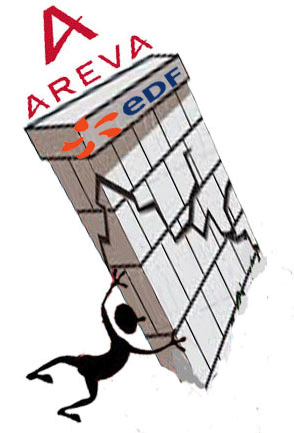 EdF: Living with its ZOMBIE REACTORS!, Jonathon Porritt, 24 Apr 16,
You seriously wouldn’t want to be a Director of EdF at the moment. The agenda for an average Board Meeting must be seriously gloomy on each and every occasion. Here’s how I imagine the key agenda items for their last meeting on 16th February – helpfullysummarised by EdF’s Company Secretary.
Item 1: Existing EPR construction projects
1.1 Olkiluoto (Finland)
Continuing, horrendous cost overruns, leading to ongoing legal stand-off with Finnish partners. Already delayed by seven years, but (hopefully!) could be finished by 2018.
1.2 Flamanville (France)
Continuing, horrendous cost overruns. Already delayed by nine years, but (hopefully!) could be finished by 2018.
1.3 Taishan (China)
Serious problems with both reactors under construction, but, this being China, everything’s shrouded in secrecy. WARNING: This could be much worse than we currently understand.
1.4 Pressure vessels
Still waiting for final safety assessment from French regulators. WARNING: There could be really serious problems here, despite our best efforts to ‘work with’ the regulator.
1.5 Deadlines/UK Treasury
These deadlines are now CRITICAL – as in EXISTENTIAL.
UK Treasury’s loan guarantees are linked to Flamanville operating successfully. And if it is not working properly by 2020, loan guarantee will be completely withdrawn.
Item 2: New reactors at Hinkley Point, Somerset………
Item 3: Extending the life of our UK reactors……
Item 4: Extending the life of our French reactors…….
Item 5: Energy Transition Law (France)…….
Item 6: Financial position…….
…..The implications of all this for the UK couldn’t possibly be more severe. Initially, HinkleyPoint was meant to be on stream by 2025, generating a whacking great 7% of total electricity supply. Earlier delays meant that this had already slipped to 2030. Now that the start date has slipped again, to 2019, AT THE EARLIEST, that 2030 date looks insanely optimistic…….http://www.jonathonporritt.com/blog/edf-living-its-zombie-reactors
France gives €3bn bailout to EDF’s Hinkley nuclear plant

 France gives €3bn lifeline to Hinkley nuclear plant, Sunday Times, Robin Pagnamenta, Energy Editor, 24 Apr 16, A decision on the proposed nuclear power station will not be taken until after an EDF shareholders’ meeeting Erance has thrown its support behind EDF, the French electricity company, and its plan to build the £18 billion nuclear power station at Hinkley Point, Somerset, by supplying a €3 billion lifeline.
President Hollande’s administration has agreed to put in the money towards a proposed €4 billion (£3 billion) cash-raising the company is proposing by issuing new shares. EDF said last night that the confirmation of the fundraising made it possible for the company to proceed with investments including Hinkley Point C by putting it on a “solid financial footing”……http://www.thetimes.co.uk/article/union-threats-force-edf-to-delay-hinkley-decision-0zf56xjms
EDF wants to extend depreciation period for nuclear plants this year, but nuclear watchdog may not be willing
 EDF to extend depreciation period for nuclear plants this year – CEO https://au.news.yahoo.com/world/a/31423313/edf-to-extend-depreciation-period-for-nuclear-plants-this-year-ceo/ Reuters on April 23, 2016 PARIS – French utility EDF will extend the depreciation period for its nuclear plants this year, its CEO said in a newspaper interview, an accounting move that will free up cash for costly investment projects in France and Britain.
“By the closing of our first-half results, we will draw the accounting consequences of our intention to extend the lifespan of our existing nuclear plants beyond 40 years,” EDF CEO Jean-Bernard Levy said in Saturday’s Le Figaro newspaper.
EDF had said before it intended to extend the lifespan of its French nuclear plants to 50 or 60 years, beyond the 40 years they were initially built for. Energy Minister Segolene Royal said in February that the government was willing to give the go-ahead for such a move.
But French nuclear watchdog ASN is the only authority allowed to grant such an extension, and it has said a decision on the matter would not come before 2018-2019. To make the accounting change, which would automatically boost EDF’s profits, the company must convince its auditors that there is a good chance of the extension being granted.
In 2003, EDF extended the depreciation schedule for nuclear reactors in its accounts to 40 years from 30 years – six years before the ASN agreed to the move.
The utility, 85 percent-owned by the French government, said on Friday it would seek to raise 4 billion euros ($4.5 billion), amid concerns that a 23 billion euro nuclear plant project at Hinkley Point in Britain would put a strain on its finances.
(Reporting by Michel Rose; Editing by Toby Chopra and Hugh Lawson)
How ionising radiation affects our bodies

The high-energy radiation given off by radioactive decay can take the form of very high speed particles (electrons in the case of beta radiation; two protons and two neutrons in alpha radiation) or waves (gamma or X-rays).
Regardless of the form it takes, all nuclear radiation has enough energy to strip electrons off atoms and molecules that it interacts with, earning it the name ionising radiation.
It is this electron-stripping (ionising) property that does the damage to our cells and tissues.
As well as generating heat, the removal of electrons can break chemical bonds. When that happens in a molecule of DNA it can cause mutations, which can lead to cancer down the track. And ionising a protein can mess with its shape and function — not something you want in the molecules that coordinate most of the chemistry in our cells.
Those effects are compounded when water molecules (H2O) in our bodies are ionised into the high energy free radicals OH– and H+, which can go on to attack other nearby molecules and cells.
Our bodies are full of water, and almost all cells have DNA, but some cells and tissues are more susceptible to damage from nuclear radiation than others.
Which cells in the body are most affected by radiation?The cells and organs that are most affected by nuclear radiation are the ones that are actively reproducing, because the DNA is more exposed when the cell is in the process of dividing.
Blood cells have the highest turnover rate in our bodies, so the tissue where they are produced — the rapidly dividing cells of the bone marrow — is the most susceptible to radiation damage.
The damage to bone marrow in high doses — and complete destruction of it in very high doses — impairs our immune system by not replacing our white blood cells.
Long-term exposure to lower doses can lead to cancerous DNA mutations in the marrow, which can lead to the blood cancer leukaemia in people exposed through work or location………
Developing foetuses are, of course, incredibly susceptible to radiation, ……
Exposure to external radiation is one thing, but ingesting radioactive particles takes the damage to another level.
Inhaling or swallowing radioactive material delivers the source of radiation directly to your cells, increasing the risk of cancer developing in the tissues where they accumulate.
Radioactive iodine (iodine-131) blown into the atmosphere by the 1986 Chernobyl explosion caused a large number of cases of thyroid cancer in people who drank contaminated milk. (Having been released in the clouds of radioactive material following the explosion, the iodine — a by-product of nuclear fission reactions — landed on fields where it was swallowed by cows).
Iodine is essential for the normal function of the thyroid gland, and with its knack for attracting iodine the gland gets a concentrated dose of iodine-131 when contaminated milk is drunk. Thankfully, thyroid cancer is treatable by removal of the gland, although a lifetime of hormone supplements follows. With a half-life of just eight days, the level of radioactive iodine fell off quickly after the accident, so the risk of exposure dropped within weeks of the disaster.
Not so with the radioactive isotope of caesium-137, which has a half-life of 30 years. Caesium is very soluble in water, so when it enters our bloodstream via contaminated food or water it ends up spreading throughout our bodies, and concentrating in muscle tissue in particular. Our bodies eventually turn over these tissues, but it takes three months to reduce the amount of caesium in our muscles by half, so the long-term exposure to beta and gamma radiation increases the chances of cancer developing in those tissues.
With a half-life of 29 years, strontium-90 joins caesium-137 as a long-lasting source of harmful radiation after nuclear accidents.
Strontium is chemically very similar to calcium, so if you ingest food contaminated with radioactive strontium isotopes like strontium-90, it ends up wherever calcium normally would — primarily in the bones.
In adults, strontium accumulates mainly on the surface of bones, but in children it can be incorporated into the growing bone itself. The beta radiation given off as the radioactive atoms decay into more stable forms can damage the bone marrow and lead to bone cancer. http://www.abc.net.au/news/2016-04-22/what-nuclear-radiation-does-to-your-body/7346324
1 This Month

of the week – Shut Down Drone Warfare!


Tell the Ukrainian Government to Drop Prosecution of Peace Activist Yurii Sheliazhenko

Petition to revoke the licensing of the Near Surface Nuclear Disposal Facility (NSDF) at Chalk River. https://www.ourcommons.ca/petitions/en/Petition/Details?Petition=e-7247
To see nuclear-related stories in greater depth and intensity – go to https://nuclearinformation.wordpress.com
-
Archives
- April 2026 (103)
- March 2026 (251)
- February 2026 (268)
- January 2026 (308)
- December 2025 (358)
- November 2025 (359)
- October 2025 (376)
- September 2025 (257)
- August 2025 (319)
- July 2025 (230)
- June 2025 (348)
- May 2025 (261)
-
Categories
- 1
- 1 NUCLEAR ISSUES
- business and costs
- climate change
- culture and arts
- ENERGY
- environment
- health
- history
- indigenous issues
- Legal
- marketing of nuclear
- media
- opposition to nuclear
- PERSONAL STORIES
- politics
- politics international
- Religion and ethics
- safety
- secrets,lies and civil liberties
- spinbuster
- technology
- Uranium
- wastes
- weapons and war
- Women
- 2 WORLD
- ACTION
- AFRICA
- Atrocities
- AUSTRALIA
- Christina's notes
- Christina's themes
- culture and arts
- Events
- Fuk 2022
- Fuk 2023
- Fukushima 2017
- Fukushima 2018
- fukushima 2019
- Fukushima 2020
- Fukushima 2021
- general
- global warming
- Humour (God we need it)
- Nuclear
- RARE EARTHS
- Reference
- resources – print
- Resources -audiovicual
- Weekly Newsletter
- World
- World Nuclear
- YouTube
-
RSS
Entries RSS
Comments RSS
 nuclear-news