Ukraine’s nuclear industry remains a time bomb
But the nuclear danger in Ukraine does not go away with the conflict in the east quieting down this year, the scale and intensity of the war reduced to a shadow of what it was during 2014 and the beginning of 2015. The country, already facing economic depression, a war and a PTSD epidemic, has to deal with the lifetime of its nuclear reactors going to an end.
Ukraine has 15 nuclear reactors divided between four nuclear power plants. Built during Soviet times, 12 of them have a designed lifetime that ends before 2020. As the government in Kiev together with the operating company Energoatom are determined to keep all reactors running for at least 10 years beyond their expiry date, four units have already received licenses for their expanded lifetime.

“The situation is that the reactors are in a bad shape and always have been,” says Patricia Lorenz, nuclear safety expert with Friends of the Earth, an organization that campaigns for solutions to environmental problems. “They lag 15 years in safety level and they are definitely not catching up. The general problem is aging, maintenance — that is always a big topic, especially with power plants here where they admit they don’t have enough money for keeping them.”
But Ukraine got a loan for bringing its reactors up to international standards. The European Bank for Reconstruction and Development is providing 300 million euro in a project that will cost 1.4 billion euro in total and is scheduled for completion by the end of 2017. The European Atomic Energy Community, or Euratom, iscontributing another 300 million euro.
According to Bankwatch, an NGO that monitors the activities of international financial institutions in order prevent them from financing environmentally and socially harmful investments, the lifetime of the four reactors was prolonged without completing necessary safety upgrades and without properly assessing all risks. This means disregarding the legal conditions attached to the EBRD loan.
The same NGO is concerned that this European financial support is nothing else but “cementing Ukraine’s dependence on an outdated and highly unsafe nuclear sector” — and with that, its dependence on Russia, as all of Ukraine’s nuclear reactors use Russian technology and are almost entirely dependent on nuclear fuel from Russia. Furthermore, Ukraine has yet to make long-term investments in infrastructure and safe disposal of radioactive waste, which is also sent back to Russia.
No peaceful atom
With the Chernobyl disaster still casting its long shadow, Ukraine’s decision to base its long-term energy policies on the lifetime extension of its Soviet-era nuclear reactors is at least worrisome. Between 2010 and 2015 alone, three different unitswere forced to shut down due to accidents, while severe safety issues wereidentified in two more units. The reality is that Ukraine’s nuclear power plants currently supply over half the country’s electricity. But some say that this comes more from a political choice of the government, rather than necessity or lack of options.
The problem with a nuclear disaster is that it doesn’t give a damn for borders. So this is not only Ukraine’s problem, it is a European one and the danger lurks on at least all of its neighboring countries. And there are questions that still need answering: Is the lifetime extension process performed so that it can ensure the safety of not only Ukrainians but all Europeans as well? Are all the measures being taken to avoid another Chernobyl? Because in the end, says Oleksandr Galuh, “there is no such thing as the peaceful atom.” http://www.huffingtonpost.com/ioana-moldovan-/chernobyl-nuclear-menace_b_9774040.html
Ukraine will have to move beyond nuclear power, but when?

 Thirty years after Chernobyl, what chance of a post-nuclear Ukraine? Ecologist, Jan Haverkamp & Iryna Holovko 26th April 2016“………A move towards clean, renewable energy sources – such as wind, water, sun, biomass and geothermal – would seem a logical route, especially given the potential savings in health costs and increase in energy independence.
Here, in these countries most afflicted by Chernobyl, economic realities make this switch to a clean energy future inevitable: the old centralised energy economy is collapsing, slowly but surely, and an awareness movement is growing.
In Ukraine, future-oriented enterprises will choose independence from the politically and economically unstable conglomerates that dominate the country’s energy sector. The question is: are these companies getting the space they need to start Ukraine’s energy [r]evolution?
The [r]evolution is inevitable – but not when it happens
Clearly, Ukraine currently faces several fundamental choices for the future. These choices relate to political contexts and preferences, but none of them is as inevitable as the need for an energy [r]evolution.
We are not asking anyone to experiment with unknown technologies. The techniques for a clean energy future exist, and Ukraine has even built up experience with them. Technically, then, the next step is an evolution. But one that means a revolutionary departure from a highly unstable energy politics that rely on centralisation of access to gas, oil, coal and nuclear power, and the energy policy and planning paradigms associated with it.
Ukraine has significant potential for the development of renewable energy sources. Asresearch for The Solutions Project by Mark Jacobson and his team at Stanford University shows, Ukraine could cover its entire energy demand in 2050 with wind, solar and water and a 32% decrease in primary energy need.
However, the fact that Ukraine currently enjoys only 1 GW of installed capacity from renewable sources signals that energy policy is yet to undergo fundamental change, and the obstacles are many.
The staying power of old energy structures should not be underestimated. Ukraine’s electricity market is a political battlefield, and not only due to interference of oligarchs and dependency on Russia for coal, nuclear fuel and technology. The market is virtually completely regulated, and regulation has become a political tool…….
Twelve of these reactors were built in the 1980s, and are now in need for large safety upgrades if they are to be operated with a lifetime extension beyond 30 years.
Risky business: ageing nuclear plants starved of investment……..
The necessary safety upgrades (for life-time extension, but also in reaction to the Fukushima catastrophe – Ukraine participated in the EU post-Fukushima nuclear stress tests) are thus weakened or postponed, and there are even indications that there is a lack of money for operational costs.
At the same time, Ukraine’s nuclear fleet faces an increased security risk due to political instability. The risks for terrorist or insurgent attack on nuclear infrastructure are currently higher than in peace time, meaning further upgrades are necessary.
In addition, most of the upgrading work is dependent on Russian technological input. Delays in the implementation of upgrades are not only caused by lack of finance, but also by unforeseen technical complications and problems with tender procedures. On top of that, Energoatom is bleeding funds on an unrealistic nuclear new build programme in Khmelnytksy, western Ukraine.
The political position of Ukraine’s increasingly risky nuclear sector is strengthened by the rhetoric that only lifetime extension of the ‘independent’ ageing nuclear fleet can fill the gap left by lost coal resources in the east.
The nuclear sector’s dependency on Russia has been masked by swapping the tenders for upgrading and new builds from Russian companies to a Czech-based company Skoda JS (a deal that is part of anti-corruption investigations in Switzerland), which is actually Russian-owned, and by tests at the Yuzhnoukrainsk nuclear power station with the use of Westinghouse nuclear fuel (produced in Sweden), partly in reaction to delivery problems with Russian fuel in the last few years.
The fact that economic control over technology and a large proportion of fuel will always come from Russia remains off the table…… the awareness that a lot of the corruption in Ukraine is related to the centralised nature of the old energy carriers is growing, and we see an increasing amount of courageous small and medium investors seeing efficiency and renewables as chances for job and income creation…….. http://www.theecologist.org/essays/2987610/thirty_years_after_chernobyl_what_chance_of_a_postnuclear_ukraine.html
Over 1,500 defects at aging Israeli nuclear plant
 Report finds more than 1,500 defects at aging Israeli nuclear plant April 26, 2016 by JNS.org.A recent examination of Israel’s nuclear reactor site in Dimona has revealed signs of 1,537 defects to the site’s aging aluminum core, according to a study released at a scientific forum held in Tel Aviv, Haaretz reported.
According to the report, the reactor core, which houses the fuel rods where nuclear fission takes place, has absorbed a great deal of heat and radiation over the years, raising questions over its ability to operation.
Israel’s nuclear reactor was supplied by France in the late 1950s and became active in 1963. According to manufacturer standards, the reactors were intended to be operational for only 40 years. …..http://www.jns.org/news-briefs/2016/4/26/report-finds-more-than-1500-defects-at-aging-israeli-nuclear-plant#.VyAwOdR97Gg=
Climate Feedback helps climate scientists to evaluate media stories
 Climate scientists are now grading climate journalism Climate Feedback provides a venue for climate scientists to evaluate the accuracy of climate news stories, Guardian, Daniel Nethery and Emmanuel Vincent, 26 Apr 16 “…..despite the scientific consensus that global warming is real and primarily due to human activity, studies show that only about half the population in some countries with among the highest CO2 emissions per capita understand that human beings are the driving force of our changing climate. Even fewer people are aware of the scientific consensus on this question. We live in an information age, but the information isn’t getting through. How can this be?
While the internet puts information at our fingertips, it has also allowed misinformation to sow doubt and confusion in the minds of many of those whose opinions and votes will determine the future of the planet. And up to now scientists have been on the back foot in countering the spread of this misinformation and pointing the public to trustworthy sources of information on climate change.
Climate Feedback intends to change that. It brings together a global network of scientists who use a new web-annotation platform to provide feedback on climate change reporting. Their comments, which bring context and insights from the latest research, and point out factual and logical errors where they exist, remain layered over the target article in the public domain. You can read them for yourself, right in your browser. The scientists also provide a score on a five-point scale to let you know whether the article is consistent with the science. For the first time, Climate Feedback allows you to check whether you can trust the latest breaking story on climate change.
Last year the scientists looked at some influential content. Take the Pope’s encyclical, for instance. The scientists gave those parts of the encyclical relating to climate science a stamp of approval. Other “feedbacks,” as we call them, have made a lasting impact. When the scientists found that an article in The Telegraphmisrepresented recent research by claiming that the world faced an impending ice age, the newspaper issued a public correction and substantially modified the online text.
But there’s more work to be done. Toward the end of the year the scientists carried out a series of evaluations of some of Forbes magazine’s reporting on climate change. The results give an idea of the scale of the problem we’re tackling. Two of the magazine’s most popular articles for 2015, one of which attracted almost one million hits, turned out to be profoundly inaccurate and misleading. Both articles, reviewed by nine and twelve scientists, unanimously received the lowest possible scientific credibility rating. This rarely occurs, and just in case you’re wondering, yes, the scientists do score articles independently: ratings are only revealed once all scientists have completed their review……http://www.theguardian.com/environment/climate-consensus-97-per-cent/2016/apr/26/climate-scientists-are-now-grading-climate-journalism
USA Dept of Energy – new funds for nuclear energy development
 Department of Energy Announces New Awards for Advanced Nuclear Energy Development
April 26, 2016 WASHINGTON, D.C. – Building on the President’s all-of-the-above energy strategy, the Department of Energy today awarded more than $5 million to undergraduate and graduate students in pursuit of nuclear engineering degrees and other nuclear science and engineering programs relevant to nuclear energy. The awards include 57 undergraduate scholarships and 33 graduate-level fellowships for students at American colleges and universities…….
French and Russian nuclear utilities to work together, on decommissiong, and more
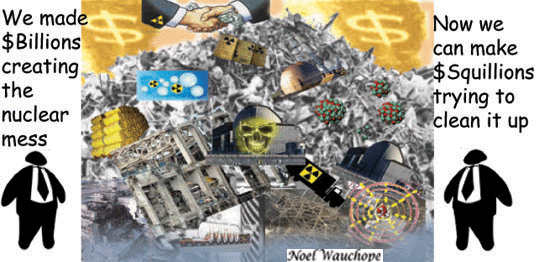 French and Russian nuclear utilities extend collaboration, World Nuclear News, 26 April 2016
French utility EDF has signed an agreement to extend its cooperation with Rosenergoatom, the operator of Russia’s civil nuclear power plants. The companies will cooperate in reactor operations, decommissioning and waste management…..
Through the agreement, EDF and Rosenergoatom intend to develop cooperation in areas such as the maintenance, modernization and operating period extension of nuclear power plants, as well as decommissioning and radioactive waste management http://www.world-nuclear-news.org/C-French-and-Russian-nuclear-utilities-extend-collaboration-2604164.html
Nuclear safety is beyond politics. Ukraine and Russia must c o-operate on this
CHERNOBYL: FALLOUT 30 (SPECIAL PROJECT)
Chernobyl NPP CEO Igor Gramotkin shared his thoughts on the plant’s future in an interview with the Ukrainian newspaper Zerkalo Nedeli published on Friday.
“Russia and Ukraine are going through difficult times, but we must now figure out how to build the relationship in the future, and why not start restoring it by jointly looking for solutions to a common problem, namely, eliminating the consequences of the Chernobyl catastrophe,” Gramotkin said.
He stressed that “nuclear radiation safety is an area that is beyond politics.”……https://www.rt.com/news/340741-chernobyl-nuclear-disaster-cooperation/
Nuclear power workers protest in Ukraine
Ukrainian nuclear power workers to protest on 30th Chernobyl disaster anniversary Rt.com 25 Apr, 2016 Ukraine’s state nuclear energy giant says all employees of the country’s nuclear plants will stage a massive protest over its frozen assets in Kiev on Tuesday, as the world will be marking the 30th anniversary of the Chernobyl disaster.
Energoatom, the operator of Ukraine’s four functioning nuclear plants, saidon its website on Monday that its workers resorted to such “extreme measure” because of the “inaction” of the state in addressing the issue of “unjustified seizure” of the company’s assets.
The assets freeze led to Energoatom stopping payments for nuclear fuel, nuclear materials and removal of used nuclear fuel, it stressed.
“The payment arrears may result in the delay in the supply of nuclear fuel to Ukrainian nuclear power plants and therefore stoppage nuclear power units,” the company warned.
The wages of the employees are also under threat, the statement by state-owned Energoatom added.
The protests action was scheduled after attempts to resolve the issue “peacefully” by the nuclear worker’s union turned out unsuccessful, it said.
The Energoatom assets were arrested in March after the court ordered to collect 127.3 million hryvnia (around $5 million) of debt from the company.
The debt to Ukrelektrovat company “is not confirmed by any primary accounting documents, while the liability of 2.5 million hryvnia that had been present on Energoatom’s balance account was written off in 2004 due to the expiration of the statute of limitations,” it explained.
The amount of the debt was artificially increased after legal enquiry by an individual expert, whose conclusions were put in doubt by the Justice Ministry and led to the launch of a criminal case, Energoatom said.
In April, the company has sent an open letter to Justice Minister, Pavel Petrenko, urging him to interfere into the situation, but the plea was ignored by the official……..https://www.rt.com/news/340902-ukraine-chernobyl-nuclear-protest/
How to take on the nuclear shills: here’s one approach.

 Exelon’s aging, unprofitable Quad Cities reactors.
Earlier this month, we reported that climate scientist Dr. James Hansen and the pro-nuclear Breakthrough Institute’s Michael Shellenberger had leaped–apparently on their own–into the battle over the future of some of Exelon’s unprofitable nuclear reactors in Illinois.
In a nutshell, Exelon wants a taxpayer and/or ratepayer (it doesn’t really care where the money comes from) bailout to ensure that Exelon will receive a profit, whether the reactors themselves are profitable or not. They aren’t, and a Clinton reactor official (the most endangered of Exelon’s fleet) said this week that even with a bailout Clinton wouldn’t be profitable for “five to seven years.”
Since Clinton’s competition, primarily wind and natural gas at present, already is profitable, the only argument Exelon has been able to make is that closing Clinton (and two units at Quad Cities) would cause carbon emissions in the state to rise. That’s…
View original post 428 more words
Danger of Chernobyl nuclear reactor wreck will remain for thousands of years
Ruined Chernobyl nuclear plant will remain a threat for 3,000 years @mattschodcnews BY MATTHEW SCHOFIELD mschofield@mcclatchydc.com , Miami Herald, 24 Apr 16,
- 30 years since Chernobyl may seem like a long time, but it’s really just the start
- Below reactor’s ruins is a 2,000-ton radioactive mass that can’t be removed
- How do you protect a site for as long a time as Western civilization has existed?
….It will be 30 years ago on 26 April that Pripyat and the nearby Chernobyl nuclear plant became synonymous with nuclear disaster, that the word Chernobyl came to mean more than just a little village in rural Ukraine, and this place became more than just another spot in the shadowy Soviet Union.
Even 30 years later – 25 years after the country that built it ceased to exist – the full damage of that day is still argued.
Death toll estimates run from hundreds to millions. The area near the reactor is both a teeming wildlife refuge and an irradiated ghost-scape. Much of eastern and central Europe continues to deal with fallout aftermath. The infamous Reactor Number 4 remains a problem that is neither solved nor solvable………..
All told, about 4,000 people would eventually die from the accident, according to a report by the World Health Organization and the International Atomic Energy Agency.
Others say those numbers are wildly low. Alexey Yablokov, a former environment adviser to Russian President Boris Yeltsin, estimated the global death toll to be 1.44 million. Other reports placed the cancer death totals at 30,000 to 60,000. Belarusian physicist Georgiy Lepin, a vice president of the association of liquidators of Chernobyl, the men brought in to fight the fire and clean up, estimated that within a few years, 13,000 rescue workers had died and another 70,000 were left unfit for work. The official number of disabled Chernobyl rescue workers today in Ukraine is 106,000.
A United Nations study says that “5 million people currently live in areas of Belarus, Russia and Ukraine that are contaminated with radionuclides due to the accident; about 100,000 of them live in areas classified in the past by government authorities as areas of ‘strict control.’ ”……….
What they figured out was the worst nuclear-energy disaster in human history, far worse than the explosion at Kyshtym nuclear complex in 1957 in what was then the Soviet Union, which released 70 tons of radioactive material into the air, or the 1957 fire at the Windscale Nuclear Reactor in northwestern England, which forced a ban on milk sales for a month, or the Three Mile Island disaster in Pennsylvania on March 29, 1979, where a cooling malfunction led to a partial meltdown.
All of central and eastern Europe was at risk. Even today, in Bavaria in southern Germany, wildlife officials warn hunters not to eat the meat of wild boars, which continue to show high levels of radiation contamination……..http://www.miamiherald.com/news/nation-world/world/article73405857.html
France’s government says decison on Hinkley nuclear plant is again delayed
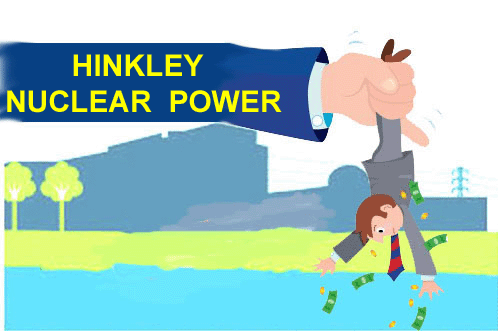
 Hinkley Point C nuclear power plant decision delayed again by EDF French economy minister says the energy giant’s green light on the £18bn project is now not expected until September, Guardian, Rob Davies, 25 Apr 16 The decision on whether to go ahead with the £18bn Hinkley Point C nuclear power project has been delayed again, after France’s economy minister said the country’s energy giant EDF may not give it the green light until September.
Emmanuel Macron’s comments come a week after he said EDF would deliver its verdict on Hinkley Point, which is set to meet 7% of the UK’s energy needs, in “the coming week or month”.
EDF said just days ago that it was expecting to make a final decision in the summer, having previously promised to do so by the time of its annual general meeting on 12 May.
The fresh delay raises the prospect that even if the project does go ahead, it will not meet its scheduled completion date of 2025, already eight years later than originally planned.
Macron told a French newspaper that three conditions must be in place before EDF, which is 85% government-owned, could proceed with building two reactors at Hinkley Point in Somerset.
He cited an improvement in EDF’s financial position, consultation with French trade unions and unspecified measures to ensure construction goes according to plan……..
[EDF has]approved a £3.1bn capital injection funded partly by the state, in a bid to shore up its finances ahead of the Hinkley decision……
Greenpeace’s director, John Sauven, responded to EDF’s previous announcement that a decision would not come until the summer by cautioning that the project was doomed…….http://www.theguardian.com/business/2016/apr/24/hinkley-point-c-nuclear-power-plant-decision-delayed-again-by-edf
Further delay for UK Hinkley nuclear project, as EDF decides to consult unions
 Fresh setback for Hinkley Point as EDF consults French unions, Telegraph UK Alan Tovey 22 APRIL 2016 Plans by EDF to build the new Hinkley Point nuclear power station have been further delayed after the French energy company said it would consult with unions before announcing its final investment decision.
After a board meeting on Friday, the company said it had agreed a “significant” recapitalisation that would make it “possible for EDF to proceed with its strategic investment programme – including Hinkley Point C”.
However, the directors added they would go through a formal consultation process with unions over the decision. Although it will not be binding on the board, this statutory process would take 60 days, pushing it close to the June 23 referendum on whether or not Britain will remain in the UK.
Sources close to the French government – which is EDF’s majority shareholder with an 85pc stake – said administrative delays could easily push this consultation past the date of the Brexit vote.
Consulting the unions over the decision presents fresh hurdles to the muchdelayed plan to build the Hinkley Point power station, the first in a fleet of new nuclear power stations for the UK.
Ten years ago, EDF was predicting Hinkley would be supplying power by 2017.
Unions are sceptical about whether EDF can afford the investment – which the French firm is financing two thirds of, with the rest coming from Chinese investors – and have made public their opposition to the scheme.
Some senior staff at EDF are also against the power company’s involvement in such a huge project…….http://www.telegraph.co.uk/business/2016/04/24/fresh-setback-for-hinkley-point-as-edf-consults-french-unions/
European law mean sit is illegal for France’s govt to fund EDF’s Hinkley nuclear project

 France funding Hinkley C ‘would be illegal’ under EU competition rules say Greenpeace and Ecotricity http://www.cheddarvalleygazette.co.uk/France-funding-Hinkley-C-illegal-EU-competition/story-29158662-detail/story.html By Cheddar Valley Gazette April 24, 2016 The European Commission is ‘almost certain’ to block the French Government spending billions of pounds of taxpayers’ money to make sure the Hinkley C nuclear power station project is completed.
That was the view of a coalition of West environmentalists today, who said if the French president Francois Hollande was to plunge £3 billion into Hinkley C, it would breach European state aid rules.
The European Union forbids states using taxpayers’ money to invest in projects which favour one company over another – and a new report revealed this morning by a leading London law firm says that would clearly be illegal under EU competition rules.
EDF, the firm planning to build a third nuclear power station in west Somerset, is majority-owned by the French Government anyway, but Greenpeace, Stroud-based renewable energy firm Ecotricity and the Green Party’s South West MEP, Molly Scott Cato, have all said they would challenge that decision, and ask the European Commission to block any state investment by France.
EDF is putting in half the £18 billion Hinkley C project cost, two Chinese nuclear energy firms are investing a third, but attempts by EDF to find that shortfall – one-sixth, or around £3 billion – have failed amid fears the project would be uneconomic.
The firm has gone to French Government ministers to ask for state backing, and that is ‘expected’ to be ratified and the project get the go-ahead in the next couple of weeks.
But the environmentalists who have long campaigned against Hinkley C said this morning that would breach EU competition rules, arguing the French Government should not be allowed to use taxpayers’ money to compete against energy providers in this country who receive no such help.
Dale Vince, Ecotricity founder, said his firm would consider legal action to stop Hinkley C. “It’s time for everyone to realise that we’ve reached the end of the road for Hinkley Point – it’s not going to happen,” he said.
“Illegal state aid is one thing, and we’ll work with Greenpeace to challenge that if it happens, but it’s not just financial issues, there are technical problems with Hinkley Point too – EDF are yet to build one of these reactors and their first two attempts are, between them, 16 years late and billions over budget.
“Our government needs to change its stance on green energy, which powered a quarter of the country last year and could do so much more if the sector received even a fraction of the economic and political support given the nuclear industry,” he added.
Greenpeace have yesterday wrote to energy minister Amber Rudd and chancellor George Osborne warning the ministers not to proceed with the project unless and until the French state support has been notified to and approved by the EU Commission.
“The only way Hinkley can be kept alive is on the life support machine of state aid,” said Greenpeace boss John Sauven. “EDF, if it is to stay in business, needs a new vision which is not looking backwards. And the UK Government needs to stop penalising the UK renewable energy industry in favour of propping up an ailing state owned nuclear industry in France.
“Globally, the nuclear market is shrinking year by year overtaken by the huge surge in renewable energy. The UK should be a haven for renewable energy investment given the massive potential for wind, solar and tidal to cost effectively meet our energy needs,” he added.
The legal opinion is given by Jon Turner QC, Ben Rayment and Julian Gregory, three eminent competition and EU law barristers from Monckton Chambers.
It sets out how the French government’s reported refinancing plans for EDF are likely to be illegal under EU law unless and until they are approved by the European Commission.
The European Commission’s investigation of state aid takes around a year, and it is doubtful that approval would be given.
“The numbers for the Hinkley deal have never stacked up and it is clear that the commercial case for this white elephant is dead,” said Green MEP for the south west, Molly Scott Cato.
“We have now a political battle where the stakes for both the UK and France are just too high to admit failure. But we cannot let this override EU rules on state aid or fair competition.”
“With EDF close to bankruptcy and serious questions over the legality of state aid for the project the French government and the French President are showing themselves to be totally irresponsible. The Board of EDF must put the interests of its shareholders and employees first and avoid committing economic suicide by rejecting a final investment decision,” she added.
EDF has consistently denied claims it was benefiting from illegal state aid, and robustly defended the legal action from Austria that the British Government’s agreement to pay EDF double the current electricity price for the energy Hinkley C will produce.
France’s tax-payers €3bn to save debt-ridden nuclear corporation EDF
State pays €3bn to bail out EDF http://www.connexionfrance.com/france-edf-electricity-areva-nuclear-investment-bail-out-view-article.html April 24, 2016THE GOVERNMENT has agreed to bail out struggling electricity company EDF to the tune of €3billion, months after it agreed a similar capital injection for nuclear energy giant Areva.
On Friday, EDF announced a €4billion capital investment programme, and the state – which owns an 85% stake in the company – has agreed to pay 75% of the cost.
The electricity giant has been fighting to bring its massive debts under control in the face of weak European electricity prices. It has also invested in several major projects, including a new British nuclear power plant at Hinkley Point.
The government said it would accept EDF shares as its dividend in 2016 and 2017, rather than cash. “The State reaffirms its confidence in the management of the company and all its employees for the success of EDF as part of a quality social dialogue,” argued the Ministries of Economy and Finance in a joint statement.
In return, EDF said it would aim to reduce its costs by €1billion in 2019 compared to 2015, and shave €2billion off its investment plans over the next three years. It had originally planned to make €700million in savings over three years. The group also plans to raise €10 billion by selling off gas, coal and oil interests.
Employee’s legal threat hangs over EDF’s U.K. Nuclear Project
EDF Unions Threaten to Go to Court Over U.K. Nuclear Project, Bloomberg, Francois De Beaupuy April 22, 2016
-
Employee representatives ask to be consulted before decision
-
Trade unions say they’ll sue if not consulted in advance
-
Electricite de France SA’s unions are threatening to take the company to court if employees are not consulted in advance on a decision concerning a proposed 18 billion-pound ($25.8 billion) U.K. atomic plant project.
EDF’s workers committee, which includes representatives from the biggest unions, met near Paris and voted to take legal action should the company fail to consult employees on Hinkley Point, according to a statement Thursday. The project is key to EDF earnings and has prompted disagreements between management and unions, it said.
“We ask that the workers’ committee is consulted before any decision by management or the board,” the committee said. If that didn’t happen then “the committee would be forced to take legal action to have any decision linked to the Hinkley Point project suspended or annulled.”
The threat marks the latest attempt by workers to delay a decision, given concerns about EDF’s finances amid falling power prices across Europe. Union FO has already threatened to call for a strike. EAS, an association of EDF employees holding the company’s shares, is asking the stock market regulator to require that the French government, which owns 85 percent of EDF, repurchases shares at the initial public offering price…..http://www.bloomberg.com/news/articles/2016-04-21/edf-unions-threaten-to-go-to-court-over-u-k-nuclear-project
1 This Month

of the week – Shut Down Drone Warfare!


Tell the Ukrainian Government to Drop Prosecution of Peace Activist Yurii Sheliazhenko

Petition to revoke the licensing of the Near Surface Nuclear Disposal Facility (NSDF) at Chalk River. https://www.ourcommons.ca/petitions/en/Petition/Details?Petition=e-7247
To see nuclear-related stories in greater depth and intensity – go to https://nuclearinformation.wordpress.com
-
Archives
- April 2026 (103)
- March 2026 (251)
- February 2026 (268)
- January 2026 (308)
- December 2025 (358)
- November 2025 (359)
- October 2025 (376)
- September 2025 (257)
- August 2025 (319)
- July 2025 (230)
- June 2025 (348)
- May 2025 (261)
-
Categories
- 1
- 1 NUCLEAR ISSUES
- business and costs
- climate change
- culture and arts
- ENERGY
- environment
- health
- history
- indigenous issues
- Legal
- marketing of nuclear
- media
- opposition to nuclear
- PERSONAL STORIES
- politics
- politics international
- Religion and ethics
- safety
- secrets,lies and civil liberties
- spinbuster
- technology
- Uranium
- wastes
- weapons and war
- Women
- 2 WORLD
- ACTION
- AFRICA
- Atrocities
- AUSTRALIA
- Christina's notes
- Christina's themes
- culture and arts
- Events
- Fuk 2022
- Fuk 2023
- Fukushima 2017
- Fukushima 2018
- fukushima 2019
- Fukushima 2020
- Fukushima 2021
- general
- global warming
- Humour (God we need it)
- Nuclear
- RARE EARTHS
- Reference
- resources – print
- Resources -audiovicual
- Weekly Newsletter
- World
- World Nuclear
- YouTube
-
RSS
Entries RSS
Comments RSS
 nuclear-news