Wildlife continues to suffer seriously from radiation at Chernobyl and Fukushima
Our studies provide new fundamental insights about consequences of chronic, multigenerational exposure to low-dose ionizing radiation. Most importantly, we have found that individual organisms are injured by radiation in a variety of ways. The cumulative effects of these injuries result in lower population sizes and reduced biodiversity in high-radiation areas.
Broad impacts at Chernobyl
 Radiation exposure has caused genetic damage and increased mutation rates in many organisms in the Chernobyl region. So far, we have found little convincing evidence that many organisms there are evolving to become more resistant to radiation.
Organisms’ evolutionary history may play a large role in determining how vulnerable they are to radiation. In our studies, species that have historically shown high mutation rates, such as the barn swallow (Hirundo rustica), the icterine warbler (Hippolais icterina) and the Eurasian blackcap (Sylvia atricapilla), are among the most likely to show population declinesin Chernobyl. Our hypothesis is that species differ in their ability to repair DNA, and this affects both DNA substitution rates and susceptibility to radiation from Chernobyl.
Much like human survivors of the Hiroshima and Nagasaki atomic bombs, birds and mammals at Chernobyl have cataracts in their eyes andsmaller brains. These are direct consequences of exposure to ionizing radiation in air, water and food. Like some cancer patients undergoing radiation therapy, many of the birds have malformed sperm. In the most radioactive areas, up to 40 percent of male birds are completely sterile, with no sperm or just a few dead sperm in their reproductive tracts during the breeding season.
Tumors, presumably cancerous, are obvious on some birds in high-radiation areas. So are developmental abnormalities in some plants and insects.
Given overwhelming evidence of genetic damage and injury to individuals, it is not surprising that populations of many organisms in highly contaminated areas have shrunk. In Chernobyl, all major groups of animals that we surveyed were less abundant in more radioactive areas. This includes birds, butterflies, dragonflies, bees, grasshoppers, spiders and large and small mammals.
Not every species shows the same pattern of decline. Many species, including wolves, show no effects of radiation on their population density. A few species of birds appear to be more abundant in more radioactive areas. In both cases, higher numbers may reflect the fact that there are fewer competitors or predators for these species in highly radioactive areas.
Moreover, vast areas of the Chernobyl Exclusion Zone are not presently heavily contaminated, and appear to provide a refuge for many species. One report published in 2015 described game animals such as wild boar and elk as thriving in the Chernobyl ecosystem. But nearly all documented consequences of radiation in Chernobyl and Fukushima have found that individual organisms exposed to radiation suffer serious harm.
There may be exceptions. For example, substances called antioxidants can defend against the damage to DNA, proteins and lipids caused by ionizing radiation. The levels of antioxidants that individuals have available in their bodies may play an important role in reducing the damage caused by radiation. There is evidence that some birds may have adapted to radiation by changing the way they use antioxidants in their bodies.
Parallels at Fukushima
Recently we have tested the validity of our Chernobyl studies by repeating them in Fukushima, Japan. The 2011 power loss and core meltdown at three nuclear reactors there released about one-tenth as much radioactive material as the Chernobyl disaster.
Overall, we have found similar patterns of declines in abundance and diversity of birds, although some species are more sensitive to radiation than others. We have also found declines in some insects, such as butterflies, which may reflect the accumulation of harmful mutationsover multiple generations.
Our most recent studies at Fukushima have benefited from more sophisticated analyses of radiation doses received by animals. In our most recent paper, we teamed up with radioecologists to reconstruct the doses received by about 7,000 birds. The parallels we have found between Chernobyl and Fukushima provide strong evidence that radiation is the underlying cause of the effects we have observed in both locations.
Some members of the radiation regulatory community have been slow to acknowledge how nuclear accidents have harmed wildlife. For example, the U.N.-sponsored Chernobyl Forum instigated the notion that the accident has had a positive impact on living organisms in the exclusion zone because of the lack of human activities. A more recent report of the United Nations Scientific Committee on the Effects of Atomic Radiation predicts minimal consequences for the biota animal and plant life of the Fukushima region.
Unfortunately these official assessments were largely based on predictions from theoretical models, not on direct empirical observations of the plants and animals living in these regions. Based on our research, and that of others, it is now known that animals living under the full range of stresses in nature are far more sensitive to the effects of radiation than previously believed. Although field studies sometimes lack the controlled settings needed for precise scientific experimentation, they make up for this with a more realistic description of natural processes.
Our emphasis on documenting radiation effects under “natural” conditions using wild organisms has provided many discoveries that will help us to prepare for the next nuclear accident or act of nuclear terrorism. This information is absolutely needed if we are to protect the environment not just for man, but also for the living organisms and ecosystem services that sustain all life on this planet……https://theconversation.com/at-chernobyl-and-fukushima-radioactivity-has-seriously-harmed-wildlife-57030
The economic meltdown of nuclear power should be a wake-up call for investors and governments
Once a reactor has reached the end of its lifetime, the cost for decommissioning and storing nuclear waste for hundreds to thousands of years have to be borne. Utilities have a mandate to make provisions for this, but whether the funds will actually suffice remains to be seen.
While the level of feed-in tariffs has been reduced for wind and solar in countries like Germany and Switzerland to reflect technology learning curves, the [UK’s] price guarantee for nuclear locks in the opposite trend.
The positive business case for non-renewable energies seems to come to an end. Thirty years after Chernobyl and five years after Fukushima, the economic meltdown of nuclear power should be a wake-up call for investors and governments
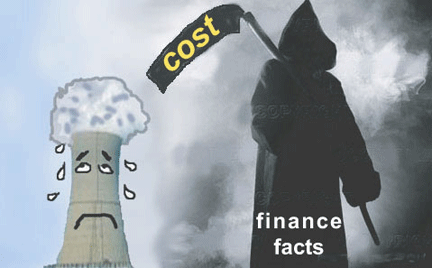 Nuclear power’s economic meltdown 30 years after Chernobyl http://www.swissinfo.ch/eng/energy-rethink_nuclear-power-s-economic-meltdown-30-years-after-chernobyl/42109822 By Rolf Wüstenhagen 25 Apr 16 Thirty years later, the nuclear industry is facing a meltdown of a different kind: an economic meltdown.
They went on to conclude that each of the middle three of these risks alone would be enough to “bring even the largest utility company to its knees financially”.
Two years after the report was published, Citi’s claim was empirically validated. The meltdown in three reactors of the Fukushima Daichi nuclear power plant in Japan led to widespread contamination.
The event marked a human and environmental tragedy, but the magnitude of the financial loss – estimates of which range from $250 billion (CHF242 billion) to $500 billion – also forced the operating company, Tepco, into the largest government bail-out in Japanese economic history.
Sharp rethink Continue reading
Indoor playgrounds help Fukushima families to deal with their very real fear of radiation
 Fukushima Parents Find Relief From Radiation At Indoor Playgrounds http://voices.nationalgeographic.com/2016/04/25/fukushima-parents-find-relief-from-radiation-at-indoor-playgrounds/ by Ari Beser in Fulbright National Geographic Stories on April 25, 2016 FUKUSHIMA, Japan—One of the biggest health problems facing Fukushima after the 2011 nuclear disaster are not directly caused by radiation exposure.
Instead, it’s the fear of exposure that has driven rates of childhood obesity in the past five years, according to the Director of Internal Medicine, Dr. Sae Ochi, M.D. who has spent the last five years researching the social impact of the nuclear disaster.
Parents who are worried about their children being exposed to radiation have discouraged them from playing outside, which has led to more sedentary activities among Fukushima youth.
Their fears are not unfounded. For one, radiation levels have decreased in the prefecture, but not disappeared entirely, according to safecast, the citizen science radiation monitoringprogram.
And children are most susceptible to radiation exposure, according to the American Thyroid Association. It can cause underactive thyroids, thyroid nodules, and even cancer in kids.
“Its not that the parents shouldn’t fear radiation,” says Ochi, “it’s just that radiation concerns have led to unhealthy practices, when it should be the opposite. People living in areas where radiation lingers should take steps to eat healthier, to move more to combat their exposure. Instead we are seeing the opposite. In lieu of eating vegetables, even vegetables from outside Fukushima, people are eating processed junk food, and fast foods, and staying at home at developing sedentary lifestyles.”
Though radiation-related problems may take years to manifest in children, the consequences of a lack of exercise and physical exertion are immediate.
Enter PEP Kids Koriyama, a free, publicly funded indoor playground 40 miles (64 kilometers) west of the crippled nuclear reactor in the city of Koriyama, where parents can let their kids loose without the threat of radiation.
The Benimaru supermarket chain donated the space, which used to be a storage facility, and the local city government funded the transformation into an over-the-top play area outfitted with all of the amenities a kid could want.
The playground’s interior represents Fukushima’s geography. A giant ball pit with a swing is Lake Inawashiro, Japan’s pacific coast, and mountains are painted on the wall. There’s also an indoor sand garden, a giant moon bounce, play houses, and even a kitchen. (Read “Five Years After Fukushima Nuclear Disaster, Survivors Share Their Stories.”)
“People come from all over Japan to come here. We even get families who evacuated Fukushima as far as Tokyo that come back for the day and let their kids play here,” said Midori Ito, director of PEP Kids. Koriyama is not technically in the evacuation zone, and anyone who chooses to leave receives no compensation.
“I love that I can take my kids here,” mother Chime Fukase told me over the din of cheering and shouting children.
“I can’t say that my concern about radiation is at zero. … I have nowhere else to take my family. I’m grateful for PEP kids to give my daughter a place to enjoy herself,” says Fukase, who is expecting another child.
PEP Kids isn’t Fukushima Prefecture’s only indoor escape: Fukushima City has its own indoor skate park and sports facility called Channel Square. Owner Manabu Tara modeled the facility after Channel Street Skate Park in San Pedro, California.
There people can ride their boards on the ramps, practice yoga, eat and drink at the café, or attend meetings about radiation concerns at the Fukushima 30-Year Project, an NPO that researches the radiation exposure that shares space with the indoor park. It’s name is based on the 30 year half life of the most prevalent radioactive contaminant in Fukushima, Cesium 137.
But unlike PEP kids, Channel Square isn’t publicly funded—which means it’s been more of a challenge to keep Channel Square going.
“Japan doesn’t really have a crowdsourcing culture,” says Tara, “so we have to be creative about how we raise money. We want to compensate for the lack of public land the kids can play on for free, so we don’t want to raise the entrance fee.”
“However if we don’t have money,” he says, “we can’t exist.”
Ari M. Beser is the grandson of Lt. Jacob Beser, the only U.S. serviceman aboard both bomb-carrying B-29s. He is traveling through Japan with the Fulbright-National Geographic Digital Storytelling Fellowship to report on the 70th anniversary of the atomic bombings of Hiroshima and Nagasaki and the fifth anniversary of the Great East Japan earthquake, tsunami, and nuclear meltdowns in Fukushima. Beser will give voice to people directly affected by nuclear technology today, as well as work with Japanese and Americans to encourage a message of reconciliation and nuclear disarmament. His new book, “The Nuclear Family,” focuses on the American and Japanese perspectives of the atomic bombings.
Petition Stand in solidarity with Chernobyl survivors!
 Petition Stand in solidarity with Chernobyl survivors! https://act.greenpeace.org/ea-action/action?ea.client.id=1844&ea.campaign.id=49719 Today five million people in the Ukraine, Russia and Belarus live in areas contaminated by Chernobyl’s radioactive fallout.
Every day these survivors must make decisions on how to reduce or limit their exposure to radiation. Shopping, cooking, eating, working outside or heating their homes are daily choices that can put their families at risk.
They are being abandoned by their governments who are not taking adequate care of their citizens. Their governments scramble to cut protection programs that ensure needed monitoring, health treatments and uncontaminated food. This is so they can save money.
Worse still, these same governments want to spend billions on extremely risky nuclear energy while ignoring their responsibility to support those who still live in the shadow of Chernobyl’s radioactive legacy.
It is unjust to cut programs to protect Chernobyl survivors.
And it’s madness to spend more money on nuclear power when safe and clean renewable energy is affordable and ready to empower communities.
Please stand in solidarity with Chernobyl survivors. Tell the leaders of Ukraine, Belarus and Russia to reinstate programs to protect Chernobyl survivors from radiation exposure and ensure another Chernobyl never happens again by investing in modern and affordable renewable energy.
The real menace of the Chernobyl nuclear situation

 30 Years After the Chernobyl Disaster, a Nuclear Menace Still Hides in Plain Sight, THE WORLD POST, Ioana Moldovan Freelance Photojournalist and Documentary Videographer 04/25/2016 “……..The highlight of the tour is getting near Chernobyl plant’s reactor no. 4, some 200 meters from its remains. That’s as close as tourists can get. From the other side of the tall fence surrounding the complex, they can see the new “sarcophagus” shining in the sun. The old “sarcophagus,” or containment, was assembled back in 1986 and was intended to be temporary. The New Safe Containment is meant to cover reactor no. 4 and offer protection from still dangerous radiation for a century to come.
Aleksandr Kupny, one of the most outspoken critics of the slow-movingsarcophagus project, is not that confident that it will last this long.
“The sarcophagus is not hermetic, was not designed to be,” he said. “If, God forbid, something collapses in there, it will equal a 3 to 4 level tornado of dust. … There are already 35 tons of dust accumulated there and it is radioactive.”
………“There are two realities,” says Bozhenko Vadim Borisovich, medical director at the hospital for radiation diseases in Kiev. “The official one of the State Nuclear Regulatory Inspectorate of Ukraine saying there is no more danger related to the Chernobyl accident, and the one I get to witness every day in this hospital.”
The medical center was opened on Aug. 1, 1986, accepting all “Chernobyl status” persons. Ever since, it has treated over 60,000 children and 600,000 adults, according to Borisovich. About a year ago when I was there, 100 children were hospitalized due to reactions from radiation.
There aren’t completely accurate figures about the number of people affected by Chernobyl. The data that Borisovich has shows that, on Jan. 15, 2015, the number affected by the power plant disaster was 2,011,799. Out of those, 453,391 were children.
“There are lots of children living in polluted areas that ingest radiation through food and water,” Borisovich says. “Children and grandchildren of Chernobyl victims present inborn malformations. Every child living there is sick. They all suffer from four to five diseases because of low immunity.”………
When people need to worry about everyday life, about making a living in an eroded economy, thinking about the danger of nuclear reactors does not even come second.
“There are no safe nuclear reactors. There is no economic stability that allows safe operation,” says Vladimir Ivanovich, former Chernobyl liquidator and former lawmaker. “Recession means lower operational quality so reactors become dangerous. Most terribly, unstable situations often occur. Right now we have Russia’s aggression and for the first time we have a continuing armed conflict next to nuclear reactors.”
Zaporizhia nuclear plant sits only 200 kilometers away from the front line in the east.
“Putin must connect Crimea by land and this goes through Zaporizhia region, through Berdiansk, Melitopol and on to Crimea,” says Bilitsky, the environmental activist. “Energodar [the small town in which the plant is actually located] is only a stone’s throw away from Melitopol [another town in Zaporizhia region]… Shoot a powerful cannon and you’re there.”
But the war in Ukraine has seen much more than a cannon shot. It has seen heavy artillery fire and even Grad missiles. People are scared that Russian troops are close and have weaponry that can hit the power plant.
“This should never happen here,” says Sergei Shygyn, chief specialist for nuclear reactors at the Zaporizhia nuclear power plant. “Both Ukraine and the international community should prevent military actions here.” He continues: “The media asked me if Zaporizhia NPP can withstand military action. It can’t. NPP’s were not designed for war.”
Having military action just around the corner, one of the main concerns is that spent fuel is kept in containers standing under the open sky, without any terror-proof cover……….http://www.huffingtonpost.com/ioana-moldovan-/chernobyl-nuclear-menace_b_9774040.html
Covering shattered Chernobyl nuclear reactor – a financial problem for Ukraine
Nuclear comeback: Funding fears for hi-tech lid on Chernobyl, The Australian, NATHAN HODGE, THE WALL STREET JOURNAL APRIL 26, 2016″………
A workforce of about 2500 people is finishing a massive steel enclosure that will cover Chernobyl’s reactor 4, where the radioactive innards of the nuclear plant are encased in a concrete sarcophagus hastily built after the disaster. The zone is now aglow with the reflective safety vests of construction workers.
If all goes to plan, the new structure — an arch 260m wide, 165m long and 110m high — will be slid into place late next year over the damaged reactor and its nuclear fuel, creating a leak-tight barrier designed to contain radioactive substances for at least the next 100 years.
The project, known as the New Safe Confinement, is a feat of engineering. It will take two or three days to slide the 36,000- tonne structure into place. The arch, which looks something like a dirigible hangar, is large enough to cover a dozen football fields.
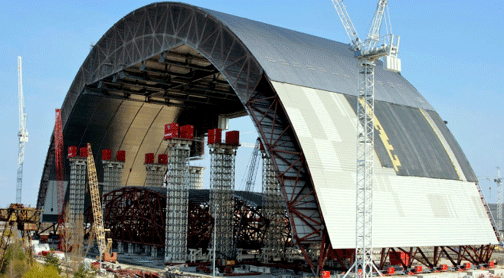
“You could put Wembley Stadium underneath here, with all the car parks,” said David Driscoll, the chief safety officer for the French consortium running the construction site.
- …….
Nicolas Caille, project director for Novarka, the consortium of Vinci and Bouygues, the French contractors running the project, said about 1000 people worked on a typical shift at the construction site, keeping to a schedule of 15 days in and 15 out.
The €2.15 billion ($3.1bn) shelter installation plan has been funded by international donors and the European Bank for Reconstruction and Development, a non-profit lending institution. But the Chernobyl clean-up faces a shortfall: €100 million is needed to finish a storage facility for highly radioactive spent nuclear fuel from the other three reactors, all now offline
The EBRD’s spent fuel facility contract is with a US-based energy technology firm. When the dollar-denominated contract was signed, the euro was stronger against the greenback; with the two currencies approaching parity, the bank faces a shortfall.
“This has dug a huge euro hole,” said Vince Novak, director of the nuclear safety department for the EBRD. “Our income is in euros.”
Mr Novak said donors would meet by the end of this month to discuss financing to finish the project, which is financed separately from the Chernobyl shelter fund.
Spent fuel rods are stored in an ageing facility.
Completion of the project, Mr Novak said, “has always been somehow in the shadow of the New Safe Confinement because it is not as attractive, not as sexy. But it is equally important in terms of nuclear safety.
Even if donors plug the gap, Chernobyl will continue to pose a financial challenge for Ukraine.
More than 40 countries and the EBRD have contributed to the Chernobyl containment work, and international donors say it will be years before the Kiev government can take on the larger share of the burden. http://www.theaustralian.com.au/business/wall-street-journal/nuclear-comeback-funding-fears-for-hitech-lid-on-chernobyl/news-story/1df7b13de774a981f1063ac3c62e9a36
Concern over influence on World Health Organisation by outside agencies, and financial support
 WHO Debates Changes To Safeguards Against Undue Influence By Outside Actors 26/04/2016 BY CATHERINE SAEZ, INTELLECTUAL PROPERTY WATCH This week a group of delegates at the UN World Health Organization is seeking to finalise agreement on a draft framework defining the organisation’s relationships with external actors, such as philanthropy, the private sector, academia, and civil society. Today, Norway put forward a potential compromise. Meanwhile, dozens of civil society organisations called on member states to stand up to pressure to compromise the intergovernmental body’s independence from private sector influence……..
According to the letter, the current process [pdf] of engagement with non-state actors restricts the acceptance of financial resources from the private sector to support salaries of WHO staff, while the current FENSA draft “ignores such restrictions and allows the Secretariat to accept financial support from the private sector to pay staff salaries.”
The groups are worried that reliance on financial support from the private sector “risks leading to the corporate capture of WHO.” They are calling for WHO member states to address the concern of sustainable financing of the organisation.
They are asking that safeguards against undue influence from the private-sector-linked entities and public-private partnerships be strengthened, and “at the very least, FENSA should not dilute the existing WHO safeguards.”
They also request WHO’s core function be “fully” protected, in particular its norm- and standard-setting activities, from the undue influence by putting in place clear rules against acceptance of cash or in-kind contributions from non-state actors for norm- and standard-setting activities. Finally, they request that the independence and integrity of WHO be protected from undue influence even during humanitarian emergencies. http://www.ip-watch.org/2016/04/26/who-debates-changes-to-safeguards-against-undue-influence-by-outside-actors/
Toshiba to lose 260 billion yen due to losses over Westinghouse nuclear power subsidiary
 Toshiba expects loss over Westinghouse to reach 260 bil. yen , Kyodo News, 26 April 2016 Toshiba Corp. said Tuesday it plans to book an asset impairment loss of around 260 billion yen ($2.3 billion) in its results for the year to March 31 by writing down the value of its U.S. nuclear power subsidiary Westinghouse Electric Co. acquired in 2006……
Toshiba said its operating loss for the year is now pegged at 690 billion yen, compared with its earlier forecast of 430 billion yen, on sales of 5.5 trillion yen against the earlier projection of 6.2 trillion yen.
“We don’t think our financial conditions have stabilized…so reinforcing our (financial) standing is the biggest challenge in the current business year,” President Masashi Muromachi told a press conference.
In computing the write down on Westinghouse, Toshiba reviewed the $2.93 billion in goodwill, or 350 billion yen based on the exchange rate at that time, it booked when acquiring the U.S. nuclear plant builder.
The goodwill, calculated by deducting from the purchase price the value of the assets and liabilities acquired, was reported on the balance sheet as a fixed asset…….http://kyodonews.net/news/2016/04/26/58694
Finnish-Russian nuclear site broken into by protestors
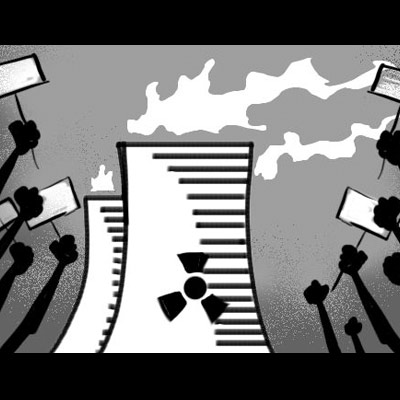
 Apr 26, 2016 Protesters break into Finnish-Russian nuclear site, Reuters, Anti-nuclear protesters broke in to a construction site on Tuesday for a nuclear reactor to be supplied by Russia’s state-owned nuclear firm Rosatom, choosing the 30th anniversary of the Chernobyl disaster for their demonstration…….
 with anyone with that kind of history,” Venla Simonen from the Stop Fennovoima protest group told Reuters by telephone…….
The Chernobyl disaster increased radiation levels in Finland, putting nuclear Finnish plant projects on ice for a decade.
This latest project has raised concerns and resistance from many Finns as the plant is set to forge deeper energy ties between EU state Finland and its former ruler Russia despite East-West tensions over the Ukraine crisis.
Rosatom has a 34 percent stake in the 7 billion euro ($7.9 billion) project. It will supply the reactor and also handle the project’s financing.
Fennovoima struggled to find local investors to fulfill an ownership condition set by the Finnish government, but utility Fortum last year signed up in a surprise move, prompting questions of political pressure from both countries involved…….http://www.reuters.com/article/us-finland-fennovoima-protests-idUSKCN0XN1TH
Germany wrestles with the dilemma of disposing of dead nuclear reactors and thier toxic wastes
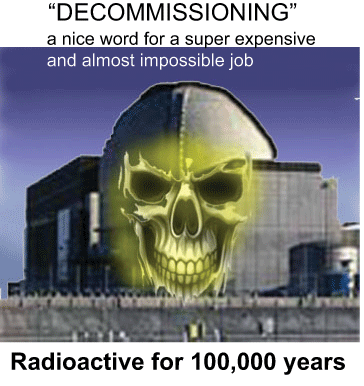 Nuclear reactor sites: Dismantle or fence off? http://www.dw.com/en/nuclear-reactor-sites-dismantle-or-fence-off/a-19111969, 26 Apr 16, Three decades after the Chernobyl disaster, Germany is preparing to go nuclear-free. Industry plans to dismantle and dispose of radioactive waste. But some green campaigners say it’s safer to leave reactor sites as-is.
Thirty years ago, the Chernobyl disaster released radioactivity that spread across much of the northern hemisphere into the atmosphere. It also spurred social movements around the world to demand an end to nuclear power.
In Germany, that end is finally in sight ,as the country prepares to go nuclear-free by 2022. But the task of safely decommissioning and dismantling nuclear power stations promises to be expensive and controversial, and will take many years.
Debate rages over how to dispose of highly radioactive spent fuel rods from commercial nuclear power stations. But there is less awareness around how the dissolving industry and its regulators must also decide what to do with disused reactor sites.
Masses of equipment and a variety of buildings at the sites were exposed to nuclear fission reaction products for years, and have become slightly or moderately radioactive as a result. Therein lies the crux of the disposal problem.
Big money, long time
The consultancy ADL has estimated it will take about two decades to fully dismantle Germany’s 17 nuclear reactor sites, and cost at least 18 billion euros – not including the cost of subsequent radioactive waste disposal.
Why will it take so long and cost so much? DW posed this question to E.ON, Germany’s largest electricity utility and owner of 11 nuclear power stations – most of them already shut down.
An E.ON spokesperson said dismantling of reactor sites must take place in stages. First, spent uranium fuel rods must be transported off-site, to interim storage elsewhere. This can’t happen until four or five years after a reactor is shut down, because the fuel rods’ radioactivity first needs to decrease sufficiently for their safe handling to become possible.
Dismantling equipment is then expected to take 10 to 15 years. Final demolition of remaining buildings and site remediation will take another two to three years after all radioactive materials have been removed from the former reactor site.
Radioactive waste materials can be treated by a variety of means – compression, desiccation, enclosure in cement, or burning to ash – to reduce total volume prior to packing, shipping, and final disposal in an approved secure long-term storage site, E.ON said.
Put it in a deep, dry hole
Schacht Konrad, a disused iron-ore mine shaft near the German town of Salzgitter, is under consideration as the national site for the final disposal of low- to medium-grade radioactive materials.
The mine was chosen because it is particularly dry inside – reducing the risk of radioactive materials dissolving and entering into the groundwater. It’s meant to take in around 90 percent (by volume) of all the radioactive rubble from decontaminated nuclear sites in Germany – but only the mildly radioactive stuff.
German law specifies a threshold of very low radioactivity below which materials are deemed safe. Materials that fall below the threshold can legally be disposed of through the regular waste disposal system. But some anti-nuclear campaigners insist there’s no safe threshold, however low.
In contrast to low-level, mildly radioactive waste from former reactor sites, highly radioactive waste – including spent fuel rods – will be left in cooling ponds on closed-down reactor sites for some decades. Ultimately, they’ll be disposed of in one or more special high-security repositories. The location of those repositories is highly contentious, and has not yet been settled.
Leave them where they’re standing?
While the government and nuclear industry are keen to get on with dismantling and removing reactors soon after they’re shut down, Jörg Schmid and Henrik Paulitz of the German division of the International Physicians for the Prevention of Nuclear War (IPPNW) think perhaps they shouldn’t be dismantled at all.
“Dismantling nuclear reactors is expensive and poses health dangers,” according to an IPPNW report in German published in January of this year.
In the report, Schmid and Paulitz say that serious consideration should be given to the option of securely fencing off old nuclear reactor sites and allowing low-level radioactivity from contaminated buildings and equipment to recede over decades.
The IPPNW’s preferred solution would see heavily contaminated elements such as spent fuel rods be removed immediately, while the less-contaminated buildings and equipment would be left in situ indefinitely.
This would avoid dispersing the radioactive material more widely, and minimize risk to human populations, the study’s authors argue.
E.ON told DW that fencing off sites was neither more nor less safe than dismantling them – but argued that dismantling is a better solution in terms of the labor market consequences.
“IPPNW’s option would mean that 300 to 400 people who work at a nuclear site would abruptly lose their jobs,” the spokesperson said.
But Paulitz countered: “The nuclear industry must answer the question: is the proposed dismantling of the reactor sites a necessary measure, or is it just a new multi-billion-euro industry?”
Radioactive steel in children’s bedrooms?
About 99 percent of the total mass of material at a former nuclear site is radioactive at such a low level that it is deemed safe – so the material is no longer covered by nuclear safety regulations and can be released into the environment, according to IPPNW’s Schmid, who is a medical doctor.
But Schmid said that what matters is total radiation exposure over time. If very large amounts of very weakly radioactive material are dispersed through the environment, for example by being reintroduced into material supply chains, that represents a significant amount of broadcast radiation exposure over time.
Dismantling nuclear power plants, Paulitz said, leads to a problem: “The great majority of the site’s materials won’t be classified as nuclear waste, and will instead be disposed of in ordinary household waste streams, or even recycled into normal supply chains.”
“From a health and safety perspective, we see this as irresponsible.” Paulitz said, as weakly radioactive steel taken from a dismantled nuclear site could end up built into a radiator in a child’s bedroom, for example.
Computer viruses have infected German nuclear power station
 German nuclear plant infected with computer viruses, operator says http://www.dailymail.co.uk/wires/reuters/article-3560358/German-nuclear-plant-infected-computer-viruses-operator-says.html , 27 April 2016 FRANKFURT, – A nuclear power plant in Germany has been found to be infected with computer viruses, but they appear not to have posed a threat to the facility’s operations because it is isolated from the Internet, the station’s operator said on Tuesday.
The Gundremmingen plant, located about 120 km (75 miles) northwest of Munich, is run by the German utility RWE.
The viruses, which include “W32.Ramnit” and “Conficker”, were discovered at Gundremmingen’s B unit in a computer system retrofitted in 2008 with data visualisation software associated with equipment for moving nuclear fuel rods, RWE said.
Malware was also found on 18 removable data drives, mainly USB sticks, in office computers maintained separately from the plant’s operating systems. RWE said it had increased cyber-security measures as a result.
W32.Ramnit is designed to steal files from infected computers and targets Microsoft Windows software, according to the security firm Symantec.
First discovered in 2010, it is distributed through data sticks, among other methods, and is intended to give an attacker remote control over a system when it is connected to the Internet.
Conficker has infected millions of Windows computers worldwide since it first came to light in 2008. It is able to spread through networks and by copying itself onto removable data drives, Symantec said.
RWE has informed Germany’s Federal Office for Information Security (BSI), which is working with IT specialists at the group to look into the incident.
The BSI was not immediately available for comment.
After Japan’s Fukushima nuclear disaster five years ago, concern in Germany over the safety of nuclear power triggered a decision by the government to speed up the shutdown of nuclear plants. Tuesday was the 30th anniversary of the Chernobyl nuclear disaster. (Reporting by Christoph Steitz, Eric Auchard and Joseph Nasr; Editing by Kevin Liffey)
European Union and other global donors pledge more money for Chernobyl nuclear safety effort
Global donors pledge more money for nuclear safety on Chernobyl anniversary, DW 26 Apr 16 Ukraine has commemorated the 30th anniversary of the Chernobyl nuclear disaster. Global donors have used the occasion to pledge additional funds to help keep the area safe for generations to come………A UN report in 2005 estimated that “up to 4,000” people could eventually perish from the invisible poison in Ukraine and neighboring Russia and Belarus.
The exact number of dead remains a subject of intense debate because the Soviet authorities kept most of the information about the disaster hidden.
Global donors
The EU was among the global donors that promised an additional 87.5 million euros ($99 million) to help secure the Chernobyl nuclear power plant, as the Ukrainian government began marking 30 years since the disaster.
The money will go toward the construction of a new spent nuclear waste storage facility, adding to the 2 billion euros already donated to helping clean up and secure the site. Ukraine still needs 15 million additional euros to be able to safely store hazardous materials underground.
“It’s an important project for the world as well as, of course, for Ukraine and Ukrainians,” said Suma Chakrabarti, chief of the European Bank for Reconstruction and Development (EBRD), the organization in charge of the project…….http://www.dw.com/en/global-donors-pledge-more-money-for-nuclear-safety-on-chernobyl-anniversary/a-19214334
Series of earthquakes is delaying Japan’s ‘nuclear revival’
 Japan’s Worst Quake Since 2011 Seen Delaying Nuclear Starts http://www.bloomberg.com/news/articles/2016-04-26/japan-s-worst-quake-since-fukushima-seen-delaying-nuclear-starts Stephen Stapczynski sstapczynski
-
Earthquakes on southern island of Kyushu kill 49 people
-
Japan lawyer group renews call for shutdown of Sendai reactors
A series of earthquakes, including amagnitude-7.3 tremor that struck about 119 kilometers (74 miles) from the Sendai nuclear facility on the southern island of Kyushu this month, destroyed hundreds of homes, snapped bridges and left at least 49 people dead. It has also revived an effort to halt the plants’ operations.
“Nuclear is under a magnifying glass now, so even the smallest problem can create big delays,” Michael Jones, a Singapore-based gas and power analyst at Wood Mackenzie Ltd. said in an e-mail. “Fukushima has changed everything, and earthquakes and volcanoes are only making things worse.”
Transport Disruptions
Trains and highways were damaged in the Kyushu earthquake and if there is a nuclear accident from another earthquake or volcanic eruption, evacuations may be difficult, Datsugenpatsu Bengodan, a group of lawyers working to wean Japan off nuclear power said in an April 19 statement. The group said Kyushu Electric Power Co.’s Sendai No. 1 and 2 reactors, which were the first to restart under post-Fukushima safety rules last year, should be shut.
An e-mail to Japan’s Nuclear Regulation Authority outside of normal business hours wasn’t immediately answered.
“Given this is the largest earthquake in over a century in Kyushu that has caused significant damage to infrastructure, it could slow down the pace of restarts,” said Tom O’Sullivan, founder of Mathyos, a Tokyo-based energy consultant. “It may now be even more imperative that emergency evacuation procedures are thoroughly tested.”
A nuclear accident at Sendai would require the evacuation of about 5,000 people in the surrounding 5 kilometers and more than 200,000 would need to seek immediate shelter within a 5- to 30-kilometer radius, according to a local government simulation from 2014.
The NRA, Japan’s nuclear regulator, said on April 18 that it sees no need to shut the two Sendai reactors. A high court on April 6 upheld a ruling that the Sendai reactors can withstand seismic damage and don’t pose a risk to the surrounding area.
A local court issued an injunction in March preventing the operation of Kansai Electric Power Co.’s Takahama No. 3 and 4 reactors, questioning whether evacuation plans and tsunami prevention measures — which had been endorsed by the government — were robust enough.
The earthquake near Japan’s only operating reactors “may boost the nation’s anti-nuclear sentiment,” Joseph Jacobelli, an analyst at Bloomberg Intelligence, said in an April 22 note. “Technical and political obstacles mean even those units approved for restart are returning at a snail’s pace.”
Ukraine: Over 2 million people receiving benefits due to radiation effects of Chernobyl nuclear disaster
Chernobyl wounds still fresh as Ukrainians mark 30th anniversary of disaster, WP, By Andrew Roth April 26 “……….On Monday, the United States announced that it was pledging an additional $10 million to the Chernobyl restoration project, on top of $400 million Washington has already committed.
The completion of construction will probably have major consequences for a small army of more than 2,000 workers, many of whom will probably no longer be needed once the project is finished. But as Ukraine seeks to cut social benefits and enact austerity measures to comply with the International Monetary Fund, the situation appears toughest for the survivors of the accident 30 years ago.
Some of the surviving liquidators, the first responders who suffered debilitating or even lethal doses of radiation while fighting to contain the fallout, have protested their treatment.
More than 2 million people in Ukraine are on Health Ministry rolls for benefits because of the accident…….https://www.washingtonpost.com/world/europe/30-years-after-chernobyl-disaster-containment-is-nearing-completion/2016/04/24/fa6888a4-064f-11e6-bfed-ef65
Toshina writes down the value of its nuclear business
Toshiba to Take $2.3 Billion Write-Down on Nuclear Business, WSJ, Toshiba also revised earnings guidance for the fiscal year, forecasting a larger operating loss By TAKASHI MOCHIZUKI April 26, 2016
TOKYO—Toshiba Corp. said it would write down the goodwill value of its nuclear-power-plant business, including its U.S. subsidiary Westinghouse Electric Co., after years of criticism that the company’s outlook on the business was too optimistic.
The electronics giant said Tuesday that it would book the one-time loss of ¥260 billion ($2.3 billion) to reflect the change in the business’s earnings prospects and Toshiba’s financial standing.Toshiba’s recent financial scandal led to downgrades of its debt,which will make borrowing more expensive and so hurt profits.
The impairment charge will be recorded in results for the fiscal year that ended on March 31, due to be reported May 12…….http://www.wsj.com/articles/toshiba-to-take-2-3-billion-write-down-on-nuclear-business-1461654771
1 This Month

of the week – Shut Down Drone Warfare!


Tell the Ukrainian Government to Drop Prosecution of Peace Activist Yurii Sheliazhenko

Petition to revoke the licensing of the Near Surface Nuclear Disposal Facility (NSDF) at Chalk River. https://www.ourcommons.ca/petitions/en/Petition/Details?Petition=e-7247
To see nuclear-related stories in greater depth and intensity – go to https://nuclearinformation.wordpress.com
-
Archives
- April 2026 (103)
- March 2026 (251)
- February 2026 (268)
- January 2026 (308)
- December 2025 (358)
- November 2025 (359)
- October 2025 (376)
- September 2025 (257)
- August 2025 (319)
- July 2025 (230)
- June 2025 (348)
- May 2025 (261)
-
Categories
- 1
- 1 NUCLEAR ISSUES
- business and costs
- climate change
- culture and arts
- ENERGY
- environment
- health
- history
- indigenous issues
- Legal
- marketing of nuclear
- media
- opposition to nuclear
- PERSONAL STORIES
- politics
- politics international
- Religion and ethics
- safety
- secrets,lies and civil liberties
- spinbuster
- technology
- Uranium
- wastes
- weapons and war
- Women
- 2 WORLD
- ACTION
- AFRICA
- Atrocities
- AUSTRALIA
- Christina's notes
- Christina's themes
- culture and arts
- Events
- Fuk 2022
- Fuk 2023
- Fukushima 2017
- Fukushima 2018
- fukushima 2019
- Fukushima 2020
- Fukushima 2021
- general
- global warming
- Humour (God we need it)
- Nuclear
- RARE EARTHS
- Reference
- resources – print
- Resources -audiovicual
- Weekly Newsletter
- World
- World Nuclear
- YouTube
-
RSS
Entries RSS
Comments RSS
 nuclear-news