Australia unwise to sell uranium to Ukraine
The Zaporizhia nuclear facility is Europe’s largest and is only 200 kilometres from the conflict zone in eastern Ukraine. Some commentators have described nuclear plants in the region as pre-deployed nuclear targets and there have already been armed incursions during the recent conflict period.

 Australia shouldn’t sell its uranium to Ukraine http://www.smh.com.au/comment/australia-shouldnt-sell-its-uranium-to-ukraine-20160331-gnv0no.html, Dave Sweeney, 31 Mar 16 Foreign Affairs Minister Julie Bishop’s announcement this week to sell Australian uranium to Ukraine is an ill-advised and dangerous retreat from responsibility.
With timing and placement that a satirist could only dream of emulating – April Fool’s Day, the month of the 30th anniversary of the Chernobyl meltdown and while attending a nuclear security summit – Bishop is set to sign a uranium supply agreement this week with Ukrainian President Petro Poroshenko.
Australia, the country that directly fuelled Fukushima now plans to sell uranium to Ukraine, the country that gave the world Chernobyl – hardly a match made in heaven.
Thirty years ago the Chernobyl nuclear disaster spread fallout over large swathes of eastern and western Europe and five million people still live in contaminated areas in Belarus, Ukraine and Russia.
Serious containment and waste management issues remain at Chernobyl with a massive concrete shield now under construction in an attempt to enclose the stricken reactor complex and reduce the chances of further radioactive releases.
Against this backdrop there are deep concerns over those parts of the Ukrainian nuclear sector that are not yet infamous names, including very real security concerns about nuclear facilities being targeted in the current conflict with Russia.
The Zaporizhia nuclear facility is Europe’s largest and is only 200 kilometres from the conflict zone in eastern Ukraine. Some commentators have described nuclear plants in the region as pre-deployed nuclear targets and there have already been armed incursions during the recent conflict period.
Australia has already suspended uranium sales to Russia – it makes scant sense to start selling uranium to Ukraine now. Along with security concerns there are serious and unresolved safety and governance issues that have dropped off the Foreign Minister’s radioactive radar with the sales plan.
Ukraine has 15 nuclear reactors – four are currently running beyond their design lifetime while a further six will reach this in 2020. That means two thirds of Ukraine’s nuclear reactors will be past their use-by date within five years.
On top of that, there is growing regional concern over the risks associated with the Poroshenko administration focus on keeping the reactors running. In rushing to extend operating licences Ukraine is cutting process and safety corners and not complying with its obligations under the Espoo Convention – an international framework agreement around transboundary environmental impact assessment.
In 2013 the Eastern Partnership, a leading East European civil society forum, declared that the absence of environmental impact assessment for nuclear projects posed “a severe threat to people both in Ukraine and in neighbouring states, including EU member states”.
These concerns have been amplified after a series of recent shutdowns, fires and safety concerns at Ukrainian nuclear facilities. Kiev’s response was a 2015 government decree preventing the national nuclear energy regulator from carrying out facility inspections on its own initiative. This coupled with increased pressure on industry whistle-blowers and critics has done nothing to address the real risks facing the nations aging nuclear fleet.
None of these issues have even been touched on by Bishop or by the Mineral Council of Australia’s yellowcake cheer squad who continue to champion a sector that remains in freefall post Fukushima. Price and production has fallen and the high risk, low return uranium sector has been hard hit with an independent market research report showing there are fewer than 1000 jobs in Australia’s embattled uranium sector.
There can be no nuclear business-as-usual in the shadow of Fukushima – a disaster that was fuelled by Australian uranium.
Following Fukushima the UN Secretary-General called for Australia to have a dedicated risk analysis of the impacts of the uranium sector. This has not happened and should take place before any new uranium deals are inked.
This new deal with Ukraine and the recent deal with India – which was signed despite a recommendation by the Joint Standing Committee on Treaties (JSCOT) that Australia not supply uranium to India at this time or on these terms – are deeply irresponsible policy positions. They put the interests of a small and under-performing mining sector ahead of Australia’s national interest and international responsibilities.
And this persistent failure to either respect or reflect the profound human and environmental lessons of past nuclear errors bodes poorly for avoiding future ones.
Nuclear power’s ever rising costs

 Nuclear Power, Once Cheap, Squeezed by Mounting Costs Reactors were supposed to provide near-limitless electricity at low prices. But as they’ve aged, their costs have climbed. US News, By Alan Neuhauser March 30, 2016 “……..Fuel costs have climbed, but age is also a chief culprit: The plants are an average 36 years old, requiring expensive and more frequent repairs.
“It gets harder to keep them running at the same price, even as competitors get cheaper and the market gets thinner,” says Peter Bradford, a commissioner with the Nuclear Regulatory Commission from 1977-1982 and a professor at Vermont Law School.
Electricity markets – flooded not only by cheap gas but also new solar and wind – paid as little as 2 cents per kilowatt-hour of electricity last year. Nuclear plants at times needed a full cent more – an additional 50 percent – to break even…..
the pressure on nuclear plants to cut costs is enormous, industry insiders say, even perhaps at the expense of safety. More than 75 percent of the nation’s nuclear plants have reported a radioactive leak in their lifetimes, for example, most recently outside New York City and Miami in February. They’ve also suffered explosions, fires and corrosion, and the Nuclear Regulatory Commission has repeatedly weakened its rules to allow plants to skirt potentially costly safety standards.
“They are expending as little amount of money on the plant as possible,” says Paul Blanch, a longtime engineer and industry worker turned watchdog.
At least four plants in the past four years have gone offline or been slated to be decommissioned, all casualties of rising costs and cheap competitors……http://www.usnews.com/news/articles/2016-03-30/nuclear-power-once-cheap-squeezed-by-mounting-costs
Nine Mile Point Nuclear Station desperate for money: call for taxpayer funding
Nine Mile Point nuclear plant faces financial peril, exec says, syracuse.com, By Tim Knauss | tknauss@syracuse.com 31 Mar 16 SCRIBA, N.Y. — Nine Mile Point Nuclear Station is “losing a lot of money” and could someday face an early closure like its Oswego County neighbor, the FitzPatrick plant, unless state officials develop price supports for Upstate nuclear plants, a top company official said Wednesday.
The pending shutdown of FitzPatrick has dominated headlines, but the larger Nine Mile Point station next door suffers similar financial hardships, said Joseph Dominguez, executive vice president of plant owner Exelon Corp.
Dominguez said the 1,900-megawatt Nine Mile Point facility no longer makes enough money to cover operating expenses. He declined to say how steep its losses are………
state officials scramble to implement new subsidies that would reward Upstate nuclear plants for generating carbon-free power and provide them with millions in additional revenue.
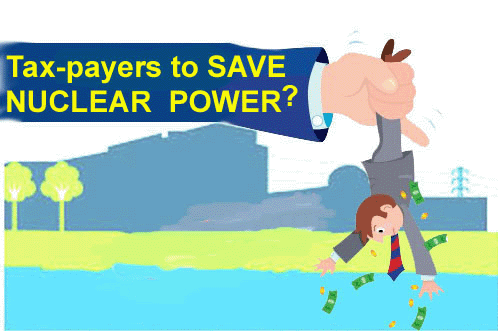
Gov. Andrew Cuomo in December ordered state regulars to establish so-called “zero emission” subsidies for Upstate nuclear plants for a 15-year period. Cuomo has committed to cutting carbon emissions 40 percent by 2030. If nuclear reactors shut down and are replaced by natural gas-fired plants, carbon emissions would increase.
But Cuomo’s plan is opposed by some advocates of renewable energy, who say forcing utility ratepayers to pay more for nuclear power is a waste of resources that should be devoted to cleaner technologies like wind and solar power.
Details of the nuclear price supports have not been worked out. But the staff of the Public Service Commission estimated last month that current wholesale electric prices are about $15 per megawatt-hour lower that what Upstate nuclear plants need to survive. If utility ratepayers have to make up that difference, the cost could be $300 million a year or more, even with FitzPatrick closed……..
Most recently, state Sen. Patty Ritchie proposed $100 million in the state budget to keep FitzPatrick operating until permanent nuclear price supports are in place.
FitzPatrick’s owner, Entergy Corp., has rejected such efforts and stays on course to close the plant.
Dominguez, of Exelon, said FitzPatrick is just one of four Upstate reactors at risk of shutting down -“ including the two at Nine Mile Point and Exelon’s other Upstate facility, the Ginna nuclear plant in Wayne County.
“We appreciate the focus that the legislators are putting on FitzPatrick, but it’s really an issue that’s broader than FitzPatrick,” he said. “It’s four units up there. A limited one-time budget fix for one plant frankly isn’t going to do it. You’re just going to end up with another plant that’s going to be in jeopardy within months, or at most years.”…….http://www.syracuse.com/news/index.ssf/2016/03/nine_mile_point_nuclear_plant_faces_financial_peril_exelon_exec_says.html
1 This Month
Chernobyl: The Lost Tapes – A good documentary on Chernobyl on SBS available On Demand for the next 3 weeks– https://www.sbs.com.au/ondemand/tv-program/chernobyl-the-lost-tapes/2352741955560

of the week–London Campaign for Nuclear Disarmament

Tell the Ukrainian Government to Drop Prosecution of Peace Activist Yurii Sheliazhenko
To see nuclear-related stories in greater depth and intensity – go to https://nuclearinformation.wordpress.com
-
Archives
- April 2026 (152)
- March 2026 (251)
- February 2026 (268)
- January 2026 (308)
- December 2025 (358)
- November 2025 (359)
- October 2025 (376)
- September 2025 (257)
- August 2025 (319)
- July 2025 (230)
- June 2025 (348)
- May 2025 (261)
-
Categories
- 1
- 1 NUCLEAR ISSUES
- business and costs
- climate change
- culture and arts
- ENERGY
- environment
- health
- history
- indigenous issues
- Legal
- marketing of nuclear
- media
- opposition to nuclear
- PERSONAL STORIES
- politics
- politics international
- Religion and ethics
- safety
- secrets,lies and civil liberties
- spinbuster
- technology
- Uranium
- wastes
- weapons and war
- Women
- 2 WORLD
- ACTION
- AFRICA
- Atrocities
- AUSTRALIA
- Christina's notes
- Christina's themes
- culture and arts
- Events
- Fuk 2022
- Fuk 2023
- Fukushima 2017
- Fukushima 2018
- fukushima 2019
- Fukushima 2020
- Fukushima 2021
- general
- global warming
- Humour (God we need it)
- Nuclear
- RARE EARTHS
- Reference
- resources – print
- Resources -audiovicual
- Weekly Newsletter
- World
- World Nuclear
- YouTube
-
RSS
Entries RSS
Comments RSS
 nuclear-news