UK sending nuclear wastes to America – dangerous and unwise
In such circumstances it becomes tempting to look for short cuts. One occasionally raised is to put all the world’s problematic waste somewhere very remote like the west Australian desert. This is a non-starter. The Czech and Slovak experience illustrated this. As a single country they planned a single repository, but after their “velvet divorce” each insisted it would not permanently manage the other’s waste. Such an international solution also contradicts the aforementioned issue of being responsible for your own legacy.
The other major hope is that science will find a convincing way either to use waste as fuel for reactors, and/or that “partitioning and transmutation” would drastically reduce the half-lives of the relevant isotopes. Yet these approaches are complex and expensive, involving molten salt reactors or accelerator-driven systems. And critically, there would still be some volume of long-lived waste that needed to be managed – no method can yet promise to drastically reduce the half-lives of all the different waste types. The only credible way forward is deep burial.
 Britain is sending a huge nuclear waste consignment to America – why?, The Conversation, Gordon MacKerron, April 5, 2016 “……..The vast majority of the UK’s waste comes from its fleet of nuclear power stations. Most of it is stored at the Sellafield site in north-west England. But the material being sent to the US is a particularly high (weapons usable) grade of enriched uranium that you wouldn’t want to move to Sellafield from its current location at Dounreay in the north of Scotland without building a new storage facility – presumably more expensive than the cost of transportation.
The decision to move this radioactive waste out of the UK has been presented as making it harder for nuclear materials to get into the hands of terrorists, but this is implausible. The UK is capable of managing homegrown highly enriched uranium itself. The plan also contradicts the principle that countries are responsible for managing their own nuclear legacy…….
we are talking about substances which could harm human health for tens of thousands of years into the future. It raises profound ethical issues of equity between generations.
Deep burial
The scientific community does in fact agree on how to dispose of these materials safely: deep underground in appropriate geology such as clay or granite, with well engineered radiation barriers as an extra defence. Yet only Sweden and Finland, with political systems built on more trust and consensus than most countries, have a clear repository plan – and it will be several years before they become operational.
Most of the storage facilities at Sellafield are designed to last mere decades. The UK has been sporadically focused on deep disposal since the early 1980s, but for a long time approached it top-down and secretively. This became known as the “DAD” method – decide, announce, defend. But it has always led to “abandon” when local communities, having had no part in the siting decision, have rebelled successfully.
It was not until 2008 that the government introduced a system of rules under which local communities would conditionally volunteer a site and then negotiate a deal with the authorities. So far it has produced no result: attempts by district councils around Sellafield to volunteer it were overruled in 2013 by Cumbria county council, the local-authority tier above them, and no other communities have come forward. The government has reserved the right to override the voluntary process but shows no sign of doing so yet.
In such circumstances it becomes tempting to look for short cuts. One occasionally raised is to put all the world’s problematic waste somewhere very remote like the west Australian desert. This is a non-starter. The Czech and Slovak experience illustrated this. As a single country they planned a single repository, but after their “velvet divorce” each insisted it would not permanently manage the other’s waste. Such an international solution also contradicts the aforementioned issue of being responsible for your own legacy.
The other major hope is that science will find a convincing way either to use waste as fuel for reactors, and/or that “partitioning and transmutation” would drastically reduce the half-lives of the relevant isotopes. Yet these approaches are complex and expensive, involving molten salt reactors or accelerator-driven systems. And critically, there would still be some volume of long-lived waste that needed to be managed – no method can yet promise to drastically reduce the half-lives of all the different waste types. The only credible way forward is deep burial…….. https://theconversation.com/britain-is-sending-a-huge-nuclear-waste-consignment-to-america-why-57074
Eurasian conflicts undermine nuclear security
 Frozen Conflicts Undermine Nuclear Security http://www.eurasianet.org/node/78126
April 5, 2016 , by Richard Weitz The renewal of armed conflict between Armenian and Azerbaijani forces over the Nagorno-Karabakh enclave can potentially have global ramifications, participants at the recent nuclear security summit in Washington cautioned.
A concern articulated in national progress reports prepared for the March 31-April 1 summit by several Eurasian governments was how corrosive the region’s ethnic and border disputes are to global nuclear security. The chaotic conditions that accompany such conflicts can make it easier for terrorists and criminal groups to get their hands on, and transport, nuclear or radioactive materials that can subsequently be used in a terror operation.
Warning that this situation “may lead to dire consequences not only for Ukraine, but for many European nations,” Ukrainian authorities called for “establishing international control over nuclear facilities that can be seized or damaged as a result of military actions.”
Azerbaijan’s report likewise observed that the unresolved Karabakh conflict means that “Azerbaijan is unable to provide proper border control along the substantial part of its borders.”
The nuclear security summit had a global scope, but Eurasia was one of the focus areas of the event. The presidents of Armenia, Azerbaijan, Georgia, Kazakhstan, and Ukraine all attended the gathering.
The fighting in Karabakh erupted just hours after Armenian President Serzh Sargsyan and his Azerbaijani counterpart, Ilham Aliyev, each met separately with US Vice President Joe Biden on the margins of the summit. In identical language describing each meeting, Biden cautioned both presidents about the need for restraint.
Although representatives of Moldova were not at the summit, there have been reports of alleged Russian-linked smugglers attempting to exploit governance lapses and security gaps connected with the country’s separatist region of Transnistria to try to sell nuclear materials to suspected terrorist organizations. Elsewhere, Georgia’s breakaway territories of Abkhazia and South Ossetia have also been associated with reports of nuclear smuggling attempts.
Russian government has provided technical and financial assistance to fellow members of the Commonwealth of Independent States and the Eurasian Economic Union to help address nuclear security threats. Despite supplying such assistance, Russian officials boycotted the Washington meeting and demanded an end to the summits, which have met every other year since 2010.
Richard Weitz is Senior Fellow and Director of the Center for Political-Military Analysis at Hudson Institute.
The global ‘Panama Papers’ financial corruption scandal
 Panama Papers: Mossack Fonseca labels leak a ‘crime and attack’The revelation of the Panama Papers detailing the off-shore structures of many wealthy clients is a “crime” and an “attack” on Panama, the law firm at the heart of the scandal has said.http://www.abc.net.au/news/2016-04-04/mossack-foncesa-says-panama-papers-a-crime-and-attack/7296858
Panama Papers: FIFA officials, Lionel Messi, Michel Platini named in secret offshore files Disgraced FIFA officials, suspended UEFA chief Michel Platini and Barcelona superstar Lionel Messi were amongst the names found the Panama Papers — leaked documents which reveal offshore financial dealings of the world’s rich and famous.http://www.abc.net.au/news/2016-04-04/fifa-officials-and-lionel-messi-named-in-offshore-files/7296140
Panama Papers leak: Australian security company Wilson linked to Hong Kong corruption scandalLeaked documents have revealed that two brothers embroiled in a massive Hong Kong corruption scandal were ultimately in control of an Australian security company that earned roughly half a billion dollars in lucrative government contracts.http://www.abc.net.au/news/2016-04-04/australian-company-wilson-linked-to-hong-kong-corruption-scandal/7291178
Panama Papers: Tax office investigating 800 Australians identified in financial record leak The Australian Tax Office (ATO) is investigating 800 Australian residents named in a massive leak of tax and financial records known as the Panama Papers. http://www.abc.net.au/news/2016-04-04/tax-office-investigating-800-australians-in-panama-papers-leak/7296512
Panama Papers: Iceland PM Gunnlaugsson urged to resign amid Mossack Fonseca data leak By International Consortium of Investigative Journalists and ABC staffPressure is mounting for Iceland’s Prime Minister to resign after an unprecedented leak of data revealed accusations he used an offshore company to hide millions of dollars in investments in Iceland’s major banks.http://www.abc.net.au/news/2016-04-04/iceland-pm-urged-to-resign-amid-panama-papers-scandal/7295742
Panama Papers: Vladimir Putin associates, Jackie Chan identified in unprecedented leak of offshore financial records An unprecedented leak of more than 11 million documents has revealed the hidden financial dealings of some of the world’s wealthiest people, as well as 12 current and former world leaders and 128 more politicians and public officials around the world.http://www.abc.net.au/news/2016-04-04/unprecedented-leak-of-offshore-financial-records-exposes-secrets/7293524
The International Consortium of Investigative Journalists (ICIJ): The Panama Papers: Exposing the Rogue Offshore Finance Industry Leak of more than 11 million documents show heads of state, criminals and celebrities using secret hideaways in tax havens.https://panamapapers.icij.org/
Panama Papers: Greens call for Wilson Security to be stripped of contracts after corruption scandal links exposedThe Greens have called on the Federal Government to strip Wilson Security of its contracts for offshore immigration detention centres after revelations the company has links to a Hong Kong corruption scandal. http://www.abc.net.au/news/2016-04-05/greens-call-for-wilson-security-sacking/7299736
Panama Papers: Here’s who has been caught in the fallout of the Mossack Fonseca leak The unprecedented leak of more than 11 million documents from Panamanian law firm Mossack Fonseca has revealed some of the hidden financial dealings of the world’s rich and powerful.
Here’s a look at some of the more high-profile people feeling the heat after the scandal broke.http://www.abc.net.au/news/2016-04-05/who-has-been-caught-in-the-panama-papers-fallout/7299666
Panama Papers: Iceland PM Gunnlaugsson refuses to resign over tax leaks; protesters take to streets Iceland’s Prime Minister is refusing to resign after leaked tax documents known as the Panama Papers revealed accusations he and his wife used an offshore firm to allegedly hide million-dollar investments. http://www.abc.net.au/news/2016-04-05/icelandic-pm-refuses-to-resign-over-panama-papers-leak/7298944 (Actually I think that he has now resigned)
Panama Papers: Fraudsters, former tax officials among Australians identified in Mossack Fonseca leak Convicted fraudsters, directors banned by the corporate regulator and former Australian Tax Office (ATO) officials are among hundreds of Australians linked to companies incorporated by Panamanian law firm Mossack Fonseca. http://www.abc.net.au/news/2016-04-05/australians-identified-in-mossack-fonseca-panama-papers-leak/7297964
(Read more about this investigation by ICIJ journalists and more than a hundred other media partners at:https://panamapapers.icij.org/about.html – and check out the videos and reading list.)
Bernie Sanders’ strategy for phasing out nuclear power
 Bernie Sanders Wants to Phase Out Nuclear Power, Mother Jones, What would replace it?—By Ben Adler Tue Apr. 5, 2016“………The aging nuclear fleet in the US is becoming increasingly uneconomical. “As reactors get older, they get more expensive to maintain. It’s not competitive with renewables or natural gas,” says Matthew McKinzie, a nuclear energy expert and advisor to the Natural Resources Defense Council Action Fund. “By mid-century, we might have 20 reactors operating.”
Getting older nuclear plants in good enough shape to get relicensed can be expensive, as environmental and safety standards have been raised since the plants were built. Renewables advocates argue that the money could be put to better uses…….
HOW THE NUCLEAR PHASEOUT FITS INTO SANDERS’ BIGGER PLAN
Sanders’ critics are right to note that under the current set of policies in place in the US, renewables won’t account for a majority of our energy portfolio for at least another two decades, so it’s not safe to assume that a retired nuclear plant would be replaced by clean energy. In that context, lopping 20 years off the life of a nuclear reactor may very well mean higher carbon emissions than if you relicensed it.
But Sanders’ desire to phase out nuclear power makes a lot more sense in the context of his broader climate and energy plan. He would make fossil fuels more expensive through a carbon tax, and make major investments in clean energy, so renewables would be better poised to replace power lost from shuttered nuclear plants.
The sticking point, of course, is that even if Sanders got to the White House, he wouldn’t get a cooperative Congress, so his larger climate plan would not be enacted. In that case, deciding whether to relicense nuclear plants would be a trickier matter.
The Sanders campaign declined to comment directly on what Sanders would do if he were president and found himself in that situation, offering only this emailed statement from spokesman Karthik Ganapathy: “Sen. Sanders knows there are lots of reasons why nuclear power is a bad idea. Whether it’s the exceptional destructiveness of uranium mining, the fact that there’s no good way to store nuclear waste or the lingering risk of a tragedy like Fukushima or Chernobyl in the US, the truth is: nuclear power is a cure worse than the disease. Safer, cleaner energy sources like wind and solar will help us meet America’s energy needs while protecting the health of our people and combatting the threat of climate change.”
Those views put Sanders right in line with environmental groups like the Sierra Cluband Greenpeace, which oppose nuclear power across the board……http://www.motherjones.com/environment/2016/04/grist-bernie-sanders-wants-to-phase-out-nuclear-power-plants
The very real threat of a terrorist Fukushima
 Could There Be a Terrorist Fukushima?, NYT, By GRAHAM ALLISON and WILLIAM H. TOBEY, APRIL 4, 2016 “……..Discussions about nuclear terrorism also tend to focus on the risk of terrorists stealing weapons-grade material or making a dirty bomb. But they often overlook the danger of terrorists attacking a nuclear plant in order to set off a Chernobyl- or Fukushima-like disaster.
That risk is real, however, and has been known for a while. The master planner of the 9/11 attacks had considered crashing a jumbo jet into a nuclear facility near New York City. A Qaeda training manual lists nuclear plants as among the best targets for spreading fear in the United States.
Striking a nuclear plant or the cooling ponds in which nuclear waste is stored wouldn’t set off a mushroom cloud or kill hundreds of thousands of people. But it would spew large amounts of radiation, spark a mass panic and render vast swaths of land uninhabitable. And it could cause thousands of early deaths from cancer.
Nuclear plants have built-in safety mechanisms, typically multiple systems that are unlikely to fail simultaneously: If one of them malfunctions, there’s always a backup, the theory goes. But redundancy is effective protection only against accidents, not against terrorists who set out to cause simultaneous system failures. For example, by targeting power and water supplies at the same time, attackers could cause a reactor to melt down or a cooling pond to ignite……..http://www.nytimes.com/2016/04/05/opinion/could-there-be-a-terrorist-fukushima.html?smid=tw-share&_r=1
Report: £40bn in savings, if UK scrapped Hinkley nuclear, and went for renewables instead
The report says that at £24bn, Hinkley Point C would be the “most expensive building on Earth”, and argues that the new reactors would pass not just economic costs to future generations, but the burdens of nuclear waste and climate change because nuclear is not quick enough to build at scale to stave off dangerous global warming
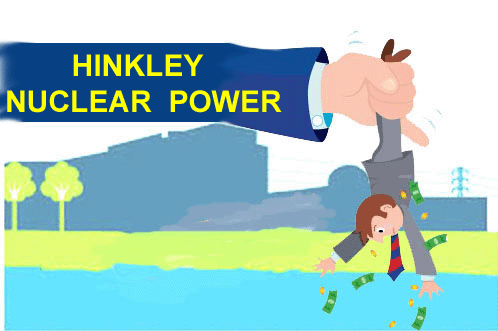
 Scrapping Hinkley for renewable alternatives would save ‘tens of billions’
Solar and wind would generate the equivalent power to Hinkley over the plant’s planned lifetime for £40bn less, says analysis comparing future costs, Guardian, Adam Vaughan, 5 Apr 16, Scrapping plans for new nuclear reactors at Hinkley Point in Somerset and building huge amounts of renewable power instead would save the UK tens of billions of pounds, according to an analysis that compares likely future costs.
The Intergenerational Foundation thinktank calculated that Britain would pay up to £40bn less for renewable alternatives that would generate the equivalent power to Hinkley over the plant’s planned lifetime.
A final investment decision by EDF on the nuclear power plant’s expansion is expected in May. The deal involves the government committing £92.50 per megawatt hour over 35 years for its electricity output, more than twice the current wholesale price.
But a report published on Tuesday by the thinktank, which campaigns on fairness between generations, found that onshore windfarms would cost £31.2bn less than Hinkley, and solar photovoltaic power £39.9bn less over 35 years to build and run. The estimate is based on both the value of subsidies paid by the taxpayer for the electricity and the cost of building the infrastructure.
The analysis is based on the government’s ‘contracts for difference’ subsidy levels for the technologies and projections by Bloomberg for how the cost of wind and solar power will fall in the future.
Andrew Simms, one of the report’s co-authors, said: “The government’s current plans for new nuclear power will break spending records, and pass both high costs and large, unknown economic risks onto every UK child for generations to come.
But, readily available, cheaper, safer and quicker renewable energy options would help Britain live both within its economic and environmental means, while also protecting and providing for future generations.”
The report says that at £24bn, Hinkley Point C would be the “most expensive building on Earth”, and argues that the new reactors would pass not just economic costs to future generations, but the burdens of nuclear waste and climate change because nuclear is not quick enough to build at scale to stave off dangerous global warming………
Renewable power has grown in the UK to the point where more electricity was generated from biomass, wind, hydro and solar power in 2015 than nuclear power stations. But it is unlikely the Intergenerational Foundation’s report will shift minds in government, which has cut subsidies for both solar and wind power while pressing ahead with the Hinkley project.
The analysis assumes the level of subsidy for solar and wind under the contracts for difference subsidy regime would remain constant, though in reality this would likely decrease as more capacity was built……. http://www.theguardian.com/environment/2016/apr/05/scrapping-hinkley-for-renewable-alternatives-will-save-tens-of-billions
Takeaways from Obama’s last Nuclear Security Summit
The 2016 Nuclear Security Summit (NSS) concluded on April 1—four days shy of the 7th anniversary of President Barack Obama’s Prague speech, in which, among other things, he announced a “new international effort to secure all vulnerable nuclear material around the world within four years.” The 2016 NSS was the fourth and final summit held in its current format.Obama expressed the hope that the 2016 summit would leave behind an enduring international nuclear architecture for securing highly enriched uranium (HEU) and plutonium.
Leaders and representatives of 52 countries and four regional and international organizations attended the summit. It produced gift baskets (political commitments signed by groups of participants), five action plans for existing international bodies, new national and multilateral commitments, a contact group to oversee implementation of commitments made, and a final communiqué.
A total of 13 gift baskets were presented during the summit, though many of them built upon previous commitments. Three were particularly notable:………
Dangerous, pointless nuclear race in East Asia
The plutonium plans of each of the three East Asian countries, reinforced by worst-case assumptions about the intentions of the others, are further destabilizing an increasingly unstable region.
The ultimate goal, however, should be to end the costly, dangerous, pointless industry of plutonium separation. The U.S. has pursued that goal since 1974, when India used plutonium from its nominally civilian breeder reactor development program to launch a nuclear weapons program. Since that time, Belgium, Germany, Switzerland and other countries have abandoned their reprocessing programs and the United Kingdom has decided to do so as well.
A Little-Known Nuclear Race Taking Place in East Asia Is Dangerous and Pointless http://www.huffingtonpost.com/frank-von-hippel/nuclear-race-asia_b_9609116.html 5 Apr 16 Frank von HippelSenior Research Physicist, Emeritus, Program on Science and Global Security, Princeton University Fumihiko YoshidaVisiting Scholar, Carnegie Endowment for International Peace
 Plutonium was first produced and separated during America’s World War II nuclear weapons project. Its destructive power became apparent at the end of the war when, in one-millionth of a second, one kilogram of plutonium in the Nagasaki bomb fissioned and destroyed the city below.
Today, a number of countries — including France and Japan — are separating plutonium from the spent fuel of their reactors and building dangerous stockpiles of this weapon-usable nuclear material with no good economic purpose.
Japan, the only non-nuclear weapons state that separates plutonium today, has accumulated almost 50 metric tons. Last month, Japan shipped more than 700 pounds of mostly weapons-grade plutonium — enough for about 50 nuclear bombs — to a more secure location in the U.S. But Prime Minister Shinzo Abe has been simultaneously pushing through a law to guarantee funding for a new spent fuel “reprocessing” plant designed to separate hundreds of tons of plutonium for use in reactor fuel.
Meanwhile, China’s new five-year plan includes a proposal to buy a reprocessing plant from France that will separate plutonium that will probably accumulate like Japan’s. And South Korea insists that it should have the same right to separate plutonium as Japan.
These plans and desires are troubling. As President Obama said during the 2012 Nuclear Security Summit, “We know that just the smallest amount of plutonium — about the size of an apple — could kill hundreds of thousands and spark a global crisis … We simply can’t go on accumulating huge amounts of the very material, like separated plutonium, that we’re trying to keep away from terrorists.”
Nuclear scientists working on weapons in the U.S. during World War II had a vision that plutonium could have a peaceful use. They proposed a plutonium “breeder” reactor that would convert uranium-238 into chain-reacting plutonium whose fission could power civilization for millennia. During the 1960s, this vision infected the global nuclear energy establishment. Since the 1970s, industrialized countries havespent about $100 billion on attempts to commercialize breeder reactors. Fortunately, this effort failed. We now understand the increased dangers of nuclear terrorism and proliferation that would have resulted had plutonium, a nuclear weapons material, become a commodity like petroleum. Conventional reactors are fueled by low-enriched uranium that is not usable in weapons.
In the absence of breeders, however, France has been continuing to separate plutonium and using it to fuel some of its conventional reactors; Japan has been trying less successfully to do the same.
The plutonium-uranium “mixed oxide” fuel produced in this way costs 10 timesmore than the low-enriched uranium that is the primary fuel for conventional reactors. But France’s government insists that Électricité de France continue to fund the bankrupt government-owned company AREVA to separate plutonium from EDF’s spent fuel. Meanwhile, Japan’s government is obliging its utilities to separate more plutonium as well. Globally, including failed plutonium programs in Russia and the United Kingdom, a surplus of more than 250 tons of plutonium — enough for 30,000 Nagasaki-type nuclear weapons — has been accumulated in civilian plutonium programs.
How can one explain the continuing interest in France, Russia, Japan, China and South Korea in separating plutonium? Institutional inertia is most of the answer in France and Russia but, in East Asia, the original use of plutonium — nuclear weapons — is also a factor. In South Korea, demands that the nation should have the right to be able to separate plutonium peak after North Korean nuclear tests. Security experts in Japan also increasingly justify its plutonium program as providing a latent nuclear deterrent against North Korea and China. China’s nuclear energy establishment is still enthralled with breeder reactors, but some analystsworry that China could use the reprocessing plant it plans to buy from France to quickly build up its nuclear weapons stockpile to the same scale as those of Russia and the United States.
The plutonium plans of each of the three East Asian countries, reinforced by worst-case assumptions about the intentions of the others, are further destabilizing an increasingly unstable region.
The United States cannot dictate to any of these countries. But it has a lot of leverage by virtue of being South Korea and Japan’s most important military ally and its agreements on peaceful nuclear cooperation with both.
In the recently completed negotiations over the renewal of the U.S.-Republic of Korea Agreement for Peaceful Nuclear Cooperation, the two countries kicked the issue of South Korea’s demand for the right to reprocess spent fuel down the road by launching a joint 10-year study of the “feasibility” of South Korea’s proposed program.
If the U.S. cannot convince France to hold off selling a reprocessing plant to China, it should at least insist that, as a part of the deal, both countries commit to “just-in-time” plutonium separation — that is, no stockpiling.
The ultimate goal, however, should be to end the costly, dangerous, pointless industry of plutonium separation. The U.S. has pursued that goal since 1974, when India used plutonium from its nominally civilian breeder reactor development program to launch a nuclear weapons program. Since that time, Belgium, Germany, Switzerland and other countries have abandoned their reprocessing programs and the United Kingdom has decided to do so as well.
The U.S. must continue to press the holdouts.
Close Indian Point nuclear station, wean off nuclear power – Bernie Sanders
Bernie Sanders calls for closing Indian Point nuclear facility, wean off nuclear energy http://www.utilitydive.com/news/bernie-sanders-calls-for-closing-indian-point-nuclear-facility-wean-off-nu/416842/ By Robert Walton | April 5, 2016
Dive Brief:
- Presidential candidate Bernie Sanders is calling for Indian Point, the controversial nuclear plant near New York City, to be closed down over safety concerns, just weeks ahead of the state’s Democratic primary, NBC News reports.
- Sanders will face fellow candidate Hillary Clinton, who has been critical of the plant but has called for making it safer rather than closing it down entirely.
- Sanders is the only presidential candidate calling for an end to nuclear power; he wants the United States to grow its renewable resources like wind and solar instead.
Dive Insight:
Entergy’s Indian Point nuclear facility has become an issue in the Presidential race, with Democratic candidate Bernie Sanders saying the plant is too near New York City to be safely operated.
“I am very concerned that the Indian Power nuclear power reactor is more than ever before a catastrophe waiting to happen,” Sanders said in a statement issued yesterday. “In my view, we cannot sit idly by and hope that the unthinkable will never happen. We must take action to shut this plant down in a safe and responsible way. It makes no sense to me to continue to operate a decaying nuclear reactor within 25 miles of New York City where nearly 10 million people live.”
New York Gov. Andrew Cuomo (D) has pushed to shutter the facility over safety concerns, and in February called for an investigation into the plant after monitoring weeks showed it was leaking contaminated water. Entergy has maintained the plant is safe and the power is essential to the region.
But while Cuomo supports Entergy’s continued operation of other nuclear units in the state, Sanders has established himself as the only candidate calling for the United States to move entirely away from nuclear power.
“Even in a perfect world where energy companies didn’t make mistakes, nuclear power is and always has been a dangerous idea because there is no good way to store nuclear waste,” he said in his statement. “That is why the United States must lead the world in transforming our energy system away from nuclear power and fossil fuels.”
Sanders will face Hillary Clinton in the New York Democratic primary later this month. Clinton, who lives less than 20 miles from the plant, has been critical of the facility but does not want to see it shut down and instead has called for improving operations at the facility.
European Commission report on nuclear power – costs blowing out, waste mount, but where to put them?
Europe plans to bury its nuclear waste—but doesn’t know where, and needs €120 billion to do it, Quartz, Cassie Werber, 5 Apr 16 “……Now, a report (pdf) from the European Commission has tried to pull together the whole bloc’s data and make a set of important estimates: How much is it going to cost to keep building plants at the rate Europe is planning them? What’s the price tag for taking old plants off line? And what will it take to dispose of the radioactive waste the plants generate?

Nuclear waste ranges in radioactivity levels. The high-level stuff has a longer half-life, taking more than 30 years to degrade. The report’s authors note: “Disposal in deep, stable geological formations is the generally recognized option for the disposal of high level waste.” In other words, it gets buried. But there is only one such burial facility in the world, and it’s in the US, in New Mexico. Europe has yet complete one, though Finland, Sweden, and France are making headway on that.
USA Secretary of State defends nuclear pact with Tehran


 Kerry on Iran nuclear deal: If they’re cheating, we’ll know it Secretary of state defends pact with Tehran ahead of expected grilling by angry Republicans in Congress, Times of Israel, BY RICHARD LARDNER April 5, 2016,WASHINGTON (AP) — US Secretary of State John Kerry on Tuesday defended the landmark nuclear deal the United States made with Iran ahead of a congressional hearing where Senate Republicans are expected to hammer the Obama administration for considering the easing of financial restrictions against Tehran.
Kerry acknowledged the harsh criticism of the arrangement, which is designed to prevent Iran from becoming a nuclear power, telling MSNBC there’s a furious debate even in Iran over whether Tehran should choose missiles over dialogue.
“I think what you’re seeing there is tension” between moderates and hard-liners over Iran’s future course, Kerry said.
Kerry’s remarks came just hours ahead of a scheduled hearing by the GOP-led Senate Foreign Relations Committee on the implementation of the nuclear accord. Thomas Shannon, the undersecretary of state for political affairs, will testify.
The committee’s hearing comes amid reports that the administration may relax the prohibition that prevents US dollars from being used in transactions with Iran. Angry lawmakers, who contend the US was taken advantage of in the deal, have countered that Tehran would be getting more than it deserves from the international nuclear pact reached last year.
While no final decision has been made, officials told The Associated Press the Treasury Department has prepared a general license permitting offshore financial institutions to access dollars for foreign currency trades in support of legitimate business with Iran, a practice that is currently illegal.
Several restrictions would apply, but the change could prove significant for Iran’s sanctions-battered economy. It also would be highly contentious in the United States, where Republican and several Democratic lawmakers say the administration promised to maintain a strict ban on dollars along with other non-nuclear penalties on Iran after last July’s seven-nation nuclear agreement.
The nuclear pact provided Iran with billions of dollars in sanctions relief for curtailing programs that could lead to nuclear weapons. But the Iranians say they haven’t benefited to the extent envisioned under the deal because of other US measures linked to human rights, terrorism and missile development concerns.
Kerry told MSNBC that Iran “needs to make some clear decisions about the role that it intends to play in the region and the world.”
Kerry added, “if they’re cheating, we will know it.”……..http://www.timesofisrael.com/kerry-on-iran-nuclear-deal-if-theyre-cheating-well-know-it/
Sellafield – what to do with its dilapidated nuclear waste facilities, and its wastes
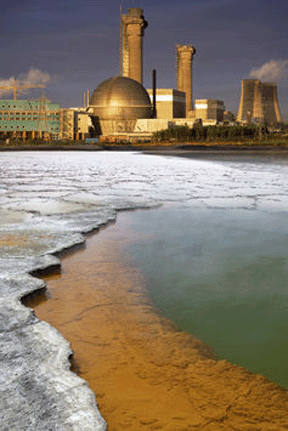 Britain is sending a huge nuclear waste consignment to America – why?, The Conversation, Gordon MacKerron, April 5, 2016 “…..In the absence of a deep-disposal plan, the UK has a more immediately pressing issue – what to do with Sellafield’s contaminated materials and waste from the UK’s near-70 years in the nuclear power and weapons business, much of which is housed in dilapidated facilities that are not fit for purpose. The Nuclear Decommissioning Authority (NDA) expects itwill cost some £68 billion to clean up Sellafield by stabilising and safely packaging the waste and building new stores. This will only be completed by around 2120.
This problem is at least now getting serious attention and resource – despite the climate of public austerity. Currently the country is spendingover £1.5 billion a year on the site, which is one of the most hazardous in Europe.
Sellafield stores a further 140 tonnes of waste plutonium that also stems from British and some overseas nuclear power. If used in bombs this amount could obliterate humanity several times over. The NDA is now focusing on what to do about this too, after years of political inattention. Yet the decision-making is laboured and the currently favoured solutionof using the plutonium as fuel for conventional reactors lacks credibility – no operator wants to use plutonium-based fuel because it is more difficult and expensive to manage than conventional fuel; and moving it around the country is a security risk.
So nuclear waste remains the Achilles heel of the nuclear industry, in the UK and elsewhere. While the financial problems behind the proposed new nuclear station Hinkley Point C attract most of the headlines, the waste problem hangs over the industry behind the scenes. Until we find a way forward that is scientifically and politically acceptable, it will continue to do so.https://theconversation.com/britain-is-sending-a-huge-nuclear-waste-consignment-to-america-why-57074
In a fully accountable marketplace, wind power is the leader
The best renewal would be the creation of a level playing field where all energy sources bear their own costs and all subsidies are removed.
In a fully accountable marketplace, challenger fuels like wind will do very well because they cost less when all costs are counted. The incumbent fuels fear that accountability—for good reason.
Market forces choose wind power http://thehill.com/blogs/congress-blog/energy-environment/274890-market-forces-choose-wind-power By Former Rep. Bob Inglis (R-S.C) 1 April 16 As a staunch believer in free markets, I don’t pick winners and losers- I let the market do that for me. And right now, the free market is telling me wind power is a big part of America’s energy future.
 There will always be people who hold on to old technology even while the evidence mounts around them that the new is better. Time and time again, history proves that those who refuse to be forward-looking get left behind. Whether it’s buggy whip manufacturers scoffing at the Model T Ford or someone hunting for a pay phone, some people just can’t adapt to the times.Here’s what happened for wind power in 2015. It was the year’s largest source of newly installed electric capacity, beating solar and natural gas by significant margins. Wind made up 35 percent of all new electricity that came online last year.
We see this progress in state after state: Iowa generated 31 percent of electricity with wind in 2015, while 12 states created at least 10 percent.
Or how about this: America continues to be the best in the world for wind energy production. We should be proud that the United States is number one on the list, beating China, Germany and every other country. Continue reading
Farmers turn to solar power for an economic “crop”
 Farmers Quit Corn; Grow Solar Power, Triple Pundit, by Leon Kaye on Friday, Apr 1st, 2016 One of the arguments used against solar power deployment is the amount of space needed for all of those solar panels. Although one study has shown that 0.6 percent of all land in the U.S. would be needed to completely electrify the country, the fight still goes on, even as solar and wind power technologies continue to increase in efficiency while decreasing in costs.
The fight is also occurring in counties across the U.S., as landowners and farmers seek new ways to generate revenue. Most of rural America has missed out on the economic revival that has conjoined technology and urbanization in many cities, so these counties are also seeking new ways to generate tax revenues. Farmers, of course, have also taken a hit due to the ongoing slump in global commodities.
The controversy over farmers having the right to sign contract with solar and wind power companies is now taking center stage in North Carolina.
The combination of the state’s Renewable Energy Portfolio Standard (REPS), which requires utilities operating in the state to generate some electricity from renewables, along with its booming tech culture, has turned the Tar Heel State into a solar powerhouse. In fact, the Solar Energy Industries Association (SEIA) says North Carolina ranks third in the nation amongst U.S. states in total solar capacity. Last year, the installation of over 1,100 megawatts of solar power placed North Carolina in second nationally in new solar generation.
And much of this power is generated in rural counties across the state, from the northern border with Virginia to along the South Carolina state line. According to Solar Strata, one company that is riding North Carolina’s solar boom, these new solar farms are appearing on farmland where crops such as tobacco, peanuts, cotton and corn can no longer earn enough money for farmers to keep their land. Other sites are appearing on fallow land that has not been farmed in years. Companies such as Solar Strata pay rent to these farmers, with contracts that often last as long as 20 years. As quoted by one farmer who was interviewed by Joe Ryan of Bloomberg, “It gives me a way to keep the farm . . . and pass it to my grandchildren.”…….http://www.triplepundit.com/2016/04/harvesting-solar-offers-farmers-stable-incomes/
Saving the family farm – through farming the wind
In many cases, lease payments from turbines are the difference between keeping a farm and selling off the land.
Jason Wilson of Calhan, CO, told me, “The wind farm allowed us to be able to keep our family farm. We had come to a point where it no longer made financial sense to keep the property even with its vast sentimental value. The wind farm balanced the financial viability with the sentimental value, allowing the family farm to be passed on to the next generation.”
wind farms bring other opportunities for employment. Wind turbine technician is the fastest growing occupation in the country and presents another employment avenue for people who enjoy rural lifestyles.
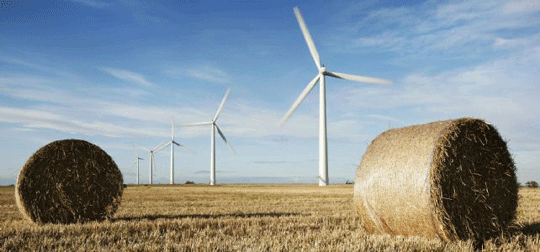
How does wind help the family farm stay in the family?, http://www.aweablog.org/how-does-wind-help-the-family-farm-stay-in-the-family/ Greg Alvarez, 22 Mar 16, During my tour through Colorado wind power last week, I often heard how wind helps keep the fabric of rural communities intact, allowing them to thrive.
Land lease payments make it possible for family famers and ranchers to keep their businesses running, expanded tax revenue provides resources to buy new emergency services equipment, and wind farms bring well-paying jobs to the community, meaning young people don’t have to leave home to find a good career.
Millions in financial resources for rural communities
New data released today allows us to quantify these sorts of anecdotes: landowners with wind turbines on their property now receive a total of $222 million in lease payments every year. Overall, landowners in six states currently receive over $10 million each year in lease payments, and 26 states have landowners that receive over $1 million.
This revenue acts as a drought resistant cash crop for family farmers and ranchers, providing a stable source of income they can count on when productivity declines because of drought or other causes. It also helps protect them from commodity price fluctuations, a frequent source of frustration in the agricultural world.
Real world impacts
In many cases, lease payments from turbines are the difference between keeping a farm and selling off the land.
Jason Wilson of Calhan, CO, told me, “The wind farm allowed us to be able to keep our family farm. We had come to a point where it no longer made financial sense to keep the property even with its vast sentimental value. The wind farm balanced the financial viability with the sentimental value, allowing the family farm to be passed on to the next generation.”
The Wilson farm sits on the plains at the base of Pike’s Peak. It’s a beautiful, serene place started by Jason’s great-grandfather in the 1940’s. Jason will be taking over the operation in the coming years, and his family explained they had no doubt this transition is only possible because of the lease payments they receive in exchange for hosting wind turbines.
Tax revenue helps communities thrive
Land lease payments aren’t the only source of revenue from wind farms; they also help expand the tax base. In many states, wind increases property tax funds by millions of dollars. For example, in Colorado increased property tax revenue from wind could near $19 million a year by 2030.
When our team visited a wind farm in the northeastern part of the state, in a town called Peetz, we heard that the local fire department had been using hand-me-down trucks in poor condition from other counties. Some locals joked that the old fire trucks couldn’t make it up a hill. However, after a wind farm was built, the resulting tax base expansion enabled the town to purchase brand new trucks.
Since around 70 percent of American wind farms are located in rural communities where median household incomes are lower than overall U.S. median incomes, lease payments and added tax revenue are doubly important. Overall, wind farm investment in such areas has exceeded $101 billion.
Wind farms mean local jobs
A final component in this economic picture concerns the jobs wind farms bring to a community.
In many rural areas, jobs are limited to agricultural professions. Young people that may want to pursue a different livelihood are often forced to move away because of a lack of options, even if they don’t want to leave their families and hometowns.
However, wind farms bring other opportunities for employment. Wind turbine technician is the fastest growing occupation in the country and presents another employment avenue for people who enjoy rural lifestyles.
Our team met with a wind farm operations and maintenance crew in Peetz, CO, and many of its members fell exactly into this category. Working as a wind turbine technician provided them with well-paying jobs while also allowing them to stay in the town they grew up in and loved, in close proximity to their extended families. The crew told us this option simply wasn’t available before the wind farm was built.
There are a multitude of different ways wind power brings resources and opportunities to local communities. Even better, the dollar amounts and job numbers will only increase as we continue to grow this American energy source, which will help rural towns thrive along the way.
1 This Month
Chernobyl: The Lost Tapes – A good documentary on Chernobyl on SBS available On Demand for the next 3 weeks– https://www.sbs.com.au/ondemand/tv-program/chernobyl-the-lost-tapes/2352741955560

of the week–London Campaign for Nuclear Disarmament

Tell the Ukrainian Government to Drop Prosecution of Peace Activist Yurii Sheliazhenko
To see nuclear-related stories in greater depth and intensity – go to https://nuclearinformation.wordpress.com
-
Archives
- April 2026 (124)
- March 2026 (251)
- February 2026 (268)
- January 2026 (308)
- December 2025 (358)
- November 2025 (359)
- October 2025 (376)
- September 2025 (257)
- August 2025 (319)
- July 2025 (230)
- June 2025 (348)
- May 2025 (261)
-
Categories
- 1
- 1 NUCLEAR ISSUES
- business and costs
- climate change
- culture and arts
- ENERGY
- environment
- health
- history
- indigenous issues
- Legal
- marketing of nuclear
- media
- opposition to nuclear
- PERSONAL STORIES
- politics
- politics international
- Religion and ethics
- safety
- secrets,lies and civil liberties
- spinbuster
- technology
- Uranium
- wastes
- weapons and war
- Women
- 2 WORLD
- ACTION
- AFRICA
- Atrocities
- AUSTRALIA
- Christina's notes
- Christina's themes
- culture and arts
- Events
- Fuk 2022
- Fuk 2023
- Fukushima 2017
- Fukushima 2018
- fukushima 2019
- Fukushima 2020
- Fukushima 2021
- general
- global warming
- Humour (God we need it)
- Nuclear
- RARE EARTHS
- Reference
- resources – print
- Resources -audiovicual
- Weekly Newsletter
- World
- World Nuclear
- YouTube
-
RSS
Entries RSS
Comments RSS
 nuclear-news