Cloud study shows that global warming danger even more extreme
 Global warming may be far worse than thought, cloud analysis suggests, Guardian, Oliver Milman, 8 Apr 16
Researchers find clouds contain more liquid – as opposed to ice – than was previously believed, threatening greater increase in temperatures. Climate change projections have vastly underestimated the role that clouds play, meaning future warming could be far worse than is currently projected, according to new research.
Researchers said that a doubling of carbon dioxide in the Earth’s atmosphere compared with pre-industrial times could result in a global temperature increase of up to 5.3C – far warmer than the 4.6C older models predict.
The analysis of satellite data, led by Yale University, found that clouds have much more liquid in them, rather than ice, than has been assumed until now. Clouds with ice crystals reflect more solar light than those with liquid in them, stopping it reaching and heating the Earth’s surface.
The underestimation of the current level of liquid droplets in clouds means that models showing future warming are misguided, says the paper, published in Science. It also found that fewer clouds will change to a heat-reflecting state in the future – due to CO2 increases – than previously thought, meaning that warming estimates will have to be raised.
Such higher levels of warming would make it much more difficult for countries to keep the global temperature rise to below 2C, as they agreed to do at the landmark Paris climate summit last year, to avoid dangerous extreme weather and negative effects on food security. The world has already warmed by 1C since the advent of heavy industry, driven by CO2 concentrations soaring by more than 40%……. http://www.theguardian.com/environment/2016/apr/07/clouds-climate-change-analysis-liquid-ice-global-warming?CMP=share_btn_tw
Pro Nuclear Environmentalists trivialise Chernobyl with lies about psychological trauma
Radiation harm deniers? Pro-nuclear environmentalists and the Chernobyl death toll, Ecologist, Dr Jim Green 7th April 2016“……..Psychological trauma
 Finally, PNEs [Pro Nuclear Environmentalists] also trivialise Chernobyl by peddling the furphy that the psychological trauma was greater than the biological effects from radiation exposure. There’s no dispute that, as the WHO states, the relocation of more than 350,000 people in the aftermath of the Chernobyl disaster “proved a deeply traumatic experience because of disruption to social networks and having no possibility to return to their homes.”
How to compare that psychological trauma to estimates of the death toll, such as the UN/WHO estimate of 9,000 cancer deaths in ex-Soviet states? Your guess is as good as mine.
Perhaps the biological damage and psychological trauma can be compared and ranked if we consider the second of the two defensible positions regarding the long-term death toll – UNSCEAR’s position that the death toll is uncertain. Does the psychological trauma outweigh the 50 or so known deaths, around 6,000 non-fatal thyroid cancers (withanother 16,000 to come), and an uncertain long-term death toll?
The argument only begins to make sense if you accept the third of the two defensible positions regarding the death toll – the view that there were no deaths other than emergency workers and a small number of deaths from thyroid cancers. Thus Mark Lynasasserts that “as Chernobyl showed, fear of radiation is a far greater risk than radiation itself in the low doses experienced by the affected populations” and he goes on to blame anti-nuclear campaigners for contributing to the fear.
But the trauma isn’t simply a result of a fear of radiation – it arises from a myriad of factors, particularly for the 350,000 displaced people. Nor is the fear of radiation necessarily misplaced given that the mainstream scientific view is that there is no threshold below which radiation exposure is risk-free.
Most importantly, why on earth would anyone want to rank the biological damage and the psychological trauma from the Chernobyl disaster? Chernobyl resulted in both biological damage and psychological trauma, in spades.
Psychological insult has been added to biological injury. One doesn’t negate the other.
Dr Jim Green is the national nuclear campaigner with Friends of the Earth Australia and editor of the Nuclear Monitor newsletter, where a version of this article was originally published. Nuclear Monitor, published 20 times a year, has been publishing deeply researched, often critical articles on all aspects of the nuclear cycle since 1978. A must-read for all those who work on this issue! http://www.theecologist.org/News/news_analysis/2987515/radiation_harm_deniers_pronuclear_environmentalists_and_the_chernobyl_death_toll.html
Russi, france, USA, all vying to market nuclear reactors to China
Rosatom hopes to plug into nuclear industry By Lyu Chang (China Daily) 2016-04-08 Rosatom, the Russian State Atomic Energy Corp, is seeking to hit big in China’s nuclear industry with the opening of a regional center headquartered in Beijing on Thursday,according to a senior official of the company.
“We are looking to expand our business in China, a market with huge potential for growth inthe nuclear industry, and the activities of regional center are designed to help strengthen ourcooperation with the country,” said Alexander Merten, president of Rosatom InternationalNetwork……..
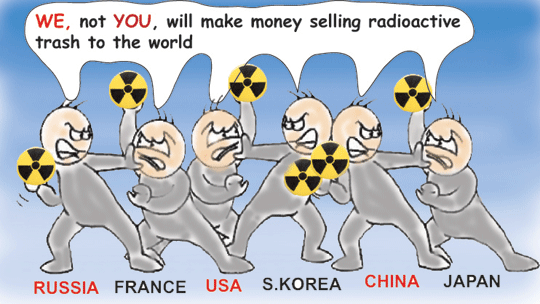
China’s nuclear industry is on the fast track to become one of the world’s largest, with plans tohave completed 58 gigawatts of installed capacity with another 30 gW under construction bythe end of 2020.
But Rosatom will face fierce competition from companies such as the US WestinghouseElectric and France’s nuclear giant Areva with rival third-generation nuclear designs such asAP1000 and EPR1000, both of which aim to expand its presence in the Chinese market…….https://mail.google.com/mail/u/0/#inbox?compose=153f5049f5598818
France suggests UK’s Hinkley Point nuclear project could still be postponed

 Hinkley Point nuclear project could still be postponed http://www.theweek.co.uk/60778/hinkley-point-nuclear-project-could-still-be-postponed
Delaying £18bn development is ‘up for discussion’, says France’s Segolene Royal Plans to build the world’s most expensive nuclear power station at Hinkley Point, near Somerset, could hit further delays, a French government official has hinted. Speaking during a radio interview this week, ecology minister Segolene Royal was asked whether the £18bn project, which is two-thirds funded by French state-backed energy giant EDF, would be postponed. She responded by stating simply that it is “still under discussion”, says The Guardian.
“There’s an agreement between France and Britain so things should go ahead. But the trade unions are right to ask for the stakes to be re-examined,” Royal said.
In particular, there should be “further proof” that the venture would not affect investment in renewable energy, she added.
Last week, the Financial Times reported that a group of senior engineers at EDF had circulated a white paper among executives calling for a delay of at least two years to overcome deficiencies in design and the “very low” competency of fellow state-owned reactor supplier, Areva. Board member and employee director Christian Taxil has also publicly called for the plans to be postponed.
Supporters for the deal include the British government, which has staked its reputation on Hinkley Point as the core part of its carbon-light energy strategy for future decades, and French economy minister Emmanuel Macron, who has said it will almost certainly get approval at an EDF investor meeting next month.
The incentives for the company are long-term and come in the form of an energy price guarantee that is almost three times current wholesale prices. A new agreement also offers £20bn protection against a future UK government pulling the plug.
The FT reports that 100 EDF engineers also responded to their colleagues concerns by issuing an open letter stating that the company can “build and deliver the two Hinkley Point reactors on time”.
Coal and nuclear – the ugliest twins of global warming and environmental damage theme for April 2016

The nuclear industry proudly touts itself as the solution to climate change. But nothing could be further from the truth. The full nuclear fuel chain emits large amounts of Co2 and other greenhouse emissions. In the coming decades, indirect carbon dioxide emissions from nuclear power plants will increase considerably, because high-grade resources of uranium are exhausted and much more fossil energy will have to be used to mine uranium. In view of this trend, nuclear power plants will no longer have an emissions advantage over modern gas-fired power plants, let alone in comparison to the advantages offered by increased energy efficiency or greater use of renewable energies.
Even when they pretend that nuclear power would cut emissions, the industry itself is well aware that the thousands of reactors needed to have any real impact could not be up and running for many decades – way too late for combatting the global warming process.
That situation suits the fossil fuel industries perfectly. Coal can keep on being mined – “in the meantime”, and nuclear power can take over many decades later, when the coal runs out.
Fossil fuel and nuclear industries are large centralised operations. The much touted Small Modular Nuclear Reactors are supposed to be “decentralised”, but in fact are produced in, and totally dependent on, the same centralised grandiose way as the “conventional” big reactors.
The nuclear industry is very comfortable indeed, with the continuance of dirty fossil fuel industries, aiming for a smooth transition later on, when it can get its dirty industry up and running – meanwhile posing as the world’s saviour from climate chnage.
Fishermen suing Japanese govt over radiation from 1950s atomic tests
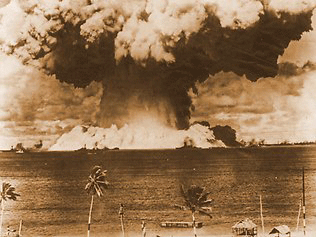 Japanese fishermen to sue over fallout from Bikini Atoll nuclear tests in 1950s Julian Ryall 8 APRIL 2016 http://www.telegraph.co.uk/news/2016/04/08/japanese-fishermen-to-sue-over-fallout-from-bikini-atoll-nuclear/
Agroup of fishermen is to sue the Japanese government for failing to release records detailing their exposure to radiation from US nuclear tests in the Pacific in the 1950s.
Some 20 people, including relatives of fishermen who have since died, are to file their case with the Kochi District Court in May, each demanding Y2 million (£13,088) in compensation.
The men have been particularly angered by the actions of the Ministry of Health, Labour and Welfare, which in September 2014 admitted it had data on the radioactive fallout that around 500 fishing vessels and their crews were exposed to in the Castle Bravo nuclear tests.
The ministry had previously claimed the documents no longer existed, the Asahi newspaper reported.
The first of the Castle Bravo tests, on March 1, 1954, was three times more powerful than scientists had initially predicted, producing a fireball around 4.5 miles across within a second.
The mushroom cloud reached a height of nearly 9 miles in around one minute and eventually climbed to an altitude of 25 miles. The blast was estimated to be 1,000 times more powerful than the atomic bombs that devastated Hiroshima and Nagasaki. As well as producing a larger blast, strong winds took the fallout far greater distances than the scientists had expected.
The Daigo Fukuryu Maru was approximately 800 miles east of Bikini Atoll, one of the Marshall Islands in the central Pacific, and more than 80 miles outside the US government’s 92,000 square mile exclusion zone around the island, when the first bomb was detonated.
Fallout began to coat the tuna fishing boat – and its 23 crew – about two hours later. Unaware of the danger, they scooped the radioactive ash off the deck with their bare hands, while one of the fishermen, Matashichi Oishi, said he licked the dust, reporting that it was gritty but had no taste.
By the time the ship docked in Japan two weeks later, the men were suffering from nausea, headaches, burns, pain in their eyes and bleeding from their gums and were diagnosed with acute radiation poisoning.
In September, 40-year-old Aikichi Kuboyama died as a result of his exposure. In 1955, the US paid Japan $2 million in “consolation money” and concluded the issue at the political level. The Japanese government paid each of the crew of the Lucky Dragon Y2 million (£13,088 at present day exchange rates), but provided nothing to fishermen aboard other ships.
The health ministry in Tokyo maintains that crew members of 10 ships were exposed to radiation, but it insists that their doses “did not reach levels that could damage their health”.
Tests conducted on enamel on the teeth of the fishermen by a professor at Okayama University of Science revealed radiation measuring up to 414 millisieverts, equivalent to people standing about 1 mile from the hypocenter of the atomic bomb that was dropped on Hiroshima in 1945.
Under Japanese law, anyone who was within 2.2 miles of the Hiroshima or Nagasaki atomic bomb detonation points is eligible for medical allowances for a range of illnesses, including cancer.
Estimating the Chernobyl death toll from radiation – rubbishy opinions from “Pro Nuclear Environmentalists”
 Radiation harm deniers? Pro-nuclear environmentalists and the Chernobyl death toll Jim Green, The Ecologist, 7 April 2016, With few if any exceptions, self-styled pro-nuclear environmentalists peddle flapdoodle and tommyrot regarding the Chernobyl death toll.
Before considering their misinformation, a brief summary of credible positions and scientific studies regarding the Chernobyl cancer death toll (for detail see this earlier article in The Ecologist).
Epidemiological studies are of course important but they’re of limited use in estimating the overall Chernobyl death toll. The effects of Chernobyl, however large or small, are largely lost in the statistical noise of widespread cancer incidence and mortality.
The most up-to-date scientific review is the TORCH-2016 report written by radiation biologist Dr Ian Fairlie. Dr Fairlie sifts through a vast number of scientific papers and points to studies indicative of Chernobyl impacts: an increased incidence of radiogenic thyroid cancers in Austria; an increased incidence of leukemia among sub-populations in ex-Soviet states (and possibly other countries ‒ more research needs to be done); increases in solid cancers, leukemia and thyroid cancer among clean-up workers; increased rates of cardiovascular disease and stroke that might be connected to Chernobyl (more research needs to be done); a large study revealing statistically significant increases in nervous system birth defects in highly contaminated areas in Russia, similar to the elevated rates observed in contaminated areas in Ukraine; and more.
Without for a moment dismissing the importance of the epidemiological record, let alone the importance of further research, suffice it here to note that there is no way that one could even begin to estimate the total Chernobyl death toll from the existing body of studies.
Estimates of collective radiation exposure are available ‒ for example the International Atomic Energy Agency (IAEA) estimates a total collective dose of 600,000 person-Sieverts over 50 years from Chernobyl fallout. And the collective radiation dose can be used to estimate the death toll using the Linear No Threshold (LNT) model.
If we use the IAEA’s collective radiation dose estimate, and a risk estimate derived from LNT (0.1 cancer deaths per person-Sievert), we get an estimate of 60,000 cancer deaths. Sometimes a risk estimate of 0.05 is used to account for the possibility of decreased risks at low doses and/or low dose rates ‒ in other words, 0.05 is the risk estimate when applying a ‘dose and dose rate effectiveness factor’ or DDREF of two. That gives an estimate of 30,000 deaths.
Any number of studies (including studies published in peer-reviewed scientific literature) use LNT ‒ or LNT with a DDREF ‒ to estimate the Chernobyl death toll. These studies produce estimates ranging from 9,000 cancer deaths (in the most contaminated parts of the former Soviet Union) to 93,000 cancer deaths (across Europe).
Those are the credible estimates of the cancer death toll from Chernobyl. None of them are conclusive ‒ far from it ‒ but that’s the nature of the problem we’re dealing with. Moreover, LNT may underestimate risks. The 2006 report of the US National Academy of Sciences’ Committee on the Biological Effects of Ionising Radiation (BEIR) states: “The committee recognizes that its risk estimates become more uncertain when applied to very low doses. Departures from a linear model at low doses, however, could either increase or decrease the risk per unit dose.”
So the true Chernobyl cancer death toll could be lower or higher than the LNT-derived estimate of 60,000 deaths ‒ a point that needs emphasis and constant repetition since the nuclear industry and its supporters frequently conflate an uncertain long-term death toll with a long-term death toll of zero.
Another defensible position is that the long-term Chernobyl cancer death toll is unknown and unknowable because of the uncertainties associated with the science. The UN Scientific Committee on the Effects of Atomic Radiation (UNSCEAR) states (p.64):
“The Committee has decided not to use models to project absolute numbers of effects in populations exposed to low radiation doses from the Chernobyl accident, because of unacceptable uncertainties in the predictions. It should be stressed that the approach outlined in no way contradicts the application of the LNT model for the purposes of radiation protection, where a cautious approach is conventionally and consciously applied.”
Pro-nuclear environmentalists
So there are two defensible positions regarding the Chernobyl cancer death toll ‒ estimates based on collective dose estimates (with or without a DDREF or a margin of error in either direction), and UNSCEAR’s position that the death toll is uncertain.
A third position ‒ unqualified claims that the Chernobyl death toll was just 50 or so, comprising some emergency responders and a small percentage of those who later suffered from thyroid cancer ‒ should be rejected as dishonest or uninformed spin from the nuclear industry and some of its scientifically-illiterate supporters……..www.theecologist.org/News/news_analysis/2987515/radiation_harm_deniers_pronuclear_environmentalists_and_the_chernobyl_death_toll.html
More news about the Panama corruption papers
Panama Papers Q&A: What is the scandal about?
April 6, 2016. A huge leak of documents has lifted the lid on how the rich and powerful use tax havens to hide their wealth. The files were leaked from one of the world’s most secretive companies, a Panamanian law firm called Mossack Fonseca.
http://www.bbc.com/news/world-35954224
Panama Papers: Here’s who has been caught in the fallout of the Mossack Fonseca leak
Updated April 6, 2016. The unprecedented leak of more than 11 million documents from Panamanian law firm Mossack Fonseca has revealed some of the hidden financial dealings of the world’s rich and powerful.
Here’s a look at some of the more high-profile people feeling the heat after the scandal broke.
http://www.abc.net.au/news/2016-04-05/who-has-been-caught-in-the-panama-papers-fallout/7299666
(And see item ‘Panama Papers: Australian pair linked to companies striking mining deals with North Korea’ listed above in the Nuclear/Uranium section of this digest.)
Panama Papers: Mossack Fonseca founder protests innocence, says company was ‘hacked’
The Panamanian lawyer at the centre of a data leak scandal that has embarrassed a clutch of world leaders says his firm is a victim of a hack from outside the company, and has filed a complaint with state prosecutors.
Obama calls for international tax reform amid Panama Papers revelations
April 6, 2016. Unscripted remarks come as Justice Department confirms it is examining US links to leaked documents from Panama-based tax firm Mossack Fonseca
The Panama Papers couldn’t come at a worse time for the Coalition
The avoidance of tax by corporate executives and the very rich is the last thing the Turnbull Government needs as it prepares for a federal budget that is likely to be anchored by a cut in the company tax rate, writes Peter Lewis.
http://www.abc.net.au/news/2016-04-06/lewis-liberals-and-the-panama-papers/7302494
Panama shell games
Tuesday 5 April 2016. Over 11 million tax and financial records have been leaked from a Panamanian based law firm. What’s in the records reveals how global elites evade taxes and use shell companies to launder money.
Politicians and financial regulators are scrambling to provide answers on how to slow down the criminal exploitation of national tax systems.
Guest: Jason Sharman, Professor and Director, Centre for Governance and Public Policy at Griffith University.
http://www.abc.net.au/radionational/programs/latenightlive/panama-shell-games/7300660
The Guardian view on the Panama Papers: secret riches and public rage
April 5, 2016. Resentment of a financial elite has been simmering for years. Now the biggest-ever leak moves the focus to politicians. Tackling tax avoidance is the only way to restore trust
France to put Panama back on list of tax havens: finance minister
April 5, 2016. Paris (AFP) – France will put Panama back on its list of countries that do not cooperate in efforts to track down tax dodgers, Finance Minister Michel Sapin said Tuesday in the wake of the Panama Papers revelations.
“France has decided to put Panama back on the list of uncooperative countries, with all the consequences that will have for those who have transactions” with the central American state, Sapin told parliament.
Iceland’s leader resigns, first casualty of Panama Papers
Apr 5, 2016. Iceland’s Prime Minister Sigmundur David Gunnlaugsson resigned on Tuesday, becoming the first casualty of leaked documents from a Panamanian law firm which have shone a spotlight on the offshore wealth of politicians and public figures worldwide.
http://www.reuters.com/article/us-panama-tax-idUSKCN0X10C2
(Note links provided to related Reuters coverage.)
Panama papers: China censors online discussion
4 April 2016. China appears to be censoring social media posts on the Panama Papers document leak which has named several members of China’s elite, including President Xi Jinping’s brother-in-law.
http://www.bbc.com/news/world-asia-china-35957235
(Note links provided to related BBC coverage.)
Fennovoima not permitted to store its radioactive trash at Onkalo disposal site

 Fennovoima still looking for final nuclear waste disposal site http://yle.fi/uutiset/fennovoima_still_looking_for_final_nuclear_waste_disposal_site/8795028. 7 Apr 16
The nuclear waste management company Posiva has remained steadfast in its refusal to allow waste from the planned Fennovoima nuclear power plant to be stored in its Onkalo disposal site in south-western Finland. The company had indicated that it would not accommodate Fennovoima’s nuclear waste even before the Pyhäjoki project got off the ground.
Nuclear waste management company Posiva said that it has not changed its mind about allowing spent fuel from the Fennovoima nuclear power plant in Pyhäjoki to be stored in its Onkalo waste facility being built further south on the west coast.
Posiva has said that the subterranean cave is reserved for use only by joint owners Teollisuuden Voima, TVO, which operates a series of reactors at the Olkiluoto nuclear power plant in Eurajoki, western Finland, and energy giant Fortum, which operates its own nuclear power facilities in Loviisa, southern Finland. The latter also has a six-percent stake in the controversial Fennovoima project.
Posiva chief executive Janne Mokka said that the spent nuclear fuel depository and its surrounding areas have been reserved only for waste generated by TVO and Fortum.
Fennovoima has expressed the hope that possible waste from its Pyhäjoki nuclear facility could be accommodated in the Posiva cave.
However Posiva CEO Mokka said that the firm had so far mainly discussed how it could pass on the expertise earned from the Posiva deep geological depository to the Pyhäjoki project.
Disposal plan to be filed with ministry officials
Posiva began working on the depository in 2004, but only received a final green light for the project in November last year. It is to begin operations sometime in the early 2020s.
Fennovoima is currently planning a final waste disposal plan that is due to be lodged with the Ministry of Employment and the Economy in a few months.
However if the company cannot reach an agreement with Posiva, it will have to present ministry officials with an environmental impact assessment as part of alternative disposal plan.
Steadfast refusal from Posiva
Fennovoima has remained tight-lipped about possible cooperation with Posiva, but would only say that the matter is being discussed. A Fennovoima spokesperson said that the company is currently preparing a report into a waste disposal facility with the help of internal consultants.
Back in 2012, Posiva had already indicated that it would not accept waste from any other nuclear facility apart from that produced by its owners, TVO and Fortum. The Eurajoki subterranean disposal site is the world’s first permanent deep storage facility.
Spent fuel from the Fortum and TVO plants will have to be stored for 40-60 years before it cools enough to be stored underground. As the oldest Finnish reactors have been in operation since the late 1970s, some of their waste will soon be old enough for encapsulation.
40-year, €3.3bn project
The facility, which has been planned since 1983, is intended to keep the waste safe for some 100,000 years. The companies have estimated the price tag for the entire project at 3.3 billion euros.
Posiva’s initial refusal to host the waste from the Fennovoima project came just as Finland’s Supreme Administrative Court overturned appeals to block the project’s progress.
The motions were filed by one private individual and a number of environmental protection organisations seeking to block construction at two sites under consideration, one at Simo and the other at Pyhäjoki, both in the northwest.
The project has otherwise been beset by setbacks and controversy, but infrastructure work began in September last year.
Under Finnish law, all waste from nuclear facilities must be permanently stored in Finland.
Future’s children will blame us for those wrong energy decisions
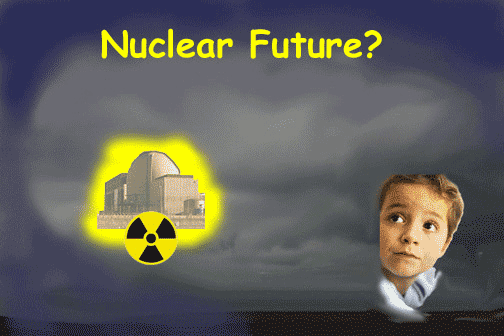
We are making the wrong energy choices for future generations, Guardian, Andrew Simms, 8 Apr 16
Our children’s children will not thank us for investing so heavily in technologies like nuclear at the expense of safer, low-carbon options “……It’s easy to see the superficial political attraction of projects like Hinkley C – they look like big, simple solutions to a problem. They’re technologically shiny, highly visible, seemingly easy to keep an eye on and have large, influential lobbies behind them.
With so much seemingly in its favour, it says a lot about the state of the nuclear industry that Hinkley C is heading south faster than a great snipe in migration. In a new report for theIntergenerational Foundation, co-published with the New Weather Institute, I found the economic case alone for new nuclear to be as leaky as a plastic bag of plutonium.
Discounting the untold extra billions, typically hidden and underwritten by the public, required by nuclear reactors to pay for complex security, disposal of radioactive waste, insurance (and, perversely, liabilities from under-insurance), over the course of its initial 35-year contract period, Britain could save at least £30-£40bn on electricity generated by solar and onshore wind with their costs steadily falling.
The costs for nuclear generation, meanwhile, have been doing exactly the opposite. From a government estimate of £5.6bn in 2008, by the time EU officials signed off the deal to build Hinkley C just six years later, the expected construction cost had risen to over £24bn. As obstacles, the burden of the financial architecture for the deal is only beaten by the problems with the technology itself which was meant to be state-of-the-art and a flagship for its operator EDF.
A range of renewable energy options are readily available that prove to be cheaper, safer, more secure, quicker to deliver and, overall, better value for Britain. Yet, instead of grasping this option, the government seems to have gone out of its way to hamper renewables by slashing support and creating a capricious, unstable policy environment…….
If we really are to have policies for the long term and with future generations in mind, we need to ensure energy choices are made to protect and promote their interests. A rational, evidence-based, intergenerational energy system won’t just emerge from political rhetoric, it needs to be designed and based on clear principles.
Such principles would include having an energy system most likely to preserve a climate convivial for future generations; a system with the least toxic environmental burden and which maximises ancillary economic benefits such as local jobs, manufacturing and services.
As an opening bid, here’s a set of intergenerational design criteria to aid intelligent, future energy planning. They are:
- Employment and broader economic return on investment – how much value to the broader economy does investment in different technologies bring; in other words, what is its economic multiplier effect?
- Environmental return on investment – how efficiently does an investment lower carbon emissions and minimise other toxic pollutants and contribute to a healthy environment?
- Energy return on investment – how much energy is generated for the amount of money invested to produce that energy?
- Security return on investment – how much does the technology contribute to domestic energy security and what other security risks does it carry?
- Transition return on investment – how does it contribute, comparatively to the speed and scale of deployment of low carbon energy generating capacity?
- Conviviality return on investment – the degree to which a technology can be responsive to and supportive of a society’s or a community’s own vision and pathway for its development, and that of future generations.
Paul Massara, is the chief executive of the energy supplier, RWE npower. Reflecting on the prospect of Hinkley C, he commented: “We will look back and think that nuclear was a expensive mistake. It’s one of those deals where my children, and my children’s children, are going to be thinking ‘was that a good deal’?”
It’s easy to imagine what conclusion they will come to, and the bewilderment they will feel at why better options were not more aggressively pursued. http://www.theguardian.com/environment/2016/apr/07/we-are-making-the-wrong-energy-choices-for-future-generations
Threat of Islamic State and al Qaeda getting nuclear weapons is real
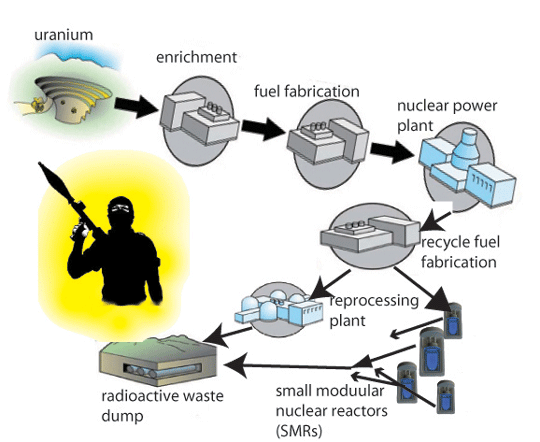 Islamic State, al Qaeda and nuclear madness, Reuters By John Lloyd April 8, 2016 “……..Earlier this month, President Barack Obama invoked the need for world leaders to cope with “the danger of a terrorist group obtaining and using a nuclear weapon.” In his speech at the Nuclear Security Summit, he had much success to report: earlier commitments to secure or eliminate nuclear material had been followed by most of the world’s states.
A “but” was coming, and it was large: both al Qaeda and Islamic State actively seek nuclear weaponry, Obama said, and “there is no doubt that if these madmen ever got their hands on a nuclear bomb or nuclear material they most certainly would use it to kill as many innocent people as possible.” That seems likely to be true: both groups have said so, and a member of Islamic State — which has already used chemical weapons — obtained surveillance footage of a manager at a nuclear facility in Belgium, with a view, officials say, of possibly developing a “dirty” bomb (a conventional explosive device packed with radioactive material).
The head of U.S. National Intelligence, James Clapper, told a Senate committee last month that “the threat of WMD is real. Biological and chemical materials and technologies, almost always dual use, move easily in the globalized economy, as do personnel with the scientific expertise to design and use them.” The veteran commentator on terrorism, Bruce Hoffman, wrote in March that Islamic State is moving towards the “final Definitive Victory State… when the caliphate ultimately triumphs over the rest of the world.” For that, it will need nuclear weapons.
Hoffman also believes that the two groups most hungry for global domination — Islamic State and al Qaeda — may merge, in spite of their leaders’ mutual hostility. This possibility, he said, quoting an unnamed senior U.S. official, “would be an absolute and unprecedented disaster for (the United States) and our allies.”
More cheer? Russia didn’t attend the nuclear summit. Moscow had said last November that it thought the United States was trying to “take the role of the main and ‘privileged’ player in this sphere” — so it didn’t show. Russia, Obama said to reporters, had made little, if any, progress on the Security Summit’s goals — because Putin has been pursuing a vision of of “emphasizing military might.”
The United States and Russia are estimated to have between them 95 percent of the world’s 15,000 nuclear warheads: the United States 6,970, Russia, 7300. The United States has been slightly reducing its stock; Russia has not. Obama, in a speech in Prague near the beginning of his first presidency seven years ago, called for a nuclear-free world — as Ronald Reagan had done before him.
By contrast, Putin has threatened to use nuclear weapons on Islamic State, on Turkey and as a response to Western protests when Russian forces seized Crimea. In the summer of 2014, in a more veiled threat, he told a youth group that “Let me remind you that Russia is one of the world’s biggest nuclear powers. These are not just words — this is the reality. What’s more, we are strengthening our nuclear deterrent capability and developing our armed forces.”
The United States, like Russia, modernizes and upgrades its nuclear forces continually, and islikely to sell Patriot interceptor missiles to Poland — much to Russia’s fury. But somehow, the widening gulf between the nations has to be bridged, or we face the largest problem of all: a widely-dispersed ability to annihilate much of the world.
The news should not just be “depressing,” but rather a prompt for greater engagement and understanding of its complexity. And with understanding comes the need to support those politicians, officials and organizations seeking compromise and solution. If the 20th was the American century, the 21st must be the world’s, in which the facts of multiple threats prompt a mutual response. Without it, the cocoons we seek to hide from bad news crumble more by the year. http://blogs.reuters.com/great-debate/2016/04/08/islamic-state-al-qaeda-and-nuclear-madness/
USA facing up to the dilemma of mounting nuclear waste
“Don’t fall for an idea that this is unsafe to keep it where it is and now we have to move it. I would say it is unsafe, but it’s not going to be safer somewhere else.”
Meanwhile some attendees questioned whether a true consent-based siting process is possible and argued that no fully-informed communities would consent to hosting nuclear waste.
“It will be very hard to find communities that will be willing,” said Wasserman-Nieto. “We really needto stop the creation of this waste.
“I begged and pleaded with the Blue Ribbon commission, do not target Native American tribes again for these dumps,” . “This is an environmental injustice, this is radioactive racism.”
Energy Department Seeks Public Process for Nuclear Waste Storage, TruthOut, Friday, 08 April 2016 By Kari Lydersen, Midwest Energy News | Report Half a century ago when the town of Zion, Illinois agreed to site a nuclear power plant on its Lake Michigan shoreline, civic leaders felt they were helping to secure a clean and dependable energy source through the turn of the century.
They never intended to become a nuclear waste dump.
But since the Zion plant closed in 1998, waste has been stored on-site as it is at working and defunct reactors across the country. And since neither a permanent geologic repository nor proposed interim storage sites for nuclear waste have been created, the waste may remain in Zion for quite some time……..
city leaders decided it was worth it, in part because, “There was an understanding that when the operating license of the plant expired, these 400 acres would be returned to pristine condition,” Hill said. “That was the deal — it was an unwritten deal but that was the deal the people of Zion understood. There was never an understanding that once the plant closed the people of Zion would play host to a radioactive dump.”
The Chicago hearing is part of a new Department of Energy effort aimed at avoiding situations like the debacle surrounding efforts to build a permanent repository at Yucca Mountain and other controversies regarding the storage of nuclear waste. The process will include public comments in the Federal Register, public meetings around the country, webinars and small group meetings, with a summary of the findings to be published in late 2016.
The process builds on a Blue Ribbon Commission launched in 2010 to study the waste issue…….
A Voluminous Problem
There are about 70,000 metric tons of spent fuel from power generation stored at operating and defunct commercial reactors and a small number of sites managed by the Department of Energy nationwide. Waste is usually stored in pools for about five years, and then moved to dry casks.
Illinois has the most reactors and waste sites of any state, with the decommissioning Zion reactor and six operating plants. About 2,200 metric tons of waste are being produced each year, and currently operating reactors will over their lifetime bring the total inventory to about 140,000 metric tons of spent fuel, according to the government.
In remarks delivered by video to the Chicago event, Energy Secretary Ernest Moniz stressed that no specific sites for permanent or interim storage are currently being considered; rather the department is seeking input on how to construct a consent-based process to choose sites so waste can be removed from individual reactors…….
Some proposed creating a new entity or agency to carry out the process, since there is a “long history with DOE.”
Some compared the issue to genetically modified foods, worrying that “what people don’t know can hurt them,” as one group put it. They expressed concerns about trains, trucks and barges carrying nuclear waste through communities to storage sites. Some questioned whether new storage sites are necessary, and proposed turning reactor sites where waste is currently stored into interim sites.
“If it’s a safety issue, then why has it been safe to keep the nuclear waste there for as long as we have?” asked Gail Snyder, board president of the anti-nuclear group Nuclear Energy Information Service. “Don’t fall for an idea that this is unsafe to keep it where it is and now we have to move it. I would say it is unsafe, but it’s not going to be safer somewhere else.”
Speaking on a panel before the group discussions, environmental activist Kim Wasserman-Nieto stressed the need for a meaningful consent-based process, not a token one with a predetermined outcome……
John Kotek, DOE acting assistant secretary for the Office of Nuclear Energy, said that the department plans to make grants to local governments, states, communities and tribal nations to participate in the consent-based siting process. He said the department has requested $25 million from Congress for such grants.
Meanwhile some attendees questioned whether a true consent-based siting process is possible and argued that no fully-informed communities would consent to hosting nuclear waste.
“It will be very hard to find communities that will be willing,” said Wasserman-Nieto. “We really need to stop the creation of this waste to avoid having these conversations every couple years.”
During the public comment period, Kevin Kamps, radioactive waste watchdog of the anti-nuclear organization Beyond Nuclear, argued that Native American leaders have been offered financial incentives in an effort to coerce them to accept radioactive waste.
“I begged and pleaded with the Blue Ribbon commission, do not target Native American tribes again for these dumps,” said Kamps. “This is an environmental injustice, this is radioactive racism.” http://www.truth-out.org/news/item/35562-energy-department-seeks-public-process-for-nuclear-waste-storage
Bulletin of the Atomic Scientists analyses outcome of The Nuclear Security Summit
On the progress side:
- Enough states ratified the 2005 amendment to the physical protection convention to finally bring the amendment into force. That will provide a somewhat stronger legal foundation for nuclear security efforts – and will trigger a review conference that some hope could be a key new element of the nuclear security architecture.
- China joined in the strengthening nuclear security implementation initiative, thereby committing to achieve the objectives of International Atomic Energy Agency (IAEA) nuclear security recommendations and accept peer reviews of its nuclear security arrangements. Just after the summit ended India announced that it too is joining.
- Japan and the United States removed hundreds of kilograms of weapon-grade plutonium and highly enriched uranium (HEU) from the Fast Critical Assembly in Japan, as promised at the last summit. Japan also committed to eliminate the HEU at the critical assembly at Kyoto University.
- States agreed to 18 new group commitments or “gift baskets,” on topics ranging from protecting against insider threats to replacing radiological sources with less dangerous technologies. Probably the most important of these was the commitment to create a “Nuclear Security Contact Group–a set of senior officials who will keep meeting on the margins of the IAEA General Conference, to keep at least moderately high-level attention focused on nuclear security.
On the missed opportunity side:
- We still have no progress toward building a global commitment that all nuclear weapons and weapons-usable nuclear materials, wherever they may be, need to be secured against the full spectrum of plausible adversary threats. (See discussion inManaging the Atom’s new report.)
- The communiqué, as expected, offers no firm new commitments (though it does more firmly establish the goal of continuous improvement in nuclear security). More disappointing, the “action plans” for five international institutions offer few steps beyond what those institutions are already doing–certainly less than is needed to fill the gap left by the end of the summit process.
- Many of the gift baskets have few specifics or deadlines; how much they will actually do to accelerate progress toward their objectives remains unknown.
- Many key countries – including Pakistan, Russia, and others – are still not participating in the initiative on strengthening nuclear security implementation that China and India joined.
The question now is: where do we go from here? ………. http://thebulletin.org/nuclear-security-summit-wins-losses-and-draws9310
European electricity association bemoans lack of competitiveness of nuclear energy
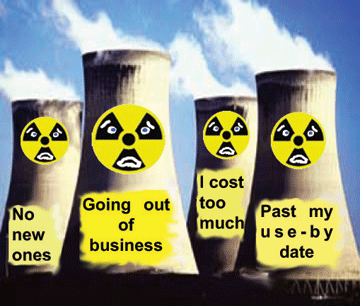 Organizations call for positive EU leadership on nuclear, World Nuclear News, 08 April 2016 European electricity association Eurelectric has welcomed the European Commission’s recently published Nuclear Illustrative Program (PINC), but expressed regrets at its failure to address the issue of premature reactor closures due to market conditions. European nuclear industry association Foratom also called on the PINC to address the impact of market conditions on nuclear investments……..
The EC is mandated by the Euratom Treaty to issue periodically a new PINC report to indicate targets for nuclear production and the investments that will be needed to attain them. The latest report found that investment of between €350 billion ($399 billion) and €450 billion will be required over the next 35 years to maintain EU nuclear generating capacity at between 95 and 105 GWe. It is the first PINC to be published since the 2011 accident at the Fukushima Daiichi plant in Japan and includes investments related to post-Fukushima upgrades and the safe operation of existing nuclear facilities as well as new capacity…….
Eurelectric’s policy paper also called for an “improved regulatory framework” to help facilitate investment, and said Europe must find market-based solutions to reduce the investment risks associated with capital-intensive low-carbon energy projects including nuclear……… http://www.world-nuclear-news.org/NP-Organizations-call-for-positive-EU-leadership-on-nuclear-0804167.html
Global nuclear security rules made more strict
Tighter global nuclear security rules to take effect in May http://www.reuters.com/article/us-nuclear-security-idUSKCN0X51NI More than 100 countries will have to meet higher standards on the protection of nuclear facilities and materials from next month, the U.N. nuclear watchdog said on Friday.
Nicaragua on Friday formally completed ratification of an amendment to the Convention on the Physical Protection of Nuclear Material, meaning enough states have ratified it for it to go into force, the International Atomic Energy Agency said.
“(The amendment) will help reduce the risk of a terrorist attack involving nuclear material, which could have catastrophic consequences,” IAEA chief Yukiya Amano said in a statement.
The convention was adopted by 152 countries a decade ago, and had to be ratified by two thirds of them to go into effect.
The amendment, intended to guarding against threats such as smuggling and sabotage, makes it legally binding for countries to protect nuclear facilities as well as the domestic use, storage and transportation of nuclear material.
It also provides for broader cooperation among countries on finding and recovering stolen or smuggled nuclear material.
The convention and amendment are only binding on countries that have ratified them, an IAEA spokesman said. Amano said last month more work was needed to make the requirement universal.
The United States, Russia, India, Pakistan and former Soviet republics including Kazakhstan, Ukraine and Uzbekistan are among the countries that have ratified the amendment, according to the IAEA. Those that have not include Iran and North Korea.
(Reporting by Francois Murphy; editing by Andrew Roche)
1 This Month
Chernobyl: The Lost Tapes – A good documentary on Chernobyl on SBS available On Demand for the next 3 weeks– https://www.sbs.com.au/ondemand/tv-program/chernobyl-the-lost-tapes/2352741955560

of the week–London Campaign for Nuclear Disarmament

Tell the Ukrainian Government to Drop Prosecution of Peace Activist Yurii Sheliazhenko
To see nuclear-related stories in greater depth and intensity – go to https://nuclearinformation.wordpress.com
-
Archives
- April 2026 (114)
- March 2026 (251)
- February 2026 (268)
- January 2026 (308)
- December 2025 (358)
- November 2025 (359)
- October 2025 (376)
- September 2025 (257)
- August 2025 (319)
- July 2025 (230)
- June 2025 (348)
- May 2025 (261)
-
Categories
- 1
- 1 NUCLEAR ISSUES
- business and costs
- climate change
- culture and arts
- ENERGY
- environment
- health
- history
- indigenous issues
- Legal
- marketing of nuclear
- media
- opposition to nuclear
- PERSONAL STORIES
- politics
- politics international
- Religion and ethics
- safety
- secrets,lies and civil liberties
- spinbuster
- technology
- Uranium
- wastes
- weapons and war
- Women
- 2 WORLD
- ACTION
- AFRICA
- Atrocities
- AUSTRALIA
- Christina's notes
- Christina's themes
- culture and arts
- Events
- Fuk 2022
- Fuk 2023
- Fukushima 2017
- Fukushima 2018
- fukushima 2019
- Fukushima 2020
- Fukushima 2021
- general
- global warming
- Humour (God we need it)
- Nuclear
- RARE EARTHS
- Reference
- resources – print
- Resources -audiovicual
- Weekly Newsletter
- World
- World Nuclear
- YouTube
-
RSS
Entries RSS
Comments RSS
 nuclear-news