Who are the pro nuclear donors funding Center for Strategic and International Studies (CSIS)?
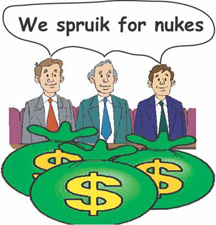 US Think Tank Urging Japan Keep Nuclear Funded By Japanese Govt & Nuclear Industry , Simply Info, April 12th, 2016 | “……The CSIS received over $500,000 from the Japanese government. …Japan is a top donor to CSIS. Only the UAE and US are included in that top donor category along with Japan.
Contributions over $200,000
Lockheed Martin Corporation
Northrop Grumman Corporation
Contributions over $100,000
Bechtel Corporation
General Dynamics Corporation
Mitsubishi Corporation
Nippon Keidanren
Raytheon
Contributions over $65,000
Marubeni Corporation
Rolls-Royce plc
Contributions over $35,000
Fluor Corporation
GE Foundation
Hitachi, Ltd.
ITOCHU Corporation
Mitsubishi Heavy Industries, Ltd.
Mitsui & Co., Ltd.
Contributions under $34,999
Chubu Electric Power Co., Inc.
E. I. du Pont de Nemours and Company
Électricité de France S.A.
Exelon Corporation
General Atomics
General Electric Company
Honeywell International, Inc.
Mitsubishi Hitachi Power Systems, Ltd.
Toshiba Corporation
URENCO USA http://www.fukuleaks.org/web/?p=15416
Plymouth needs an unbiased Nuclear Committee to advise on decommissioning Pilgrim Nuclear Power Station
 Rash of resignations from the Nuclear Matters Committee Forget the nuclear power plant, the town’s Nuclear Matters Committee is decommissioning itself. Wicked Local Plymouth By Frank Mand
fmand@wickedlocal.com Apr. 14, 2016
PLYMOUTH – Forget the nuclear power plant, the town’s Nuclear Matters Committee is decommissioning itself.
Long-time member and chair Jeff Berger resigned last year, or at least thought he had. According to the town clerk it’s not official. Committee member Rich Grassie followed shortly thereafter, to devote his energy to another project.Chairman Rich Rothstein offered his letter of resignation earlier this year, and then committee member Heather Lightner did the same.
The full committee is supposed to have nine-members so today – including Berger who is technically still on the committee – they barely have enough members to reach a quorum (five) and hold a meeting.
So does the Nuclear Matters Committee still matter?
Brian Sullivan, a senior fellow at the American Leadership and Policy Foundation who writes a column on safety issues, including nuclear power topics, for the Old Colony Memorial, says it couldn’t have happened at a worse time.
“We in Plymouth are at a critical juncture when it comes to the decommissioning of the Pilgrim Nuclear Power Station,” Sullivan told the Old Colony last month. “Unfortunately, we are suffering a brain-drain at the same time.”
Sullivan suggests the resignations might be due to the committee’s lack of independence.
“We know from his recent commentary,” Sullivan said, “that former NMC Chairman Jeff Berger is pleased to now be able to speak out without having to be concerned about political reservations.”
It may not be that simple though………
Lightner, one of the newest members and the last to resign is also the most skeptical of those who recently resigned about the committee’s continued relevance.
“Although the Nuclear Matters Committee has a wealth of knowledge related to nuclear power and nuclear engineering, the committee is seriously lacking a diverse membership,” Lightner told the Old Colony. “If the NMC is to continue and bring value to the town, it must include more members who can speak to environmental issues, economic factors and development, and health and safety as part of the decommissioning conversation and decision-making process.”
Lightner would also like to see the selectmen, who appoint all committee members, limit the number of members who are associated with the nuclear industry or Entergy in particular and institute term limits to encourage new ideas and a balanced decommissioning discussion.
“Otherwise, the NMC should be dissolved,” Lightner said. “Perhaps the best plan is to appoint a brand new, more diverse group focused specifically on decommissioning, which could then advise the Entergy Working Group and Board of Selectmen.”
But even the town seems to be moving away from the committee…….http://plymouth.wickedlocal.com/article/20160414/NEWS/160418679/?Start=2
The Pilgrim nuclear power plant not to close until 2019
Closing date set for Pilgrim nuclear power plant will close May 31, 2019, plant operator Entergy announced. Boston Globe By David Abel and John R. Ellement GLOBE STAFF APRIL 14, 2016 The company that owns the Pilgrim Nuclear Power Station said Thursday that it intends to refuel next year and continue operating the power plant in Plymouth for three more years.
Officials at Entergy Corp. said the plant will close on May 31, 2019. The company had been weighing whether to shutter the plant next year — as critics had hoped it would — before it would be required to start an expensive refueling process.
The decision means Pilgrim’s 609 employees will continue to work there until the plant closes, but activists say it also means Entergy will continue operating what the Nuclear Regulatory Commission has deemed one of the nation’s least-safe reactors…….
Local activists who have long opposed the plant’s continued operations said they worry that Entergy is more concerned about its finances than public safety.
“The bottom line is that this decision is about Entergy’s pocketbook — not about public safety,” said Mary Lampert, director of Pilgrim Watch, a longtime critic of the plant. “This is an old plant, and Entergy is unwilling to spend the money to fix the problems, and the NRC is allowing them to do that. That means we’re in a heightened period of risk.”
Last October, Pilgrim said it would close no later than June 2019, after supplying power to more than a half-million homes and businesses for four decades. The announcement came a month after the NRC designated Pilgrim one of the nation’s three least-safe reactors.
Company officials have said they decided to close the plant because of the plummeting price of a competing fuel, natural gas, and the reluctance of federal and regional officials to provide financial incentives for nuclear power plants…….https://www.bostonglobe.com/metro/2016/04/14/pilgrim-nuclear-power-plant-close-may/FRXGHcfMrk3nSngdYueMML/story.html
Hillary Clinton calls Donald Trump “reckless” on nuclear policy
 Clinton blasts Trump’s ‘dangerous’ nuclear talk, Politico By NICK GASS 04/14/16 Hillary Clinton ratcheted up her attacks on Donald Trump’s national security expertise Thursday with a blistering New York Daily News op-ed in which she laid out her nuclear proposals and called his statements perhaps the “most reckless” from “any major presidential candidate in modern history.”
Referring to Trump’s frequent insistence that the United States needs “unpredictability” from a commander in chief and that he would not take the nuclear option “off the table,” Clinton said Trump would risk a dangerous arms race in East Asia and in the Middle East. The Republican front-runner said late last month that he would consider withdrawing U.S. forces from both countries and suggested that both nations should arm themselves with nuclear weapons.
“Trump’s policies would reverse decades of bipartisan consensus. Even letting friendly nations go nuclear would make it harder for us to prevent rogue regimes from doing the same,” the former secretary of state wrote in the Daily News, which on Wednesday endorsed her over Bernie Sanders.
Clinton also noted that the terrorists involved in last month’s Brussels attacks had been monitoring a Belgian nuclear scientist and nuclear plant, calling it “a chilling warning that ISIS may be pursuing the sabotage of a nuclear site or acquisition of material to make a dirty bomb.”……….http://www.politico.com/blogs/2016-dem-primary-live-updates-and-results/2016/04/hillary-clinton-trump-national-security-221942
Fukushima – the irradiation of a nation
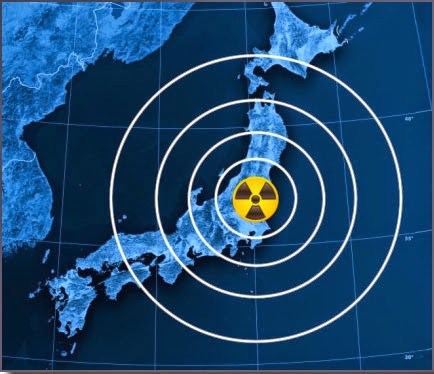 Top Official: Over 60 million Japanese irradiated by Fukushima — Nuclear Expert: 50,000 sq. miles of Japan highly contaminated… Many millions need to be evacuated… Gov’t has decided to sacrifice them, it’s a serious crime — TV: More than 70% of country contaminated by radiation (VIDEOS) http://enenews.com/top-official-60-million-japanese-irradiated-fukushima-nuclear-expert-50000-square-miles-country-highly-contaminated-many-millions-be-evacuated-govt-decided-sacrifice-serious-crime-professor-70-l?utm_source=feedburner&utm_medium=email&utm_campaign=Feed%3A+ENENews+%28Energy+News%29
Interview with nuclear engineer Hiroaki Koide (translation by Prof. Robert Stolz, transcription by Akiko Anson), published Mar 8, 2016 (emphasis added): [Radioactive] material has been dispersed, contaminating Tohoku, Kanto [Tokyo area], and western Japan… [The law says] that absolutely nothing may be removed from a radioactive management area in which the levels exceed 40,000 Becquerels per square meter… [H]ow much area has been contaminated beyond 40,000 Bq/m2… that answer is 140,000 km^2 [54,054 square miles]… Indeed, while centered on Fukushima, parts of Chiba and Tokyo have also been contaminated. The number of people living in what must be called a radiation-controlled area is in the millions, and could exceed ten million… I believe the government has the responsibility to evacuate these entire communities… the government decided to leave them exposed to the real danger of radiation. In my view, Fukushima should be declared inhabitable… but if that were to be done, it would likely bankrupt the country… They’ve decided to sacrifice people… In my view, this is a serious crime committed by Japan’s ruling elite… [F]undamentally, people must not be forced to live in contaminated areas… First must come complete evacuation… [W]hen it comes to radiation… “removal of contaminants” is impossible… This stuff contaminates everything.
Naoto Kan, former Prime Minister of Japan, Apr 11, 2016 (at 2:15 in): The molten material broke through the pressure vessel and accumulated low down in the containment. Now what would have happened if this molten material had escaped from the containment?… A radius of 250 kilometers — which includes the city of Tokyo — anyone living in this area, if you count them up it comes to 50 million or 40% of the Japanese population, and they would all have had to be evacuated. As we know from Chernobyl, not just a couple of weeks, but 30 years or 40 years — it would have virtually meant the end of Japan. [Note: Many nuclear experts believe the molten fuel did in fact escape from the containment] Half the population was subject to radiation [Japan Population: 127 million]. That’s something that could just be imagined, for instance the event of losing a major war.
Arirang (Gov’t-funded Korean TV network), ‘Fukushima and Its Aftermath’, Mar 16, 2016 (at 6:45 in) —Prof. Kim Ik-Jung, Medical College at Dongguk Univ.: “When you look at the contamination map, about 70% of Japan is contaminated by radiation. That means that 70% of Japan’s agricultural and marine products are contaminated.”… According to PNAS, one of the five major scientific journals, over 70% of the land in Japan is contaminated by radiation.
Global renewable energy boom, with Asia Pacific at the heart of it
Asia Pacific at the heart of global renewables boom Investments in clean energy reached record highs last year, spelling an optimistic outlook but new sources of competition for industry players. Eco Business, By Vaidehi Shah, 7 Apr 16, The global clean energy sector continued its breakneck development with a record US$329 billion of new investments last year, and Asia Pacific is at the heart of this boom, according to a new report by professional services firm EY.
The London-headquartered consultancy’s Renewable Energy Country Attractiveness Index 2016 report, released in late February, showed that Asia Pacific secured almost US$180 million in clean energy investments last year – more than half of the global total.
China topped the index with US$110.5 billion in investments, followed by the United States, Japan, the United Kingdom and India.
Wind and solar are the key energy sources driving the spike in global renewable energy investment, found EY. Together, the two sectors snapped up US$270 billion in clean energy investments last year, more than 80 percent of the US$329 billion total.
They also accounted for half of all new power generation capacity installed last year, contributing 120 gigawatts of new energy projects.
Asia Pacific saw more clean power going online than any other region, with 36 GW of solar and 31.5 GW of wind capacity added. This capacity was significantly higher than 8.9 GW in North America for solar energy, and 15 GW for Europe last year.
Asia Pacific’s electrifying growth
Matthew Rennie, managing partner, power and utilities, EY Australia, noted that India, Indonesia and Singapore are some of Asia’s most exciting markets.
With US$10.9 billion in clean energy investments last year, “India is the rising star of the Asia Pacific renewables market, and is starting to challenge China as the present index leader,” he said.
The rapid growth of investments in India is thanks to the government’s ambitious target to install 175 gigawatts of renewable energy capacity by 2022, announced last year. The country has also allocated US$400 million to finance this goal in its 2015 budget.
Indonesia, too, plans to scale up renewable energy………http://www.eco-business.com/news/asia-pacific-at-the-heart-of-global-renewables-boom/
Nuclear industry up to their old tricks, spruiking “new nuclear”
But thorium can’t fuel a reactor by itself: rather, a uranium- or plutonium-fueled reactor can convert thorium-232 into fissionable (and plutonium-like, highly bomb-usable) uranium-233. Thorium’s proliferation [8], waste, safety, and cost problems differ only in detail from uranium’s: e.g., thorium ore makes less mill waste, but highly radioactive U-232 makes fabricating or reprocessing U-233 fuel hard and costly.

‘New’ nuclear reactors? Same old story, Ecologist, Amory Lovins 12th April 2016 The nuclear industry is forever reinventing itself with one brilliant ‘new’ idea after another, Amory Lovins wrote in this classic 2009 essay. But whether it’s touting the wonders of future SMRs, IFRs or LFTRs, the reality never changes: the reactors they are building right now are over time, over budget and beset by serious, entirely unforeseen technical problems….. Continue reading
Allison MacFarlane on nuclear safety
 How to protect nuclear plants from terrorists, PhysOrg April 14, 2016 by Allison Macfarlane, The Conversation In the wake of terrorist attacks in Brussels, Paris, Istanbul, Ankara and elsewhere, nations are rethinking many aspects of domestic security. Nuclear plants, as experts have long known, are potential targets for terrorists, either for sabotage or efforts to steal nuclear materials.
Currently there are 444 nuclear power plants operating in 30 countries around the world and 243 smaller research reactors, which are used to produce isotopes for medical uses and to train nuclear engineers. The nuclear industry also includes hundreds of plants that enrich uranium and fabricate fuel for reactors. Some of these facilities contain materials terrorists could use to build a nuclear or “dirty” bomb. Alternatively, power plants could be “hijacked” to create an accident of the sort experienced at Chernobyl and Fukushima, sending clouds of radioactivity over hundreds of miles.
At last month’s Nuclear Security Summit in Washington, D.C., representatives from 52 countries pledged to continue improving their nuclear security and adopted action plans to work together and through international agencies.
But significant countries like Russia and Pakistan are not participating. And many in Europe are just beginning to consider physical security measures. From my perspective as a former nuclear regulator and now as director of the Center for International Science and Technology Policy at George Washington University, it is clear that nuclear plants are vulnerable to terrorist attacks.
It is not news that security is weak at many civilian nuclear power and research facilities.
In October 2012, Greenpeace activists entered two nuclear power plants in Sweden by breaking open a gate and scaling fences without being stopped by guards. Four of them hid overnight on a roof at one reactor before surrendering the next morning.
Just this year, Sweden’s nuclear regulatory agency adopted a requirement for armed guards and additional security measures at the plants. However, these upgrades do not have to be in place until early 2017.
In 2014 French nuclear plants were plagued by unexplained drone overflights. And Greenpeace activists broke into the Fessenheim nuclear plant near the German border and hung a large banner from the reactor building.
In light of the recent Brussels attacks, reports from Belgium are more alarming. In 2012 two employees at the country’s Doel nuclear power station left Belgium to fight in Syria. In 2014 an unidentified saboteur tampered with lubricant in the turbine at the same reactor, causing the plant to shut down for five months. And earlier this year authorities investigating the Paris attacks discovered video surveillance footage of a Belgian nuclear official in the home of one of the Paris suspects.
One has to assume that potential attackers may understand how the sites and materials can be used.
Given the heightened state of alert in Europe, governments should, I believe, immediately increase security at civilian nuclear facilities. They could emulate the United States, where security at nuclear facilities has substantially increased since the September 11, 2001 terrorist attacks.
American role model
U.S. nuclear power plants now are some of the most well-guarded facilities in the world.
The U.S. Nuclear Regulatory Commission (NRC) regulates both safety and security at nuclear power plants. After 9/11, these sites were required to add multiple layers of protection, with the cores of reactors (where the fuel is located) the most highly defended areas………
The United States has also adopted regulations to ensure cybersecurity at reactors. As new, entirely digital reactors come online, such measures will be more necessary than ever.
The successful 2010 Stuxnet attack, for example, in which a computer worm infiltrated computers at Iranian nuclear facilities and caused machines to malfunction, showed how vulnerable unprotected computer networks can be.
Improving security worldwide
There are no global standards for physical protection at civilian nuclear facilities. Each country adopts its own laws and regulations dictating what nuclear site owners are required to do to protect plants from attack.
As a result, measures at plants can vary widely, with some countries depending on the local police force for protection and leaving guards unarmed. Often the level of security depends on cultural norms and attitudes, but the recent attacks in Europe suggest a rapid adjustment is needed.
Here are steps that, in my view, all countries can take to make nuclear plants more secure……..
To prevent an attack at a nuclear site, governments must take security at nuclear sites seriously now, not a year from now.
In light of the current terrorist threat and with four Nuclear Security Summits completed, countries with nuclear plants need to up their game with regards to physical security at nuclear power facilities before it’s too late. http://phys.org/news/2016-04-nuclear-fromterrorists.html#jCp
Fukushima ice wall a very costly failure
Amid rampant waste, Fukushima’s frozen wall up in smoke http://america.aljazeera.com/blogs/scrutineer/2015/3/24/rampant-waste-fukushima-frozen-wall-up-in-smoke.html
Japan’s Board of Audit reported that TEPCO, the company nominally in charge of the crippled facility, along with other construction and utility giants, had operated an insular and insufficiently transparent process that resulted in a lengthy list of massive expenditures on untested tactics and shoddy equipment.
The biggest ticket failure was apparently a $270 million water decontamination system from French nuclear behemoth Areva. Designed to remove radioactive cesium from water gushing from Fukushima Daiichi’s three destroyed reactors, the machine was never fully operational, functioned only three months and processed only 77,000 tons of liquid — in total — a minute fraction of the 300,000 tons of contaminated water flowing from the site (and into the sea) each day.
An attempt to contain at least some of that water, a series of pipes and trenches filled with coolant that was to form an “ice wall,” turned out to be another of the cleanup’s dramatically costly and utterly ineffective schemes.
As detailed last summer, the freezing technique was borrowed from tunnel excavation, but had never been tried under such circumstances or on such a large scale. After a year of planning and months of construction, authorities couldn’t get even the small first stage of the project to freeze. Even after adding ten tons of ice and a ton of dry ice on top of the piped coolant every day, TEPCO could not get within 10 degrees (F) of the temperature needed to form a barrier.
By late 2014, 400 tons of ice and somewhere between $840,000 (audited waste) and $300 million (projected cost) later, TEPCO conceded failure.
Other attempts to contain the radioactive water have also come at immense cost. TEPCO spent $134 million on rubber-gasketed tanks that quickly began leaking into the surrounding ground and ocean. And $18 million was spent to build large underground pools that failed within weeks.
Another costly boondoggle detailed in the audit is the $150 million blown on desalination equipment that was supposed to purify the seawater poured over the overheating reactor cores. (All of Fukushima’s cooling systems failed during the 2011 earthquake and tsunami, resulting in reactor meltdowns, melt-throughs, hydrogen explosions and containment breaches.) One machine worked for just five days; the best of them survived only six weeks.
Fukushima’s disaster mitigation is four years into what is projected, by the very best estimates, to be a 30- to 40-year cleanup — and even then, there will be many long-term logistical, safety and health concerns. No serious models forecast the project can be accomplished with just the $1.6 billion (190 billion yen) currently allocated, but by that math, waste alone will outstrip the budget three- or four-times over before cleanup is “complete.”
According to German intelligence, terrorist Salah Abdeslam did not have German nuclear files
German intelligence agency disputes reports Salah Abdeslam had German nuclear files http://www.theguardian.com/world/2016/apr/14/paris-attacks-suspect-salah-abdeslam-had-german-nuclear-files
Spokeman for domestic intelligence agency says its head did not brief MPs on files found in Paris attacks suspect’s flat Guardian, Reuters in Berlin. Germany’s domestic intelligence agency has denied reports that Salah Abdeslam, a prime suspect in the Paris attacks, possessed documents about a nuclear research centre in Germany.
Newspapers in the Redaktions Netzwerk Deutschland (RND) media group said on Thursday that documents were found relating to the Juelich centre near the Belgium-Germany border, which is used for the storage of atomic waste.
The centre said in a statement that there was no indication of any danger and that Juelich was in contact with security authorities and nuclear supervisors.
The RND newspapers cited sources within the parliamentary control committee, whose meetings are confidential, as saying that Hans-Georg Maaßen, the head of the domestic intelligence agency (BfV), told the nine-person committee at the end of March that Abdeslam had the documents.
It said he had disclosed to the committee, which monitors the work of German security agencies, that printouts of articles from the internet and photos of the Juelich chairman, Wolfgang Marquardt, had been found in Abdeslam’s apartment in the Molenbeek area of Brussels.
The BfV on Thursday denied Maaßen had briefed the committee. “This is not right,” a spokeswoman said. “We have no information about this. Our president Maaßen never talked to any members of parliament.”
Two committee members also told Reuters that they had not been informed about the matter.
RND earlier reported that several members of the Bundestag and a terrorism expert at the BfV said they knew of this information and that Maaßen had confidentially informed them.
Abdeslam, born and raised in Belgium to Moroccan-born parents, was arrested on 18 March in Brussels. Four days later, suicide bombers killed 32 people in Brussels airport and on a rush-hour metro train.
Concerns that Islamic extremists are turning their attention to potential weak spots in the nuclear industry have risen since the attacks.
German nuclear centre a target for Paris terrorist?
Paris terrorist was eyeing German nuclear centre http://www.thelocal.de/20160414/paris-attacks-ringleader-had-records-of-german-nuclear-plant 4 Apr 2016 Salah Abdeslam, a key figure in the Paris attacks last November, was gathering information on a nuclear energy research centre in Germany, new evidence seen by German media revealed on Thursday.
- Swedish police hold terror suspect wanted in Germany (13 Apr 16)
- Munich police release suspects after terror probe (08 Apr 16)
- ’11 terror plots foiled in Germany since 2000′ (29 Mar 16)
Salah Abdeslam had documents at his apartment about a nuclear research centre at Jülich in North Rhine-Westphalia, raising concerns for authorities about what he many have been planning on German soil.
The documents included articles printed out from online sources about the research facility, as well as photos of the centre’s head, Wolfgang Marquardt, newspapers under the publishing group Redaktionsnetzwerk Deutschland (RND) reported, citing members of a parliamentary panel.
Abdeslam is currently being held in a Belgian prison, waiting to be deported to France, where he will face trial for terrorism offences in connection with the November 13th Paris attacks that left 130 dead.
The most recent documents were reportedly found inside of Abdeslam’s apartment where the French national was arrested last month in the Molenbeek district of Brussels.
Just days later, three bombs went off in Brussels in a coordinated terror attack that killed 32 people.
German domestic intelligence (Verfassungsschutz) President German Hans-Georg Maaßen reportedly informed several members of a Bundestag (German Parliament) security committee last month about the findings.
But according to RND, the Chancellery and the Interior Ministry declared that they did not have any information about the documents.
Similar information about the Brussels terrorists monitoring a Belgian nuclear scientist several weeks ago fueled speculation that they could have been planning to somehow get radioactive material for a dirty bomb, perhaps by blackmailing the researcher. They reportedly spied on the researcher, including filming him at his home for hours.
Immediately after the Brussels attacks, a Belgian nuclear power plant was evacuated of all non-essential personnel. Officials were also concerned when it emerged that two former Belgian nuclear power plant workers had gone to Syria to fight with Isis, one of whom was killed.
German nuclear power plants are extensively protected against the possibility of any interferences or other actions by an outside person, including terror attacks, according to the German Environment Ministry.
But according to environmental NGO BUND, the reactors are not sufficiently safe enough against air attacks.
The folly of wasting time and money on EPR nuclear reactor
 Nuclear power and climate change Too little, too late
The EPR nuclear reactor A dangerous waste of time and money NIRS Briefing January 2012 The French EPR* is a nuclear reactor design that is aggressively marketed by the French companies Areva and EDF. Despite the companies’ marketing spin, not only is the reactor hazardous, it is also more costly and takes longer to build than renewable-energy alternatives. While no EPR is currently operating anywhere in the world, four reactors are under construction in Finland (Olkiluoto 3, construction started in 2005), France (Flamanville 3, 2007) and China (Taishan 1 and 2, 2009-10). The projects have failed to meet nuclear safety standards in design and construction, with recurring construction defects and subsequent cover-ups, as well as ballooning costs and timelines that have already slipped significantly.
EDF in America going for wind power, abandoning nuclear
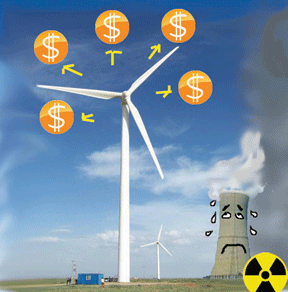 EDF shows that wind makes better sense than nuclear,Ecologist Chris Goodall April 2016 EDF in the UK may be propelled by its disastrous nuclear ambitions, writes Chris Goodall. But across the Atlantic it’s another story: the company is the US’s biggest wind developer, and selling its power, profitably, for under 40% of the price it has been promised for Hinkley C, including federal tax credits…….
Within the same company, they do things very differently on the other side of the Atlantic; there EDF focuses wholeheartedly on wind and has no nuclear under development.
It has just proudly announced that it has become the largest wind developer in North America with a portfolio in 2015 of over 1 gigawatt of newly constructed wind farms.
If it continues at the current rate, it will be generating more electricity from wind by 2025 than would be provided by Hinkley Point C. The numbers are as follows. Hinkley will generate about 25 terawatt hours a year. EDF’s 2015 annual portfolio of new wind projects will provide about 3 terawatt hours a year at average US utilisation factors.
If it continues to develop new wind projects at the rate of 1 gigawatt a year, it will be generating well over 30 terawatt hours a year from wind by the end of 2025. 2025 is when EDF says Hinkley will be finished.
What about the capital cost of wind versus nuclear? The latest US estimates suggest a figure of about $1,700 per kilowatt of capacity. That means EDF’s projects completed in 2015 cost about $1.8bn. Over ten years, that rate of installation will mean a total cost of around $18bn or about £13bn. Wind is therefore at least 30% cheaper to construct.
And it is much cheaper to operate. The most important project it completed in 2015, the 250 MW farm at Roosevelt in New Mexico, has sold its electricity for the next 20 years to a utility for $23.39 a megawatt hour, less than 20% of the price agreed for Hinkley of £92.50/MWh.
Note that the Roosevelt price is somewhat subsidised by Federal tax credits but even without this benefit the cost of wind would be less than 40% of the price of UK nuclear. Wind saves consumers money when compared to the nuclear alternative.
It’s simple really: renewables are a better and more secure investment
EDF finances many of its US wind projects on the back of power purchase agreements with major companies such as Microsoft, Procter and Gamble and Google. They commit to buy the electricity produced at a fixed price, not the inflation adjusted figure that the UK will pay for Hinkley. The EDF press release said:
“Corporate America is increasingly turning to renewable energy to power its business operations, based both on consumer preferences and because renewable energy simply makes economic sense.”
We never hear this line from EDF in the UK.
EDF cannot guarantee the wind will blow or the sun shine. Unlike in Britain, its US business is also investing heavily in energy storage. The US company has announced 100MW of battery systems in the US because “Energy storage is an attractive, cost-effective addition to intermittent energy generation projects.” However there’s no mention of batteries on EDF’s UK web site.
For sensible reasons large international companies often pursue varied market strategies in different countries. EDF in the US has decided to back wind while the UK has gone for nuclear.
But even a quick look shows that the energy and financial returns to the US strategy seem far clearer and better for the company, and its customers, than the tactics of the UK business. http://www.theecologist.org/blogs_and_comments/commentators/2987489/edf_shows_that_wind_makes_better_sense_than_nuclear.html
American nuclear engineer arrested for allegedly secretly helping China’s nuclear program
 US Engineer Helped China’s Nuclear Program for 2 Decades, Authorities Say http://abcnews.go.com/US/us-engineer-helped-chinas-nuclear-program-decades-authorities/story?id=38403235 By MIKE LEVINE Apr 14, 2016 The FBI has arrested an American nuclear engineer in Delaware for allegedly spending the past two decades illegally helping China build nuclear material with expertise he gleaned from others inside the United States.
According to a federal indictment unsealed today in Tennessee, Allen Ho — a naturalized U.S. citizen with residency in both Delaware and China — worked with others inside the United States to help Chinese agencies develop and produce “special” material relating to nuclear reactors.
Under the direction of a Chinese government agency, Ho allegedly identified and recruited experts from the U.S. civil nuclear industry who could provide the technical assistance he sought — often paying them for their help or arranging for them to travel to China, prosecutors say.
“China has the budget to spend,” Ho allegedly told one of the experts he tried to recruit in 2009. “China will be able to design their Nuclear Instrumentation System independently and manufactur[e] them independently after the project is complete.”
Specifically, Ho and others looked to obtain what the Justice Department calls “integral assistance” and “sensitive nuclear technology” relating to a “Small Modular Reactor Program” and an “Advanced Fuel Assembly Program” in China, and the group allegedly also sought help with nuclear reactor-related computer codes.
“Prosecuting those who seek to evade U.S. law by attaining sensitive nuclear technology for foreign nations is a top priority for [us],” the head of the Justice Department’s National SecurityDivision, John Carlin, said in a statement.
While operating his own technology firm based in Delaware, Ho has also been a senior adviser with China’s largest nuclear power company, which specializes in the development and manufacture of nuclear reactors, according to prosecutors.
Charged with conspiracy to unlawfully engage and participate in the production and development of special nuclear material outside the United States, Ho could face life in prison if convicted.
“The arrest and indictment in this case send an important message to the U.S. nuclear community that foreign entities want the information you possess,” FBI Executive Assistant Director Michael Steinbach said. “The federal government has regulations in place to oversee civil nuclear cooperation, and if those authorities are circumvented, this can result in significant damage to our national security.”
Wind power – the big buy-up by big companies
Why companies like Google and Walmart are buying so much wind power, WP, By Brady Dennis April 12 The U.S. wind energy industry had a memorable 2015, from installing thousands of new turbines across the country to supporting a growing number of jobs.
But perhaps one of the most noteworthy brights spots of the past year, according to an annual report released Tuesday by the American Wind Energy Association (AWEA), was the growing demand for wind energy from major corporations. High-tech firms such as Google Energy, Facebook and Amazon Web Services, as well as more traditional companies such as Procter & Gamble, General Motors, Walmart and Dow Chemical, have signed contracts to purchase increasing amounts of wind energy in coming years.
Corporations and other non-utility customers — including some municipalities and universities — accounted for more than half of the wind power capacity sold through so-called power purchase agreements in 2015, according to the AWEA. The group said that corporate and other non-utility buyers have signed contracts for more than 4,500 megawatts of wind power capacity, or enough to power the equivalent of about 1.2 million American homes.
Why does that matter?
[These states are setting wind energy records – and suing over Obama’s climate plans]
- Wind energy is seeing a global, not just a domestic boom. While the United States generated more electricity from wind than in any previous year during 2015, China outpaced every other nation in the amount of new wind energy capacity. China, the United States, Germany, Brazil and India combined to produce more than 80 percent of all new wind capacity installations in 2015, according to the AWEA………https://www.washingtonpost.com/news/energy-environment/wp/2016/04/12/why-companies-like-google-and-walmart-are-buying-so-much-wind-power/
1 This Month

of the week – Shut Down Drone Warfare!


Tell the Ukrainian Government to Drop Prosecution of Peace Activist Yurii Sheliazhenko

Petition to revoke the licensing of the Near Surface Nuclear Disposal Facility (NSDF) at Chalk River. https://www.ourcommons.ca/petitions/en/Petition/Details?Petition=e-7247
To see nuclear-related stories in greater depth and intensity – go to https://nuclearinformation.wordpress.com
-
Archives
- April 2026 (114)
- March 2026 (251)
- February 2026 (268)
- January 2026 (308)
- December 2025 (358)
- November 2025 (359)
- October 2025 (376)
- September 2025 (257)
- August 2025 (319)
- July 2025 (230)
- June 2025 (348)
- May 2025 (261)
-
Categories
- 1
- 1 NUCLEAR ISSUES
- business and costs
- climate change
- culture and arts
- ENERGY
- environment
- health
- history
- indigenous issues
- Legal
- marketing of nuclear
- media
- opposition to nuclear
- PERSONAL STORIES
- politics
- politics international
- Religion and ethics
- safety
- secrets,lies and civil liberties
- spinbuster
- technology
- Uranium
- wastes
- weapons and war
- Women
- 2 WORLD
- ACTION
- AFRICA
- Atrocities
- AUSTRALIA
- Christina's notes
- Christina's themes
- culture and arts
- Events
- Fuk 2022
- Fuk 2023
- Fukushima 2017
- Fukushima 2018
- fukushima 2019
- Fukushima 2020
- Fukushima 2021
- general
- global warming
- Humour (God we need it)
- Nuclear
- RARE EARTHS
- Reference
- resources – print
- Resources -audiovicual
- Weekly Newsletter
- World
- World Nuclear
- YouTube
-
RSS
Entries RSS
Comments RSS
 nuclear-news