Hinkley nuclear deal with France turning out a very bad one for Britain
“The decision-makers on both sides are totally underestimating” the risks, says Mycle Schneider, an independent nuclear analyst in Paris. “But the farther they go on, the more difficult it is to pull out.”
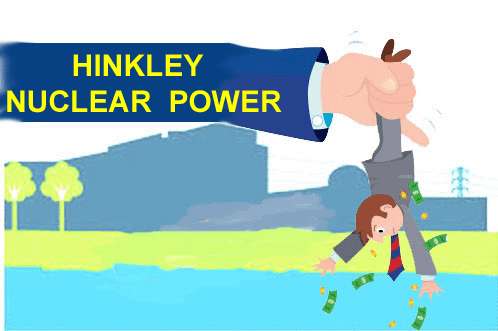
French Plans for a Nuclear Plant Begin to Look Like a Bad Deal for Britain,Bloomberg 30 Apr 16 A new reactor design poses risks on both sides of the English Channel. As Britain races to replace its aging nuclear reactors and coal generators, it’s hoping to team up with France to build the most expensive power plant in history—a massive atomic facility with two reactors at Hinkley Point on England’s southwestern coast. It could provide 7 percent of the country’s electricity by 2025. But the design, intended to showcase the latest French reactor technology, poses engineering and financial problems that could create a costly morass for both countries.
Public support for the project in Britain has fallen to 33 percent, down from 57 percent in 2013, according to a YouGov poll released on April 26 commissioned by New Nuclear Watch Europe, a pro-nuclear group.
In the end, politics could trump finance and technology. France wants to protect thousands of well-paying jobs in its nuclear industry. And British Prime Minister David Cameron, who in March joined French President François Hollande in reaffirming support for Hinkley Point, is keen for a project that would create jobs in an economically depressed region. “The decision-makers on both sides are totally underestimating” the risks, says Mycle Schneider, an independent nuclear analyst in Paris. “But the farther they go on, the more difficult it is to pull out.”
—With Francois de Beaupuy and Rachel Morison http://www.bloomberg.com/news/articles/2016-04-29/hinkley-point-u-k-nuclear-plant-plans-begin-to-look-like-bad-deal
No comments yet.
1 This Month

of the week – Shut Down Drone Warfare!


Tell the Ukrainian Government to Drop Prosecution of Peace Activist Yurii Sheliazhenko

Petition to revoke the licensing of the Near Surface Nuclear Disposal Facility (NSDF) at Chalk River. https://www.ourcommons.ca/petitions/en/Petition/Details?Petition=e-7247
To see nuclear-related stories in greater depth and intensity – go to https://nuclearinformation.wordpress.com
-
Archives
- March 2026 (251)
- February 2026 (268)
- January 2026 (308)
- December 2025 (358)
- November 2025 (359)
- October 2025 (376)
- September 2025 (257)
- August 2025 (319)
- July 2025 (230)
- June 2025 (348)
- May 2025 (261)
- April 2025 (305)
-
Categories
- 1
- 1 NUCLEAR ISSUES
- business and costs
- climate change
- culture and arts
- ENERGY
- environment
- health
- history
- indigenous issues
- Legal
- marketing of nuclear
- media
- opposition to nuclear
- PERSONAL STORIES
- politics
- politics international
- Religion and ethics
- safety
- secrets,lies and civil liberties
- spinbuster
- technology
- Uranium
- wastes
- weapons and war
- Women
- 2 WORLD
- ACTION
- AFRICA
- Atrocities
- AUSTRALIA
- Christina's notes
- Christina's themes
- culture and arts
- Events
- Fuk 2022
- Fuk 2023
- Fukushima 2017
- Fukushima 2018
- fukushima 2019
- Fukushima 2020
- Fukushima 2021
- general
- global warming
- Humour (God we need it)
- Nuclear
- RARE EARTHS
- Reference
- resources – print
- Resources -audiovicual
- Weekly Newsletter
- World
- World Nuclear
- YouTube
-
RSS
Entries RSS
Comments RSS
 nuclear-news
Leave a comment