The next nuclear disaster will probably be an intentional one
Unfortunately, we may have to await an intentional Chernobyl to take place first to galvanize this sort of preventive action.
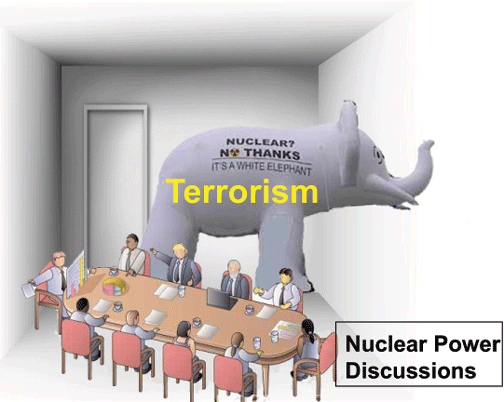
The next nuclear disaster may be intentional http://www.japantimes.co.jp/opinion/2016/04/28/commentary/world-commentary/next-nuclear-disaster-may-intentional/#.VyJ1ktR97Gh BY BENNETT RAMBERG REUTERS LONDON – Chernobyl’s 30th anniversary on Tuesday came against the backdrop of growing apprehension that nuclear reactors may become a terrorist target.
Serious concern arose during the recent Islamic State attacks in Brussels. Evidence suggested that the assailants were considering a nuclear-related incident. The terrorists had a senior Belgian nuclear official under surveillance, and two former nuclear power plant employees were reported to have joined Islamic State.
This may help explain why Belgian authorities rushed military forces to protect its nuclear plants.
The scare provided a reminder that nuclear reactors are radiological mines that terrorists could exploit. Destruction of a plant would mark a zenith of terrorist violence. Radioactive elements would spread across national boundaries. It would endanger the lives of many, while creating economic and environmental havoc mimicking the Chernobyl or Fukushima explosions.
How concerned should the West and other regions be? And if the peril remains so serious, why doesn’t the international community impose mandatory security standards?
Actually, Washington has tried to do just that. On June 14, 1946, the United States proposed the Baruch Plan at the United Nations. It called for an International Atomic Development Authority that would maintain “managerial or ownership of all atomic energy activities potentially dangerous to world security” and “the power to control, inspect and license all other atomic activities.”
Had Cold War politics not intervened, reactors would likely be safer and more secure today. Instead, the international community now faces a patchwork of national regulations. The result leaves open a terrorist nuclear Pandora’s Box.
Certainly, enforcement of robust security standards — including adequately manned, trained and armed guard forces; physical barriers to vital areas; detection, alarm and communication systems; a careful vetting of all plant employees to ensure against infiltration of terrorists and criminals, along with other measures — are but a small price to pay to avoid yet another intentional or accidental Chernobyl or Fukushima.
Unfortunately, given inertia, we may have to wait for the intentional Chernobyl to take place to get action. Consider that nuclear critics have been concerned for decades that reactors are likely terrorist targets and not enough is being done to protect them.
They insisted that terrorists could breach the containment structures of nuclear power plants using sophisticated hand-held weapons, rocket-propelled grenades, vehicular bombs and water-based or airborne attack. They also warned about insider sabotage of vital plant life lines, which could release the core’s deadly radioactive contents.
But with no serious attack so far, complacency has set in. Belgium finally put armed guards at its plants only after last year’s Paris terrorist attacks. How many other nations among the 30 with power reactors have been equally complacent? But smugness has been revealed to be an embarrassment. In 2012, Greenpeace activists broke into a Swedish nuclear installation. The environmental activists scaled fences surrounding two nuclear power reactors and hid four of its party overnight on the roof of one. In 2014, another group of Greenpeace activists broke into a French nuclear power plant near the German border and hung a large banner from the reactor building.
These stunts demonstrate there is something seriously wrong with power-plant security practices in the two countries, and in perhaps many others. The International Atomic Energy Agency, the World Association of Nuclear Operators and the European Union all press for reactor security and safety by offering guidelines. They send survey teams to evaluate plant security at the request of the host country. But they cannot force countries to change their security habits.
Generally, such mindsets don’t change easily. It takes events, not hypotheticals, to do that.
It took the 1993 truck bombing of the World Trade Center in New York, for example, to push the U.S. into setting tougher standards for protecting reactors against vehicular bombings. Then, the Sept. 11, 2001, attacks prompted the Nuclear Regulatory Commission to boost defenses against ground attacks because members believed that better airport security would protect against a 9/11-style air attack on reactors.
But even in the U.S., which purports to apply the security gold standard, mock attacks have repeatedly found holes in reactor security.
We should expect that only an intentional Chernobyl incident will get complacent countries to dramatically change their security culture. Here is where international groups, if given authority, can do some planning to address the issue.
The plan should lay out mandatory security and safety requirements for all nuclear plants worldwide, to be administered by the International Atomic Energy Agency or other authorized body to license plant operations. Were the security at a licensed plant found to be inadequate, the authorized agency would suspend the plant’s license until operators made the required fixes.
Unfortunately, we may have to await an intentional Chernobyl to take place first to galvanize this sort of preventive action.
A second double-shell tank leaking radiation at Hanford?
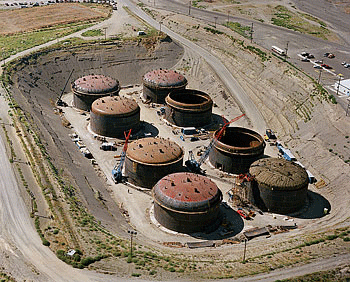
 Signs emerge of a second double-shell tank leaking at Hanford , Susannah Frame, KING 5.com 27 Apr 16, Radioactive particles have been measured at elevated levels for the first time in the outer safety space of the Hanford double-shell tank known as AY-101. The contractor that manages the tank told employees “we recently discovered higher-than-expected radioactivity readings” from filters that are part of the tank’s continuous air monitor (CAM).
“The filter contained traces of radioactive americium, cesium and plutonium, raising the possibility that the material is from tank waste that has escaped from the primary shell of the double-shell tank,” wrote Rob Gregory, chief operating officer of Washington River Protection Solutions.
Sources tell KING 5 that alarms went off last week to alert staff of the presence of “hot” (radioactive) particles trapped in filters of the tank’s continuous air monitor (CAM). The sources say this is the first time readings of this sort have been detected in AY-101.
The U.S. Department of Energy confirmed to the state that radioactive particles had been detected by filters circulating air from inside AY-101, according to officials with the Washington Department of Ecology.
But DOE’s Office of River Protection, which oversees the tank farms at Hanford, said no alarms went off indicating radioactive particles had been detected………
The citizen watchdog group Hanford Challenge also said sources of its own confirmed the detection of elevated radiation levels outside the primary liner of AY-101. The group’s sources say the by-products confirmed include Cesium-137, plutonium, and a high-beta emitter (most likely Strontium-90) that are all constituents commonly found in Hanford’s underground tanks.
The executive director of Hanford Challenge, Tom Carpenter, said this recent event has “serious implications” for the Hanford Site.
“Simply put, Hanford is nearly out of double-shell tank space, especially after pumping out AY-102 and emptying some of the shakier single-shell tanks…This is no other realistic option but to begin building new tanks immediately,” said Carpenter.
Elevated radiation and radioactive materials found in the CAM filters was the first indication that AY-102 was leaking. This was a red flag for the Department of Energy (DOE), which owns Hanford, 15 years before confirmation of the leak. Those high CAM filter readings in the 1990s were dismissed by DOE and its contractors at the time……..http://www.king5.com/mb/news/local/investigations/signs-emerge-of-a-second-double-shell-tank-leaking-at-hanford/154338445
USA Republicans – half of them accept the science of climate change

 Half of U.S. Conservatives Say Climate Change Is Real, Bloomberg, Trump and Cruz reject global warming, while more Republicans see it as a threat.Eric Roston eroston
The new survey results, “Politics & Global Warming 2016,” suggest a growing gap between what most registered Republican voters understand to be true and what the party leadership says it believes, particularly on the presidential campaign trail this year.
Liberal-to-moderate Republicans say climate change is real in much higher numbers than the party’s right wing does. More than 70 percent of GOP moderates say they know the world is warming, up 10 percentage points from two years ago. But only half of these Republicans, and just 26 percent of conservative Republicans, identify the problem as caused mostly by human activities (PDF)…….
The survey confirms that while only liberal Democrats put climate change near the top of their agenda, it remains a litmus test for credibility among many registered voters. Respondents were more likely to pick a candidate who strongly supports fighting climate change, 43 percent to 14 percent. They also reported feeling less likely to vote for an opponent to climate policy.
The issue is generational as well as partisan, according to Sheril Kirshenbaum, director of the University of Texas-Austin Energy Poll. Younger Americans are much likelier to understand climate change—but that doesn’t mean they’ll vote…..
Climate change is also the most divisive of the 23 issues—a fact the researchers will look at in more detail next week, when it reports on what each presidential candidates’ supporters think about the issue. http://www.bloomberg.com/news/articles/2016-04-27/half-of-u-s-conservatives-say-climate-change-is-real
Widespread and lingering medical effects of the Chernobyl nuclear disaster
 The Medical Implications of the 1986 Chernobyl Nuclear Disaster http://www.globalresearch.ca/the-medical-implications-of-the-1986-chernobyl-nuclear-disaster/5521671 Thirty Years Ago, April 1986 By Helen Caldicott Global Research, April 25, 2016 The following text by renowned scientist
and physician Dr. Helen Caldicott on the impacts of the 1986 Chernobyl will be followed in a subsequent article by an analysis of the medical implications of the Fukushima disaster
 The only on-site medical and epidemiological data gathered after Chernobyl was released in a report published by the New York Academy of Medicine in 2009 titled “Chernobyl – Consequences of the Catastrophe for People and the Environment,” which was gleaned from over 5000 papers published largely in Russian and translated into English.
These studies were gathered mainly from populations residing in the heavily irradiated zones in the Ukraine, Belarus and European Russia. However the Russian government classified all the relevant medical data for 3 years.
The Chernobyl 1986 catastrophe has turned into a new medical experiment conducted on millions of innocent people, much like the populations of Hiroshima and Nagasaki.
Because, the International Atomic Energy Agency, the United Nations Security Committee on the Effects of Atomic Radiation and the World Health Organisation never collected data from real patients, instead to their discredit they estimated the number of potential diseases that they derived only from calculations of radioactive releases and extrapolated doses.
Hence it is vitally important to scientifically and epidemiologically document the many illnesses which arose after the accident so that the medical profession can learn from these shocking accidents. These papers presented in the Chernobyl report by the NY Academy of Sciences attempt to do so. Some people say that they are not adequately peer reviewed so they should be ignored, however they are the only on-the-ground documentations of the many illnesses afflicting the irradiated populations
In essence 28 years after the accident, 50% of thirteen European countries are still contaminated by a variety of long-lived radioactive elements and the medical effects are severe in some areas. Before Chernobyl, 80% of the children in Belarus were healthy and now only 20% remain in good health.
Millions of people initially were exposed to very high radiation doses from short-lived radioactive elements so the initial radiation doses were thousands of times higher than doses received 3 years later.
Types of radioactive elements Continue reading
Austria losing to climate change its most precious environmental resource – glaciers
Austria’s Treasured National Resource, Its Glaciers, Are Melting Fast. inside climate news, Glaciers across the country retreated an average of 72 feet in 2015, more than twice the rate of the previous year, finds an annual survey.BY BOB BERWYN APR 28, 2016 VIENNA—NEARLY ALL OF AUSTRIA’S 900 GLACIERS RETREATED LAST YEAR AMID RECORD-SETTING HEAT, ACCORDING TO AUSTRIAN SCIENTISTS. THE RAPID MELTING MIRRORS A TREND ACROSS THE ALPS AND UNDERSCORES SCIENTISTS’ WARNINGS OF ACCELERATING, EXTREME CLIMATE IMPACTS CAUSED BY HUMAN-CAUSED GREENHOUSE GAS EMISSIONS.
Across the country, the glaciers retreated an average of 72 feet in 2015, more than twice the rate of the previous year, the Austrian Alpine Association said in its annual glacier survey. Three of the country’s glaciers retreated by more than 320 feet. The nonprofit association—which promotes mountain culture, research and conservation— has beenconducting detailed glacier measurements since 1927, creating a dramatic record of climate change effects in the alpine region.
“The summer of 2015 was more than 2 degrees Celsius warmer than the long-term average,” said survey team coordinator Andrea Fischer, a glaciologist with the Austrian Academy of Sciences. “Long periods of high pressure and the absence summer snowfall…are the reasons for the glacial meltdown.”
Austria’s largest glacier, the Pasterz, retreated by 177 feet in 2015, the survey found. Its volume has declined by half since it was first accurately measured in 1851. The annual survey measures a representative sample of 92 major glaciers; 96 percent were found to be receding.
Globally, 2015 was the hottest year since recordkeeping began in 1880, by a large margin, with the bulk of the temperature rise a result of manmade global warming, according to the World Meteorological Organization and U.S. government science agencies. Last summer was also the warmest on record in Austria, surpassing the previous record set in 2003, when heat waves were blamed for 30,000 deaths in Europe…….
If the Paris climate accord leads to the world limiting the global temperature rise to 2 degree Celsius, about 60 percent of the world’s glaciers will melt away in the next few centuries. At 1.5 degrees Celsius of warming, about 50 percent will vanish, Marzeion said.
Melting glaciers are among the most visible signs of climate change, and they are a crucial, disappearing water source. Changes in streamflows will affect hydroelectric power generation in the Himalaya, according to a 2013 study published in the journal Nature. The buildup of meltwater in the valleys beneath glaciers also increases the risk of catastrophic flooding……..http://insideclimatenews.org/news/27042016/austria-glaciers-melting-fast-climate-change-global-warming-alps-pasterze
Idaho in danger from nuclear waste, and must be protected
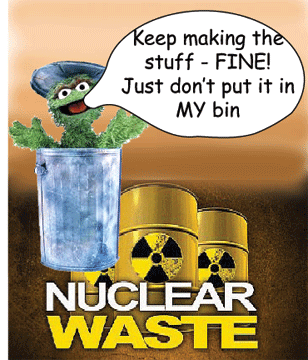 Idaho must be protected from nuclear waste HTTP://WWW.IDAHOSTATESMAN.COM/OPINION/READERS-OPINION/ARTICLE74125087.HTML BY WENDY WILSON, 28 Apr 16, Houston, we have a problem.” Although engineers and workers at the Idaho National Laboratory in Southeast Idaho have always tried to handle nuclear material safely, it doesn’t always work. Since 2005, accidents and inadvertent releases have happened with alarming regularity. In 2012, Department of Energy investigators told the Snake River Alliance that they had significant concerns and that INL was not handling plutonium safely.
Although the DOE has failed to meet countless deadlines to clean up what is already here, new proposals to import spent nuclear fuel from commercial power plants have swept safety concerns under the rug. DOE’s reputation for missed deadlines once led former Gov. Cecil Andrus to compare the agency to the Boise used car dealership “Fairly Reliable Bob’s.”
The most current missed deadline is that the DOE has failed to treat 900,000 gallons of intensely radioactive liquid waste stored at INL. Recent failures at the plant have cost taxpayers hundreds of millions of dollars in cost overruns and the system may never work.
In the meantime, this extremely dangerous waste is stored in buried tanks decades old. INL’s tanks have never leaked, as far as we know, but the pipes and valves connecting them have. The waste from those leaks may never be cleaned up and may always be in our soil and groundwater.
The McClatchy News Agency, parent company of the Idaho Statesman, recently reported that there have been nearly 400 nuclear-related deaths associated with the INL. Far more people have been sickened by their work there.
Twenty-five years ago, a Magic Valley fish farmer raised the alarm about plutonium shipments from Colorado to be buried on top of the Eastern Snake Plain Aquifer. The public was outraged. Former Gov. Andrus stepped up and Gov. Phil Batt forged a nuclear waste agreement with the DOE banning future imports of spent fuel from commercial nuclear power plants until specific timetables for clean up were met.
Today, the Byron nuclear waste proposed to come to INL falls under this ban. It is being stored safely in Indiana and it is unfathomable why Idaho would sign a “waiver” to allow the feds to bring it here and put Idahoans at risk.
Our land and water will continue to be contaminated until our political leaders put the health and safety of Idahoans ahead of DOE’s broken promises. There is still plutonium buried above the Snake River Aquifer, perhaps till the end of time. Let’s not forget.
Idahoans shouldn’t become lab animals for nuclear malfunction. Idaho Attorney General Lawrence Wasden is doing the right thing forcing the DOE to follow its own deadlines. Without a permanent national repository for nuclear waste, what comes to Idaho will stay here for decades, if not forever. Idahoans should stand together and tell the federal government to focus on INL’s existing nuclear experiment — cleaning up what is already here.
Wendy Wilson is interim executive director of the Snake River Alliance, Idaho’s nuclear watchdog and advocate for clean energy, found at www.snakeriveralliance.org.
California State Senate demands removal of stored nuclear waste from San Onofre power plant
 State Senate approves removing stored nuclear waste from San Onofre power plant http://www.cbs8.com/story/31842881/state-senate-approves-removing-stored-nuclear-waste-from-san-onofre-power-plantPosted: Apr 29, 2016 SAN ONOFRE (CNS) – A resolution demanding that the U.S. Department of Energy remove stored nuclear waste at the shuttered San Onofre Nuclear Generating Station was approved by the state Senate Thursday.
The resolution authored by Sen. Patricia Bates, R-Laguna Niguel, urges President Barack Obama and Congress to approve a bill in the House of Representatives that would consolidate the storage of nuclear waste. The bill is in the House Energy and Commerce Committee’s Subcommittee on Environment and the Economy.
“It’s way past time for the federal government to move the nuclear waste stored at San Onofre to a location away from densely populated and environmentally sensitive areas,” Bates said. “I’m pleased that my state Senate colleagues have endorsed my call to Washington D.C. to approve pending legislation that would help make Orange and San Diego County residents safer.”
The San Onofre plant has been shut down since a small, non-injury leak occurred in a steam generator in January 2012. Operator and majority owner Southern California Edison later decided to retire the plant’s two reactors,
rather than follow a costly start-up process.
Closing the facility is expected to take a couple of decades, however, so Edison recently received permission to expand nuclear waste storage tanks at San Onofre, despite opposition from environmental groups and local politicians.
Germany’s compromise plan to make power companies pay for nuclear waste disposal

 German utilities to pay for nuclear waste disposal, DW, 28 Apr 16 In October, Germany set up a high-level commission to decide how to finance the country’s nuclear phase-out. It has now recommended that power companies pay into a multi-billion euro fund managed by the government.
In October, Germany set up a high-level eleven-member commission, KFK, to review the financing of the nuclear phase-out. The government’s goal was to ensure comprehensive safety, decommissioning and waste disposal processes, and see to it that their costs would be borne by nuclear power companies, not by taxpayers.
“The tasks of interim storage of radioactive waste, manufacturing of waste containers, and construction and operation of final repositories, and transfer of waste from interim storage to final repositories should be transferred to the state,” the KFK said in a statement released Wednesday in Berlin.
The estimated costs are to be covered by power companies paying a total of 23.3 billion euro ($26.4 billion) into a state-owned fund, with partial payments to be made in tranches over the next few years. In exchange, the state will take on all the residual financial risks associated with radioactive waste management – so if disposing of radioactive waste ends up costing more than 23.3 billion euro, the government, not the companies, will be on the hook for those cost overruns.
The 23.3 billion euro is composed of the current all-in 4.7 billion euro cost estimate of processing, enclosing and transferring high-level waste to final repositories, plus a 12.4 billion euro estimate for the costs of selecting, building and operating final repositories, plus a 35 percent “risk premium” – which is less than the risk premium of at least 50 percent that environmental groups had proposed, but more than the companies want to pay.
Compromise deal
The deal was characterized by the KFK’s three co-chairs as a compromise aimed at ensuring decommissioning costs wouldn’t lead to the insolvency of the four power companies that own nuclear reactors in Germany. Their balance sheets have been under heavy pressure in recent years due to price competition from solar and wind power suppliers in wholesale electricity markets.
The four large power-generation companies that own Germany’s 17 commercial nuclear reactors are E.ON, RWE, EnBW, and Vattenfall, a company owned by the Swedish state. Eight of the 17 reactors are still in operation, but the last of them is due to be shut down by the end of 2022. Nuclear power accounted for 14 percent of Germany’s total electricity production in 2015.
The 23.3-billion-euro deal only covers interim storage, transport and final disposal of high-level radioactive waste – including the spent fuel rods currently sitting in pools at nuclear reactor sites, as well as low- and medium-level radioactive waste such as machinery and buildings from decommissioned reactors. Packaging the waste for interim storage as well as dismantlement of reactor buildings and equipment and site remediation will remain the technical and financial responsibility of the four power companies.
Until now, the companies had been given the option of either removing reactor equipment and buildings, disposing of waste, and remediating reactor sites, on the one hand, or securely and permanently fencing off the sites and preventing unauthorized access. The KFK has now recommended that fencing-off will no longer be an option: All sites are to be dismantled and remediated. The commission said the government should speed up the permitting process to enable faster site decommissioning……….http://www.dw.com/en/german-utilities-to-pay-for-nuclear-waste-disposal/a-19218042
Vattenhall nuclear corporation in financial trouble, opposes nuclear risk premium, seeks to abolish Swedish tax

 Vattenfall CEO says Germany’s proposed nuclear risk premium ‘too high’ Stockholm (Platts)–28 Apr 2016
* Plan ‘disproportionate’ to utilities’ economic strength
* Nuclear, hydro taxes in Sweden should be abolished
The CEO of Swedish utility Vattenfall, which has large stakes in Germany’s Brunsbuttel and Krummel nuclear plants, said the additional amount German nuclear power producers would have to pay for decommissioning and spent fuel storage under a proposed plan is “disproportionate to the economic strength of the utilities.”
The German Commission on the Review of the Financing of the Nuclear Phaseout, or KFK, recommended to the German government that nuclear utilities pay a so-called risk premium of Eur23.3 billion ($26.4 billion) into a fund for decommissioning reactors and final storage of spent fuel, which would be administered by the state.
That payment would be on top of the almost Eur40 billion in provisions that utilities have set aside to finance decommissioning and storage.
……NUCLEAR TAX Turning to its Swedish nuclear operations, Hall again called on the government to abolish the capacity tax on nuclear power. The tax is based on the amount of electricity reactors can generate, not on actual generation.
Hall and other Swedish nuclear utility executives have said that the tax, coupled with low electricity prices, is making nuclear power unprofitable. As a result, Vattenfall plans to shut two reactors ahead of the end of their technical lifetimes………http://www.platts.com/latest-news/electric-power/stockholm/vattenfall-ceo-says-germanys-proposed-nuclear-26430524
So-called “charity” nuclear front group lobbies UK govt to fund Small Nuclear Reactors

 UK think tank urges nuclear innovation, World Nuclear News, 28 April 2016 A think tank [Alvin Weinberg Foundation] has urged the British government to spend money earmarked for nuclear R&D on ensuring that at least three advanced reactors including at least one small modular reactor (SMR) and a Generation IV design have completed regulatory assessment by the early 2020s.
Weinberg Next Nuclear’s report, Next Steps for Nuclear Innovation in the UK….. The latest study follows a report by the same foundation, The Need for Nuclear Innovation, published in November 2015. Later that month, the UK government announced plans to invest £250 million ($377 million) over five years in a nuclear R&D program to include a competition to identify the best value SMR for the country. The initial phase of the competition was launched in March, with a call for initial expressions of interest.
The first phase of the competition, which will also lead to the development of an SMR Roadmap to set out the policy framework and assess the potential for possible pathways for SMRs in the UK, will run until late 2016. Individual reactor designs will not be assessed at this stage……
At least one of the reactors supported should be a Generation IV design that could use fuel made from previously used reactor fuel and from the UK’s plutonium stocks. It suggests that SMRs and “micro-reactors” – reactors of less than 20 MWe capacity – will be cheaper to construct than large reactors….
Finally, the report proposes that UK regulators cooperate with their peers in other countries, citing US and Canadian regulatory practices where proposed reactor designs are discussed with developers before the formal regulatory process begins. It calls for a three-way collaboration to be established with the aim of establishing international standards for the safety of advanced reactors……
Weinberg Next Nuclear is part of the Alvin Weinberg Foundation. The report was prepared with the sponsorship of Terrestrial Energy, Urenco and Moltex Energy, with Weinberg Next Nuclear retaining sole editorial control.http://www.world-nuclear-news.org/NP-UK-think-tank-urges-nuclear-innovation-2804167.html
Most of Belgium’s population to be given potassium iodide pills
 Belgium Considers New Steps to Confront Nuclear Radiation Fears More people near nuclear plants could receive potassium iodide pills under government plan, WSJ, By NATALIA DROZDIAK April 28, 2016, BRUSSELS—Belgium is considering handing out potassium iodide pills to large swaths of its population to help protect them from diseases caused by radioactivity in the event of a nuclear accident, a spokeswoman at the health ministry said on Thursday.
The review comes as neighboring countries including Germany and the Netherlands have complained about the poor safety standards at Belgium’s nuclear plants.
Concerns have centered on the discovery several years ago of thousands of tiny cracks in the steel walls of pressure vessels in some of Belgium’s reactors.
Potassium iodide pills can minimize radiation risks, including preventing thyroid cancer, the most common serious outcome of a major nuclear accident.
The Belgian federal government is considering recommendations by the national health council this year to expand the radius for potassium iodide distribution to those living within 100 kilometers (60 miles) of each of the country’s nuclear plants, covering most of the population……http://www.wsj.com/articles/belgium-mulls-mass-iodide-handout-to-settle-nuclear-fears-1461862403
Westinghouse keen to fleece UK tax-payers with Small Modular Nuclear Reactors
Westinghouse is engaging its UK stakeholders in its SMR offering to the country’s government, the company announced today. Mark Menzies, member of parliament for the Fylde constituency where the company’s Springfields site is located, said that he had already formally registered his support for Westinghouse’s proposal to produce SMRs for the UK market. He said that feedback from stakeholders would be essential for as the proposal, which could see SMR pressure vessels sourced and manufactured in the UK, to move forward. http://www.world-nuclear-news.org/NP-UK-think-tank-urges-nuclear-innovation-2804167.html
USA Federal regulators approve permit for new nuclear reactor in New Jersey
 Permit for a new nuclear reactor in N.J. OK’d by feds, By Bill Gallo Jr. | For NJ.com 28 Apr 16, Federal regulators have OK’d a key permit that would be needed for the construction of a new nuclear reactor in New Jersey, officials said Thursday.
The Nuclear Regulatory Commission’s Atomic Safety and Licensing Board, following numerous reviews, found that PSEG Nuclear met all safety and environmental requirements needed for the Early Site Permit.
That permit is not a green light for the utility to build a new reactor at its generating site at Artificial Island along the Delaware River in Lower Alloways Creek Township.
The permit will be good for 20 years. It does not, however, mean that PSEG Nuclear is ready to put a shovel into the ground. Many federal, state and local approvals would still be needed.
“This is an important final step to have the ESP issued,” said Joe Delmar, spokesman for PSEG Nuclear. “It provides us with a 20-year window to pursue a construction and operating license.” PSEG Nuclear has said during the application process that it was not ready to build another plant, but wanted to be prepared…..
The decision for the permit does not have to go before the full NRC board of commissioners.
This is only the fifth Early Site Permit ever issued by the NRC, according to Sheehan. In 2007 the agency enacted the rule that allowed utility companies to bank approval for a new plant until they, the utility, decided to build……
PSEG Nuclear currently operates three reactors —€” Salem 1, Salem 2 and Hope Creek. The plants, three of the four nuclear rectors now operating in New Jersey, comprise the second-largest nuclear generating complex in the U.S. Only the Palo Verde plant in the Arizona desert generates more power.
All three of the PSEG Nuclear reactors have been granted 20-year licenses extensions.
The utility has chosen a site north of its Hope Creek reactor on Artificial Island as the site where a new plant could be constructed. If another plant is built the utility has already said it would build a second access road to the Island from the mainland.
Depending on the size of the reactor, a new plant could cost upwards of $15 billion, according to some estimates. Any new reactor would also require the construction of a cooling tower to cut down on the amount of water drawn for cooling purposes from the Delaware River.
Currently, PSEG Nuclear’s Hope Creek plant has a cooling tower, but its Salem 1 and Salem 2 units do not. Those two reactors, when operating at full power, draw in and return to the Delaware River approximately three billion gallons of water a day.
Environmentalists oppose any plans for a new reactor at the Island.
“It’s unnecessary, not needed and there are real safety issues we are concerned about,’ Jeff Tittel, executive director of the New Jersey Sierra Club, said Thursday.
He said the project would require the filling in of hundreds of acres of sensitive wetlands and because of its location where the Delaware River and Delaware Bay meet, any new plant would be vulnerable to storm surge and a rising sea level.
Tittel said the high cost of building a nuclear plant would likely be borne by ratepayers and there are cheaper sources of electricity. He pointed to renewable energy sources such as wind power are becoming less expensive as are gas-fired generating plants.
Aside from environmental and economic concerns, Tittel sees a safety threat……. Bill Gallo Jr. may be reached at bgallo@njadvancemedia.com. Follow Bill Gallo Jr. on Twitter @bgallojr. Find NJ.com on Facebook. http://www.nj.com/salem/index.ssf/2016/04/permit_for_a_new_nuclear_reactor_in_nj_okd_by_feds.html
Amber Rudd discredited on her claim of “no liabilities’ if Hinkley nuclear project is cancelled
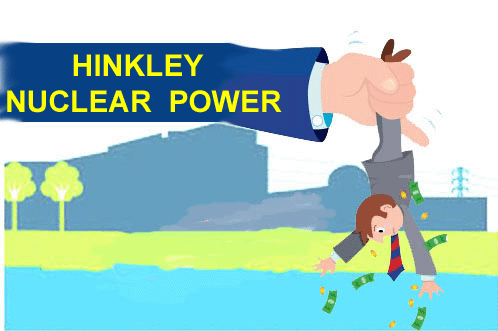 Non-nuclear options for constant energy, Guardian, Pete Wilkinson, Chairperson, Together Against Sizewell C 28 Apr 16 Energy secretary Amber Rudd clearly has the gift of clairvoyance. She says that no liabilities would fall to the UK taxpayer or consumer should Hinkley Point C be cancelled. Who, pray, would foot the bill to complete the project should EDF withdraw after a few years of construction when cost and time overruns became apparent, as they have with other projects in France and Finland?
And assuming the plant ever began generating its costly electricity, who would be responsible for the waste management costs, the size of which can only be estimated since the location, depth, technical details about cladding, inventory, or even if there will ever be a repository, remain stubbornly vague and could yet result in indefinite storage on site? Spent nuclear fuel from Hinkley C or Sizewell C would be on their respective sites for an estimated 160 years. Who will take title to hundreds of tonnes of spent nuclear fuel if, as is likely, within that time period, EDF disappears?
As usual, the public purse would be required to bail out a private venture. Rudd’s claim of “no liabilities” is as irresponsible as a short-term response to legitimate concerns as government’s energy policy will prove to be in the long term. Better to cancel Hinkley, Sizewell and all the other nuclear plans now while some semblance of energy policy credibility remains, than to see it unravel in the most embarrassing way over the coming decades, leaving communities like ours to carry the can for government obsession with a nuclear fix.
http://www.theguardian.com/environment/2016/apr/27/non-nuclear-options-for-constant-energy
Vattenfall puts pressure on Swedish government to cut nuclear tax,
State-owned Swedish utility Vattenfall will struggle to invest in required safety upgrades of its nuclear reactors in Sweden if the government doesn’t abolish its tax on nuclear power, Chief Executive Magnus Hall said on Thursday……..http://www.reuters.com/article/vattenfall-nuclear-idUSL5N17V5HN
1 This Month

of the week – Shut Down Drone Warfare!


Tell the Ukrainian Government to Drop Prosecution of Peace Activist Yurii Sheliazhenko

Petition to revoke the licensing of the Near Surface Nuclear Disposal Facility (NSDF) at Chalk River. https://www.ourcommons.ca/petitions/en/Petition/Details?Petition=e-7247
To see nuclear-related stories in greater depth and intensity – go to https://nuclearinformation.wordpress.com
-
Archives
- April 2026 (44)
- March 2026 (251)
- February 2026 (268)
- January 2026 (308)
- December 2025 (358)
- November 2025 (359)
- October 2025 (376)
- September 2025 (257)
- August 2025 (319)
- July 2025 (230)
- June 2025 (348)
- May 2025 (261)
-
Categories
- 1
- 1 NUCLEAR ISSUES
- business and costs
- climate change
- culture and arts
- ENERGY
- environment
- health
- history
- indigenous issues
- Legal
- marketing of nuclear
- media
- opposition to nuclear
- PERSONAL STORIES
- politics
- politics international
- Religion and ethics
- safety
- secrets,lies and civil liberties
- spinbuster
- technology
- Uranium
- wastes
- weapons and war
- Women
- 2 WORLD
- ACTION
- AFRICA
- Atrocities
- AUSTRALIA
- Christina's notes
- Christina's themes
- culture and arts
- Events
- Fuk 2022
- Fuk 2023
- Fukushima 2017
- Fukushima 2018
- fukushima 2019
- Fukushima 2020
- Fukushima 2021
- general
- global warming
- Humour (God we need it)
- Nuclear
- RARE EARTHS
- Reference
- resources – print
- Resources -audiovicual
- Weekly Newsletter
- World
- World Nuclear
- YouTube
-
RSS
Entries RSS
Comments RSS
 nuclear-news