Radioactive rain within Indian Point 2 reactor cavity falls on workers

 23 Years of Radioactive Rainfall at New York Nuclear Plant, Huffington Post, Roger Witherspoon, 18 Apr 16,
And after decades of ignoring the problem and having workers wear raincoats and rain hats to prevent radioactive contamination from the indoor precipitation, Entergy pledged in 2010 to try different methods in each of the next three refueling outages to see if they could stop the flow of water through the massive concrete and steel tub surrounding the reactor. That six-year plan was deemed acceptable by the NRC.
But Entergy’s efforts during the first two refueling outages failed. The plant is currently in the midst of the third refueling outage and NRC spokesman Neil Sheehan said in an email exchange that the company has been unable to find or halt the leaks.
“Entergy is still working on a solution to the problem of leakage from the Unit 2 refueling cavity,” Sheehan wrote. “Thus far, the leakage has not yet been halted. But it’s important to note that leakage is captured in the containment building sump and then processed in the plant’s radioactive water cleanup system.
“We had a metallurgical specialist at the site this week to observe Unit 2 refueling activities. As part of his inspection, he reviewed the work on the refueling cavity. The results of that review will be documented in an upcoming inspection report.”
- The steady drip of about 10 gallons per minute comes through the specially designed, concrete, waterproof cavity which surrounds the reactor and is filled with water in order for refueling to take place. Exposure to the reactor core would kill anyone in the area, so the cavity extends more than 30 feet above the reactor itself. When filled, the reactor head can be removed remotely and the 12-foot long fuel rods lifted out and transported on an underwater train through a flooded canal to the spent fuel pool in an adjacent building………
- At this decades-long leak rate, more than 4.6 million gallons of radioactive rain has fallen through the reactor cavity and transfer canal onto the work area below………
Entergy has been seeking 20 year extensions on the licenses of the twin reactors, which are now more than 40 years old, since 2007. The license for Indian Point 2 expired in 2013, and the license for Indian Point 3 expired last year. They are currently allowed to operate by the NRC until the licensing process is complete. The NRC is actively seeking to relicense all of the nation’s 100 reactors, and has so far granted extensions to about 75. The license review process for all other reactors has taken an average of two years.
- The extensions for both Indian Point plants, however, are being challenged by the environmental groups Riverkeeper and Clearwater, and the State of New York on several grounds, including contentions that the ageing management process for the plants’ critical components is flawed and unreliable……….
An Old, Unsolved Problem
The indoor leaks at Indian Point stem from a grave miscalculation made when the nation’s nuclear plants were designed in the 50s and 60s. It was assumed, explained Lochbaum, that pipes and concrete conduits wouldn’t break down over time and that concrete, though porous, was certainly unlikely to leak in the two weeks to a month needed for refueling and reactor maintenance. http://linkis.com/huffingtonpost.com/jBTm9
Growing concern over Sendai Nuclear Plant as earthquakes continue in the region
 Kyushu Earthquake Swarm Raises Concerns Over Nuclear Plant Safety IEEE Spectrum, By John Boyd 21 Apr 2016 The populous island of Kyushu in southwest Japan has been shaken by hundreds of earthquakes and aftershocks over the past eight days, and there is no immediate end in sight to Mother Nature’s upheavals.
The first major quake, 6.5 in magnitude, struck on April 14. A second more disastrous tremblor measuring 7.3 hit the area at 1:25 am on Thursday, April 16, injuring thousands of people, and killing dozens. Water, electricity and gas services have been disrupted. Buildings, roads, and bridges have been destroyed, complicating search, rescue and aid efforts for emergency workers and the Japan Self-Defense Force. The quakes are occurring inland, so there are no tsunami warnings.
As the quakes continue, fears are growing over the safety of two nuclear reactors in the Sendai Nuclear Plant operated by Kyushu Electric Power Co. (Kyuden). According to the Japan Times, citizens’ fears are rising, while mayors from more than 100 cities have called on the central government “to re-evaluate the way earthquake safety standards for nuclear power plants are calculated.”……http://spectrum.ieee.org/energywise/energy/nuclear/kyushu-earthquake-swarm-raises-concerns-over-nuclear-plant-safety
22 April Paris Agreement signing ceremony at United Nations, New York
 The Paris Agreement signing ceremony at a glance https://theconversation.com/the-paris-agreement-signing-ceremony-at-a-glance-58221 [good charts etc] April 22, 2016 Leaders and diplomats from more than 160 countries are gathering at the United Nations’ New York headquarters on April 22 to sign the Paris Agreement – the landmark climate deal hammered out at the culmination of last year’s talks.
The ceremony marks the start of a year-long opportunity for countries to sign the agreement, although most of the world will sign on the opening day. But the process doesn’t end there – nations will still need to ratify the treaty domestically. Only when at least 55 countries, accounting for at least 55% of global greenhouse emissions, have done so will the Paris deal become international law.
March the world’s hottest month in recorded history
 ‘Worse things in store’: Steaming hot world sets more temperature records, The Age, April 20, 2016 Peter Hannam Environment Editor, The Sydney Morning Herald
The Earth sizzled in March with the most unusually warm month in recorded history as average land surface temperatures easily exceeded levels deemed by scientists to constitute dangerous climate change.
The abnormal weather has continued into April as the most powerful tropical cyclone ever recorded in the Indian Ocean dumped rain at rates reaching 300 mm an hour, and Australian scientists declared the worst coral bleaching event ever on the Great Barrier Reef.
Combined global land and sea-surface temperatures in March were 1.22 degrees above the 20th-century average, beating the previous record for the month – set just a year earlier – by almost one-third of a degree, the US National Oceanic and Atmospheric Administration said. Each of the past 11 months have now broken global temperature records, the longest such streak in the agency’s 137 years of data collection.
Land surface temperatures for March, though, were 2.33 degrees above the 20th-century average, smashing the previous March record set in 2008 by 0.43 degrees. It was also the most unusually warm reading for any month, eclipsing February, NOAA said.
The record breaking conditions come as leaders of 150-plus nations are due to gather in New York this week to ratify the global climate pact agreed in Paris in late 2015 to limit global warming to 1.5-2 degrees, compared with pre-industrial times………
The most abnormally hot regions of the world last month included Australia, which set a record with minimum temperatures almost 2 degrees above the average for 1961-90, while the Arctic region was about 3.3 degrees above average, NOAA said.
The El Nino has played a role in boosting temperatures in the year. The stalling or reversal of equatorial trade winds in the Pacific that characterise such events created a huge pool of relatively warm water in the central and eastern Pacific that is now breaking up.
However, the first three months of 2016 were not only the warmest on record for surface temperatures by 0.28 degrees – set a year earlier – they also beat the same period in 1998 by 0.45 degrees during a similar strength El Nino, NOAA said.
For the first three months of this year, average land surface temperatures were 2.05 degrees above the 20th-century average and a full 0.95 degrees warmer than in 1998, the agency said.
Most powerful Indian Ocean storm
The list of extreme weather events this year continues to grow……….http://www.theage.com.au/environment/climate-change/worse-things-in-store-steaming-hot-world-sets-more-temperature-records-20160419-goaf58.html
Judge rules against proposed Turkey Point nuclear plans

 Court overturns state’s approval of proposed Turkey Point plans, Palm Beach Post April 21, 2016 Florida Power & Light’s quest to add two new reactors and miles of new transmission lines at its Turkey Point plant south of Miami experienced a major setback Wednesday when an appellate court overturned a state decision that would have permitted the reactors.
While the 2014 approval of Units 6 & 7 by Gov. Rick Scott and his Cabinet found the project would not harm the Everglades or wetlands and would not impact endangered birds such as the snail kite and the wood stork, the court disagreed.
To read the 28-page ruling, click here.
The Third District Court of Appeal reversed the state’s approval of nuclear Units 6 and 7 in an appeal brought by the City of Miami, the Village of Pinecrest and Miami-Dade County.
The court remanded the case and found the board failed to apply Miami’s applicable land development regulations, failed to properly apply environmental regulations and erroneously thought it did not have the power to require FPL to install miles of power lines underground at FPL’s expense.
“FPL presented no competent substantial evidence that the project could satisfy the environmental performance standards” of Miami-Dade County rules, Judge Ivan Fernandez wrote in the ruling…….
By the end of this year, FPL customers will have paid $247 million towards units 6 and 7. The U.S. Nuclear Regulatory Commission has not yet issued the operating license for the project slated to be completed by 2028.
Juno Beach based FPL’s Turkey Point plant is home to two nuclear reactors, known as units 3 and 4. The plant’s two-by-five mile unlined earthen cooling canal system has caused an underwater saltwater plume that has spread roughly 5 miles west of the plant, an administrative law judge found in February.
The cooling canals have been linked to pollutants in Biscayne Bay and into ground water, according to data released by Miami-Dade County. http://protectingyourpocket.blog.palmbeachpost.com/2016/04/20/court-overturns-states-approval-of-two-proposed-turkey-point-reactors/
Russian nuclear corporation Rosatom to “educate” South Africans on benefits of nuclear power

 ROSATOM TO GROW PUBLIC AWARENESS ON NUCLEAR ENERGY, Eyewitness News, The Russian atomic energy company faces strong resistance from environmental lobbyists in SA. Rahima Essop 21 Apr 16 CAPE TOWN – Rosatom says it has to ‘gradually grow public awareness and acceptance’ about nuclear energy as the Russian atomic energy company faces strong resistance from environmental lobbyists and opposition politicians in South Africa.
Two organisations have challenged the legality of government’s proposed 9,600 MW nuclear build programme in court before Energy Minister Tina Joemat-Pettersson calls for quotes for the tender.
Rosatom is said to be on the inside track for the contract.
The Democratic Alliance (DA), meanwhile, is pushing for the project to be abandoned on the basis that it’s unaffordable and shrouded in secrecy.
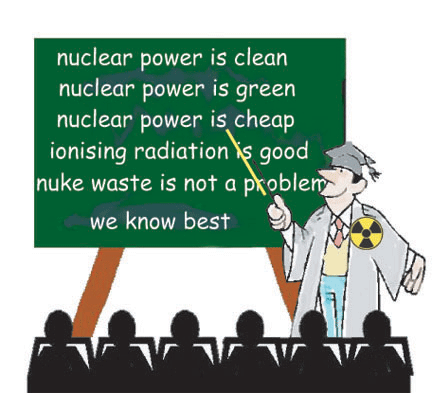
Rosatom has billed nuclear as a cheap source of energy and a job-creating solution for the country.
The company, which is building 34 reactors across the globe, is hoping to influence South African perceptions about nuclear…….Rosatom has sponsored a press trip to Hungary. http://ewn.co.za/2016/04/21/Rosatom-to-gradually-grow-public-awareness-on-nuclear-energy
Israel duped USA over its nuclear program – declassified documents
 Declassified: How Israel Misled the U.S. About Its Nuclear Program Ben-Gurion’s mumbling to Kennedy helped delay the Americans’ assessment that Jerusalem was on the verge of building a bomb. Haaretz, Ofer Aderet Apr 21, 2016 Dimona nuclear reactor’s joint international research projects revealed for first time
Pakistan’s nukes at risk of theft by ISIS?
Islamic State could steal Pakistan’s nuclear weapons and make ‘dirty bomb’, defence analysts warn, ABC News, By freelance correspondent Ashraf Ali in Islamabad , 21 Apr 16, The mounting concern of an Islamic State presence in Pakistan has put the spotlight on the security of the country’s nuclear arsenal.
Key points:
- Some security experts fear country’s nuclear arsenal at risk from IS operatives
- Others disagree, pointing to security around weapons
- Pakistan’s nuclear technology previously leaked to Iran, Libya and North Korea
In February, the director-general of Pakistan’s intelligence bureau, Aftab Sultan, said hundreds of fighters from his country were joining IS in Syria, generating concerns about their links and activities when they returned home.
He also said an undisclosed network in Pakistan had been broken up.
More recently, US President Barack Obama declared at a nuclear summit in Washington: “The threat from terrorists trying to launch a nuclear attack is real. It would change the world.”
The warnings have triggered debate in Pakistan about the possibility of a “dirty” nuclear bomb……..http://www.abc.net.au/news/2016-04-20/growing-concerns-is-could-steal-nuclear-weapons/7342722
Washington Post and New York Times in the arms of the nuclear lobby?
 Trampling Science to Boost Nuclear Power,
  FAIR, By Jim Naureckas 20 Apr 16, When the Washington Post and New York Times are making the same corporate-friendly point, it’s safe to assume that some PR agency somewhere is earning its substantial fees.
In this case, the subject is the need for nuclear power—and, for the Post editorial board (4/18/16), for fracking as well. Standing in the way of this in the Post’s version is favorite target Bernie Sanders, while the Times business columnist Eduardo Porter (4/19/16) blames the “scientific phobias and taboos” of “progressive environmentalists.”
“While campaigning in New York, Mr. Sanders has played up his opposition to nuclear power,” the Post editorialists wrote, citing his contention that the Indian River nuclear plant, 25 miles from Manhattan, is a “catastrophe waiting to happen.” Sanders’ “criticism came as little surprise,” the Post declared; “he had already promised to phase out nuclear power nationwide by steadily retiring existing reactors.”
“If we are serious about global warming, we will ignore Mr. Sanders’ sloganeering,” the paper urged. “Nuclear accounts for about a fifth of the country’s electricity, and it is practically emissions-free.”
In reality, nuclear power is not emissions-free; the process of mining and enriching uranium fuel, along with constructing nuclear plants, operating backup generators during reactor downtime, disposal of nuclear waste and eventual decommissioning of plants all contribute to greenhouse gas emissions. According to an analysis published by the journal Nature (9/24/08), nuclear power does produce 14 times less in greenhouse gas emissions than coal, and seven times less than natural gas—but twice as much as solar cells and seven times as much as onshore wind farms. For halting climate change, in other words, there are more serious options than nuclear.
The Post went on:
Shutting down that much clean electricity generation would put the country into a deep emissions hole. Mr. Sanders argues that he will invest heavily in renewables. Yet every dollar spent to replace one carbon-free source with another is a dollar that could have been spent replacing dangerous and dirty coal plants. Under Mr. Sanders’ vision, either the country would fail to maximize emissions cuts, or it would waste huge amounts of money unnecessarily replacing nuclear plants.
Sanders actually favors “a moratorium on nuclear power plant license renewals in the United States”—in other words, as the Post had earlier described it more accurately, “phas[ing] out nuclear power nationwide by steadily retiring existing reactors.” So it’s not a question of using money to replace a nuclear plant that could have gone to replacing a coal plant; the nuclear plants need to be replaced with something when they reach the end of their useful lives.
And if you put that money into renewables rather than into a new nuclear plant, you can reduce emissions more quickly. The investment bank Lazard analyzes the “levelized cost of energy”—the cost of building and operating an electrical plant per unit of electricity produced. In its latest report (11/15), the bank found that nuclear’s LCOE ranged from $97 to $136 per megawatt-hour, while wind costs between $32 and $77; utility-scale photovoltaic solar was priced between $50 to $70. Note that these costs for nuclear do not include the decommissioning of obsolete plants, which can add $1 billion–$4 billion to the lifetime cost, nor the cost of accidents like the Fukushima meltdown, which is expected to cost Japan some $300 billion (Renewable Energy World,4/28/16).
The Post concluded that the best bet would be to put a tax on carbon, then “let the market find the fastest and most efficient road to slowing the warming of the planet.” The irony is that if you had a truly market-driven energy system, there’d be no need for a moratorium on nuclear licenses; if you didn’t have thePrice-Anderson Act capping industry liability for nuclear accidents—requiring it to pay less than 2 cents on the dollar of the projected costs—it’s unlikely that another plant would ever be built………
The Times column offered some pre-emptive criticism of its own analysis: “Highlighting the left’s biases may seem like a pointless effort to apportion equal blame along ideological lines.” It’s not pointless at all, though: It’s a great way to sell pro-corporate policies under the guise of objective truth.
Jim Naureckas is the editor of FAIR.org. He can be followed on Twitter:@JNaureckas. http://fair.org/home/trampling-science-to-boost-nuclear-power/
In Tanzania, distributed solar power not only for home lighting, now for business, too
 Solar panels power business surge – not just lights – in Tanzania BY KIZITO MAKOY UKARA, Tanzania (Thomson Reuters Foundation) 19 Apr 16 –
“………SOLAR STEPS UP
Around the world, as the costs of solar energy plunge, it is increasingly being used to power industry and businesses, a huge step forward from simply supplying lighting and basic electrical power in places like Tanzania, experts say.
Nyakalege, for instance, now uses solar power to operate his three milling machines simultaneously. He has employed three people to help him and has seen his customer base rise to 600 a day…….
The solar system at Bwisya is part of a project to provide reliable and affordable electricity to the nearly 2,000 households and more than 200 businesses on Ukara, in order to boost opportunities to earn an income.
It is the first of 30 such systems JUMEME plans to install over the next two years. They are expected to supply power to around 100,000 people, company officials said.
The company has even bigger plans for the longer-term, they said.
“Our goal is to set up 300 systems and serve up to 1 million people in rural areas across Tanzania by 2022, making JUMEME the largest mini-grid operator in the country,” said Thadeus Mkamwa, one of the company’s directors.
The project, jointly funded by the European Union and private investors with political support from the Tanzanian government , has a total budget of 38.4 billion shillings ($17.6 million), Mkwama said.
PRE-PAID SOLAR POWER
In Bwisya, the largest village on Ukara, 250 customers are due to be connected to a hybrid power station consisting of a 60-kilowatt (KW) solar photovoltaic system and a 240 KW-hour battery bank. A diesel generator provides back-up.
The system will be extended in the second half of this year to connect the other villages on the island, Mkamwa said.
The installation charges for individual homes and business are repaid by customers in installments. Consumers pre-pay for their power, with costs per unit depending on the amount of electrical equipment they use…….http://www.reuters.com/article/us-tanzania-solar-energy-idUSKCN0XG1VX
World’s wind energy industry set to nearly double in next five years
 Global wind capacity to nearly double in next five years: GWEC, http://www.reuters.com/article/us-global-windpower-idUSKCN0XG1UA Nina Chestney, 19 Apr 16 Global wind energy capacity will nearly double in the next five years, largely led by further market growth in China, but also as a stronger industry emerges in the United States, the Global Wind Energy Council (GWEC) said on Tuesday.
capacity was 433 gigawatts (GW) at the end of 2015, a 17 percent rise from the year before. to comply with emissions cut targets, prices continue to fall and policies to support wind power in the United States stabilize, the wind industry association said in the report.In December last year in Paris, almost 200 countries agreed a landmark deal to cut greenhouse gas emissions from 2020 with the aim of limiting global average temperature rise to below 2 degrees Celsius.
“The Paris Agreement requires a fully decarbonized power system by 2050 if not before, if we are keeping temperatures below 2 C above pre-industrial levels,” Steve Sawyer, GWEC Secretary General, said in a statement.
New markets in Africa, Asia and Latin America are also emerging which will be sources of growth in the next decade.
Outside of China, the Asian market will be led by India but new markets in Indonesia, Vietnam, the Philippines, Pakistan and Mongolia are also developing quickly, the report said.
Disastrous state of Hanford’s nuclear waste farm
We Should Be Very Worried About That Leaky Nuclear Waste Facility in Washington, Gizmodo, Maddie Stone, 21 Apr 16, Earlier this week, we heard alarming reports of a “significant” nuclear waste leak at Hanford, the largest radioactive waste dumpsite in the country. Should we be worried? Absolutely. But mainly because this is a symptom of a much bigger problem that’s been festering for decades.
Located just a few miles north of Richland in eastern Washington, the Hanford site houses 53 million gallons of some of the most toxic material on Earth—radioactive sludge leftover from the world’s first full-scale plutonium reactor. Most of the time, the facility is out of sight and mind, but every few years, news of a mishap at Hanford sparks public hysteria.

“We have 177 of these tanks, containing the bulk of America’s high-level nuclear waste,” Tom Carpenter, executive director of the environmental watchdog group Hanford Challenge, told Gizmodo. “These tanks are in terrible shape, and we know others are subject to failure in the same way.”……….http://gizmodo.com/we-should-be-very-worried-about-that-leaky-nuclear-wast-1771933003
Uranium market continues its relentless downward plunge
 Uranium market is getting crushed Uranium price falls to lowest since May 2005 as bearishness overwhelms the sector, Mining.com 20 Apr 16 Iron ore is on an insane run, copper’s dug itself out of January’s seven-year trough, tin and zinc are in bull markets, coking coal is heading for triple digits and crude’s holding onto 60% gains since February’s low despite the Doha disaster.
Uranium?
It’s having the worst start to a year in a decade. U3O8 is down more than 25% in 2016 with the UxC broker average price sliding to $25.69 a pound on Friday. That’s the cheapest uranium has been since May 2, 2005.
Haywood Securities in a research note points out that the spot U3O8 price “saw three years of back-to-back double-digit percentage losses from 2011-13, but none worse than what we’ve seen thus far in 2016, and at no point since Fukushima, did the average weekly spot price dip below $28 a pound.” The long term price, where most uranium business is conducted, is languishing at around $44 a pound.
Uranium was actually the best performing commodity in 2015 by virtue of having declined in value only slightly over the course of the year. So what’s happening?
Vancouver-based Haywood attributes the decline to “a dearth of non-discretionary buying from utilities combined with an over-supplied market which continues to inflate global inventories, partially attributable to the continued shutdown of Japanese reactors and the ramp-up of production at selected uranium mines including Cigar Lake.”
Five years after the Japanese disaster only two of the country’s 50 nuclear reactors are back on line. In other developed markets nuclear power is also in retreat.
Top user France which relies on its 58 plants for more than three-quarters of its electricity needs, has begun a program to reduce that figure to 50%. Problems with next-generation plants developed by French state utility EDF and top supplier Areva are well-documented. Germany is phasing out the technology and the last new nuclear power station to enter service in the US was 20 years ago…….
Stockpiles at utilities were estimated at an already elevated 217,ooo tonnes uranium at the end of 2014. That translates into more than three years’ worth of feedstock for the world’s installed nuclear power capacity.
Special arrangements like top producer Kazakhstan’s uranium-sovereign debt deal with China leave little room for non-state players. ….http://www.mining.com/uranium-market-getting-crushed/
Anti-nuclear environmentalists not at all the same as climate denialists
Why anti-nuclear enviros just aren’t the same as climate deniers http://grist.org/politics/why-anti-nuclear-enviros-just-arent-the-same-as-climate-deniers/ By Ben Adler on Apr 20, 2016 Pundits looking to burnish their independent credentials are fond of claiming that liberals have their own biases as impervious to evidence as climate-science denial. The examples they cite are always bogus, though.
The latest such argument comes from Eduardo Porter, economics columnist at The New York Times. Porter asserted on Tuesday that liberals are standing in the way of combatting climate change. Not only that, he declared that they are doing it because they don’t accept science.
“Even as progressive environmentalists wring their hands at the G.O.P.’s climate change denial, there are biases on the left that stray just as far from the scientific consensus,” Porter wrote. ”For starters, they stand against the only technology with an established track record of generating electricity at scale while emitting virtually no greenhouse gases: nuclear power.”
Even if we were to concede Porter’s questionable premise that liberals oppose nuclear power, their opposition is not a rejection of “the scientific consensus.” There is no scientific consensus in favor of nukes. It’s not even a scientific question.
Porter tried to justify his contention with the following: “Only 35 percent of Democrats, compared with 60 percent of Republicans, favor building more nuclear power plants, according to a poll by the Pew Research Center. It is the G.O.P. that is closer to the scientific consensus. According to a separate Pew poll of members of the American Association for the Advancement of Science, 65 percent of scientists want more nuclear power too.”
Set aside the fact that 65 percent is not a consensus, and you still have the problem that Porter misuses the word scientific. The policy preferences of scientists are not scientific, even if 100 percent share them. As with all voters, scientists form their political judgements based on a complex web of priorities, values, and knowledge or ignorance of empirical facts. Whether we should use more nuclear power is a political, not a scientific, question. The same Pew poll Porter cites found that most scientists oppose offshore oil drilling, but that is no more a “scientific consensus” than the views of AAAS members on the minimum wage or Social Security.
The scientific consensus on climate change is clear. Of the 24,000 peer-reviewed scientific articles on climate change published in 2013 and 2014, fully 99.99 percent found that the Earth is warming and greenhouse gas emissions are largely responsible. That, unlike a 65 percent majority, is an actual consensus. Even if all scientists wanted more nuclear power plants, it wouldn’t be a scientific consensus, just the policy preference measured by an opinion poll of people who happen to be scientists.
Every candidate for the Republican presidential nomination denies the scientific findings on climate change, as do all but a handful of Republicans in Congress. According to a Pew poll from last year, “71% of Democrats and independents who lean to the Democratic Party say the Earth is warming due to human activity, compared with 27% among their Republican counterparts.” This is what rejection of a scientific consensus looks like.
The question of whether we build more nuclear reactors has environmental, public health and safety, economic, and even moral dimensions. Voters must balance the low greenhouse gas emissions of nuclear against the environmental damage of uranium mining, the threat of nuclear meltdown or terrorist attack on a reactor, and the problem of storing spent fuel rods. In light of all that, most liberals, like 35 percent of scientists, lean against building new nukes.
This is partly because many liberals view the nuclear energy industry as dependent on corporate welfare. Our energy utilities are corporations, not government entities. They generally haven’t been building nuclear power plants for the last few decades because they’re extremely expensive, almost five times as costly upfront as a gas-fired power plant, and frequently suffer from cost overruns. And they already get plenty of help from the government. Nuclear plants depend on federal loan guarantees to support their construction, and enjoy subsidies that help cover the costs of mining uranium, providing plant security, free access to cooling water, and waste disposal. They also, given the history of reactor meltdowns, would be too expensive to insure without the Price-Anderson Act, which limits liability for a nuclear accident. (The cost of nuclear energy, like its other downsides, is not mentioned in Porter’s column.)
The real question, then, is whether we should heap more subsidies on the nuclear industry to lower the cost. Most liberals think that any subsidies would be better spent on safer and cheaper renewable energy. Porter can disagree, but his view does not entitle him to smear liberals as anti-science.
Oddly enough, Porter neglected to mention the public policy that truly does impede nuclear power: subsidies for fossil fuels. By not taxing carbon emissions, we allow gas and coal-fired power plants to stick us all with the bill for climate change. It’s a subsidy that makes fossil fuels artificially cheap. A stiff carbon tax would make nuclear power more competitive with fossil fuels.
The only presidential candidate who backs a carbon tax is the same one who Porter lambasted for opposing new nuclear power: Bernie Sanders. “Ted Cruz’s argument that climate change is a hoax to justify a government takeover of the world is absurd,” Porter wrote. “But Bernie Sanders’s argument that ‘toxic waste byproducts of nuclear plants are not worth the risks of the technology’s benefit’ might also be damaging.”
Many mainstream environmental experts think that Sanders’s proposal to deny all relicensing applications for nuclear reactors is too broad and may increase carbon emissions in the short-term. But that doesn’t make it the same type of problem as Cruz and Donald Trump’s denial that climate change even exists. Conservatives deny reality — making debate over policy solutions impossible — while Sanders reaches a counterproductive conclusion on one specific issue.
Whatever the merits of Porter’s affection for nuclear power, it’s simply wrong to accuse anyone who doesn’t share his view of denying an objective scientific consensus. Dishonest hippie punching may entice readers to click but it leaves them less informed.
Belgian nuclear safety in question, after repeated reactor shutdowns
Renewed shutdowns cast doubt on Belgian nuclear safety, DW, 21.04.2016 Martin Kuebler, Brussels
Belgium’s nuclear authority has said its power plants are safe after calls by Germany to shut down two aging reactors. But critics say details are lacking – and point to a conflict of interest. Martin Kuebler reports.
With doubts about the safety of Belgium’s nuclear reactors rife among neighboring countries, and the threat of attacks on its nuclear sites still a valid concern, the news that one of the country’s disputed reactors had once again shut down unexpectedly on Thursday wasn’t encouraging.
Late in the afternoon, utilities operator Engie Electrabel announced that the 34-year-old Doel 3 reactor near the city of Antwerp, close to the border with the Netherlands, had automatically shut down following a standard test – “normal procedure if there is an anomaly,” according to a plant spokesperson. The Belga news agency said the outage was expected to last for 24 hours.
Earlier in the day, Engie also said the Doel 1 reactor – shut down since April 13 for maintenance work scheduled to last several days – would now remain offline until May 31 “for additional analyses” and “operational maintenance.” Doel 1 and 2, in operation since the mid-1970s, were set to be taken out of service in 2015 after 40 years, until parliament decided to extend their lifespans by another decade.
The shutdowns are just the latest for Belgium’s seven aging reactors, which in the last two years have gone offline around 10 times for various technical problems or minor emergencies like fires – four incidents this year alone.
On Wednesday, German Environment Minister Barbara Hendricks called on the Belgian government to shut down Doel 3 and Tihange 2, located near the eastern city of Liège, for an indefinite period to guarantee safety “until further research can be undertaken.”
Her request came after a meeting between representatives of the German Environment Ministry, an independent German Reactor Safety Commission (RSK) and Belgium’s Federal Agency for Nuclear Control (FANC) in early April, in which Germany expressed its concern over tiny cracks in the pressure vessels of the two reactors discovered in 2012.
Hendricks pointed out that RSK had failed to confirm that the reactors were safe, and called for further tests to show that Belgium “takes the concerns of its German neighbors seriously.” The Tihange nuclear power station is located about 60 kilometers (37 miles) from the German border, and the decision to restart Tihange 2 in December sparked great concern in the nearby city of Aachen.
Belgium’s Energy and Environment Minister Marie-Christine Marghem was unavailable for comment on Thursday………. http://www.dw.com/en/renewed-shutdowns-cast-doubt-on-belgian-nuclear-safety/a-19206484
1 This Month

of the week – Shut Down Drone Warfare!


Tell the Ukrainian Government to Drop Prosecution of Peace Activist Yurii Sheliazhenko

Petition to revoke the licensing of the Near Surface Nuclear Disposal Facility (NSDF) at Chalk River. https://www.ourcommons.ca/petitions/en/Petition/Details?Petition=e-7247
To see nuclear-related stories in greater depth and intensity – go to https://nuclearinformation.wordpress.com
-
Archives
- April 2026 (19)
- March 2026 (251)
- February 2026 (268)
- January 2026 (308)
- December 2025 (358)
- November 2025 (359)
- October 2025 (376)
- September 2025 (257)
- August 2025 (319)
- July 2025 (230)
- June 2025 (348)
- May 2025 (261)
-
Categories
- 1
- 1 NUCLEAR ISSUES
- business and costs
- climate change
- culture and arts
- ENERGY
- environment
- health
- history
- indigenous issues
- Legal
- marketing of nuclear
- media
- opposition to nuclear
- PERSONAL STORIES
- politics
- politics international
- Religion and ethics
- safety
- secrets,lies and civil liberties
- spinbuster
- technology
- Uranium
- wastes
- weapons and war
- Women
- 2 WORLD
- ACTION
- AFRICA
- Atrocities
- AUSTRALIA
- Christina's notes
- Christina's themes
- culture and arts
- Events
- Fuk 2022
- Fuk 2023
- Fukushima 2017
- Fukushima 2018
- fukushima 2019
- Fukushima 2020
- Fukushima 2021
- general
- global warming
- Humour (God we need it)
- Nuclear
- RARE EARTHS
- Reference
- resources – print
- Resources -audiovicual
- Weekly Newsletter
- World
- World Nuclear
- YouTube
-
RSS
Entries RSS
Comments RSS
 nuclear-news