Future uninhabitable for Middle East, due to climate change?
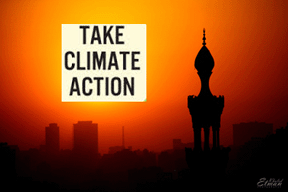 Climate Change (I) Will the Middle East Become ‘Uninhabitable’? IPS, By Baher Kamal This is the first of a two-part series of reports focusing on the impact of climate change on the Middle East & North of Africa region, ahead of the signing ceremony of the Paris climate agreement, on 22 April 2016 in New York. Part II will address the dramatic issue of water scarcity in the region.
CAIRO, Apr 18 2016 (IPS) – This is not about any alarming header—it is the dramatic conclusion of several scientific studies about the on-going climate change impact on the Middle East region, particularly in the Gulf area. The examples are stark.
“Within this century, parts of the Persian Gulf region could be hit with unprecedented events of deadly heat as a result of climate change, according to a study of high-resolution climate models,” a recent Massachusetts Institute of Technology (MIT) research warned.
The research–titled “Persian Gulf could experience deadly heat”, reveals details of a business-as-usual scenario for greenhouse gas emissions, but also shows that curbing emissions could forestall these “deadly temperature extremes.”
The study, which was published in detail ahead of the Paris climate summit in the journal Nature Climate Change, was conducted by Elfatih Eltahir, a professor of civil and environmental engineering at MIT, and Jeremy Pal PhD ’01 at Loyola Marymount University.
The authors conclude that conditions in the Persian Gulf region, including its shallow water and intense sun, make it “a specific regional hotspot where climate change, in absence of significant mitigation, is likely to severely impact human habitability in the future.”
Running high-resolution versions of standard climate models, Eltahir and Pal found that many major cities in the region could exceed a tipping point for human survival, even in shaded and well-ventilated spaces. Eltahir says this threshold “has, as far as we know … never been reported for any location on Earth.”……….
While global models predict sea levels rising from about 0.1 to 0.3 meters by the year 2050, and from about 0.1 to 0.9 meters by 2100, the World Bank says, for MENA, the social, economic, and ecological impacts are expected to be relatively higher compared to the rest of the world. Low-lying coastal areas in Tunisia, Qatar, Libya, United Arab Emirates, Kuwait, and specially Egypt are at particular risk.
Climate change also poses many challenges to the region’s cities, which represent hubs for economic, social, cultural and political activities. Rising sea level could affect 43 port cities—24 in the Middle East and 19 in North Africa, according to the World Bank study.
“In the case of Alexandria, Egypt, a 0.5 meter rise would leave more than 2 million people displaced, with 35 billion dollars in losses in land, property, and infrastructure, as well as incalculable losses of historic and cultural assets.”(TO BE CONTINUED) http://www.ipsnews.net/2016/04/will-the-middle-east-become-uninhabitable/
No comments yet.
1 This Month



Tell the Ukrainian Government to Drop Prosecution of Peace Activist Yurii Sheliazhenko

Petition to revoke the licensing of the Near Surface Nuclear Disposal Facility (NSDF) at Chalk River. https://www.ourcommons.ca/petitions/en/Petition/Details?Petition=e-7247


of the week – STOP SMALL MODULAR REACTORS IN CANADA
To see nuclear-related stories in greater depth and intensity – go to https://nuclearinformation.wordpress.com
-
Archives
- March 2026 (222)
- February 2026 (268)
- January 2026 (308)
- December 2025 (358)
- November 2025 (359)
- October 2025 (376)
- September 2025 (258)
- August 2025 (319)
- July 2025 (230)
- June 2025 (348)
- May 2025 (261)
- April 2025 (305)
-
Categories
- 1
- 1 NUCLEAR ISSUES
- business and costs
- climate change
- culture and arts
- ENERGY
- environment
- health
- history
- indigenous issues
- Legal
- marketing of nuclear
- media
- opposition to nuclear
- PERSONAL STORIES
- politics
- politics international
- Religion and ethics
- safety
- secrets,lies and civil liberties
- spinbuster
- technology
- Uranium
- wastes
- weapons and war
- Women
- 2 WORLD
- ACTION
- AFRICA
- Atrocities
- AUSTRALIA
- Christina's notes
- Christina's themes
- culture and arts
- Events
- Fuk 2022
- Fuk 2023
- Fukushima 2017
- Fukushima 2018
- fukushima 2019
- Fukushima 2020
- Fukushima 2021
- general
- global warming
- Humour (God we need it)
- Nuclear
- RARE EARTHS
- Reference
- resources – print
- Resources -audiovicual
- Weekly Newsletter
- World
- World Nuclear
- YouTube
-
RSS
Entries RSS
Comments RSS
 nuclear-news
Leave a comment