Ukraine sticks with nuclear power, ignoring Chernobyl disaster
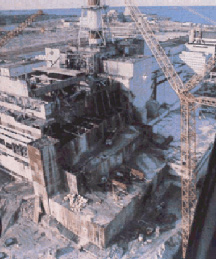 Chernobyl Anniversary: Ukraine Holds Fast to Nuclear Energy Despite Disaster, NBC News, by ALEXEY EREMENKO CHERNOBYL, 17 Apr 16 Ukraine — Three decades after the Chernobyl disaster sent a radioactive cloud over much of Europe, opposition to nuclear power has fizzled into obscurity here.
The huge blast and fire immediately killed 31 people in the northern corner of what is now Ukraine on April 26, 1986. The total death toll is disputed but theWorld Health Organization has estimated that 4,000 other fatalities will eventually be linked to the worst nuclear power plant disaster in history.
With its reactor that burned for days and miles-long columns of evacuation buses carrying thousands of people away from the plume of radiation, memories of the disaster remain vivid in Europe. Fallout was recorded as far away as 1,450 miles away in Britain as well as in Norway.
Worldwide shock turned to anger and triggered calls for a wholesale reassessment of the industry. Germany even plans to decommission all of its reactors by 2022.
But while the incident left locals in what was then the Soviet Union with a first-hand glimpse of the dangers, Ukraine is now among the countries most dependent on atomic fission. …….
CHERNOBYL, Ukraine — Three decades after the Chernobyl disaster sent a radioactive cloud over much of Europe, opposition to nuclear power has fizzled into obscurity here.
The huge blast and fire immediately killed 31 people in the northern corner of what is now Ukraine on April 26, 1986. The total death toll is disputed but theWorld Health Organization has estimated that 4,000 other fatalities will eventually be linked to the worst nuclear power plant disaster in history.
With its reactor that burned for days and miles-long columns of evacuation buses carrying thousands of people away from the plume of radiation, memories of the disaster remain vivid in Europe. Fallout was recorded as far away as 1,450 miles away in Britain as well as in Norway.
Worldwide shock turned to anger and triggered calls for a wholesale reassessment of the industry. Germany even plans to decommission all of its reactors by 2022.
But while the incident left locals in what was then the Soviet Union with a first-hand glimpse of the dangers, Ukraine is now among the countries most dependent on atomic fission. Every second light bulb is powered by uranium.
“Nuclear energy is the foundation of the country’s electricity generation system,” said Ilona Zayec, a spokeswoman for the state monopoly Energoatom.
Last year, the country’s 15 reactors produced 82,000-megawatt-hours of electricity, or 56.5 percent of Ukraine’s total energy consumption, according to Energoatom.
Only France got a larger share of their energy from nuclear power in 2015,according to the United Nations’ IAEA watchdog. The United States only generates 19.5 percent from fission.
“There’s not much trust toward the nuclear industry after the disaster,” said Tetiana Verbytska of the State Scientific and Technical Center for Nuclear and Radiation Safety of Ukraine, a state nuclear safety watchdog. “But while the majority of the population think ‘it’s not safe,’ there’s no alternative.”…….
The disaster is attributed to a combination of faulty construction and human error. However, three of four Chernobyl reactors continued to crank out energy for a decade-plus after the accident……
Geiger counters still go wild in hotspots in the Chernobyl Exclusion Zone, a 19-mile security area around the plant that has become an overgrown forest full of thriving wildlife. A short stay is relatively safe, but the area won’t be fit for human habitation for at least 10,000 years………
That doesn’t mean that Ukrainians believe the nuclear industry is safe — a majority don’t. Almost 65 percent of Ukrainians said their nuclear plants weren’t safe in a 2011 nationwide survey by the Razumkov Center, which is the latest poll available. But only 10 percent of Ukrainians said the nation should shut down its reactors.
The government in Kiev has mothballed plans for more reactors — an unaffordable endeavor in the current economy — but wants to prolong the shelf life of existing ones.
Safety, not the banning of nuclear facilities, is the focus for officials………The answer to why Ukraine preferred boosting safety to decommission is simple: Nuclear energy remains the second cheapest source of electricity in Ukraine after hydropower. However, critics say that’s because the cost of decommissioning existing reactors is not factored in to such calculations…….
The National Ecological Center of Ukraine’s Urbansky has a different view. He was a 12-year-old living around 60 miles away in Kiev at the time of the explosion.
“I feel I was affected, because later I had some health problems,” he said. “[Government officials] tried to do everything not to link any disease with Chernobyl accident, even those who had cancers and leukemia.” http://www.nbcnews.com/news/world/chernobyl-anniversary-ukraine-holds-fast-nuclear-energy-despite-disaster-n554036
2 Comments »
Leave a comment
1 This Month

Petition to revoke the licensing of the Near Surface Nuclear Disposal Facility (NSDF) at Chalk River. https://www.ourcommons.ca/petitions/en/Petition/Details?Petition=e-7247


of the week – STOP SMALL MODULAR REACTORS IN CANADA
To see nuclear-related stories in greater depth and intensity – go to https://nuclearinformation.wordpress.com
-
Archives
- March 2026 (153)
- February 2026 (268)
- January 2026 (308)
- December 2025 (358)
- November 2025 (359)
- October 2025 (376)
- September 2025 (258)
- August 2025 (319)
- July 2025 (230)
- June 2025 (348)
- May 2025 (261)
- April 2025 (305)
-
Categories
- 1
- 1 NUCLEAR ISSUES
- business and costs
- climate change
- culture and arts
- ENERGY
- environment
- health
- history
- indigenous issues
- Legal
- marketing of nuclear
- media
- opposition to nuclear
- PERSONAL STORIES
- politics
- politics international
- Religion and ethics
- safety
- secrets,lies and civil liberties
- spinbuster
- technology
- Uranium
- wastes
- weapons and war
- Women
- 2 WORLD
- ACTION
- AFRICA
- Atrocities
- AUSTRALIA
- Christina's notes
- Christina's themes
- culture and arts
- Events
- Fuk 2022
- Fuk 2023
- Fukushima 2017
- Fukushima 2018
- fukushima 2019
- Fukushima 2020
- Fukushima 2021
- general
- global warming
- Humour (God we need it)
- Nuclear
- RARE EARTHS
- Reference
- resources – print
- Resources -audiovicual
- Weekly Newsletter
- World
- World Nuclear
- YouTube
-
RSS
Entries RSS
Comments RSS
 nuclear-news
To be exact, the United States only gets 8% of its electricity from nuclear energy.
See the Lawrence Livermore energy usage flow charts, such as this one from 2014:
Crazy is crazy does