According to German intelligence, terrorist Salah Abdeslam did not have German nuclear files
German intelligence agency disputes reports Salah Abdeslam had German nuclear files http://www.theguardian.com/world/2016/apr/14/paris-attacks-suspect-salah-abdeslam-had-german-nuclear-files
Spokeman for domestic intelligence agency says its head did not brief MPs on files found in Paris attacks suspect’s flat Guardian, Reuters in Berlin. Germany’s domestic intelligence agency has denied reports that Salah Abdeslam, a prime suspect in the Paris attacks, possessed documents about a nuclear research centre in Germany.
Newspapers in the Redaktions Netzwerk Deutschland (RND) media group said on Thursday that documents were found relating to the Juelich centre near the Belgium-Germany border, which is used for the storage of atomic waste.
The centre said in a statement that there was no indication of any danger and that Juelich was in contact with security authorities and nuclear supervisors.
The RND newspapers cited sources within the parliamentary control committee, whose meetings are confidential, as saying that Hans-Georg Maaßen, the head of the domestic intelligence agency (BfV), told the nine-person committee at the end of March that Abdeslam had the documents.
It said he had disclosed to the committee, which monitors the work of German security agencies, that printouts of articles from the internet and photos of the Juelich chairman, Wolfgang Marquardt, had been found in Abdeslam’s apartment in the Molenbeek area of Brussels.
The BfV on Thursday denied Maaßen had briefed the committee. “This is not right,” a spokeswoman said. “We have no information about this. Our president Maaßen never talked to any members of parliament.”
Two committee members also told Reuters that they had not been informed about the matter.
RND earlier reported that several members of the Bundestag and a terrorism expert at the BfV said they knew of this information and that Maaßen had confidentially informed them.
Abdeslam, born and raised in Belgium to Moroccan-born parents, was arrested on 18 March in Brussels. Four days later, suicide bombers killed 32 people in Brussels airport and on a rush-hour metro train.
Concerns that Islamic extremists are turning their attention to potential weak spots in the nuclear industry have risen since the attacks.
German nuclear centre a target for Paris terrorist?
Paris terrorist was eyeing German nuclear centre http://www.thelocal.de/20160414/paris-attacks-ringleader-had-records-of-german-nuclear-plant 4 Apr 2016 Salah Abdeslam, a key figure in the Paris attacks last November, was gathering information on a nuclear energy research centre in Germany, new evidence seen by German media revealed on Thursday.
- Swedish police hold terror suspect wanted in Germany (13 Apr 16)
- Munich police release suspects after terror probe (08 Apr 16)
- ’11 terror plots foiled in Germany since 2000′ (29 Mar 16)
Salah Abdeslam had documents at his apartment about a nuclear research centre at Jülich in North Rhine-Westphalia, raising concerns for authorities about what he many have been planning on German soil.
The documents included articles printed out from online sources about the research facility, as well as photos of the centre’s head, Wolfgang Marquardt, newspapers under the publishing group Redaktionsnetzwerk Deutschland (RND) reported, citing members of a parliamentary panel.
Abdeslam is currently being held in a Belgian prison, waiting to be deported to France, where he will face trial for terrorism offences in connection with the November 13th Paris attacks that left 130 dead.
The most recent documents were reportedly found inside of Abdeslam’s apartment where the French national was arrested last month in the Molenbeek district of Brussels.
Just days later, three bombs went off in Brussels in a coordinated terror attack that killed 32 people.
German domestic intelligence (Verfassungsschutz) President German Hans-Georg Maaßen reportedly informed several members of a Bundestag (German Parliament) security committee last month about the findings.
But according to RND, the Chancellery and the Interior Ministry declared that they did not have any information about the documents.
Similar information about the Brussels terrorists monitoring a Belgian nuclear scientist several weeks ago fueled speculation that they could have been planning to somehow get radioactive material for a dirty bomb, perhaps by blackmailing the researcher. They reportedly spied on the researcher, including filming him at his home for hours.
Immediately after the Brussels attacks, a Belgian nuclear power plant was evacuated of all non-essential personnel. Officials were also concerned when it emerged that two former Belgian nuclear power plant workers had gone to Syria to fight with Isis, one of whom was killed.
German nuclear power plants are extensively protected against the possibility of any interferences or other actions by an outside person, including terror attacks, according to the German Environment Ministry.
But according to environmental NGO BUND, the reactors are not sufficiently safe enough against air attacks.
The folly of wasting time and money on EPR nuclear reactor
 Nuclear power and climate change Too little, too late
The EPR nuclear reactor A dangerous waste of time and money NIRS Briefing January 2012 The French EPR* is a nuclear reactor design that is aggressively marketed by the French companies Areva and EDF. Despite the companies’ marketing spin, not only is the reactor hazardous, it is also more costly and takes longer to build than renewable-energy alternatives. While no EPR is currently operating anywhere in the world, four reactors are under construction in Finland (Olkiluoto 3, construction started in 2005), France (Flamanville 3, 2007) and China (Taishan 1 and 2, 2009-10). The projects have failed to meet nuclear safety standards in design and construction, with recurring construction defects and subsequent cover-ups, as well as ballooning costs and timelines that have already slipped significantly.
EDF in America going for wind power, abandoning nuclear
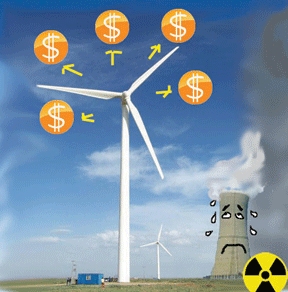 EDF shows that wind makes better sense than nuclear,Ecologist Chris Goodall April 2016 EDF in the UK may be propelled by its disastrous nuclear ambitions, writes Chris Goodall. But across the Atlantic it’s another story: the company is the US’s biggest wind developer, and selling its power, profitably, for under 40% of the price it has been promised for Hinkley C, including federal tax credits…….
Within the same company, they do things very differently on the other side of the Atlantic; there EDF focuses wholeheartedly on wind and has no nuclear under development.
It has just proudly announced that it has become the largest wind developer in North America with a portfolio in 2015 of over 1 gigawatt of newly constructed wind farms.
If it continues at the current rate, it will be generating more electricity from wind by 2025 than would be provided by Hinkley Point C. The numbers are as follows. Hinkley will generate about 25 terawatt hours a year. EDF’s 2015 annual portfolio of new wind projects will provide about 3 terawatt hours a year at average US utilisation factors.
If it continues to develop new wind projects at the rate of 1 gigawatt a year, it will be generating well over 30 terawatt hours a year from wind by the end of 2025. 2025 is when EDF says Hinkley will be finished.
What about the capital cost of wind versus nuclear? The latest US estimates suggest a figure of about $1,700 per kilowatt of capacity. That means EDF’s projects completed in 2015 cost about $1.8bn. Over ten years, that rate of installation will mean a total cost of around $18bn or about £13bn. Wind is therefore at least 30% cheaper to construct.
And it is much cheaper to operate. The most important project it completed in 2015, the 250 MW farm at Roosevelt in New Mexico, has sold its electricity for the next 20 years to a utility for $23.39 a megawatt hour, less than 20% of the price agreed for Hinkley of £92.50/MWh.
Note that the Roosevelt price is somewhat subsidised by Federal tax credits but even without this benefit the cost of wind would be less than 40% of the price of UK nuclear. Wind saves consumers money when compared to the nuclear alternative.
It’s simple really: renewables are a better and more secure investment
EDF finances many of its US wind projects on the back of power purchase agreements with major companies such as Microsoft, Procter and Gamble and Google. They commit to buy the electricity produced at a fixed price, not the inflation adjusted figure that the UK will pay for Hinkley. The EDF press release said:
“Corporate America is increasingly turning to renewable energy to power its business operations, based both on consumer preferences and because renewable energy simply makes economic sense.”
We never hear this line from EDF in the UK.
EDF cannot guarantee the wind will blow or the sun shine. Unlike in Britain, its US business is also investing heavily in energy storage. The US company has announced 100MW of battery systems in the US because “Energy storage is an attractive, cost-effective addition to intermittent energy generation projects.” However there’s no mention of batteries on EDF’s UK web site.
For sensible reasons large international companies often pursue varied market strategies in different countries. EDF in the US has decided to back wind while the UK has gone for nuclear.
But even a quick look shows that the energy and financial returns to the US strategy seem far clearer and better for the company, and its customers, than the tactics of the UK business. http://www.theecologist.org/blogs_and_comments/commentators/2987489/edf_shows_that_wind_makes_better_sense_than_nuclear.html
American nuclear engineer arrested for allegedly secretly helping China’s nuclear program
 US Engineer Helped China’s Nuclear Program for 2 Decades, Authorities Say http://abcnews.go.com/US/us-engineer-helped-chinas-nuclear-program-decades-authorities/story?id=38403235 By MIKE LEVINE Apr 14, 2016 The FBI has arrested an American nuclear engineer in Delaware for allegedly spending the past two decades illegally helping China build nuclear material with expertise he gleaned from others inside the United States.
According to a federal indictment unsealed today in Tennessee, Allen Ho — a naturalized U.S. citizen with residency in both Delaware and China — worked with others inside the United States to help Chinese agencies develop and produce “special” material relating to nuclear reactors.
Under the direction of a Chinese government agency, Ho allegedly identified and recruited experts from the U.S. civil nuclear industry who could provide the technical assistance he sought — often paying them for their help or arranging for them to travel to China, prosecutors say.
“China has the budget to spend,” Ho allegedly told one of the experts he tried to recruit in 2009. “China will be able to design their Nuclear Instrumentation System independently and manufactur[e] them independently after the project is complete.”
Specifically, Ho and others looked to obtain what the Justice Department calls “integral assistance” and “sensitive nuclear technology” relating to a “Small Modular Reactor Program” and an “Advanced Fuel Assembly Program” in China, and the group allegedly also sought help with nuclear reactor-related computer codes.
“Prosecuting those who seek to evade U.S. law by attaining sensitive nuclear technology for foreign nations is a top priority for [us],” the head of the Justice Department’s National SecurityDivision, John Carlin, said in a statement.
While operating his own technology firm based in Delaware, Ho has also been a senior adviser with China’s largest nuclear power company, which specializes in the development and manufacture of nuclear reactors, according to prosecutors.
Charged with conspiracy to unlawfully engage and participate in the production and development of special nuclear material outside the United States, Ho could face life in prison if convicted.
“The arrest and indictment in this case send an important message to the U.S. nuclear community that foreign entities want the information you possess,” FBI Executive Assistant Director Michael Steinbach said. “The federal government has regulations in place to oversee civil nuclear cooperation, and if those authorities are circumvented, this can result in significant damage to our national security.”
Wind power – the big buy-up by big companies
Why companies like Google and Walmart are buying so much wind power, WP, By Brady Dennis April 12 The U.S. wind energy industry had a memorable 2015, from installing thousands of new turbines across the country to supporting a growing number of jobs.
But perhaps one of the most noteworthy brights spots of the past year, according to an annual report released Tuesday by the American Wind Energy Association (AWEA), was the growing demand for wind energy from major corporations. High-tech firms such as Google Energy, Facebook and Amazon Web Services, as well as more traditional companies such as Procter & Gamble, General Motors, Walmart and Dow Chemical, have signed contracts to purchase increasing amounts of wind energy in coming years.
Corporations and other non-utility customers — including some municipalities and universities — accounted for more than half of the wind power capacity sold through so-called power purchase agreements in 2015, according to the AWEA. The group said that corporate and other non-utility buyers have signed contracts for more than 4,500 megawatts of wind power capacity, or enough to power the equivalent of about 1.2 million American homes.
Why does that matter?
[These states are setting wind energy records – and suing over Obama’s climate plans]
- Wind energy is seeing a global, not just a domestic boom. While the United States generated more electricity from wind than in any previous year during 2015, China outpaced every other nation in the amount of new wind energy capacity. China, the United States, Germany, Brazil and India combined to produce more than 80 percent of all new wind capacity installations in 2015, according to the AWEA………https://www.washingtonpost.com/news/energy-environment/wp/2016/04/12/why-companies-like-google-and-walmart-are-buying-so-much-wind-power/
Rapid collapse of ice shelves in Antarctica
 Scientists Are Watching in Horror as Ice Collapses Everything we learn about ice shows that it is disturbingly fragile, even in Antarctica. National Geographic, By Douglas Fox APRIL 12, 2016 “……..The catastrophic collapse of Larsen A and several other ice shelves along the Antarctic Peninsula has yielded important lessons about the vulnerability of Antarctica’s ice sheets to a warming climate. A new analysis of ice sheet instability, published March 31 in Nature, took the public by surprise when it projected that global sea level might rise six feet by 2100, and as much as 40 to 50 feet by the year 2500. (Read “Why the New Sea Level Alarm Can’t Be Ignored.”) That study seemed to double, overnight, the amount of sea level rise that can be expected. But many glacial scientists weren’t surprised. The new estimate is based on insights that have emerged slowly, over 20 years, in the aftermath of these ice shelf collapses.
The Aftermath of an Ice Shelf Collapse
Explore the fjords along the northeastern Antarctic Peninsula today, and it’s easy to find landscapes that look scarred even to the casual observer. …..
The glacier, now absent, had retreated several miles into its fjord. The fjord used to hold 2,000 feet (600 meters) of ice. Now it held 2,000 feet of seawater instead.
The aftermath of an ice shelf collapse is obvious in Sjögren’s fjord. When the ice shelf in front of Sjögren disintegrated in 1995, it removed the buttress that stabilized the glacier. The glacier started sliding into the sea at twice its original speed. Sjögren erupted in crevasses and thinned by several hundred feet as it stretched. After a few years, the glacier had retreated miles into its fjord as icebergs splintered off the glacier’s front faster than the ice could flow forward…….
Every ice shelf that disintegrated along the Antarctic Peninsula has shown the same pattern: summer melting of its top layers, winter refreezing of those top layers into icy crusts able to hold large melt ponds, and the re-exposure of long-buried crevasses.
For all of these ice shelves, the moment of death occurred suddenly. Each collapse began when water from the melt ponds drained into the crevasses. The weight of the water drove the cracks deeper—like a wedge, says Ted Scambos, a glaciologist with the National Snow and Ice Data Center at the University of Colorado in Boulder, who discovered the process. These fluid wedges eventually broke through the bottom of the ice shelf, calving off one iceberg, then another and another—a process called hydrofracturing that can devour an ice shelf nearly the size of Rhode Island in a matter of hours or days……..
Ice loss may have begun at a narrow beachhead in Antarctica, at the north end of the Antarctic Peninsula, but it has expanded on multiple fronts, as new regions of ice come into play every several years. As warm summer temperatures push farther south, so will the problems of melt ponding, ice shelf disintegration, and ice cliff collapse, which drive the rapid retreat of ice. (Read more about how calving causes mini-tsunamis daily in Antarctica.)
Scattered melt ponds already appear on some of the ice shelves that surround the Antarctic mainland, much farther south than any that have collapsed so far. The amount of ice lost each year from all of Antarctica’s ice shelves has increased 12-fold between 1994 and 2012.
Aside from warm air, the fringes of Antarctica’s ice are under assault from another source—warming ocean currents that melt the undersides of ice shelves. (Read more about research on what climate change will mean for whales.)……..http://news.nationalgeographic.com/2016/04/160412-ice-sheet-collapse-antarctica-sea-level-rise/
Widespread support for Church of England’s stand against Exxon Mobil
Church of England takes on energy giant ExxonMobil http://www.christiantoday.com/article/church.of.england.takes.on.energy.giant.exxonmobil/83931.htm Mark Woods CHRISTIAN TODAY CONTRIBUTING EDITOR 13 April 2016 The Church Commissioners have won widespread support for a move to put pressure on energy giant ExxonMobil to disclose the impact of climate change policy on its business.
The Church Commissioners manage a fund of around £6.7 billion, whose revenues are used to support the Church of England. The Commissioners co-filed a shareholder motion with the New York State Comptroller Thomas DiNapoli. It asks Exxon to disclose the effect on its business if measures to restrict global warming to two degrees are successful.
More than 30 institutional investors have so far said they will vote for the motion.
Exxon’s competitors Shell and BP have already agreed to disclose how much they will be impacted by efforts to lower greenhouse gas emissions. They were targeted by similar shareholder proposals co-filed in 2015 by the Church Commissioners and other investors. Exxon had attempted to have the resolution struck down by the Securities and Exchange Commission but its request was denied last month.
Church Commissioners spokesman Edward Mason said: “We are delighted with the scale of support this resolution has received so far. The resolution is part of a much wider trend following the Paris Agreement for investors to ask companies to improve disclosure on how they are positioned for the risks and opportunities posed by climate change.”
Exxon has funded groups spreading information denying human-induced climate change and lobbying politicians against climate change legislation. While it pledged to cease doing so in 2007, a Guardian report last July claimed it was continuing the practice.
It has a long history of rejecting shareholder motions on climate change and of rejecting the scientific consensus.
When Exxon challenged the most recent shareholder motion, DiNapoli said: “ExxonMobil risks becoming an outlier among its peers who have publicly supported reining in climate change.
“As investors, we need to know how ExxonMobil’s bottom line will be impacted by the global effort to reduce emissions and what the company plans to do about it.”
Exxon is also under under pressure from a coalition of 17 US attorneys general, Attorneys General United for Clean Power (AGUCP), who have banded together to enforce climate change laws. New York attorney general Eric Schneiderman announced at a press conference on March 29 that the coalition was working to find “creative ways to enforce laws being flouted by the fossil fuel industry and their allies in their shortsighted efforts to put profits above the interests of the American people and the integrity of our financial markets”.
Schneiderman referred to a “relentless assault from well-funded, highly aggressive and morally vacant forces that are trying to block every step by the federal government to take meaningful action” to fight climate change.
The initiative by the attorneys general was criticised by some religious conservatives, however.
Jeffrey Riley, professor of ethics at New Orleans Baptist Theological Seminary, told Baptist Press: “Few deny that the climate is changing – it always has. The debate is on the cause. In spite of the public rhetoric that declares scientific consensus, the debate is still out. Public and political rhetoric on this issue is neither truth nor an argument for truth. Christians who hold that we are stewards of the earth ought to be interested in truth, and for that reason should not support any action that stifles legitimate scientific and economic debate.”
Climate Change Threatening Mt Everest
Climate Change Is Melting Everest Research shows that higher temperatures around the world’s tallest peak are thawing its glaciers, which could spell doom for villages in the Khumbu Valley, Outside, By: Anna Callaghan Apr 12, 2016 “As a colorful circus of tents pops up at Everest Base Camp this spring, a pair of Ph.D. students will set up camp 1,000 feet downvalley, on the Khumbu Glacier, resuming a research project they started last year. Their goal: to determine just how quickly the world’s highest glacier is melting.From the Alps to the Andes, ice at high elevations is disappearing rapidly. On Everest, the effects of a warming planet are likely to manifest in two ways that affect climbers. First, the Khumbu Glacier will shrink, and parts of it could possibly become impassable for climbers. Someday, even Base Camp may have to be moved from its current location on the glacier to another spot nearby.
Second, the Khumbu Icefall between Base Camp and Camp I may see a higher frequency of rock and ice avalanches—like the one that killed 16 Sherpas in 2014. The Icefall naturally migrates downhill between three and four feet per day, but that could accelerate as temperatures rise. Earth’s average surface temperature has gone up by more than 1.5 degrees since the late 1800s, and two-thirds of that warming has taken place since 1975
“It doesn’t take a rocket scientist to work out that if you increase the temperature where ice is normally frozen to the bedrock, the hold is going to be weakened and become increasingly unstable and the ice is more likely to detach from the bedrock,” says Duncan Quincey, professor of geomorphology at the University of Leeds, in the UK. He is supervising the research of Owen King and Scott Watson, the Ph.D. students who will spend a few weeks on the glacier this spring. “In places like the Icefall we’ve seen these tragic accidents, and I think it’s fair to say it’s symptomatic of high-elevation warming.”……http://www.outsideonline.com/2067651/climate-change-melting-everest
Fake safety check at German nuclear facility
Nuclear staff feigned safety check just before SZ.de newspaper
magazine [Google translation]
The Ministry of Environment of Baden-Württemberg has the operator now prohibited, the affected reactor Philippsburg 2 to go back. From Michael Bauchmüller , Berlin 14 Apr 16
The power company EnBW has uncovered a serious vulnerability in one of its nuclear power plants. As the company announced on Wednesday, an employee of an external service faked last December a security check, without having performed it. The Ministry of Environment in Stuttgart said on Wednesday the re-start of the reactor……..http://www.sueddeutsche.de/politik/vom-netz-genommen-akw-mitarbeiter-taeuschte-sicherheitspruefung-nur-vor-1.2948941
Conspiracy charges against Chinese state-owned nuclear firm an US citizen
Chinese state-owned firm, US citizen charged in nuclear case: US http://www.smh.com.au/world/chinese-stateowned-firm-us-citizen-charged-in-nuclear-case-us-20160414-go6w6t.html
April 15, 2016 Washington: A Chinese state-owned nuclear power company and a US citizen were indicted on Thursday on charges of conspiracy to produce special nuclear material outside the United States without the required US authorisation, the Justice Department said.
The China General Nuclear Power Company and Allen Ho, a naturalised US citizen and a nuclear engineer, were charged in a two-count indictment in the Eastern District of Tennessee, the department said in a statement.
Operating licence for Olkiluoto 3 nuclear reactor applied for by TVO
Finland’s TVO applies for delayed Olkiluoto nuclear plant licence http://uk.reuters.com/article/finland-nuclearpower-idUKL5N17H192 Apr 14, 2016
Finnish utility Teollisuuden Voima (TVO) has applied for an operating licence for its much-delayed Olkiluoto 3 nuclear reactor, saying it is on track to start production in late 2018.
“This is a significant milestone. The project is moving from installations to tests,” project manager Jouni Silvennoinen said in a statement on Thursday.
It was originally due to start operation in 2009, and TVO has traded blame for the delay with the plant’s supplier consortium Areva-Siemens , with both demanding billions of euros from each other in an ongoing arbitration at the International Chamber of Commerce. (Reporting by Jussi Rosendahl; Editing by Alexander Smith)
Nuclear issue is a complicated one for election in Wales
Welsh election: Nuclear issue ‘difficult’ for Plaid, BBC News 14 Apr 16 Opposing nuclear power is difficult for Plaid Cymru, its leader has said, because of the jobs which depend on it.
Leanne Wood told a live BBC TV election special the party was “very clear” in its opposition to nuclear weapons.
But she said in terms of jobs on Anglesey, the nation had “put all our eggs in the nuclear basket” with 6,000 people working at Wylfa power station.
Ms Wood said if a replacement for Wylfa did not go ahead, an alternative source of jobs would have to be found.
Speaking on BBC Wales TV’s Ask the Leader programme in Aberystwyth, she said: “Plaid Cymru is opposed to Trident and we’ve been very clear on the case of opposing nuclear weapons.
“On the case of nuclear power that’s a little bit more difficult for us, I will be honest with you. This has not been a straight forward question for Plaid Cymru.
“I’m not personally convinced that nuclear power is the answer and I’m not convinced that it stacks up financially.
“I would prefer us to take more of a renewables-based approach. We’ve got in our manifesto an aim to meet all the electricity needs in as far as we can in Wales… renewably by 2035.”
Plans are being made for a new power station called Wylfa Newydd to be built next to the old Wylfa plant, which is being decommissioned.
Horizon Nuclear Power, owned by the Japanese giant Hitachi, is still in the process of drawing up detailed plans, which will be submitted by 2017………http://www.bbc.com/news/election-2016-wales-36050553
Nuclear terrorism
The Reality of Fighting Nuclear Terror, GeoPolitical MonitorApril 14, 2016 K.N. Pandita In the two-day summit in Washington (March 31 – April 1), representatives of 49 countries interacted on the danger of terrorists acquiring nuclear weapons as “the most immediate and extreme threat to global security.”
Have the four meetings of NSS since 2009 achieved the objective? It is a moot question. Radioactive materials in numerous countries are still vulnerable. International nuclear security architecture continues to be fragmented and predominantly based on nonbinding measures. And the NSS has not left behind a successor.
Russia’s refusal to participate in Washington Summit dealt a blow to the success of NSS because she has the largest stock of weapons-usable materials in the world.
Concerns about the security of nuclear holdings apply to various countries, ranging from Pakistan, where terrorist groups are highly active, to the United States, who’s Y-12 National Security Complex in Oak Ridge, Tennessee – home to large stocks of HEU – was infiltrated in 2012 by a group of activists. Keeping away North Korea and Iran from the NSS puts the very concept of the summit into controversy.
Without true multilateral initiatives, success in battling nuclear terror may remain elusive. Initiatives like the Global Initiative to Combat Nuclear Terrorism and the G-8 Global Partnership against the Spread of Weapons of Mass Destruction, the International Atomic Energy Agency, the United Nations, European Union, and Interpol all have significant role to play.
Are the big nuclear powers really willing to make a breakthrough and secure the world against the threat of nuclear weapons falling in wrong hands? The summit did not propose concrete steps towards this objective.
Pakistan, the unstable nuclear power in South Asia, is vulnerable to nuclear pilferage. That notwithstanding, the U.S. has sold eight nuclear-capable F-16 Fighters to her on the plea of strengthening her thrust to quell terror and insurgency in her north. In the past, Pakistan has used American gifted weapons against India. It is the United States’ indirect recognition of Pakistan legitimizing use of the nuclear option. Put simply, the decision grossly contradicts the spirit of the NSS…….https://www.geopoliticalmonitor.com/the-reality-of-fighting-nuclear-terror/
1 This Month

of the week – Shut Down Drone Warfare!


Tell the Ukrainian Government to Drop Prosecution of Peace Activist Yurii Sheliazhenko

Petition to revoke the licensing of the Near Surface Nuclear Disposal Facility (NSDF) at Chalk River. https://www.ourcommons.ca/petitions/en/Petition/Details?Petition=e-7247
To see nuclear-related stories in greater depth and intensity – go to https://nuclearinformation.wordpress.com
-
Archives
- April 2026 (91)
- March 2026 (251)
- February 2026 (268)
- January 2026 (308)
- December 2025 (358)
- November 2025 (359)
- October 2025 (376)
- September 2025 (257)
- August 2025 (319)
- July 2025 (230)
- June 2025 (348)
- May 2025 (261)
-
Categories
- 1
- 1 NUCLEAR ISSUES
- business and costs
- climate change
- culture and arts
- ENERGY
- environment
- health
- history
- indigenous issues
- Legal
- marketing of nuclear
- media
- opposition to nuclear
- PERSONAL STORIES
- politics
- politics international
- Religion and ethics
- safety
- secrets,lies and civil liberties
- spinbuster
- technology
- Uranium
- wastes
- weapons and war
- Women
- 2 WORLD
- ACTION
- AFRICA
- Atrocities
- AUSTRALIA
- Christina's notes
- Christina's themes
- culture and arts
- Events
- Fuk 2022
- Fuk 2023
- Fukushima 2017
- Fukushima 2018
- fukushima 2019
- Fukushima 2020
- Fukushima 2021
- general
- global warming
- Humour (God we need it)
- Nuclear
- RARE EARTHS
- Reference
- resources – print
- Resources -audiovicual
- Weekly Newsletter
- World
- World Nuclear
- YouTube
-
RSS
Entries RSS
Comments RSS
 nuclear-news