Wind power in America in a big way, and transmission grid development

US Wind Energy Juggernaut: You Ain’t Seen Nothing Yet (CT Exclusive Interview), Clean Technica, April 4th, 2016 by Tina Casey The American Wind Energy Association will release its much anticipated annual report on April 12, and the group’s CEO Tom Kiernan provided CleanTechnica with some advance insights during a one-on-one phone chat last week. Hint: it’s gonna be big.
Kiernan also discussed two recent major milestone developments in the US wind industry, one being the construction of the nation’s first ever offshore wind farm — which will finally open the floodgates to developing the immense Atlantic Coast wind resources — and the other involving the Energy Department in what will be the biggest ever renewable energy project in the US.
The 2015 American Wind Energy Association Report
AWEA has already teased some info for its 2015 annual wind energy report to the press, underscoring the sector’s reduction in carbon dioxide, sulfur dioxide, and nitrogen emissions:
Electricity generated by wind in 2015 displaced an estimated 176,000 metric tons of SO2 and 106,000 metric tons of NOx, representing $7.3 billion in avoided health costs last year alone.
AWEA provides third-party statistics that suggest wind sector growth has contributed to a total US power sector emissions drop down to 1995 levels, while average electricity rates dropped — yes, dropped — 5.5 percent below 2009.
The group also states that “wind energy is the most cost-effective energy source to comply with the Clean Power Plan” put forth by President Obama last summer, and in the interview Kiernan emphasized that wind also provides the US with a pathway for honoring its Paris COP21 global climate pledge.
Among other tidbits, AWEA’s 2015 statistics reveal that the US is now #1 in global wind energy production.
During his conversation with CleanTechnica, Kiernan provided this additional teaser for the 2015 report:
There will be some exciting news about jobs growth…for example wind technicians [maintenance, service and repair positions] is now the fastest-growing profession in the country…
The group has also has some big news about private sector, non-utility wind investments and it has scheduled another preview announcement about the report for April 7, so stay tuned for that.
Offshore Wind Ready For Its Closeup
CleanTechnica’s conversation with Kiernan began with a discussion of the soon-to-be-completed Block Island wind farm off the coast of Rhode Island. Offshore wind energy development faces some technological challenges compared to onshore, so getting “steel in the water” is a major development for the industry:………
Biggest Ever Clean Power Project In The US
The other big development is the Energy Department’s announcement that it will get behind the proposed 700-mile megawatt Clean Line Plains & Eastern transmission line, designed primarily to transport electricity from Oklahoma and Texas wind farms through Arkansas to Tennessee and points east.
At 4,000 megawatts, Plains & Eastern counts as the biggest renewable energy project so far in US history. By way of comparison, the Hoover Dam hydropower plant clocks in at 2,000 megawatts of capacity.
The other striking thing about the project is the Energy Department approval (check out theTennessee Valley Authority for an idea of the scale and impact of major federally sanctioned energy initiatives).
As described by Kiernan, federal involvement provides wind with the same procedural advantages that other conventional forms of energy have long enjoyed:
It’s important for building momentum for [wind] transmission projects throughout the country…conventional power has long term, proven regulatory processes that are speedier. This is the first one for clean energy…it’s a very important step for the industry. This is a transformational project.
US Wind Energy Rising………http://cleantechnica.com/2016/04/04/us-wind-energy-takes-off-with-transmission-offshore-farm/
New campaign ‘Two Degrees of Change’ urges female executives to demand action on climate change
New campaign enlists women in boardrooms to take up climate issue
UN-backed ‘Two Degrees of Change’ encourages female executives to demand action from their companies to stave off the threat of global warming, Guardian. Fiona Harvey 12 Apr 16, Women working in financial services are opening a new front in the battle against climate change, with the launch of a UN-backed initiative to take global warming concerns into business boardrooms.
Helena Morrissey, chief executive of Newton Investment Management and a long-time campaigner for women in boardrooms, is spearheading the new “Two Degrees of Change” initiative. Under it, women will be encouraged to raise climate issues with their company boards, and demand companies and investors take action to stave off the threat of dangerous warming.
The name comes from the pledge made by governments at the historic Paris climate conference in December to limit global warming to no more than 2C, which scientists say is the threshold of safety.
Morrissey, who set up the “30% Club” named for her target to see 30% of board seats in big companies going to women, told the Guardian: “This is about having more women in senior roles [in business] focusing on climate change and changing the narrative. We need female voices in our boardrooms on this.”
Shareholders would benefit, she said, as the risks of climate change are still poorly taken into account in many companies, and traditional financial services companies have yet to make the major changes likely to be necessary in strategy.
Morrissey added that many women were more aware of climate change as a pressing problem than men at the top of the financial services sector. “Women are often interested in these areas more than men, and interested in a long-term view,” she said. “Many women find themselves working within an established culture at old-fashioned companies.”
Forming a network dedicated to helping women would be beneficial for businesses as well as the climate, she said: “Women see how change can happen within their companies, but they need encouragement and empowerment to speak out.”
She was joined at the launch on Monday in London by Christiana Figueres, the UN’s climate chief who led the successful negotiations at Paris, and Rachel Kyte, former vice president of the World Bank leading on climate change and now senior representative for the UN on sustainable energy, as well as a roll-call of City women specialising in green issues.
Figueres also highlighted links between the issues: “There is a clear parallel between the progress we’ve seen on gender equality and climate change in the last six years. Evidence suggests a greater presence of women the boardroom and in senior leadership can help increase the corporate focus on climate change.”
The UN’s climate change arm, the UN Framework Convention on Climate Change, has championed the representation of women through its “Women for Results” grouping……..http://www.theguardian.com/environment/2016/apr/11/un-launches-campaign-to-enlist-women-in-boardrooms-to-take-up-climate-issue
Sea level rise has been underestimated – new ice studies suggest
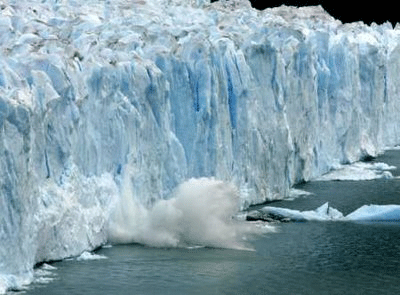 Ice melt studies say we underestimate sea level rise, Independent Australia Peter Boyer 11 April 2016, Are melting polar ice sheets as stable as we think, or have we missed something? If a couple of new ice studies are only partly right, we face massive disruption from sea level rise within decades.
SCIENTIFIC DEBATE about this has picked up in the wake of the March publication of two major research papers by scientists from the U.S., France, Germany and China.
A paper by James Hansen and 18 other climatologists in the open-access science journal Atmospheric Chemistry and Physics, examined ancient climate change to assess how that compares with today’s melting of Greenland and Antarctic ice sheets.
It argues that during this century, ice sheet meltwater spreading over parts of the Southern Ocean and the North Atlantic will increase the temperature variation between these cooler parts and warming regions, resulting in more violent storms.
The meltwater layer also acts as a transparent lid on warming ocean waters undermining polar ice sheets sitting on bedrock below sea level. The paper’s startling prediction is that consequent disintegration could bring several metres of sea level rise within 150 years and possibly by 2070.
A paper published last week in the science journal Nature, also examining past rapid changes, looked at how the Antarctic ice sheet might react to warming of atmosphere as well as ocean, and reached similarly disturbing conclusions.
U.S. scientists Robert DeConto and David Pollard studied the puzzle of how the massive Antarctic ice sheet shed large amounts of ice over relatively short time-frames in prehistoric warming events.
Their modelling showed that if today’s high carbon emissions continue, warmer air would add to the impact of warming seas. Fracturing ice shelves and coastal cliffs would bring rapid ice loss and contribute ‘more than a metre of sea-level rise by 2100’………https://independentaustralia.net/environment/environment-display/ice-melt-studies-say-we-underestimate-sea-level-rise,8866
World powers worried at effects of climate change, drought, causing conflicts
We’re running out of water, and the world’s powers are very worried, Reveal, By Nathan Halverson / April 11, 2016 Secret conversations between American diplomats show how a growing water crisis in the Middle East destabilized the region, helping spark civil wars in Syria and Yemen, and how those water shortages are spreading to the United States.
Classified U.S. cables reviewed by Reveal from The Center for Investigative Reporting show a mounting concern by global political and business leaders that water shortages could spark unrest across the world, with dire consequences.
Many of the cables read like diary entries from an apocalyptic sci-fi novel.
“Water shortages have led desperate people to take desperate measures with equally desperate consequences,” according to a 2009 cable sent by U.S. Ambassador Stephen Seche in Yemen as water riots erupted across the country.
On Sept. 22 of that year, Seche sent a stark message to the U.S. State Department in Washington relaying the details of a conversation with Yemen’s minister of water, who “described Yemen’s water shortage as the ‘biggest threat to social stability in the near future.’ He noted that 70 percent of unofficial roadblocks stood up by angry citizens are due to water shortages, which are increasingly a cause of violent conflict.”
Seche soon cabled again, stating that 14 of the country’s 16 aquifers had run dry. At the time, Yemen wasn’t getting much news coverage, and there was little public mention that the country’s groundwater was running out.
These communications, along with similar cables sent from Syria, now seem eerily prescient, given the violent meltdowns in both countries that resulted in a flood of refugees to Europe.
Groundwater, which comes from deeply buried aquifers, supplies the bulk of freshwater in many regions, including Syria, Yemen and drought-plagued California. It is essential for agricultural production, especially in arid regions with little rainwater. When wells run dry, farmers are forced to fallow fields, and some people get hungry, thirsty and often very angry.
The classified diplomatic cables, made public years ago by Wikileaks, now are providing fresh perspective on how water shortages have helped push Syria and Yemen into civil war, and prompted the king of neighboring Saudi Arabia to direct his country’s food companies to scour the globe for farmland. Since then, concerns about the world’s freshwater supplies have only accelerated……..
The water-fueled conflicts in the Middle East paint a dark picture of a future that many governments now worry could spread around the world as freshwater supplies become increasingly scarce. The CIA, the State Department and similar agencies in other countries are monitoring the situation.
In the past, global grain shortages have led to rapidly increasing food prices, which analysts have attributed to sparking the Arab Spring revolution in several countries, and in 2008 pushed about 150 million people into poverty, according to the World Bank.
Water scarcity increasingly is driven by three major factors: Global warming is forecast to create more severe droughts around the world. Meat consumption, which requires significantly more water than a vegetarian or low-meat diet, is spiking as a growing middle class in countries such as China and India can afford to eat more pork, chicken and beef. And the world’s population continues to grow, with an expected 2 billion more stomachs to feed by 2050……..
These problems are not just happening overseas, but already are leading to heated political issues in the United States. In the western part of the country, which Nestle forecast will suffer severe long-term shortages, tensions are heating up as Middle Eastern companies arrive to tap dwindling water supplies in California and Arizona………
Back in Yemen in 2009, U.S. Ambassador Seche described how as aquifers were drained, and groundwater levels dropped lower, rich landowners drilled deeper and deeper wells. But everyday citizens did not have the money to dig deeper, and as their wells ran dry, they were forced to leave their land and livelihoods behind.
“The effects of water scarcity will leave the rich and powerful largely unaffected,” Seche wrote in the classified 2009 cable. “These examples illustrate how the rich always have a creative way of getting water, which not only is unavailable to the poor, but also cuts into the unreplenishable resources.” https://www.revealnews.org/article/were-running-out-of-water-and-the-worlds-powers-are-very-worried/
Religious groups urge US lawmakers to approve funding for Green Climate Fund (GCF)
Faith groups call for more international climate funding The Hill, By Devin Henry – 04/11/16 More than 120 religious groups are encouraging lawmakers to approve President Obama’s proposed $750 million contribution to an international climate change fund.
In a letter to members of Congress, the groups say the  is an important way to “build resilience and stability in the face of the unavoidable impacts of climate change,” an issue they say their faith backgrounds call them to focus on.
The GCF is an international pool of money designed to help poor and developing countries cope with climate change. Obama has requested Congress provide $750 million for the fund in 2017. …….http://thehill.com/policy/energy-environment/275864-faith-groups-call-for-more-international-climate-funding
UN study of 1.5 degrees Celsius – it may not be feasible
U.N. panel to study a cap on global warming that may be out of reach http://www.reuters.com/article/us-climatechange-temperatures-idUSKCN0X81PH OSLO/LONDON | BY ALISTER DOYLE AND NINA CHESTNEY Top climate scientists will launch a study this week of how hard it would be to limit global warming to 1.5 degrees Celsius (2.7 Fahrenheit), although many of them fear it might be too late to reach that level.
The world’s average surface temperatures reached 1C (1.8F) above pre-industrial times in a record-hot 2015. They will rise by 3C (3.6F) or more by 2100 if current trends continue, many projections show.
A 195-nation climate summit in Paris in December asked the U.N.’s Intergovernmental Panel on Climate Change for a report in 2018 on limiting warming to just 1.5C. The IPCC began a three-day meeting in Nairobi on Monday to consider how to do that.
“Do we know how? No. It is definitely a moon shot,” Christiana Figueres, the U.N.’s climate chief, said at a conference in London on Monday.
Paris set a goal of limiting average surface temperatures to “well below” 2C while “pursuing efforts” for 1.5C. Documents prepared for the Nairobi meeting say scientific literature about 1.5C is thin.
Many scientists have barely focused on the 1.5C goal, reckoning it would require unrealistically deep cuts in emissions. Experts say the IPCC will comply with the Paris request, with misgivings.
“I don’t seek how they can say ‘No’,” David Victor, a professor of international relations at the University of California, San Diego, told Reuters. “But I don’t see how they say ‘Yes’ with a straight face.”
Some IPCC studies suggest 1.5C will be feasible if the world develops low-costtechnologies later this century to extract greenhouse gases from the atmosphere.
Many poor nations, fearing melting ice that will raise sea levels and swamp their coasts, campaign for “1.5 to stay alive”.
“My concern is that the 2018 report may have lots of information about how hard it will be to achieve 1.5C, and relatively little about the benefits,” Myles Allen, a professor at Oxford University, told Reuters.
He noted that countries pushing hardest for the 1.5C limit, including small, low-lying island states such as the Marshall Islands or the Maldives, wanted to stress the advantages.
Limiting warming to 1.5C rather than 2C would limit, for instance, sea level rise, the melt of Arctic sea ice, damage to coral reefs and the acidification of the oceans, according to IPCC studies.
(Reporting By Alister Doyle, editing by Larry King)
1 This Month

of the week – Shut Down Drone Warfare!


Tell the Ukrainian Government to Drop Prosecution of Peace Activist Yurii Sheliazhenko

Petition to revoke the licensing of the Near Surface Nuclear Disposal Facility (NSDF) at Chalk River. https://www.ourcommons.ca/petitions/en/Petition/Details?Petition=e-7247
To see nuclear-related stories in greater depth and intensity – go to https://nuclearinformation.wordpress.com
-
Archives
- April 2026 (34)
- March 2026 (251)
- February 2026 (268)
- January 2026 (308)
- December 2025 (358)
- November 2025 (359)
- October 2025 (376)
- September 2025 (257)
- August 2025 (319)
- July 2025 (230)
- June 2025 (348)
- May 2025 (261)
-
Categories
- 1
- 1 NUCLEAR ISSUES
- business and costs
- climate change
- culture and arts
- ENERGY
- environment
- health
- history
- indigenous issues
- Legal
- marketing of nuclear
- media
- opposition to nuclear
- PERSONAL STORIES
- politics
- politics international
- Religion and ethics
- safety
- secrets,lies and civil liberties
- spinbuster
- technology
- Uranium
- wastes
- weapons and war
- Women
- 2 WORLD
- ACTION
- AFRICA
- Atrocities
- AUSTRALIA
- Christina's notes
- Christina's themes
- culture and arts
- Events
- Fuk 2022
- Fuk 2023
- Fukushima 2017
- Fukushima 2018
- fukushima 2019
- Fukushima 2020
- Fukushima 2021
- general
- global warming
- Humour (God we need it)
- Nuclear
- RARE EARTHS
- Reference
- resources – print
- Resources -audiovicual
- Weekly Newsletter
- World
- World Nuclear
- YouTube
-
RSS
Entries RSS
Comments RSS
 nuclear-news