Future’s children will blame us for those wrong energy decisions
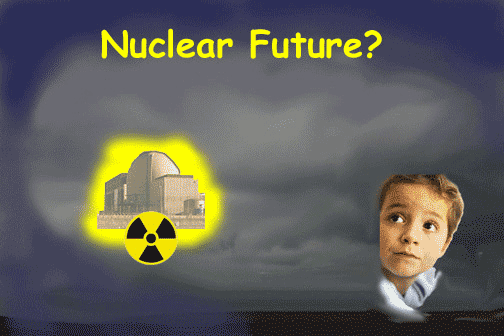
We are making the wrong energy choices for future generations, Guardian, Andrew Simms, 8 Apr 16
Our children’s children will not thank us for investing so heavily in technologies like nuclear at the expense of safer, low-carbon options “……It’s easy to see the superficial political attraction of projects like Hinkley C – they look like big, simple solutions to a problem. They’re technologically shiny, highly visible, seemingly easy to keep an eye on and have large, influential lobbies behind them.
With so much seemingly in its favour, it says a lot about the state of the nuclear industry that Hinkley C is heading south faster than a great snipe in migration. In a new report for theIntergenerational Foundation, co-published with the New Weather Institute, I found the economic case alone for new nuclear to be as leaky as a plastic bag of plutonium.
Discounting the untold extra billions, typically hidden and underwritten by the public, required by nuclear reactors to pay for complex security, disposal of radioactive waste, insurance (and, perversely, liabilities from under-insurance), over the course of its initial 35-year contract period, Britain could save at least £30-£40bn on electricity generated by solar and onshore wind with their costs steadily falling.
The costs for nuclear generation, meanwhile, have been doing exactly the opposite. From a government estimate of £5.6bn in 2008, by the time EU officials signed off the deal to build Hinkley C just six years later, the expected construction cost had risen to over £24bn. As obstacles, the burden of the financial architecture for the deal is only beaten by the problems with the technology itself which was meant to be state-of-the-art and a flagship for its operator EDF.
A range of renewable energy options are readily available that prove to be cheaper, safer, more secure, quicker to deliver and, overall, better value for Britain. Yet, instead of grasping this option, the government seems to have gone out of its way to hamper renewables by slashing support and creating a capricious, unstable policy environment…….
If we really are to have policies for the long term and with future generations in mind, we need to ensure energy choices are made to protect and promote their interests. A rational, evidence-based, intergenerational energy system won’t just emerge from political rhetoric, it needs to be designed and based on clear principles.
Such principles would include having an energy system most likely to preserve a climate convivial for future generations; a system with the least toxic environmental burden and which maximises ancillary economic benefits such as local jobs, manufacturing and services.
As an opening bid, here’s a set of intergenerational design criteria to aid intelligent, future energy planning. They are:
- Employment and broader economic return on investment – how much value to the broader economy does investment in different technologies bring; in other words, what is its economic multiplier effect?
- Environmental return on investment – how efficiently does an investment lower carbon emissions and minimise other toxic pollutants and contribute to a healthy environment?
- Energy return on investment – how much energy is generated for the amount of money invested to produce that energy?
- Security return on investment – how much does the technology contribute to domestic energy security and what other security risks does it carry?
- Transition return on investment – how does it contribute, comparatively to the speed and scale of deployment of low carbon energy generating capacity?
- Conviviality return on investment – the degree to which a technology can be responsive to and supportive of a society’s or a community’s own vision and pathway for its development, and that of future generations.
Paul Massara, is the chief executive of the energy supplier, RWE npower. Reflecting on the prospect of Hinkley C, he commented: “We will look back and think that nuclear was a expensive mistake. It’s one of those deals where my children, and my children’s children, are going to be thinking ‘was that a good deal’?”
It’s easy to imagine what conclusion they will come to, and the bewilderment they will feel at why better options were not more aggressively pursued. http://www.theguardian.com/environment/2016/apr/07/we-are-making-the-wrong-energy-choices-for-future-generations
No comments yet.
1 This Month

of the week – Shut Down Drone Warfare!


Tell the Ukrainian Government to Drop Prosecution of Peace Activist Yurii Sheliazhenko

Petition to revoke the licensing of the Near Surface Nuclear Disposal Facility (NSDF) at Chalk River. https://www.ourcommons.ca/petitions/en/Petition/Details?Petition=e-7247
To see nuclear-related stories in greater depth and intensity – go to https://nuclearinformation.wordpress.com
-
Archives
- April 2026 (79)
- March 2026 (251)
- February 2026 (268)
- January 2026 (308)
- December 2025 (358)
- November 2025 (359)
- October 2025 (376)
- September 2025 (257)
- August 2025 (319)
- July 2025 (230)
- June 2025 (348)
- May 2025 (261)
-
Categories
- 1
- 1 NUCLEAR ISSUES
- business and costs
- climate change
- culture and arts
- ENERGY
- environment
- health
- history
- indigenous issues
- Legal
- marketing of nuclear
- media
- opposition to nuclear
- PERSONAL STORIES
- politics
- politics international
- Religion and ethics
- safety
- secrets,lies and civil liberties
- spinbuster
- technology
- Uranium
- wastes
- weapons and war
- Women
- 2 WORLD
- ACTION
- AFRICA
- Atrocities
- AUSTRALIA
- Christina's notes
- Christina's themes
- culture and arts
- Events
- Fuk 2022
- Fuk 2023
- Fukushima 2017
- Fukushima 2018
- fukushima 2019
- Fukushima 2020
- Fukushima 2021
- general
- global warming
- Humour (God we need it)
- Nuclear
- RARE EARTHS
- Reference
- resources – print
- Resources -audiovicual
- Weekly Newsletter
- World
- World Nuclear
- YouTube
-
RSS
Entries RSS
Comments RSS
 nuclear-news
Leave a comment