Fishermen suing Japanese govt over radiation from 1950s atomic tests
 Japanese fishermen to sue over fallout from Bikini Atoll nuclear tests in 1950s Julian Ryall 8 APRIL 2016 http://www.telegraph.co.uk/news/2016/04/08/japanese-fishermen-to-sue-over-fallout-from-bikini-atoll-nuclear/
Agroup of fishermen is to sue the Japanese government for failing to release records detailing their exposure to radiation from US nuclear tests in the Pacific in the 1950s.
Some 20 people, including relatives of fishermen who have since died, are to file their case with the Kochi District Court in May, each demanding Y2 million (£13,088) in compensation.
The men have been particularly angered by the actions of the Ministry of Health, Labour and Welfare, which in September 2014 admitted it had data on the radioactive fallout that around 500 fishing vessels and their crews were exposed to in the Castle Bravo nuclear tests.
The ministry had previously claimed the documents no longer existed, the Asahi newspaper reported.
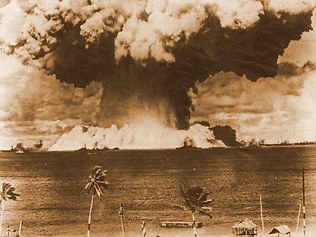
The first of the Castle Bravo tests, on March 1, 1954, was three times more powerful than scientists had initially predicted, producing a fireball around 4.5 miles across within a second.
The mushroom cloud reached a height of nearly 9 miles in around one minute and eventually climbed to an altitude of 25 miles. The blast was estimated to be 1,000 times more powerful than the atomic bombs that devastated Hiroshima and Nagasaki. As well as producing a larger blast, strong winds took the fallout far greater distances than the scientists had expected.
The Daigo Fukuryu Maru was approximately 800 miles east of Bikini Atoll, one of the Marshall Islands in the central Pacific, and more than 80 miles outside the US government’s 92,000 square mile exclusion zone around the island, when the first bomb was detonated.
Fallout began to coat the tuna fishing boat – and its 23 crew – about two hours later. Unaware of the danger, they scooped the radioactive ash off the deck with their bare hands, while one of the fishermen, Matashichi Oishi, said he licked the dust, reporting that it was gritty but had no taste.
By the time the ship docked in Japan two weeks later, the men were suffering from nausea, headaches, burns, pain in their eyes and bleeding from their gums and were diagnosed with acute radiation poisoning.
In September, 40-year-old Aikichi Kuboyama died as a result of his exposure. In 1955, the US paid Japan $2 million in “consolation money” and concluded the issue at the political level. The Japanese government paid each of the crew of the Lucky Dragon Y2 million (£13,088 at present day exchange rates), but provided nothing to fishermen aboard other ships.
The health ministry in Tokyo maintains that crew members of 10 ships were exposed to radiation, but it insists that their doses “did not reach levels that could damage their health”.
Tests conducted on enamel on the teeth of the fishermen by a professor at Okayama University of Science revealed radiation measuring up to 414 millisieverts, equivalent to people standing about 1 mile from the hypocenter of the atomic bomb that was dropped on Hiroshima in 1945.
Under Japanese law, anyone who was within 2.2 miles of the Hiroshima or Nagasaki atomic bomb detonation points is eligible for medical allowances for a range of illnesses, including cancer.
No comments yet.
1 This Month

of the week – Shut Down Drone Warfare!


Tell the Ukrainian Government to Drop Prosecution of Peace Activist Yurii Sheliazhenko

Petition to revoke the licensing of the Near Surface Nuclear Disposal Facility (NSDF) at Chalk River. https://www.ourcommons.ca/petitions/en/Petition/Details?Petition=e-7247
To see nuclear-related stories in greater depth and intensity – go to https://nuclearinformation.wordpress.com
-
Archives
- April 2026 (79)
- March 2026 (251)
- February 2026 (268)
- January 2026 (308)
- December 2025 (358)
- November 2025 (359)
- October 2025 (376)
- September 2025 (257)
- August 2025 (319)
- July 2025 (230)
- June 2025 (348)
- May 2025 (261)
-
Categories
- 1
- 1 NUCLEAR ISSUES
- business and costs
- climate change
- culture and arts
- ENERGY
- environment
- health
- history
- indigenous issues
- Legal
- marketing of nuclear
- media
- opposition to nuclear
- PERSONAL STORIES
- politics
- politics international
- Religion and ethics
- safety
- secrets,lies and civil liberties
- spinbuster
- technology
- Uranium
- wastes
- weapons and war
- Women
- 2 WORLD
- ACTION
- AFRICA
- Atrocities
- AUSTRALIA
- Christina's notes
- Christina's themes
- culture and arts
- Events
- Fuk 2022
- Fuk 2023
- Fukushima 2017
- Fukushima 2018
- fukushima 2019
- Fukushima 2020
- Fukushima 2021
- general
- global warming
- Humour (God we need it)
- Nuclear
- RARE EARTHS
- Reference
- resources – print
- Resources -audiovicual
- Weekly Newsletter
- World
- World Nuclear
- YouTube
-
RSS
Entries RSS
Comments RSS
 nuclear-news
Leave a comment