Dangerous, pointless nuclear race in East Asia
The plutonium plans of each of the three East Asian countries, reinforced by worst-case assumptions about the intentions of the others, are further destabilizing an increasingly unstable region.
The ultimate goal, however, should be to end the costly, dangerous, pointless industry of plutonium separation. The U.S. has pursued that goal since 1974, when India used plutonium from its nominally civilian breeder reactor development program to launch a nuclear weapons program. Since that time, Belgium, Germany, Switzerland and other countries have abandoned their reprocessing programs and the United Kingdom has decided to do so as well.
A Little-Known Nuclear Race Taking Place in East Asia Is Dangerous and Pointless http://www.huffingtonpost.com/frank-von-hippel/nuclear-race-asia_b_9609116.html 5 Apr 16 Frank von HippelSenior Research Physicist, Emeritus, Program on Science and Global Security, Princeton University Fumihiko YoshidaVisiting Scholar, Carnegie Endowment for International Peace
 Plutonium was first produced and separated during America’s World War II nuclear weapons project. Its destructive power became apparent at the end of the war when, in one-millionth of a second, one kilogram of plutonium in the Nagasaki bomb fissioned and destroyed the city below.
Today, a number of countries — including France and Japan — are separating plutonium from the spent fuel of their reactors and building dangerous stockpiles of this weapon-usable nuclear material with no good economic purpose.
Japan, the only non-nuclear weapons state that separates plutonium today, has accumulated almost 50 metric tons. Last month, Japan shipped more than 700 pounds of mostly weapons-grade plutonium — enough for about 50 nuclear bombs — to a more secure location in the U.S. But Prime Minister Shinzo Abe has been simultaneously pushing through a law to guarantee funding for a new spent fuel “reprocessing” plant designed to separate hundreds of tons of plutonium for use in reactor fuel.
Meanwhile, China’s new five-year plan includes a proposal to buy a reprocessing plant from France that will separate plutonium that will probably accumulate like Japan’s. And South Korea insists that it should have the same right to separate plutonium as Japan.
These plans and desires are troubling. As President Obama said during the 2012 Nuclear Security Summit, “We know that just the smallest amount of plutonium — about the size of an apple — could kill hundreds of thousands and spark a global crisis … We simply can’t go on accumulating huge amounts of the very material, like separated plutonium, that we’re trying to keep away from terrorists.”
Nuclear scientists working on weapons in the U.S. during World War II had a vision that plutonium could have a peaceful use. They proposed a plutonium “breeder” reactor that would convert uranium-238 into chain-reacting plutonium whose fission could power civilization for millennia. During the 1960s, this vision infected the global nuclear energy establishment. Since the 1970s, industrialized countries havespent about $100 billion on attempts to commercialize breeder reactors. Fortunately, this effort failed. We now understand the increased dangers of nuclear terrorism and proliferation that would have resulted had plutonium, a nuclear weapons material, become a commodity like petroleum. Conventional reactors are fueled by low-enriched uranium that is not usable in weapons.
In the absence of breeders, however, France has been continuing to separate plutonium and using it to fuel some of its conventional reactors; Japan has been trying less successfully to do the same.
The plutonium-uranium “mixed oxide” fuel produced in this way costs 10 timesmore than the low-enriched uranium that is the primary fuel for conventional reactors. But France’s government insists that Électricité de France continue to fund the bankrupt government-owned company AREVA to separate plutonium from EDF’s spent fuel. Meanwhile, Japan’s government is obliging its utilities to separate more plutonium as well. Globally, including failed plutonium programs in Russia and the United Kingdom, a surplus of more than 250 tons of plutonium — enough for 30,000 Nagasaki-type nuclear weapons — has been accumulated in civilian plutonium programs.
How can one explain the continuing interest in France, Russia, Japan, China and South Korea in separating plutonium? Institutional inertia is most of the answer in France and Russia but, in East Asia, the original use of plutonium — nuclear weapons — is also a factor. In South Korea, demands that the nation should have the right to be able to separate plutonium peak after North Korean nuclear tests. Security experts in Japan also increasingly justify its plutonium program as providing a latent nuclear deterrent against North Korea and China. China’s nuclear energy establishment is still enthralled with breeder reactors, but some analystsworry that China could use the reprocessing plant it plans to buy from France to quickly build up its nuclear weapons stockpile to the same scale as those of Russia and the United States.
The plutonium plans of each of the three East Asian countries, reinforced by worst-case assumptions about the intentions of the others, are further destabilizing an increasingly unstable region.
The United States cannot dictate to any of these countries. But it has a lot of leverage by virtue of being South Korea and Japan’s most important military ally and its agreements on peaceful nuclear cooperation with both.
In the recently completed negotiations over the renewal of the U.S.-Republic of Korea Agreement for Peaceful Nuclear Cooperation, the two countries kicked the issue of South Korea’s demand for the right to reprocess spent fuel down the road by launching a joint 10-year study of the “feasibility” of South Korea’s proposed program.
If the U.S. cannot convince France to hold off selling a reprocessing plant to China, it should at least insist that, as a part of the deal, both countries commit to “just-in-time” plutonium separation — that is, no stockpiling.
The ultimate goal, however, should be to end the costly, dangerous, pointless industry of plutonium separation. The U.S. has pursued that goal since 1974, when India used plutonium from its nominally civilian breeder reactor development program to launch a nuclear weapons program. Since that time, Belgium, Germany, Switzerland and other countries have abandoned their reprocessing programs and the United Kingdom has decided to do so as well.
The U.S. must continue to press the holdouts.
Close Indian Point nuclear station, wean off nuclear power – Bernie Sanders
 Bernie Sanders calls for closing Indian Point nuclear facility, wean off nuclear energy http://www.utilitydive.com/news/bernie-sanders-calls-for-closing-indian-point-nuclear-facility-wean-off-nu/416842/ By Robert Walton | April 5, 2016
Dive Brief:
- Presidential candidate Bernie Sanders is calling for Indian Point, the controversial nuclear plant near New York City, to be closed down over safety concerns, just weeks ahead of the state’s Democratic primary, NBC News reports.
- Sanders will face fellow candidate Hillary Clinton, who has been critical of the plant but has called for making it safer rather than closing it down entirely.
- Sanders is the only presidential candidate calling for an end to nuclear power; he wants the United States to grow its renewable resources like wind and solar instead.
Dive Insight:
Entergy’s Indian Point nuclear facility has become an issue in the Presidential race, with Democratic candidate Bernie Sanders saying the plant is too near New York City to be safely operated.
“I am very concerned that the Indian Power nuclear power reactor is more than ever before a catastrophe waiting to happen,” Sanders said in a statement issued yesterday. “In my view, we cannot sit idly by and hope that the unthinkable will never happen. We must take action to shut this plant down in a safe and responsible way. It makes no sense to me to continue to operate a decaying nuclear reactor within 25 miles of New York City where nearly 10 million people live.”
New York Gov. Andrew Cuomo (D) has pushed to shutter the facility over safety concerns, and in February called for an investigation into the plant after monitoring weeks showed it was leaking contaminated water. Entergy has maintained the plant is safe and the power is essential to the region.
But while Cuomo supports Entergy’s continued operation of other nuclear units in the state, Sanders has established himself as the only candidate calling for the United States to move entirely away from nuclear power.
“Even in a perfect world where energy companies didn’t make mistakes, nuclear power is and always has been a dangerous idea because there is no good way to store nuclear waste,” he said in his statement. “That is why the United States must lead the world in transforming our energy system away from nuclear power and fossil fuels.”
Sanders will face Hillary Clinton in the New York Democratic primary later this month. Clinton, who lives less than 20 miles from the plant, has been critical of the facility but does not want to see it shut down and instead has called for improving operations at the facility.
European Commission report on nuclear power – costs blowing out, waste mount, but where to put them?
Europe plans to bury its nuclear waste—but doesn’t know where, and needs €120 billion to do it, Quartz, Cassie Werber, 5 Apr 16 “……Now, a report (pdf) from the European Commission has tried to pull together the whole bloc’s data and make a set of important estimates: How much is it going to cost to keep building plants at the rate Europe is planning them? What’s the price tag for taking old plants off line? And what will it take to dispose of the radioactive waste the plants generate?

Nuclear waste ranges in radioactivity levels. The high-level stuff has a longer half-life, taking more than 30 years to degrade. The report’s authors note: “Disposal in deep, stable geological formations is the generally recognized option for the disposal of high level waste.” In other words, it gets buried. But there is only one such burial facility in the world, and it’s in the US, in New Mexico. Europe has yet complete one, though Finland, Sweden, and France are making headway on that.
USA Secretary of State defends nuclear pact with Tehran


 Kerry on Iran nuclear deal: If they’re cheating, we’ll know it Secretary of state defends pact with Tehran ahead of expected grilling by angry Republicans in Congress, Times of Israel, BY RICHARD LARDNER April 5, 2016,WASHINGTON (AP) — US Secretary of State John Kerry on Tuesday defended the landmark nuclear deal the United States made with Iran ahead of a congressional hearing where Senate Republicans are expected to hammer the Obama administration for considering the easing of financial restrictions against Tehran.
Kerry acknowledged the harsh criticism of the arrangement, which is designed to prevent Iran from becoming a nuclear power, telling MSNBC there’s a furious debate even in Iran over whether Tehran should choose missiles over dialogue.
“I think what you’re seeing there is tension” between moderates and hard-liners over Iran’s future course, Kerry said.
Kerry’s remarks came just hours ahead of a scheduled hearing by the GOP-led Senate Foreign Relations Committee on the implementation of the nuclear accord. Thomas Shannon, the undersecretary of state for political affairs, will testify.
The committee’s hearing comes amid reports that the administration may relax the prohibition that prevents US dollars from being used in transactions with Iran. Angry lawmakers, who contend the US was taken advantage of in the deal, have countered that Tehran would be getting more than it deserves from the international nuclear pact reached last year.
While no final decision has been made, officials told The Associated Press the Treasury Department has prepared a general license permitting offshore financial institutions to access dollars for foreign currency trades in support of legitimate business with Iran, a practice that is currently illegal.
Several restrictions would apply, but the change could prove significant for Iran’s sanctions-battered economy. It also would be highly contentious in the United States, where Republican and several Democratic lawmakers say the administration promised to maintain a strict ban on dollars along with other non-nuclear penalties on Iran after last July’s seven-nation nuclear agreement.
The nuclear pact provided Iran with billions of dollars in sanctions relief for curtailing programs that could lead to nuclear weapons. But the Iranians say they haven’t benefited to the extent envisioned under the deal because of other US measures linked to human rights, terrorism and missile development concerns.
Kerry told MSNBC that Iran “needs to make some clear decisions about the role that it intends to play in the region and the world.”
Kerry added, “if they’re cheating, we will know it.”……..http://www.timesofisrael.com/kerry-on-iran-nuclear-deal-if-theyre-cheating-well-know-it/
Sellafield – what to do with its dilapidated nuclear waste facilities, and its wastes
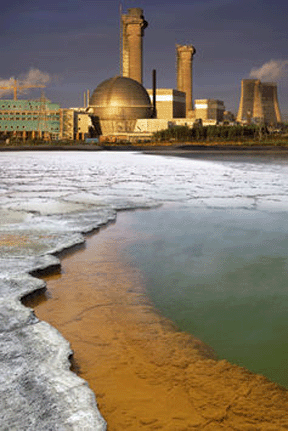 Britain is sending a huge nuclear waste consignment to America – why?, The Conversation, Gordon MacKerron, April 5, 2016 “…..In the absence of a deep-disposal plan, the UK has a more immediately pressing issue – what to do with Sellafield’s contaminated materials and waste from the UK’s near-70 years in the nuclear power and weapons business, much of which is housed in dilapidated facilities that are not fit for purpose. The Nuclear Decommissioning Authority (NDA) expects itwill cost some £68 billion to clean up Sellafield by stabilising and safely packaging the waste and building new stores. This will only be completed by around 2120.
This problem is at least now getting serious attention and resource – despite the climate of public austerity. Currently the country is spendingover £1.5 billion a year on the site, which is one of the most hazardous in Europe.
Sellafield stores a further 140 tonnes of waste plutonium that also stems from British and some overseas nuclear power. If used in bombs this amount could obliterate humanity several times over. The NDA is now focusing on what to do about this too, after years of political inattention. Yet the decision-making is laboured and the currently favoured solutionof using the plutonium as fuel for conventional reactors lacks credibility – no operator wants to use plutonium-based fuel because it is more difficult and expensive to manage than conventional fuel; and moving it around the country is a security risk.
So nuclear waste remains the Achilles heel of the nuclear industry, in the UK and elsewhere. While the financial problems behind the proposed new nuclear station Hinkley Point C attract most of the headlines, the waste problem hangs over the industry behind the scenes. Until we find a way forward that is scientifically and politically acceptable, it will continue to do so.https://theconversation.com/britain-is-sending-a-huge-nuclear-waste-consignment-to-america-why-57074
In a fully accountable marketplace, wind power is the leader
The best renewal would be the creation of a level playing field where all energy sources bear their own costs and all subsidies are removed.
In a fully accountable marketplace, challenger fuels like wind will do very well because they cost less when all costs are counted. The incumbent fuels fear that accountability—for good reason.
Market forces choose wind power http://thehill.com/blogs/congress-blog/energy-environment/274890-market-forces-choose-wind-power By Former Rep. Bob Inglis (R-S.C) 1 April 16 As a staunch believer in free markets, I don’t pick winners and losers- I let the market do that for me. And right now, the free market is telling me wind power is a big part of America’s energy future.
 There will always be people who hold on to old technology even while the evidence mounts around them that the new is better. Time and time again, history proves that those who refuse to be forward-looking get left behind. Whether it’s buggy whip manufacturers scoffing at the Model T Ford or someone hunting for a pay phone, some people just can’t adapt to the times.Here’s what happened for wind power in 2015. It was the year’s largest source of newly installed electric capacity, beating solar and natural gas by significant margins. Wind made up 35 percent of all new electricity that came online last year.
We see this progress in state after state: Iowa generated 31 percent of electricity with wind in 2015, while 12 states created at least 10 percent.
Or how about this: America continues to be the best in the world for wind energy production. We should be proud that the United States is number one on the list, beating China, Germany and every other country. Continue reading
Farmers turn to solar power for an economic “crop”
 Farmers Quit Corn; Grow Solar Power, Triple Pundit, by Leon Kaye on Friday, Apr 1st, 2016 One of the arguments used against solar power deployment is the amount of space needed for all of those solar panels. Although one study has shown that 0.6 percent of all land in the U.S. would be needed to completely electrify the country, the fight still goes on, even as solar and wind power technologies continue to increase in efficiency while decreasing in costs.
The fight is also occurring in counties across the U.S., as landowners and farmers seek new ways to generate revenue. Most of rural America has missed out on the economic revival that has conjoined technology and urbanization in many cities, so these counties are also seeking new ways to generate tax revenues. Farmers, of course, have also taken a hit due to the ongoing slump in global commodities.
The controversy over farmers having the right to sign contract with solar and wind power companies is now taking center stage in North Carolina.
The combination of the state’s Renewable Energy Portfolio Standard (REPS), which requires utilities operating in the state to generate some electricity from renewables, along with its booming tech culture, has turned the Tar Heel State into a solar powerhouse. In fact, the Solar Energy Industries Association (SEIA) says North Carolina ranks third in the nation amongst U.S. states in total solar capacity. Last year, the installation of over 1,100 megawatts of solar power placed North Carolina in second nationally in new solar generation.
And much of this power is generated in rural counties across the state, from the northern border with Virginia to along the South Carolina state line. According to Solar Strata, one company that is riding North Carolina’s solar boom, these new solar farms are appearing on farmland where crops such as tobacco, peanuts, cotton and corn can no longer earn enough money for farmers to keep their land. Other sites are appearing on fallow land that has not been farmed in years. Companies such as Solar Strata pay rent to these farmers, with contracts that often last as long as 20 years. As quoted by one farmer who was interviewed by Joe Ryan of Bloomberg, “It gives me a way to keep the farm . . . and pass it to my grandchildren.”…….http://www.triplepundit.com/2016/04/harvesting-solar-offers-farmers-stable-incomes/
Saving the family farm – through farming the wind
In many cases, lease payments from turbines are the difference between keeping a farm and selling off the land.
Jason Wilson of Calhan, CO, told me, “The wind farm allowed us to be able to keep our family farm. We had come to a point where it no longer made financial sense to keep the property even with its vast sentimental value. The wind farm balanced the financial viability with the sentimental value, allowing the family farm to be passed on to the next generation.”
wind farms bring other opportunities for employment. Wind turbine technician is the fastest growing occupation in the country and presents another employment avenue for people who enjoy rural lifestyles.
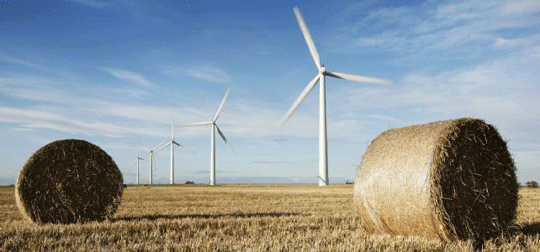
How does wind help the family farm stay in the family?, http://www.aweablog.org/how-does-wind-help-the-family-farm-stay-in-the-family/ Greg Alvarez, 22 Mar 16, During my tour through Colorado wind power last week, I often heard how wind helps keep the fabric of rural communities intact, allowing them to thrive.
Land lease payments make it possible for family famers and ranchers to keep their businesses running, expanded tax revenue provides resources to buy new emergency services equipment, and wind farms bring well-paying jobs to the community, meaning young people don’t have to leave home to find a good career.
Millions in financial resources for rural communities
New data released today allows us to quantify these sorts of anecdotes: landowners with wind turbines on their property now receive a total of $222 million in lease payments every year. Overall, landowners in six states currently receive over $10 million each year in lease payments, and 26 states have landowners that receive over $1 million.
This revenue acts as a drought resistant cash crop for family farmers and ranchers, providing a stable source of income they can count on when productivity declines because of drought or other causes. It also helps protect them from commodity price fluctuations, a frequent source of frustration in the agricultural world.
Real world impacts
In many cases, lease payments from turbines are the difference between keeping a farm and selling off the land.
Jason Wilson of Calhan, CO, told me, “The wind farm allowed us to be able to keep our family farm. We had come to a point where it no longer made financial sense to keep the property even with its vast sentimental value. The wind farm balanced the financial viability with the sentimental value, allowing the family farm to be passed on to the next generation.”
The Wilson farm sits on the plains at the base of Pike’s Peak. It’s a beautiful, serene place started by Jason’s great-grandfather in the 1940’s. Jason will be taking over the operation in the coming years, and his family explained they had no doubt this transition is only possible because of the lease payments they receive in exchange for hosting wind turbines.
Tax revenue helps communities thrive
Land lease payments aren’t the only source of revenue from wind farms; they also help expand the tax base. In many states, wind increases property tax funds by millions of dollars. For example, in Colorado increased property tax revenue from wind could near $19 million a year by 2030.
When our team visited a wind farm in the northeastern part of the state, in a town called Peetz, we heard that the local fire department had been using hand-me-down trucks in poor condition from other counties. Some locals joked that the old fire trucks couldn’t make it up a hill. However, after a wind farm was built, the resulting tax base expansion enabled the town to purchase brand new trucks.
Since around 70 percent of American wind farms are located in rural communities where median household incomes are lower than overall U.S. median incomes, lease payments and added tax revenue are doubly important. Overall, wind farm investment in such areas has exceeded $101 billion.
Wind farms mean local jobs
A final component in this economic picture concerns the jobs wind farms bring to a community.
In many rural areas, jobs are limited to agricultural professions. Young people that may want to pursue a different livelihood are often forced to move away because of a lack of options, even if they don’t want to leave their families and hometowns.
However, wind farms bring other opportunities for employment. Wind turbine technician is the fastest growing occupation in the country and presents another employment avenue for people who enjoy rural lifestyles.
Our team met with a wind farm operations and maintenance crew in Peetz, CO, and many of its members fell exactly into this category. Working as a wind turbine technician provided them with well-paying jobs while also allowing them to stay in the town they grew up in and loved, in close proximity to their extended families. The crew told us this option simply wasn’t available before the wind farm was built.
There are a multitude of different ways wind power brings resources and opportunities to local communities. Even better, the dollar amounts and job numbers will only increase as we continue to grow this American energy source, which will help rural towns thrive along the way.
Europe’ s Nuclear Illustrative Programme (PINC) report on investments in nuclear safety
 Commission presents report on investments in nuclear safety https://ec.europa.eu/energy/en/news/commission-presents-nuclear-illustrative-programme 05 April 2016
This is the first report since Fukushima in 2011, focusing on the investments related to post-Fukushima safety upgrades and to the safe operation of existing facilities. In addition, this Nuclear Illustrative Programme (PINC) highlights the estimated financing needs related to nuclear power plants’ decommissioning and to the management of radioactive waste and spent fuel. The Nuclear Illustrative Programme provides a basis for discussion and aims to include all stakeholders, especially civil society, in the discussion on the role of nuclear energy trends and related investments for the period up to 2050.
While EU countries are free to decide their energy mix, the Energy Union Strategy and the European Energy Security Strategy stressed that EU countries who decide to use nuclear energy in their own energy mix have to apply the highest standards of safety, security, waste management and non-proliferation as well as diversify their nuclear fuel supplies.
Vice-President responsible for Energy Union, Maroš Šefčovič said: “Based on Member States input, the Nuclear Illustrative Programme of the Commission provides a useful photograph of the whole lifecycle of nuclear power in Europe: from the front-end of fuel fabrication, to safety upgrades and long-term operations, to the back-end of the cycle, including waste management and decommissioning. The PINC contributes to the implementation of the Energy Union strategy, by looking into relevant Member States’ investments from the perspective of safety, security of supply, diversification, technological and industrial leadership”
Commissioner for Climate Action and Energy, Miguel Arias Cañete said: “Five years after the accident at Fukushima Daiichi, Europe has learnt the lessons. The Nuclear Illustrative Program brings together for the first time an overview of all investment aspects of nuclear energy in a single document. It thus contributes to the public discussion on nuclear matters. Together we should be able to identify ways to cooperate across Europe to ensure that knowledge about the safest use of nuclear power plants is shared, rather than done separately by each regulator, and that the management of radioactive waste is secured financially by Member States until its final disposal.“
Today, the Commission also presented a recommendation to EU countries concerning the application of Article 103 of the Euratom Treaty. The recommendation requires EU countries to have the Commission’s opinion on agreements with non-EU countries on nuclear matters (Intergovernmental Agreements) before concluding them. This recommendation aims to make that process more efficient by clarifying the key aspects and requirements that EU countries have to take into account when negotiating such agreements, in particular regarding the new directives on nuclear safety and the safe management of spent fuel and radioactive waste. The application of this recommendation should reduce the need for the Commission to object to the conclusion of agreements, and thereby reduce the risk of delay in their conclusion.
Indigenous people push for decontamination of Los Alamos National Laboratory atomic research area
Tribe on front lines of fight over nuclear lab contamination Seattle Times, April 4, 2016 By SUSAN MONTOYA BRYAN The Associated Press ALBUQUERQUE, N.M. (AP) — The tribal community of San Ildefonso Pueblo sits in the shadow of Los Alamos National Laboratory, one of the nation’s premier laboratories and the birthplace of the atomic bomb.
The tribe is on the front lines of a battle to rein in contamination left behind by decades of bomb-making and nuclear research.
Pueblo Gov. James Mountain says he’s encouraged that New Mexico regulators, under a revamped cleanup proposal, have identified as a priority a plume of chromium contamination at the tribe’s border with the lab.
San Ildefonso Pueblo, in northern New Mexico’s high desert, has a tribal enrollment of about 750. Its members are known for their artistry, creating jewelry, paintings, traditional black-on-black pottery and other works.
Groundwater sampling shows increasing chromium concentrations at the edges of the plume, indicating it’s migrating through an area considered sacred by the tribe and closer to the Rio Grande, which provides drinking water to communities throughout the region. The plume has stretched about 1 mile into the upper part of the regional aquifer, and is about a half-mile wide and 100 feet thick.
It’s about a half-mile from the closest drinking water well.
“Without a doubt, it definitely raises concerns,” Mountain said.
The contamination was first detected more than a decade ago, and officials traced it to potassium dichromate used to prevent corrosion inside cooling towers at Los Alamos lab’s power plant. As part of regular maintenance from 1956 to 1972, the chemicals were discharged into canyons below…….
The U.S. Energy Department’s Office of Environmental Management is asking for $189 million for work at the lab next fiscal year. That would pay for handling radioactive waste stored at the lab, as well as completing the chromium investigation.
“The essence is groundwater is precious in New Mexico so we take threats to groundwater very seriously,” he said. “We certainly think there’s an elevated risk associated with any contamination to groundwater.”
The area also is home to flaked stone tools, ceramic shards and even a wagon road that dates back to the homestead period of the 1800s.
“It’s a very important area to the pueblo,” Mountain said. “And it’s not just on the parameters of physical inhabitation. There’s an effect on the pueblo’s health and welfare, on our mental well-being, our spiritual well-being.” http://www.seattletimes.com/nation-world/tribe-on-front-lines-of-fight-over-nuclear-lab-contamination/
Cambridge votes to Divest $1Billion From Nuclear Weapons
 Hawking Says ‘Don’t Bank on the Bomb’ and Cambridge Votes to Divest $1Billion From Nuclear Weapons, Future of Life Institute April 4, 2016/ by Max Tegmark
1,000 nuclear weapons are plenty enough to deter any nation from nuking the US, but we’re hoarding over 7,000, and a long string of near-misses have highlighted the continuing risk of an accidental nuclear war which could trigger a nuclear winter, potentially killing most people on Earth. Yet rather than trimming our excess nukes, we’re planning to spend $4 million per hour for the next 30 years making them more lethal.
Although I’m used to politicians wasting my tax dollars, I was shocked to realize that I was voluntarily using my money for this nuclear boondoggle by investing in the very companies that are lobbying for and building new nukes: some of the money in my bank account gets loaned to them and my S&P500 mutual fund invests in them. “If you want to slow the nuclear arms race, then put your money where your mouth is and don’t bank on the bomb!”, my physics colleague Stephen Hawking told me. To make it easier for others to follow his sage advice, I made an app for that together with my friends at the Future of Life Institute, and launched this“Brief History of Nukes” that’s 3.14 long in honor of Hawking’s fascination with pi.
Our campaign got off to an amazing start this weekend at an MIT conferencewhere our Mayor Denise Simmons announced that the Cambridge City Council has unanimously decided to divest their billion dollar city pension fund from nuclear weapons production.“Not in our name!”, she said, and drew a standing ovation. “It’s my hope that this will inspire other municipalities, companies and individuals to look at their investments and make similar moves”.
“In Europe, over 50 large institutions have already limited their nuclear weapon investments, but this is our first big success in America”, said Susi Snyder, who leads the global nuclear divestment campaign dontbankonthebomb.com. Boston College philosophy major Lucas Perry, who led the effort to persuade Cambridge to divest, hoped that this online analysis tool will create a domino effect: “I want to empower other students opposing the nuclear arms race to persuade their own towns and universities to follow suit.”
Many financial institutions now offer mutual funds that cater to the growing interest in socially responsible investing, including Ariel, Calvert, Domini, Neuberger, Parnassuss, Pax World and TIAA-CREF. “We appreciate and share Cambridge’s desire to exclude nuclear weapons production from its pension fund. Pension funds are meant to serve the long-term needs of retirees, a service that nuclear weapons do not offer”, said Julie Fox Gorte, Senior Vice President for Sustainable Investing at Pax World.
“Divestment is a powerful way to stigmatize the nuclear arms race through grassroots campaigning, without having to wait for politicians who aren’t listening”, said conference co-organizer Cole Harrison, Executive Director of Massachusetts Peace Action, the nation’s largest grassroots peace organization. “If you’re against spending more money making us less safe, then make sure it’s not your money.”
You’ll find our divestment app here. If you’d like to persuade your own municipality to follow Cambridge’s lead, using their policy order as a model, here it is::……….http://futureoflife.org/2016/04/04/hawking-says-dont-bank-on-the-bomb-and-cambridge-votes-to-divest-1billion-from-nuclear-weapons/
India upset, but Obama maintains concern over nuclear arsenal in South Asia
Despite India’s criticism, White House says Obama stands by concern over nuclear arsenal in South Asia, DNA, 5 Apr 2016 White House says US favours reduction of tension between India and Pak.
A day after India criticised Barack Obama for asking it to reduce its nuclear arsenal, the White House said the President stands by his concerns over nuclear and missile developments in South Asia.
“The President’s comments were motivated by the concern that we have about nuclear and missile developments in South Asia. In particular, we’re concerned by the increased security challenges that accompany growing stockpiles, particularly tactical nuclear weapons that are designed for use on the battlefield,” White House Press Secretary Josh Earnest told reporters. “These systems are a source of concern because they’re susceptible to theft due to their size and load of employment.
Essentially, by having these smaller weapons, the threshold for their use is lowered and the risk that a conventional conflict between India and Pakistan, could escalate to include the use of nuclear weapons,” he said…….
On Friday, Obama had identified South Asia in particular India and Pakistan as one area where there is a need to be progress in the area of nuclear security and reduction of nuclear arsenal. India reacted strongly to Obama’s comments. http://www.dnaindia.com/world/report-despite-india-s-criticism-white-house-says-obama-stands-by-concern-over-nuclear-arsenal-in-south-asia-2198484
Very serious consequences if Iran nuclear deal scrapped
U.S. warns of dire consequences if By Nicole Gaouette April 5, 2016 Washington (CNN)The Obama administration warned of dire consequences Tuesday should the next occupant of the Oval Office scrap the Iran nuclear deal.
Britain’s Wylfa Newydd nuclear plant not likely to go ahead
‘Slim chance’ Wylfa Newydd nuclear plant will go ahead By Steffan Messenger BBC Wales Environment Correspondent 5 April 2016
Plans to build a new nuclear power plant on Anglesey have a “slim to zero” chance of going ahead, an industry expert has claimed.
Independent consultant Mycle Schneider is a lead author of the annual World Nuclear Status report. He said the Hinkley Point C project’s difficulties would affect Wylfa Newydd’s ability to attract investors. But Horizon Nuclear Power said it was very confident the new power station would be delivered successfully.
Speaking to BBC Radio Cymru’s Post Cyntaf programme, Mr Schneider, who has advised both the French and German governments on nuclear policy, said: “The Hinkley Point project is in great difficulties and you could argue that the uncertainties are even larger in the case of Wylfa Newydd.”
The Anglesey plant, he said, would need “very clear and very large subsidies to get off the ground”.
Horizon is in talks with the Department of Energy and Climate Change (DECC) on issues such as the strike price, which will be key to attracting additional finance. Richard Foxhall of Horizon Nuclear Power told BBC Wales other investors would need to be brought on board to deliver Wylfa Newydd and that talks were ongoing.
“What is important is that the right conditions for investment are made and part of that is discussions with the government,” he said.
“But we’re very, very confident that we can reach a successful conclusion to those negotiations and make sure the conditions are there to attract investment.”
The chairman of Horizon’s parent company Hitachi has warned it may walk away from the project if a viable deal cannot be reached………http://www.bbc.com/news/uk-wales-35959840
Lawmakers want Entergy to pay its fair share of tax
Westchester OKs Indian Point tax deal http://www.lohud.com/story/news/local/westchester/2016/04/05/westchester-oks-indian-point-tax-deal/82635322/ Mark Lungariello, mlungariel@lohud.com
Entergy agrees to pay almost $4 million for 2015, but some lawmakers wanted a more equitable deal running through 2024.
The owners of Indian Point Energy Center will pay Westchester County more per year in a new tax deal approved Monday, although some lawmakers questioned if the company is really paying its fair share under the agreement.
The county Board of Legislators approved in a 12-4 vote a new payment in lieu of taxes, or PILOT, for the two active nuclear reactors and an adjacent building at Indian Point in Buchanan. The land is property-tax exempt and the plant’s owner, Entergy, instead pays a set fee negotiated with the municipality.
The new deal runs through 2024, with Entergy’s payment increasing annually by the lesser amount of the New York state tax cap or 2 percent. Under the deal, the company agreed to pay almost $4 million to Westchester backdated for 2015 after paying $3.1 million in the final year of its last PILOT.
Legislator Catherine Parker, a Rye Democrat, voted against the PILOT after a public hearing during which no members of the public spoke.
“We want to make sure that we have an equitable situation for the taxpayer and for the entity,” she said.
Legislature Chairman Michael Kaplowitz, a Somers Democrat who also voted against the measure, had sought to renegotiate the terms so that the PILOT was tied more directly to the county’s annual tax increase or decrease.
The expired PILOT, he said, was agreed to during an uncertain time for nuclear facilities. Under that agreement, Indian Point’s owner paid $3.4 million in 2003 but that payment decreased to a low of $2.6 million in 2007 before bouncing back up.
Entergy bought Unit 2 from Con Edison and Unit 3 from NYPA. Unit 1 is no longer in use. The company has separate PILOTs already approved by the town of Cortlandt, the village of Buchanan and the Hendrick Hudson school district.
1 This Month


18 March Webinar @ 1 PM EST: An Assessment of SMR Projects: The Case of Canada
register for the zoom:
https://us02web.zoom.us/webinar/register/WN_o8BIIOUvQ2ONJR1nta65DQ#/registration


of the week – STOP SMALL MODULAR REACTORS IN CANADA
To see nuclear-related stories in greater depth and intensity – go to https://nuclearinformation.wordpress.com
-
Archives
- March 2026 (138)
- February 2026 (268)
- January 2026 (308)
- December 2025 (358)
- November 2025 (359)
- October 2025 (376)
- September 2025 (258)
- August 2025 (319)
- July 2025 (230)
- June 2025 (348)
- May 2025 (261)
- April 2025 (305)
-
Categories
- 1
- 1 NUCLEAR ISSUES
- business and costs
- climate change
- culture and arts
- ENERGY
- environment
- health
- history
- indigenous issues
- Legal
- marketing of nuclear
- media
- opposition to nuclear
- PERSONAL STORIES
- politics
- politics international
- Religion and ethics
- safety
- secrets,lies and civil liberties
- spinbuster
- technology
- Uranium
- wastes
- weapons and war
- Women
- 2 WORLD
- ACTION
- AFRICA
- Atrocities
- AUSTRALIA
- Christina's notes
- Christina's themes
- culture and arts
- Events
- Fuk 2022
- Fuk 2023
- Fukushima 2017
- Fukushima 2018
- fukushima 2019
- Fukushima 2020
- Fukushima 2021
- general
- global warming
- Humour (God we need it)
- Nuclear
- RARE EARTHS
- Reference
- resources – print
- Resources -audiovicual
- Weekly Newsletter
- World
- World Nuclear
- YouTube
-
RSS
Entries RSS
Comments RSS
 nuclear-news