Terrorism threat to Britain’s nuclear facilities is increasing – warns Nuclear Regulator
 Nuclear watchdog warns of terrorist threat to UK reactors As Hinkley Point hangs in balance, strategic plan acknowledges security risks Independent, Mark Leftly Associate business editor @MLeftly 26 March 2016
Britain’s nuclear industry is under threat from cyber-attacks, terrorism and state-sponsored espionage, regulators have warned.
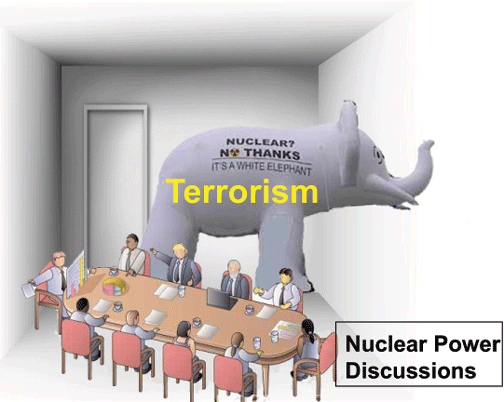
Buried in the Office for Nuclear Regulation’s 2016-20 strategic plan are bleak references to the growing threat of attack on Britain’s 15 operational reactors, which account for nearly a fifth of the country’s electricity. The Independent has established this is the first time that the ONR has explicitly acknowledged the growing terrorist threat to the nuclear industry.
The document states: “The threat of terrorism in the nuclear sector will continue to be managed proportionately and effectively through national and international capabilities. The capabilities of potential adversaries to operate in cyberspace will continue to grow.”
At the top of a list of the industry’s corporate risks, the ONR writes: “Failure to protect the confidentiality, integrity and availability of sensitive information and assets from both known and emerging security threats to the UK nuclear infrastructure (eg, cyber-attacks, terrorist activity, state-sponsored espionage).”
In another reference, it says: “We recognise the world is increasingly globalised and digitised, where both the terrorist threat and the risks from cyberspace are changing. The Government and duty-holders have well-developed security capabilities to deter and defend against organisations and individuals that might conspire to attack or exploit the nuclear estate. ONR will continue to work with the Government to ensure that security-focused regulations evolve to remain fit for purpose and align with safety regulation.”
The news comes at a sensitive time, with French giant EDF weighing up whether to risk its balance sheet on building a £24.5bn reactor at Hinkley Point on the Somerset coast. This is supposed to herald a new generation of nuclear power plants, which are needed to bridge the UK’s yawning energy gap, but EDF has delayed a final investment decision until May. There are also reports that the Isis terrorists who attacked Brussels might have planned to steal radioactive materials from a Belgian nuclear plant to build a bomb.
John Large, the nuclear expert who warned in a 2014 report for the French authorities that reactors are highly vulnerable to drone attacks, said the admission was “a step forward”, but warned: “It might be too late. The problem is that the plants were designed in the 1950s and 1960s and those designs ignored terrorism. That’s one of the problems they [the nuclear industry] face. ……..
Clive Lewis, a shadow Energy minister, pointed out that the ONR’s admission comes shortly after news that the Civil Nuclear Constabulary will be cut by about 200 officers by 2020, despite government promises to protect police funding. ….. http://www.independent.co.uk/news/uk/home-news/exclusive-nuclear-watchdog-warns-of-terrorist-threat-to-uk-reactors-a6953396.html
Renewable energy shines in American energy investment
 If a Power Plant Is Built in U.S., It’s Likely to be Renewable [good graphs] http://www.
climatecentral.org/news/if-a-power-plant-is-built-in-us-chances-are-its-renewable-20175
March 25th, 2016 If a new electric power plant is built in the U.S. these days, chances are it’s renewable — either wind or solar.
That’s the gist of a report the U.S. Department of Energy released this week showing that, together, wind and solar accounted for nearly two-thirds of all new electric power plants built in 2015. It’s a trend expected to continue through 2016, even with low natural gas prices likely to keep utilities building plenty of gas-fired power plants, too.
“Right now, it’s primarily a wind and solar market,” U.S. Energy Information Administration analyst Chris Namovicz said, adding that renewables have been thriving on an extension of wind and solar tax credits, though wind is becoming competitive with fossil fuels even without the help of a tax credit.
As global investments in renewable energy far outpace investments in fossil fuels for electric power, the expansion of wind, solar and other renewable energy sources is critical for the globe to uphold the Paris climate agreement, which aims to keep global warming to 2°C (3.6°F) above pre-industrial levels.
Burning coal to produce electricity is the world’s leading driver of climate change. In the U.S., low natural gas prices and climate policies are allowing lower-carbon energy sources to eclipse coal as the leading sources of electricity.
Together, wind and solar accounted for 67 percent of all new electric power generation capacity built in the U.S. in 2015. That adds up to more than 13 gigawatts of carbon-free electric power generation capacity, enough to provide power to more than 9 million homes.
Natural gas accounted for 30 percent of new electric power generation capacity built last year.
Most renewable-powered plants built in the U.S. last year were built in two states — Texas and California — according to EIA data. Texas is the reigning champ of the wind industry, accounting for 42 percent — more than 3 gigawatts — of all the new wind power capacity built in the U.S. in 2015. Oklahoma, Kansas, Iowa, and North Dakota rounded out the top five wind farm-building states in 2015.
Wind is in the process of rebounding from the industry nearly going bust in 2013, a year when the industry bottomed out because of great uncertainty about the future of a wind power production tax credit. Last year, Congress extendedthe tax credit through 2019.
Today, more than 50,000 wind turbines twirl across the U.S. — enough to power 19 million homes.
As for solar, California built more than any other state in 2015 — more than 2 gigawatts. The state was responsible for building 42 percent of all new solar power constructed last year.
About half of all that solar energy built in California last year came from large utility-scale solar farms. The rest was built in the form of rooftop solar or small solar power systems.
North Carolina, Nevada, Arizona, and Utah rounded out the top five states building new solar plants in 2015.
Shot dead – Belgian nuclear security guard, and his security badge stolen
 Guard at Belgian nuclear plant shot dead; his security badge was stolen. By Kellan Howell – The Washington Times – Saturday, March 26, 2016 Just two days after terrorists attacked the Brussels airport and subway system, a security guard for a Belgian nuclear facility was murdered and his security access badge was stolen, Belgian media reported Saturday.
The security guard’s badge was de-activated as soon as it was discovered it was stolen, according to French newspaper Derniere Heure.
He was shot dead in the Charleroi region of Belgium as he walked his dog, International Business Times reported. http://www.washingtontimes.com/news/2016/mar/26/belgian-nuclear-guard-shot-badge-stolen/
India’s push for solar power to bring over a million jobs
India Solar Power Push May Produce Over 1 Million Jobs http://cleantechnica.com/2016/03/23/india-solar-power-push-may-produce-over-1-million-jobs/ March 23rd, 2016 by Smiti Mittal Originally published on Sustainnovate. India’s massive solar power capacity addition target is expected to be a revolution in the Indian jobs market as well.
According to a report by the Natural Resources and Defense Council (NRDC), India may end up creating over a million new jobs in its endeavour to have 100 GW of operational solar power capacity by March 2022.
The report suggests that a massive army of engineers, construction, and maintenance workers shall be required set up the scores of solar power capacity planned by the central and state governments.

Around 210,800 site engineers and designers would be required to set the large-scale as well as rooftop solar power systems rolling. Around 624,600 semi-skilled workers would be needed for the construction and on-field execution of the projects. To monitor ongoing operations at the power plants and their maintenance, another 182,400 semi-skilled workers would be needed. Thus, a total of 1,017,800 jobs are expected be created if India indeed manages to set up a cumulative operational capacity of 100 GW by 2022.
Jobs creation and empowering youth is one of the major policies of the current government. The ‘Skill India’ program launched by the Indian government aims to provide employment to youth by providing them industrial training in the solar power sector. Several agencies across the country have already started such training programs.
Some state governments have also announced financial support to unemployed youth to set up rooftop solar power systems to help them generate a source of income.
Growing danger of cyber attack on Britain’s nuclear facilities
 ISIS could target British nuclear plants with its army of hackers, Mirror UK 26 MAR 2016 BY JOHN SHAMMAS A document from the Office for Nuclear Regulation warns of “the threat of terrorism in the nuclear sector” Britain’s nuclear plants are a target for terrorists such as Islamic State militants, it has been claimed.
The warning comes from the Office for Nuclear Regulation’s 2016-20 strategic plan document. It also warns of the growing threat posed by hackers, alongside espionage from rival powers……….
ISIS supporters posted a video threatening the UK in the wake of the Brussels terror attacks…….http://www.mirror.co.uk/news/uk-news/isis-could-target-british-nuclear-7633012
Nuclear Security Summit clouded by Belgium terrorism news
 Belgium Attacks Loom Over Final Nuclear Security Summit Aaron Mehta, Defense News March 27, 2016 WASHINGTON — When President Barack Obama kicks off the fourth and final Nuclear Security Summit (NSS) in Washington on Thursday, he will tell delegations from 51 nations, plus major groups such as the European Union and United Nations, about successes made in ensuring nuclear material does not fall into the hands of terrorists.
It’s a timely message in the wake last Tuesday’s attacks in Belgium, which have been claimed by the Islamic State group, commonly known as ISIS or ISIL. But some in the nonproliferation community are concerned that when the summit shuts down at the end of the week, the issue of securing fissile material will cease to be a prime focus for the nations.
Speaking hours after the attacks, Rose Gottemoeller, undersecretary of state for arms control and international security, laid out the stakes clearly: “Nothing I can say would highlight [the summit’s message], sadly, better than this tragic attack in Brussels this morning. Thank god those terrorists do not have their hands on nuclear materials.”…….http://www.defensenews.com/story/defense/policy-budget/2016/03/27/belgium-terrorism-attakcs-nuclear-security-summit-isis/82231000/
Donald Trump says Japan and South Korea could have their own nuclear weapons.
 Donald Trump says Japan and South Korea could have their own nuclear weapons The revelation came in perhaps his most extensive interview yet about his foreign policy plans, Independent Andrew Buncombe New York @AndrewBuncomb 27 Mar 16 Donald Trump has said he is open to the idea of both Japan and South Korea developing their own nuclear deterrents and would like to withdraw US troops from their soil.
In perhaps his most detailed explanation yet about his foreign policy plans if he were to be elected president, Mr Trump told a US newspaper that allowing the two countries to do this would reduce pressure on the US to come to their defence every time North Korea acted aggressively. He also said he would consider stopping oil purchases from Saudi Arabia unless the Saudi government provided troops to fight Isis.
“There’ll be a point at which we’re just not going to be able to do it any more. Now, does that mean nuclear? It could mean nuclear,” Mr Trump, the frontrunner for the Republican presidential nomination, told the New York Times.
Mr Trump said the US “cannot be the policeman of the world” and suggested that Tokyo and Seoul would move to develop their own weapons regardless, if the US continued along what he described as a path of “weakness”. “Would I rather have North Korea have [nuclear weapons] with Japan sitting there having them also? You may very well be better off if that’s the case,” Mr Trump said. “If Japan had that nuclear threat, I’m not sure that would be a bad thing for us.”…….http://www.independent.co.uk/news/world/americas/us-elections/donald-trump-says-japan-and-south-korea-could-have-their-own-nuclear-weapons-a695466
Big Tokyo protest against Japanese govt’s nuclear plans
Over 30K people protest Japanese PM’s plan to restart nuclear reactors (VIDEO) Rt.com : 26 Mar, 2016 Over 30,000 people turned up for demonstrations in Tokyo to protest a plan being promoted by Japan’s prime minister to restart a number of nuclear power plants. On March 11, Japan marked the five-year anniversary of the devastating Fukushima disaster.
Ruptly footage captured people waving flags, carrying banners, and holding up placards while marching through popular Yoyogi Park on Friday. The activists say that restarting the nuclear reactors will create safety risks. Some banners read “To the Absence of a Nuclear Power Plant Future,” local media reported……..https://www.rt.com/news/337325-anti-nuclear-rally-tokyo/
USA minimising effect of Fukushima nuclear radiation: Clinton’s secret food pact.


 Radiating Americans: Fukushima rain, Clinton’s secret food pact, Examiner, Deborah Dupre
Human Rights Examiner , 27 Mar 16, Government agreed to downplay Fukushima radiation Fukushima is far from stabilized according to energy advisor veteran with 39 years of nuclear power engineering experience, Arnie Gundersen who told Solar IMG Saturday that Americans, not just in the northwest, are unaware of being rained on with Fukushima nuclear hot particles and eating Fukushima contaminated food because the US government has deliberately minimized the catastrophe, partially due to a pact Secretary of State Hillary Clinton signed with Japan. Gundersen, with a team of other scientists, intends to prove government statements about Fukushima are false.
“The United States came up with a decision to downplay Fukushima,” said Gundersen who is awakening the public with information such as hot particles in rain will continue falling in the U.S., not just in the Pacific Northwest, for another year, and mentioning high-level fallout in Oklahoma a few days ago.
Gundersen told SolarIMG that high-level people he knows in the State Department said Hillary Clinton signed a pact with her counterpart in Japan agreeing for the United States to continue buying food from Japan, despite that food not being properly tested for radioactive materials.
“So we are not sampling the food coming into the United States,” he said, repeating, “The US government has come up with a decision at the highest levels of the State Department, as well as other departments who made a decision to downplay Fukushima.”
In April, the month after the powerful tsunami and earthquake crippled Japan including its nuclear power plant, “Hillary Clinton signed a pact with Japan that she agreed there is no problem with Japanese food supply and we will continue to buy them so we are not sampling food coming in from Japan” according to Gundersen.
Due to this high degree of secrecy enshrouding the Fukushima nuclear catastrophe, that Gundersen said is ongoing, he has called on Americans with Geiger counters to send samples to him for an independent research team’s study.
Gundersen says the new study will prove that what the U.S. government is telling Americans is false………
One reason millions will die from Fkushima is what some experts in July called scandalous collusion to cover-up the horrendous facts about the nuclear holocaust occurring.
Fukushima stabilized? Many children to suffer thyroid cancer in three to five years
“The reactors are better than since the accident,” said Gundersen, but “they all have holes on them, so they are not holding water.” “Until a couple of weeks ago, they had to constantly add water. Now there’s a system in place that’s cleaning the water enough that they can pump it back into the reactor.”
Gundersen stated that the reactors are still creating “an enormous amount of waste” and that “the filters are hotter than a pistol.” “I still believe water is leaking into the ocean and I know water’s leaking into the ground table,” he said.
Gundersen said it is a concern that there are indications that there is still iodine on site plus, ‘enormous amounts of iodine have been in the water.” “There’s an awful lot of kids that are going to have thyroid problems in the next three to five years as the result of this.”
Kicking the nuclear can, Worst to come: Unit 4, Contaminated food and water, Children and cancer……….http://www.examiner.com/article/radiating-americans-fukushima-rain-clinton-s-secret-food-pact
State of the Climate – World Meteorological Organization
 WMO Press Release 21 March, 2016: State of the Climate: Record Heat and Weather Extremes
The year 2015 made history, with shattered temperature records, intense heatwaves, exceptional rainfall, devastating drought and unusual tropical cyclone activity, according to the World Meteorological Organization. That record-breaking trend has continued in 2016.
The WMO Statement on the Status of the Climate in 2015 gave details of the record land and sea surface temperatures, unabated ocean warming and sea level rise, shrinking sea ice extent, and extreme weather events around the world.
It was released to coincide with World Meteorological Day on 23 March, which has the theme “Hotter, drier, wetter. Face the Future.”
http://public.wmo.int/en/media/press-release/state-of-climate-record-heat-and-weather-extremes
(The key findings are listed here – and a link is provided to the Press Conference webcast)
WMO Press Release, 23 March 2016: World Meteorological Day. Hotter, Drier, Wetter. Face the Future
“The future is now,” said WMO Secretary-General Petteri Taalas
U.N. Secretary-General Ban Ki-moon has issued a rallying call on World Meteorological Day for decision-makers and all actors in society to “face the future now” and respond to the challenge of climate change and so avert its worst impacts and “lay the foundations for a world of peace, prosperity and opportunity for all.” …
On 21 March, WMO issued the full report on the Status of the Global Climate in 2015.
It also collaborated with Climate Central to reach out to television weather presenters, highlighting the main findings of the climate report, including with a package of high quality graphics.
http://public.wmo.int/en/media/news/world-meteorological-day-hotter-drier-wetter-face-future
Statement on the Status of the Global Climate in 2015
March 2016. The World Meteorological Organization (WMO) is the United Nations system’s authoritative voice on weather, climate and water. For over two decades, WMO has published annual assessments of the state of the global climate in the U.N.’s six official languages to inform governments about global climate trends and extreme and notable events at the national and regional levels. These assessments integrate and analyze information provided by leading climate data centers and by the world’s National Meteorological and Hydrological Services (NMHSs).
http://www.climatecentral.org/wmo-state-of-the-climate
(Read the Report Summary here – and note links provided to related videos, interactives, maps, images & other resources. The full 28-page report ‘WMO Statement on the status of the global climate in 2015’ can be downloaded here:http://library.wmo.int/pmb_ged/wmo_1167_en.pdf)
*******
Marshall Shepherd: 96% of American Meteorological Society members think climate change is happening.
March 24, 2016. You may have seen them. Media reports a few years ago claiming that a survey of the American Meteorological Society (AMS) refutes the consensus position regarding climate change. When I saw how that survey and the results were being twisted and distorted, I realized that people read things with an eye for what they want to believe, so-called confirmation bias. AMS Executive Director Dr. Keith Seitter even wrote on the AMS website clarifying the results andcondemning rampant distortion that was being spread. A full statement of the survey authors’ response to the horrific distortion of their findings can be found at this link. With such a mischaracterized response, the AMS felt that a new survey was needed. The preliminary results of that new report were released this week.
http://www.forbes.com/sites/marshallshepherd/2016/03/24/96-of-american-meteorological-society-members-think-climate-change-is-happening-says-new-report/#34f13dd13935 & http://www.environmentalhealthnews.org/t/5863920798415471994
North Dakota rejects plan for experimental deep borehole
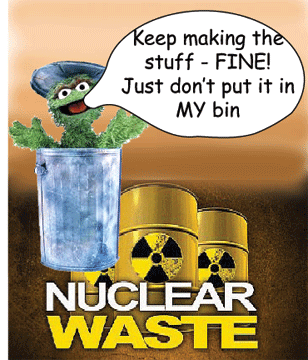 This time, it’s North Dakota that sinks an experiment related to burying nuclear waste, Science,By Warren Cornwall Mar. 23, 2016 , The history of failed attempts to deal with U.S. nuclear waste gained another chapter this month, when local opposition prompted scientists to abandon tests of a new disposal technique in eastern North Dakota.
In early March, Battelle Memorial Institute, a large research nonprofit based in Columbus, quietly withdrew plans to drill two holes up to 5 kilometers deep into the granite bedrock beneath the rolling prairie there. Those were supposed to be the centerpiece of an $80 million, federally funded project to see whether the government could get rid of some highly radioactive waste by sticking it deep underground.
The retreat followed objections from residents of rural Pierce County, who feared the drilling would open the door to nuclear waste. It underscores the treacherous path facing any major effort tied to nuclear waste, even when federal officials insist the project was a test that would never involve radioactive material.

“If we would have allowed this, the next step we really feel would have been (nuclear waste) in our backyard,” says David Migler, chair of the Pierce County Commission, which voted unanimously to oppose the tests……..
the Department of Energy (DOE) in recent years has directed money to so-called “deep boreholes” as a less-objectionable and cheaper way to deal with some of the waste.(Click here to read “Deep Sleep,” a Science feature story on the initiative.) Advocates said the approach could entomb waste in stable rock deep in Earth, far from underwater aquifers . Fuel rods—the vast majority of high-level waste—have been ruled out as too big to easily fit in these boreholes. But Moniz has said it could be ideal for some kinds of waste, particularly 1936 slender, half-meter-long tubes of highly radioactive cesium-137 and strontium-90. Those are currently stored in a pool of water at a federal nuclear facility in eastern Washington state.
But there are many unanswered questions about the borehole strategy. Scientists need to figure out how practical and how expensive it will be to drill a 43-centimeter-wide hole that deep. They also want to test ways to ensure the surrounding rock at the bottom of the hole is solid enough, and that any water there can’t travel up toward the surface. DOE hired Battelle, which manages a number of the department’s research labs, to lead the pilot project to answer such questions.
Battelle officials say they picked the North Dakota site—8 hectares of state-owned land approximately 25 kilometers south of the county seat of Rugby—because it was far from any active earthquake zones, had the kind of solid crystalline “basement” rock the government wanted, and wasn’t near oil and gas drilling. They teamed up with the University of North Dakota’s (UND’s) Energy and Environmental Research Center (EERC) in Grand Forks.
The project quickly struck a sour note in Pierce County. The problems began when local officials didn’t learn about it until an article appeared in the newspaper in the capital city of Bismarck, Migler says. Concerns grew when news coverage stated a goal of the study was to find out if the geology was suitable for storing nuclear waste, he said. The history of Nevada’s fight over Yucca Mountain added to the worries………http://www.sciencemag.org/news/2016/03/time-it-s-north-dakota-sinks-experiment-related-burying-nuclear-waste
Japanese journalists under pressure from government
Japanese journalists allege government pressure on media http://bigstory.ap.org/urn:publicid:ap.org:8b04d4cd11ec4f289c57a7c88c02e1ca By MARI YAMAGUCHI Mar. 24, 2016 TOKYO (AP) — Five Japanese journalists accused Prime Minister Shinzo Abe’s government on Thursday of pressuring broadcasters to reduce criticism of its policies, but also lamented what they called a failure by media to live up to their convictions.
They spoke at a news conference after Minister of Internal Affairs and Communications Sanae Takaichi warned broadcasters last month that their licenses could be revoked if they failed to be impartial in political coverage. Continue reading
Residential solar power a money saver
Saving Money With Solar Power http://mentalitch.com/saving-money-with-solar-power/The boundless financial benefits of solar power Having a solar energy system in your home puts you at a great advantage without being completely reliant on the electric grid and helping the environment. This is a great move to going green and living green. Another reason is that you may want to avoid paying astronomical electricity bills in the future by traditional energy companies. Hiring a solar power installation company will help you develop a solar energy, for whatever reasons that have driven you to need for such move.So why go green with having a solar power system for your home? There are a lot of good reasons to have solar energy for your property.1) Increase in home/property value Installing a solar energy system in your home will definitely appreciate the value of your property. It will even add to the curb appeal of your home. Having a solar power system of your home will move you ahead of other property sellers in the marketplace and will be a long term benefit to the home. A licensed solar energy company will be able to help you determine how much the value of your home will be affected by the installation of a solar energy system.
2) Reduction of electricity bill costs Having a solar energy system installed in your home will help you reduce the monthly bill that you have to pay for the electric company. Before installing a solar energy system its important to get the right one that meets your needs. Professionals will first have to determine your current electricity consumption and right size the system. You may want to forgo paying the bills to the electric company completely, or at least greatly reduce electricity bills by paying the company a fraction what your previous average monthly bill. In some cases, after installing a solar energy system, your electrical bill may be completely wiped out. Some electrical companies will ‘bank’ excess power from your system so your bill even in winter or less sunny times will not increase.
Having “green energy” installed in your home comes with advantages. You may be able to get credits which will help cover the installation costs. There are many programs from the government and other organizations that reward you with incentives for having such a great source of clean, alternative energy in your home.
4) Freedom from price fluctuations by many energy companies Traditional energy companies are facing increasing demands for their power that may cause them to raise rates. With a solar power system as an alternative source of energy to your home, you can offset potential increases in your electric bill and not get caught up in the rising energy prices. Installing a solar power system in your home will give you a great advantage over those that don’t have one. Aside from contributing something good to our environment, having an alternative source of energy in your home can provide a lot of benefits. It can save you a lot of money and also increase the resale value of your property – and if you plan it right you may be able to do it with a lower cost thanks to government incentives.
Wind and solar lead in new energy generation
Wind adds the most electric generation capacity in 2015, followed by natural gas and solar
Wind, natural gas, and solar made up almost all new electric generation capacity in 2015, accounting for 41%, 30%, and 26% of total additions, respectively, according to preliminary data. The data also show a record amount of distributed solar photovoltaic (PV) capacity was added on rooftops throughout the country in 2015. The trend of wind, natural gas, and solar additions making up most new capacity is likely to continue in 2016.
http://www.eia.gov/todayinenergy/detail.cfm?id=25492
The Surprise New Boom Market for Residential Solar 03/23/2016. As the price of solar powered electricity keeps falling and rooftop panels pop up in an increasing number of neighborhoods, an interesting thing is shaping up in the market. Residential solar is no longer for just well-to-do homeowners. Indeed, the growth market in solar is median- and low-income neighborhoods in California and other locales, according to multiple recent reports.
http://www.huffingtonpost.com/greenbiz-group/residential-solars-new-bo_b_9526460.html
A revolutionary technique – recycling sunlight?
Recycling sunlight: a solar cell revolution? Christina Science Monitor Scientists have found a way to recycle sunlight and boost the amount of energy captured from the sun’s rays By Jason Thomson, Staff MARCH 24, 2016
The world of solar cells could be on the cusp of a revolution, as researchers seek to boost efficiency by harnessing the power to recycle light.
A new study, published Thursday in the journal Science, considers the properties of hybrid lead halide perovskites, a group of materials already making waves in solar cell technology, and demonstrates their ability to absorb energy from the sun, create electric charge, and then churn out some light energy of their own.
Moreover, the researchers demonstrated that such these cells can be produced cheaply, with easily synthesized materials, making the proposition much more commercially viable…….http://www.csmonitor.com/Environment/2016/0324/Recycling-sunlight-a-solar-cell-revolution
1 This Month
Chernobyl: The Lost Tapes – A good documentary on Chernobyl on SBS available On Demand for the next 3 weeks– https://www.sbs.com.au/ondemand/tv-program/chernobyl-the-lost-tapes/2352741955560

of the week–London Campaign for Nuclear Disarmament

Tell the Ukrainian Government to Drop Prosecution of Peace Activist Yurii Sheliazhenko
To see nuclear-related stories in greater depth and intensity – go to https://nuclearinformation.wordpress.com
-
Archives
- April 2026 (152)
- March 2026 (251)
- February 2026 (268)
- January 2026 (308)
- December 2025 (358)
- November 2025 (359)
- October 2025 (376)
- September 2025 (257)
- August 2025 (319)
- July 2025 (230)
- June 2025 (348)
- May 2025 (261)
-
Categories
- 1
- 1 NUCLEAR ISSUES
- business and costs
- climate change
- culture and arts
- ENERGY
- environment
- health
- history
- indigenous issues
- Legal
- marketing of nuclear
- media
- opposition to nuclear
- PERSONAL STORIES
- politics
- politics international
- Religion and ethics
- safety
- secrets,lies and civil liberties
- spinbuster
- technology
- Uranium
- wastes
- weapons and war
- Women
- 2 WORLD
- ACTION
- AFRICA
- Atrocities
- AUSTRALIA
- Christina's notes
- Christina's themes
- culture and arts
- Events
- Fuk 2022
- Fuk 2023
- Fukushima 2017
- Fukushima 2018
- fukushima 2019
- Fukushima 2020
- Fukushima 2021
- general
- global warming
- Humour (God we need it)
- Nuclear
- RARE EARTHS
- Reference
- resources – print
- Resources -audiovicual
- Weekly Newsletter
- World
- World Nuclear
- YouTube
-
RSS
Entries RSS
Comments RSS
 nuclear-news