Community solar power now getting the backing of energy utilities

 Even Utilities Are Starting To Get Behind Community Solar http://oilprice.com/Alternative-Energy/Solar-Energy/Even-Utilities-Are-Starting-To-Get-Behind-Community-Solar.html By Nick Cunningham, 28 March 2016 Solar energy is rapidly becoming one of the top choices for new electricity capacity as costs continue to decline and generous public policies accelerate tremendous growth for the sector.
Last year was a record year for the solar industry and the momentum is set to continue. In 2016, the EIA expects the U.S. electricity market to see 26 gigawatts of new capacity installed. Utility-scale solar is expected to capture 9.5 GW of that total, or more than one-third. If that comes to pass, it would be triple the rate of installations of utility-scale solar compared to 2015, and would also equate to more than the combined total of installations from 2013 to 2015.
That could be a conservative estimate. The Solar Energy Industries Association, a trade group, expects the solar industry to add 16 GW of new solar capacity, with about three-quarters of that coming from the utility-scale segment.
A much smaller segment of the solar industry could begin to take off, however. With the bulk of solar installations made up of large-scale utility-size projects, plus some commercial and residential projects proliferating at a healthy rate, the tiny but rapidly growing “community solar” sector could begin to capture a lot more attention.
The growth of solar has been held back by the large upfront costs. That problem is already being overcome with the leasing model, which requires no upfront investment.
But another problem with solar is that not everyone can participate – some people live in apartment buildings, or do not own their own home, or do not have a suitable rooftop to host PV panels. According to Greentech Media, around 77 percent of U.S. households are ineligible for solar panel installations for one reason or another.
“Community solar” solves this problem by allowing people to buy or lease a slice of a shared solar project that is somewhere off site, maybe in a nearby town or on a tract of open land. One could live in an apartment building and still buy into a community solar project, receiving credits on their utility bill.
The community solar model is becoming more common, opening up a vast new market for the solar industry. Community solar grew five-fold last year. New customers can still access a leasing model that has no upfront costs, and with community solar they do not even need to have their own rooftop to do so.
Better yet, community solar projects are increasingly competitive, offering ratepayers a clean source of power without added cost. There is a lot of room for improvement as well. As of now, the issues and design specifications can vary from project to project, but as the sector grows, developers will find ways to standardize projects, reduce development times, and scale-up a small-scale model.
No longer able to ignore the coming explosion in the solar market, utilities have been fighting to tweak public policy to block the threat of solar. But some utilities, in a recognition of reality, are trying to get in on the community solar game so as not to be left behind.
Deloitte cites the case of a Minnesota utility that allows ratepayers to buy in to a community solar project at a discounted rate if they also purchase a new electric water heater. The idea is that the household will heat their water with the extra electricity it produces at midday, avoiding the need to use electricity in the later afternoon and early evening when demand is at a peak. The customer benefits, and the utility benefits by shaving off peak demand.
State policies have also helped. In particular, Colorado and Minnesota have passed laws that require their utilities to setup community solar programs for their ratepayers. Two dozen more have voluntary programs.
Solar is popular too. Deloitte surveyed 1,500 households to find out what they thought were the most pressing energy-related issues, and 64 percent of them said “increasing the use of solar power” was a top three issue for them. As more customers discover community solar, they will increasingly demand their utility offer community solar programs to allow them access.
To be sure, community solar is still small. There are just 111 projects across the U.S., though that is sharply up from only two in 2010, according to Deloitte. Most projects are smaller than 1 megawatt, and the largest is only 20 megawatts. Most projects serve between 40 and 600 customers, according to a report from The Rocky Mountain Institute.
Nevertheless, the solar industry is growing rapidly, and community solar could be the fastest growing segment. The Rocky Mountain Institute argues that 15 GW of community solar could come online by the end of the decade.
For years, utilities have seen solar power as a threat, but that could be changing. As Deloitte puts it, the “evolution of community solar is a classic case of business model innovation turning a challenge into an opportunity. Foreseeing the inevitable growth of distributed energy resources, utilities are deploying these programs to get ahead of the game and to capture the benefits that distributed resources provide to the grid.”
Britain now boasts world’s largest floating solar energy farm
 World’s biggest floating solar farm powers up outside London
Five years in planning and due to be finished in early March, more than 23,000 solar panels will be floated on the Queen Elizabeth II reservoir near Heathrow and used to generate power for local water treatment plants Guardian, Fiona Harvey, 29 Feb 16 On a vast manmade lake on the outskirts of London, work is nearing completion on what will soon be Europe’s largest floating solar power farm – and will briefly be the world’s biggest.
But few are likely to see the 23,000 solar panels on the Queen Elizabeth II reservoir at Walton-on-Thames, which is invisible to all but Heathrow passengers and a few flats in neighbouring estates.
“This will be the biggest floating solar farm in the world for a time – others are under construction,” said Angus Berry, energy manager for Thames Water, which owns the site. “We are leading the way, but we hope that others will follow, in the UK and abroad.”

Five years in planning and due to be finished in early March, the £6m project will generate enough electricity to power the utility’s local water treatment plants for decades. The energy will help provide clean drinking water to a populace of close to 10 million people in greater London and the south-east of England, a huge and often unrecognised drain on electricity, rather than nearby homes.
Why put solar panels on water? The answer, according to Berry, is that the water is there, and might as well be used for this purpose. Floating panels, covering only about 6% of the reservoir, will have no impact on the ecosystem, he says………
A similar floating solar farm with around half the capacity of the Thames Water project is being built by water company United Utilities on a reservoir near Manchester. Construction of an even bigger farm – at 13.7MW more than twice the QEII farm – is underway on a reservoir in land-scarce Japanand due to finish in 2018…….
Putting solar panels on the water for the QEII scheme has not required planning permission, though big arrays of similar panels on land require official sanction. The government has decided to ban farmers who put solar arrays on agricultural land from receiving EU subsidies for the land.
More than 23,000 solar panels will be floated by developer Lightsource Renewable Energy at the reservoir near Walton-on-Thames, representing 6.3MW of capacity, or enough to generate the equivalent electricity consumption of about 1,800 homes…….http://www.theguardian.com/environment/2016/feb/29/worlds-biggest-floating-solar-farm-power-up-outside-london
New York Governor Andrew Cuomo blasted security conditions at Indian Point Nuclear plant
 New York’s governor just slammed the state of a nuclear power plant 40 miles from Manhattan, Business Insider MICHELLE MARK 30 MAR 16 New York Governor Andrew Cuomo blasted the troubling conditions at the Indian Point Nuclear plant Tuesday evening, announcing in a statement that hundreds of faulty bolts were found within one of the plant’s reactors.
The plant poses no immediate danger to public health and safety, but the bolts are the latest incident in a series that “raise deep concerns” about the plant’s operations and further the state’s argument that the plant should not be re-licensed, Cuomo said.
The plant is located in Buchanan, New York, approximately 40 miles from New York City.
The two working reactors at the plant opened in the 1970s, and have worried many of the 2,100 residents who live around the facility for years. The licenses for both reactors have expired, but the Nuclear Regulatory Commission determined that the amount of complaints lodged against the plant warrant its continuing operations until all the grievances are addressed, according to the Guardian.
The Indian Point facility has a long history of issues. Just a few:……http://www.businessinsider.com.au/the-ny-governor-just-slammed-the-state-of-a-nuclear-power-plant-2016-3?r=US&IR=T
Ben Jervey: Subsidized to the end – not even corporate welfare can save Big Coal.
This year, two energy companies that have each received billions of dollars in subsidies and financial support from the federal government are going into bankruptcy. You might think, in this post-Solyndra political environment, that conservative commentators and politicians would be lining up at the Fox News studios to call for some heads to roll.
But, no. Even though these companies have benefited from enough federal subsidies to make the Solyndra loan look like pocket change, there’s no outrage. Because they are coal companies (not solar), the story isn’t about how the federal government spent decades propping them up, it’s about how the president’s Clean Power Plan is taking them down.
http://www.desmogblog.com/2016/03/25/not-even-corporate-welfare-can-save-big-coal & http://www.dailyclimate.org/t/5863920798415471988
A Bailout for the Nuclear Industry – the Pepco-Exelon Merger
Is the Pepco-Exelon Merger A Bailout for the Nuclear Industry? – Big Picture with Thom Hartmann
March 27, 2016 Pepco and Exelon are about to merge and create the biggest utility company in the country. But is this merger – which is being sold as a pro-consumer – actually just a glorified bailout for the nuclear industry? Kevin Kamps joins Thom Hartmann to discuss this.
Marketing frenzy to sell nuclear reactors to the Middle East
Nuclear Power to the People The Middle East’s New Gold Rush, Foreign Affairs May 2015 By Bennett Ramberg There’s a gold rush in the Middle East, but it isn’t gold that prospectors are seeking. It’s reactor sales; these have been talked about for decades, but they’re now picking up steam. So far, Russia has taken the lead. Having built the region’s only operational nuclear power plant—Iran’s Bushehr reactor—it will begin construction in Turkey later this year or next on four reactors, with energy set to begin flowing in the early 2020s. Russia has also stuck agreements with Algeria, Egypt, Iran, and Jordan, and it is seeking to enter the Saudi market.
Other countries are now trying to make up for lost time. South Korea has already contracted to build four plants in the United Arab Emirates, with the first expected to come online in 2017. And Argentina, Canada, China, the Czech Republic, Finland, France, Japan, and the United Kingdom are among those pursuing their own agreements for reactors, component parts and/or service deals.
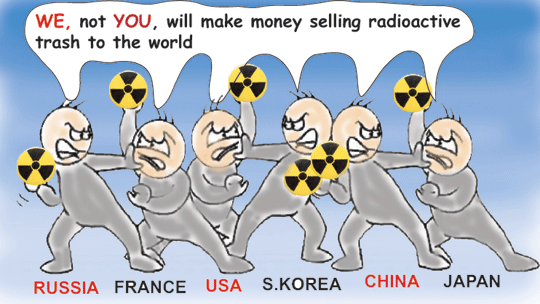
The United States, subject to Section 123 of the U.S. Atomic Energy Act—which requires that nuclear recipients adhere to a set of nonproliferation criteria to receive transfers of nuclear material, equipment, or components—finds itself more constrained in exploiting the markets. Still, in addition to supplying the Emirates with component and engineering support services under the 123 Agreement, the U.S. Commerce Department reports that GE-Hitachi and Toshiba-Westinghouse have signed contracts with Exelon to pursue reactor construction in Saudi Arabia, presuming that a 123 Agreement will be negotiated…….(registered readers only) https://www.foreignaffairs.com/articles/middle-east/2015-05-25/nuclear-power-people
Spanner in the works of Japan’s planned nuclear power revival

 Japan’s Nuclear Energy Comeback Takes a Tumble IEEE Spectrum, By John Boyd, 29 Mar 16, Just when it seemed Japan was poised to get its nuclear plants up and running again after the 2011 accident at Fukushima Daiichi brought about the shutdown of all the country’s nuclear operations, a series of mishaps has raised doubts over the government’s ability to achieve its goal of supplying 20-22 percent of Japan’s energy needs with nuclear power by 2030.
Last month, TEPCO, the regional electric utility that operated the Fukushima plant, issued a press release admitting that according to the results of a recent investigation, staffers had not followed guidelines requiring them to quickly declare a meltdown following the Daiichi accident.
“In the course of our investigations, it was discovered that TEPCO’s internal manual at the time clearly stated that a core meltdown was to be determined if the percentage of core damage exceeded 5%,” states the release. It goes on to say that, “We have confirmed that there were events where it may have been possible to issue notifications and reports more promptly immediately after the tsunami hit on March 11, 2011.”
Two days before last month’s TEPCO announcement, Kansai Electric Power Co. (KEPCO, which serves the Osaka and Kyoto regions) revealed that it had found a leak on 20 February in the filtering system of the Unit 4 reactor at its Takahama Nuclear Plant in Fukui Prefecture, some 500 kilometers west of Tokyo. A contaminated pool of water was also discovered. The incident happened during preparations to restart the reactor after Japan’s Nuclear Regulatory Authority’s (NRA) had deemed it safe to go back on line.
“Subsequently, the puddle was wiped [up] and it was confirmed that there was no remaining contamination,” the KEPCO announcement explained.
Convinced that all was well, KEPCO started up the reactor on 26 February. It shut down automatically three days later due to a “main transformer/generator internal failure,” the company reported.
But the biggest blow came on 9 March, when the District Court in Otsu, Shiga Prefecture, located near the Takahama plant—though unprecedentedly not in the same prefecture—ordered the immediate shutdown of Units 3 and 4. The decision came after it agreed with a group of local plaintiffs that the plant did not satisfy all the NRA safety requirements. The Unit 3 reactor had gone back online in January………
, says the University of Tokyo’s Terai, “Should there be more legal actions of this kind inside and outside the prefectures where the plants are located, the power companies would face serious problems in starting up their nuclear power plants.”
Given that some 30 lawsuits and petitions for injunctions have been reported in the press, such an outcome seems likely. Currently, the NRA is reviewing 20 nuclear reactors in 16 power stations to see if they meet the new regulatory rules. Meanwhile, the Takahama closures leave just two reactors in operation—both at the Sendai plant run by Kyushu Electric Power Co., also in western Japan.
Clearly, the power companies’ missteps are not helping the NRA’s efforts to rebuild trust with citizens—a critical factor in winning the necessary approval of local governments……http://spectrum.ieee.org/energywise/energy/nuclear/japans-nuclear-energy-comeback-takes-a-tumble
US govt no longer worried about Japan’s plutonium stockpiling as weapons proliferation risk?
U.S. official changes stance on Japan’s nuclear policy http://the-japan-news.com/news/article/0002840098 By Seima Oki / Yomiuri Shimbun Correspondent , 29 Mar 16, WASHINGTON — U.S. Assistant Secretary of State Thomas Countryman said in a press conference by telephone on Monday that Japan’s nuclear fuel cycle project, which reuses spent nuclear fuel from nuclear power plants to extract plutonium, does not raise concerns about nuclear nonproliferation, effectively changing his earlier position on the matter.
At a hearing of the U.S. Senate’s Foreign Relations Committee on March 17, the assistant secretary in charge of international security and nuclear nonproliferation had voiced his concerns about Japan’s nuclear policy and said that it would be desirable for Japan to halt its nuclear fuel reprocessing project.
In the press conference, Countryman said that Japan was a pioneer in the civilian use of nuclear energy and that no other country was closer or more important as a partner to the United States than Japan.
Japan’s stockpiling of plutonium has been criticized by China at U.N. meetings and on other occasions. To this, Countryman said that Japan has been proceeding in a transparent manner, which was understandable to the rest of the world.
He also expressed his stance that the U.S. government will cooperate with Japan as an ally to wipe out anxiety in the international community.Speech
Russia marketing nuclear power to Bolivia
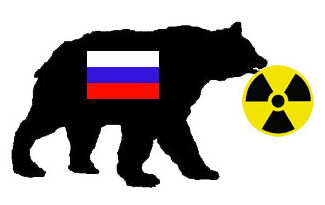 Bolivia Hopes to Gain Knowledge From Nuclear Deal With Russia, Sputnik News, 29 Mar 16, “……..Russia and Bolivia signed an agreement on peaceful nuclear cooperation in 2015. Rosatom and the Bolivian Hydrocarbon and Energy Ministry signed a memorandum of understanding on cooperation for peaceful uses of nuclear energy in November. http://sputniknews.com/business/20160329/1037166194/bolivia0russia-rosatom-nuclear.html#ixzz44KHYmPUv
Troubled history of New York’s Indian Point nuclear power station
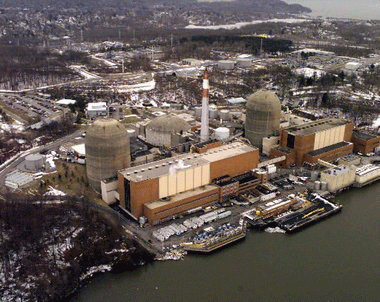 Indian Point nuclear plant reeks of troubled history As New York’s governor and other critics wage an ongoing campaign to shut the facility down citing leaks and old age, nearby residents explain complicated tale, Guardian, Sam Thielman, 29 Mar 16 Outside the Westchester Diner in Peekskill, New York, about 40 miles from New York’s Central Park, a reactor dome crests the trees behind an overpass like a giant’s bald head.
It’s one of two at Indian Point Energy Center, at the bank of the Hudson river in neighboring Buchanan, among the oldest nuclear power plants still in operation, and a monument to the energy industry’s resistance to years of work by concerned scientists, locals and state officials to close down a facility that only last month dumped a plume of radioactive waste into their groundwater.
Indian Point’s two working reactors opened in the early 1970s and have had a lot of people worried for a long time. Five years ago the New York Times wondered if it was “America’s Fukushima” – the Japanese site of the world’s worst radiation crisis since Chernobyl. In February the New York governor, Andrew Cuomo, called its operation “unacceptable” – he wants the plant closed.
It’s easy to see the source of his concern. The population density around Indian Point is of more than 2,100 people per square mile, by far the greatest for any of the US’s 61 nuclear power plants. Many of those people live and work in the plant’s shadow with growing unease.
In May 2015, an electrical transformer in the reactor called Unit 3 exploded, causing water to flood a room near the explosion where electrical distribution panels are housed and pouring 3,000 gallons of oil into the Hudson. The Union of Concerned Scientists classified the incident as a “near miss” in its annual review.Last year near misses occurred at eight nuclear facilities in the US. “Had the flooding not been discovered and stopped in time, the panels could have been submerged, plunging Unit 3 into a dangerous station blackout, in which all alternating current (AC) electricity is lost,” the report’s authors wrote. “A station blackout led to the meltdown of three nuclear reactor cores at Fukushima Dai-ichi in 2011.”
In February, radiation levels at three monitoring wells around the plant spiked, in one spot by 65,000%. Patricia Kakridas, a spokeswoman for Entergy, said the source was likely “water which exited a temporary filtration system that was set up and dismantled in late January 2016” in preparation for refueling; the company said radioactive material won’t leach into drinking water.
And in March, when the plant was being refueled, a breaker tripped and cut power in one of the reactors; when the diesel generators kicked in, they died while trying to restart the first electrical system. Fortunately a second backup worked.
Because the plant is cooled in large part by water from the Hudson – up to 2.5bn gallons a day – it kills about 1 billion fish and other aquatic organisms a year.
Incidents such as these are among the reasons Cuomo wants it closed, and Indian Point is now in a vulnerable position. The operating license for Indian Point 3 expired in December. The license for Indian Point 2 expired in 2013 (Indian Point 1 was decommissioned in 1974). Yet both remain active as the company pursues a license renewal and in the meantime Spectra, a pipeline company, is planning to add a gas pipeline that runs underneath the property to the two that have been there since the plant was built………
The fuel remains onsite at Indian Point, as it does at most nuclear power plants, and must be carefully maintained, for example it must be cooled for at least a decade before it can be sealed in concrete “dry casks”. Sheehan (and others) point out that moving it out of the state along Interstate 95 is impractical given the population density along the busy transport corridor. The plant has produced about 1,500 tons of waste and continues to produce more.
At this point, the license renewal process for Indian Point is scheduled through at least September of 2016 but the legacy of Indian Point, whether it closes or no, has a half-life of far, far longer.http://www.theguardian.com/us-news/2016/mar/28/indian-point-nuclear-plant-new-york-troubled-history
Canadian activists push for a nuclear- free world, despite Foreign Affairs Minister Stephane Dion
Activists want Canada to push for nuclear-free world despite Dion’s reticence http://www.metronews.ca/news/canada/2016/03/29/activists-want-canada-to-push-for-nuclear-free-world-despite-dion-s-reticence.html By: Mike Blanchfield The Canadian Press Mar 30 2016
OTTAWA — Anti-nuclear campaigners who want Canada to push for a global ban on nuclear weapons are concerned that Foreign Affairs Minister Stephane Dion is showing a definite lack of enthusiasm for that goal.
Dion said in a speech earlier this month that the current global security environment is simply not conducive to a ban on nuclear weapons because some states just won’t relinquish them.
Cesar Jaramillo, executive director of the peace group Project Ploughshares, says there’s never a perfect time to push for such a ban and the time to start is now.
Nuclear disarmament and security will be front and centre later this week as U.S. President Barack Obama hosts his final Nuclear Security Summit in Washington.
Prime Minister Justin Trudeau is to attend the two-day meeting, which is focused on curbing nuclear terrorism by cracking down on the trafficking of materials needed to build such a weapon.
Obama announced the initiative in a landmark speech in Prague in 2009, in which he expressed his aspiration for a nuclear-free world, even if it didn’t come in his lifetime.
Earlier this month, Dion said in a speech in Geneva that any negotiations to ban nuclear weapons would have to include all countries that possess them. “Without the participation of the countries possessing nuclear weapons, a ban would not bring us any closer to our shared goal of a world free of nuclear weapons,” Dion said on March 2. “Indeed, premature action risks undermining international stability by creating a false sense of security, without any reliable underpinnings.”
Dion’s remarks largely flew under the radar but anti-nuclear activists took note.
“The reality is that there will never be ideal international security conditions for nuclear disarmament,” Jarmillo said Monday. “Nuclear abolition will be a complex, multifaceted undertaking that will need to coexist with international security crises of varying gravity,” he added. “Nuclear disarmament measures must be started, implemented and concluded in geopolitical conditions that are predictably less than perfect.”
Paul Meyer, a retired diplomat who once served as Canada’s disarmament ambassador, said Dion should be pushing harder for a progress on broader disarmament in spite of the geopolitical obstacles. He cited Canada’s leadership in championing the anti-landmine treaty in the 1990s.
“Minister Dion should recall that if Canada had only been willing to consider ‘incremental’ progress on the disarmament of landmines back in 1997 we would still be in a world awash with these weapons,” Meyer wrote in a recent column in Ottawa’s Embassy newsweekly.
This week’s Washington summit on curbing the trafficking of nuclear components comes amid periodic reports of the theft of radioactive material that could be used to build a so-called “dirty bomb.”
Jaramillo said preventing nuclear terrorism is a worthy and urgent objective.
“But it cannot be understood in isolation from the broader multilateral dynamics related to nuclear disarmament and the slow pace of progress toward that goal,” he added. “It is still early in the Liberal government and it may still be formulating its stand on nuclear abolition. So far, however, there has been little change from the Conservative government concerning Canada’s core positions in this regard.”
The coming wave of shutdowns of old nuclear reactors in America
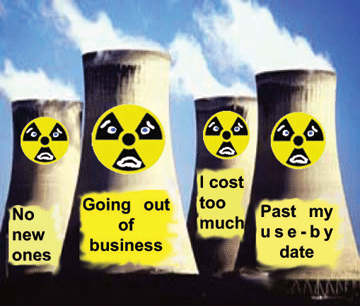 One-Third Of US Nuclear Reactors Are Near Mandatory Retirement The Daily Caller, ANDREW FOLLETT, 29 Mar 16 A 39-year-old nuclear plant in Ohio, which was only designed to operate for 40 years, was shut down Sunday for life-extending maintenance.
The Ohio reactor isn’t unique either. The average age for American nuclear reactors is 35, nearly obsolete by modern design standards and near the end of 40-year operating licenses. Sixteen American nuclear reactors are more than 42 years old, according to government data compiled and mapped last week by The Daily Caller News Foundation…….
India needs to come on itys nuclear security issues

 Come clean on nuclear security http://www.thehindu.com/opinion/op-ed/come-clean-on-nuclear-security/article8406194.ece THE HINDU, NARAYAN LAKSHMAN 29 Mar 16,
If India is more open about discussing its nuclear weapons programme with a view to ultimately denuclearising the neighbourhood, it would be one of its most courageous contributions
This week, Prime Minister Narendra Modi will touch down in Washington, DC for the fourth and final Nuclear Security Summit, a biennial conference series initiated in 2010 by the Barack Obama administration. Mr. Modi will no doubt seek to showcase India’s nuclear regime as one that adheres to the highest standards of transparency and safety through rigorous regulation of nuclear products and institutions. Although that would be welcome, what Mr. Modi’s interlocutors in the U.S. may be hoping for is that he will break with India’s tradition of maintaining a masterful silence on two questions surrounding its nuclear policy. First, how can India address disquieting signals that have emerged in recent times, which point to growing concerns over the security of its nuclear materials? Second, at a time when India’s macro strategy of rapid economic development is premised on a climate of neighbourly peace and stability in the region, is it not appropriate that Mr. Modi call for an end to the nuclear arms race in Asia, and address environmental risks of India’s covert weapons plants?
Let us consider each of these questions in turn.
India’s nuclear security
First, the need for heightened nuclear security has now become urgent, especially with the emergence of global jihadi threats such as the Islamic State. In this context, three potential nuclear terrorist threats relate to extremists making or acquiring and exploding a nuclear bomb; the danger of radioactive material being fashioned into a “dirty bomb”; and the risk of nuclear reactor sabotage.
The first and second scenarios are vectors of imminent concern in Pakistan, with analysts citing as examples a series of terrorist attacks in 2007 on nuclear weapons facilities in that country, including a nuclear missile storage facility at Sargodha and a nuclear airbase at Kamra.
However, a paper published earlier this month by Harvard University’s Kennedy School of Government cautioned that U.S. officials ranked Indian nuclear security measures as “weaker than those of Pakistan and Russia”, and U.S. experts visiting the sensitive Bhabha Atomic Research Centre (BARC) in 2008 described the security arrangements there as “extraordinarily low key” Further, the Harvard report notes, there are concerns about threats within Indian nuclear facilities stemming in part from “significant insider corruption”, and what appears to be inconsistent strength of regulation. An example that the report cites relates to the 2014 case of Vijay Singh, head constable at the Madras Atomic Power Station at Kalpakkam, who shot and killed three people with his service rifle. According to the report, this event may have been avoided had the Central Industrial Security Force’s personnel reliability programme been able to detect Mr. Singh’s deteriorating mental health, which it failed to do “despite multiple red flags, including his telling colleagues that he was about to explode like a firecracker.” With a scarcity of data points on insider threats and the attendant concerns about sabotage and nuclear accidents, the unsurprising conclusion of the report was: “Given the limited information available about India’s nuclear security measures, it is difficult to judge whether India’s nuclear security is capable of protecting against the threats it faces.”
Weapons development programme
This brings us to the second question, which relates to India’s clandestine weapons development programme.
Set within the broader context of nuclear deterrence vis-à-vis Pakistan and China, it has quietly steamed forward since the 1998 Pokhran-II tests. Recent evidence that this shadowy realm of government activity has been proceeding apace beyond the scrutiny of the media and public surfaced in June 2014when IHS Jane’s, a U.S.-based military intelligence think tank, discovered satellite imagery showing efforts underway to extend a Mysore nuclear centrifuge plant constructed in 1992 at the Rare Metals Plant at that location. According to Jane’s, the purpose behind this extension may have been the covert production of uranium hexafluoride, which could be channelled towards the manufacture of hydrogen bombs or naval reactors to power India’s nuclear submarine fleet.
One month later, another U.S. think tank, the Institute for Science and International Security, revealed additional satellite imagery suggesting that India was building a Special Material Enrichment Facility, including constructing an industrial-scale centrifuge complex in Chitradurga district in Karnataka. Some time during 2009 and 2010, approximately 10,000 acres of land were allegedly diverted at that site for various defence purposes, including 290 acres in Khudapura allocated to the Defence Research and Development Organisation (DRDO) for developing and testing drones.
A few years later, in December 2015, a study by the Centre for Public Integrity (CPI), reported in Foreign Policy magazine, confirmed that India’s under-radar ambition to acquire thermonuclear weapons at the Chitradurga site had advanced much further than many had suspected.
There are likely to be a number of other such walled-off weapons development zones across the breadth of the country, and this begs two critical questions. First, what are the broader implications of India’s covert nuclear programme for the triangular standoff vis-à-vis Pakistan and China? Second, while the Nuclear Liability Law protects its citizenry from the potentially catastrophic fallout of a nuclear accident in the civilian nuclear sector, what guarantees do we have that India’s nuclear black sites do not endanger the health of the people and the environment?
On the first question, India’s search for thermonuclear weapons certainly exacerbates the nuclear arms race with its neighbours, specifically by sparking dangerous games of tit-for-tat weaponisation, loose talk about tactical superiority and theatre nukes, and growing doubts about deterrence stability. The region is already a potential hothouse of nuclear posturing — a fact corroborated by the independent Stockholm International Peace Research Institute’s estimates that India has something in the range 90-110 nuclear weapons, Pakistan has around 120, and China has close to 260.
Environmental impact
On the question of environmental impact, evidence suggests that the Chitradurga and Khudapura sites may be degrading the surrounding grassland ecosystems called kavals, which are habitats for critically endangered local species such as the Great Indian Bustard, the Lesser Florican and the Black Buck, not to mention the livelihoods source for thousands of pastoral communities.
In February 2014, NGOs in Karnataka including the Environment Support Group complained about government land acquisitions for DRDO and BARC in the Challakere in Chitradurga, and obtained a direction from the National Green Tribunal to halt construction activity that had commenced without securing permission from the Karnataka Forest Department and the Union Ministry of Environment and Forests.
Since then, it is unclear whether the government ever paused its weapons development activity to conduct proper environmental assessments, but the CPI study indicates otherwise, citing as evidence an October 2012 letter marked “Secret” from the Ministry to atomic energy officials which suggested approval of the Mysore site’s construction as “a project of strategic importance” that would cost nearly $100 million.
When he meets Mr. Obama at the end of this month, Mr. Modi may come laden with a “house gift” as a sign of India’s sustained commitment to nuclear security. If this could be an indication that India is willing be more open about discussing its nuclear weapons programme with a view to ultimately denuclearising the neighbourhood, it would by far be one of the most courageous contribution that India could make towards a lasting subcontinental security.
Unexpected shutdown of Washington nuclear power station
Nuclear Power Plant in Washington Unexpectedly Shut Down, abc news, By THE ASSOCIATED PRESS RICHLAND, Wash. — Mar 29, 2016 Washington state’s only nuclear power plant has been shut down after operators received an indication that a system used to cool equipment wasn’t working. Officials said there was no release of radiation and no danger to the public.
The Columbia Generating Station near Richland was shut down about 1:30 p.m. on Monday, Energy Northwest spokesman John Dobken said.
Officials hope to restart the plant sometime this week, Dobken told The Associated Press early Tuesday.
The Tri-City Herald reported that the plant was shut down after operators were alerted to problems with the system that uses water to cool heat exchangers and pumps, including those that control the power level of the reactor.
Energy Northwest says it seems that a water system valve may not have been in the right position, but adds that an investigation is ongoing…….http://abcnews.go.com/US/wireStory/nuclear-power-plant-richland-unexpectedly-shut-37995902
$47 billion and counting – the cost of nuclear safety upgrades, post Fukushima
 Nuclear safety upgrades post-Fukushima cost $47 billion, The Barrel, Platt’s, 20 Mar 16 Five years after the accident at Fukushima I in Japan resulted in three reactor meltdowns, the global nuclear industry is spending $47 billion on safety enhancements mandated after the accident revealed weaknesses in plant protection from earthquakes and flooding. This is according to a Platts review put together by Steven Dolley in DC, Benjamin Leveau in London, Yuzo Yamaguchi from Tokyo, as well as Platts correspondents in Sweden, South Korea and China.
Reactions to the March 11, 2011 accident ranged from pauses in new nuclear construction programs in China to Germany’s decision to gradually phase out nuclear generation.
But in the majority of countries with nuclear power, plans for new reactors have been scaled back, not just because of the Fukushima I accident but for economic reasons, as competing sources of power become less expensive, renewable energy grows in popularity and slow economic growth curbs demand.
Global nuclear regulators carried out reviews of the accident, and in most countries nuclear plant operators were required to install backup sources of electric power and cooling water along with additional protection from earthquakes and flooding. A record-setting earthquake triggered a tsunami that swamped backup emergency power generators and disabled on-site power distribution systems at Fukushima I, leading to a complete loss of cooling.
Those safety improvements have come at a high cost.
A Platts review found that in nine of the 13 countries with the largest nuclear fleets, costs to comply with post-Fukushima requirements will total more than $40 billion, mostly before 2020. Those countries accounted for 289, or two-thirds, of the power reactors in operation worldwide.
The median of the costs was $46.9 million/reactor.
If the remaining reactors not covered in the Platts survey spent the median amount to meet post-Fukushima regulatory requirements, the global cost to make post-Fukushima enhancements would be $47.2 billion. The greatest cost per country was in Japan, where operators may spend $640 million per reactor to enhance safety.
The OECD Nuclear Energy Agency released a five-year status report on the Fukushima I accident, concluding that actions implemented by member countries had improved the overall safety of the world’s nuclear fleet, but that enhancing safety remains “a long-term process.”……..
Anti-nuclear groups have said the regulatory and industry response following the Fukushima I accident has been insufficient. Regulators in the US have “capitulated” to industry by failing to order vent filters, the group Beyond Nuclear said in a March 10 statement.
Measures to protect nuclear plants from earthquakes and flooding have left unaddressed vulnerabilities in areas such as plant security, the group said.
The biggest problem facing US nuclear plant operators recently has been economic. Low natural gas prices and an abundance of cheap renewable electricity in some markets have created financial problems for nuclear plants in competitive electricity markets. Entergy in late 2015 said it would permanently shut two stations, the 849 MW FitzPatrick in New York state and 728 MW Pilgrim in Massachusetts.
Japan’s nuclear reactors were all shut following the Fukushima I accident, and only two have met regulatory requirements and restarted.
The country’s nuclear industry has budgeted about Yen 3.1 trillion ($27.5 billion) for earthquake and tsunami protection following the accident………http://blogs.platts.com/2016/03/29/nuclear-safety-upgrades-post-fukushima/
1 This Month
Chernobyl: The Lost Tapes – A good documentary on Chernobyl on SBS available On Demand for the next 3 weeks– https://www.sbs.com.au/ondemand/tv-program/chernobyl-the-lost-tapes/2352741955560

of the week–London Campaign for Nuclear Disarmament

Tell the Ukrainian Government to Drop Prosecution of Peace Activist Yurii Sheliazhenko
To see nuclear-related stories in greater depth and intensity – go to https://nuclearinformation.wordpress.com
-
Archives
- April 2026 (114)
- March 2026 (251)
- February 2026 (268)
- January 2026 (308)
- December 2025 (358)
- November 2025 (359)
- October 2025 (376)
- September 2025 (257)
- August 2025 (319)
- July 2025 (230)
- June 2025 (348)
- May 2025 (261)
-
Categories
- 1
- 1 NUCLEAR ISSUES
- business and costs
- climate change
- culture and arts
- ENERGY
- environment
- health
- history
- indigenous issues
- Legal
- marketing of nuclear
- media
- opposition to nuclear
- PERSONAL STORIES
- politics
- politics international
- Religion and ethics
- safety
- secrets,lies and civil liberties
- spinbuster
- technology
- Uranium
- wastes
- weapons and war
- Women
- 2 WORLD
- ACTION
- AFRICA
- Atrocities
- AUSTRALIA
- Christina's notes
- Christina's themes
- culture and arts
- Events
- Fuk 2022
- Fuk 2023
- Fukushima 2017
- Fukushima 2018
- fukushima 2019
- Fukushima 2020
- Fukushima 2021
- general
- global warming
- Humour (God we need it)
- Nuclear
- RARE EARTHS
- Reference
- resources – print
- Resources -audiovicual
- Weekly Newsletter
- World
- World Nuclear
- YouTube
-
RSS
Entries RSS
Comments RSS
 nuclear-news