North Dakota rejects plan for experimental deep borehole
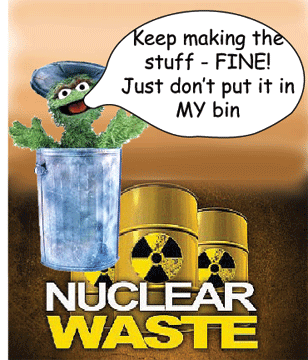 This time, it’s North Dakota that sinks an experiment related to burying nuclear waste, Science,By Warren Cornwall Mar. 23, 2016 , The history of failed attempts to deal with U.S. nuclear waste gained another chapter this month, when local opposition prompted scientists to abandon tests of a new disposal technique in eastern North Dakota.
In early March, Battelle Memorial Institute, a large research nonprofit based in Columbus, quietly withdrew plans to drill two holes up to 5 kilometers deep into the granite bedrock beneath the rolling prairie there. Those were supposed to be the centerpiece of an $80 million, federally funded project to see whether the government could get rid of some highly radioactive waste by sticking it deep underground.
The retreat followed objections from residents of rural Pierce County, who feared the drilling would open the door to nuclear waste. It underscores the treacherous path facing any major effort tied to nuclear waste, even when federal officials insist the project was a test that would never involve radioactive material.

“If we would have allowed this, the next step we really feel would have been (nuclear waste) in our backyard,” says David Migler, chair of the Pierce County Commission, which voted unanimously to oppose the tests……..
the Department of Energy (DOE) in recent years has directed money to so-called “deep boreholes” as a less-objectionable and cheaper way to deal with some of the waste.(Click here to read “Deep Sleep,” a Science feature story on the initiative.) Advocates said the approach could entomb waste in stable rock deep in Earth, far from underwater aquifers . Fuel rods—the vast majority of high-level waste—have been ruled out as too big to easily fit in these boreholes. But Moniz has said it could be ideal for some kinds of waste, particularly 1936 slender, half-meter-long tubes of highly radioactive cesium-137 and strontium-90. Those are currently stored in a pool of water at a federal nuclear facility in eastern Washington state.
But there are many unanswered questions about the borehole strategy. Scientists need to figure out how practical and how expensive it will be to drill a 43-centimeter-wide hole that deep. They also want to test ways to ensure the surrounding rock at the bottom of the hole is solid enough, and that any water there can’t travel up toward the surface. DOE hired Battelle, which manages a number of the department’s research labs, to lead the pilot project to answer such questions.
Battelle officials say they picked the North Dakota site—8 hectares of state-owned land approximately 25 kilometers south of the county seat of Rugby—because it was far from any active earthquake zones, had the kind of solid crystalline “basement” rock the government wanted, and wasn’t near oil and gas drilling. They teamed up with the University of North Dakota’s (UND’s) Energy and Environmental Research Center (EERC) in Grand Forks.
The project quickly struck a sour note in Pierce County. The problems began when local officials didn’t learn about it until an article appeared in the newspaper in the capital city of Bismarck, Migler says. Concerns grew when news coverage stated a goal of the study was to find out if the geology was suitable for storing nuclear waste, he said. The history of Nevada’s fight over Yucca Mountain added to the worries………http://www.sciencemag.org/news/2016/03/time-it-s-north-dakota-sinks-experiment-related-burying-nuclear-waste
No comments yet.
1 This Month

of the week – Shut Down Drone Warfare!


Tell the Ukrainian Government to Drop Prosecution of Peace Activist Yurii Sheliazhenko

Petition to revoke the licensing of the Near Surface Nuclear Disposal Facility (NSDF) at Chalk River. https://www.ourcommons.ca/petitions/en/Petition/Details?Petition=e-7247
To see nuclear-related stories in greater depth and intensity – go to https://nuclearinformation.wordpress.com
-
Archives
- March 2026 (251)
- February 2026 (268)
- January 2026 (308)
- December 2025 (358)
- November 2025 (359)
- October 2025 (376)
- September 2025 (257)
- August 2025 (319)
- July 2025 (230)
- June 2025 (348)
- May 2025 (261)
- April 2025 (305)
-
Categories
- 1
- 1 NUCLEAR ISSUES
- business and costs
- climate change
- culture and arts
- ENERGY
- environment
- health
- history
- indigenous issues
- Legal
- marketing of nuclear
- media
- opposition to nuclear
- PERSONAL STORIES
- politics
- politics international
- Religion and ethics
- safety
- secrets,lies and civil liberties
- spinbuster
- technology
- Uranium
- wastes
- weapons and war
- Women
- 2 WORLD
- ACTION
- AFRICA
- Atrocities
- AUSTRALIA
- Christina's notes
- Christina's themes
- culture and arts
- Events
- Fuk 2022
- Fuk 2023
- Fukushima 2017
- Fukushima 2018
- fukushima 2019
- Fukushima 2020
- Fukushima 2021
- general
- global warming
- Humour (God we need it)
- Nuclear
- RARE EARTHS
- Reference
- resources – print
- Resources -audiovicual
- Weekly Newsletter
- World
- World Nuclear
- YouTube
-
RSS
Entries RSS
Comments RSS
 nuclear-news
Leave a comment