Deep sleep for high level nuclear wastes
Deep sleep Warren Cornwall*, Science 10 Jul 2015: Vol. 349, Issue 6244, pp. 132-135
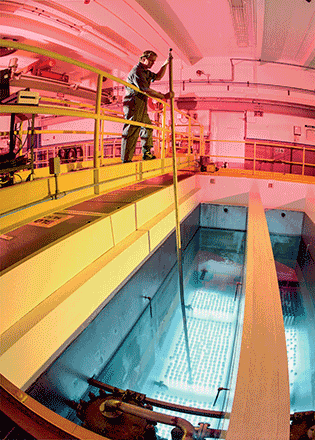 DOI: 10.1126/science.349.6244.132 One of the world’s biggest radioactive headaches sits in an aging cinderblock building in the desert near Hanford, Washington, at the bottom of a pool of water that glows with an eerie blue light. The nearly 2000 half-meter-long steel cylinders are filled with highly radioactive cesium and strontium, leftover from making plutonium for nuclear weapons. The waste has been described as the most lethal single source of radiation in the United States, after the core of an active nuclear reactor. It could cause a catastrophe if the pool were breached by an unexpectedly severe earthquake, according to the U.S. Department of Energy (DOE), the waste’s owner.
Now, a deceptively simple-sounding solution is emerging: Stick the cylinders in a very deep hole. The approach, known as deep borehole disposal, involves punching a 43-centimeter-wide hole 5 kilometers into hard rock in Earth’s crust. Engineers would then fill the deepest 2 kilometers with waste canisters, plug up the rest with concrete and clay, and leave the waste to quietly decay.
The idea has been around for decades, but not long ago scientists had all but abandoned it. Over the past 5 years, however, as improved drilling technologies converged with the political and technical woes bedeviling other nuclear waste solutions, boreholes have regained their allure. DOE has gone from spending almost nothing on borehole research to planning a full-scale field test, costing at least $80 million. And earlier this year U.S. Energy Secretary Ernest Moniz gave boreholes a dash of publicity during a major speech, mentioning them as a promising way to deal with the cesium and strontium waste at DOE’s Hanford Site nuclear complex.
Boreholes have “been plan B and just missed the boat for years,” says nuclear engineer Michael Driscoll, a retired professor from the Massachusetts Institute of Technology (MIT) in Cambridge and one of the concept’s leading advocates. “Maybe now is the time.”
Many nuclear waste veterans, however, are skeptical. The technical challenges are daunting, they argue, and boreholes won’t end political opposition to building new nuclear waste facilities. “The borehole thing to me is a red herring,” says attorney Geoff Fettus of the Natural Resources Defense Council (NRDC) in Washington, D.C., which supports underground disposal in a shallower mine, but has sued DOE over now abandoned plans to bury the waste inside Nevada’s Yucca Mountain……..
This past March, a White House policy shift opened the door further. Moniz announced that the Obama administration would abandon previous plans to put all high-level waste in one spot and instead would seek separate sites for disposing of commercial nuclear waste—about 85% of the total—and military waste. Moniz called some of the defense waste, including Hanford’s radioactive cylinders, “ideal candidates for deep borehole disposal.”………
Yet borehole disposal is not as straightforward as it might seem. The Nuclear Waste Technical Review Board, an independent panel that advises DOE, notes a litany of potential problems: No one has drilled holes this big 5 kilometers into solid rock. If a hole isn’t smooth and straight, a liner could be hard to install, and waste containers could get stuck. It’s tricky to see flaws like fractures in rock 5 kilometers down. Once waste is buried, it would be hard to get it back (an option federal regulations now require). And methods for plugging the holes haven’t been sufficiently tested. “These are all pretty daunting technical challenges,” says the board’s chair, geologist Rod Ewing, of Stanford University in Palo Alto, California.
Even if those technical problems are surmounted, boreholes might solve only a fraction of the nation’s waste problem. That’s because much of the high-level waste simply wouldn’t fit down a hole without extensive repackaging. “Due to the physical dimensions of much of the used nuclear fuel, it is not presently considered to be as good of a candidate [for borehole disposal] as the smaller waste forms,” said William Boyle, director of DOE’s Office of Used Nuclear Fuel Disposition Research and Development, in a statement to Science. Spent fuel rods from commercial power reactors, for instance, are often bundled into casks that are about 2 meters across.
Then there’s the same problem that dogged Yucca Mountain: the politics of finding a place to drill the holes. “Let’s just assume [boreholes] could work better than anybody ever imagined,” says Fettus, the NRDC attorney. “You still wouldn’t solve the nut that everyone has been unable to solve”: persuading state and local governments to take on waste from across the nation………
Other nations with nuclear waste, including China, are watching. But, for now, the United States is the only country getting ready to drill. “Nobody else has stepped forward,” says Geoff Freeze, a nuclear engineer at Sandia who is overseeing the U.S. experiment. “It kind of fell to us.” http://science.sciencemag.org/content/349/6244/132.full
No comments yet.
1 This Month

of the week – Shut Down Drone Warfare!


Tell the Ukrainian Government to Drop Prosecution of Peace Activist Yurii Sheliazhenko

Petition to revoke the licensing of the Near Surface Nuclear Disposal Facility (NSDF) at Chalk River. https://www.ourcommons.ca/petitions/en/Petition/Details?Petition=e-7247
To see nuclear-related stories in greater depth and intensity – go to https://nuclearinformation.wordpress.com
-
Archives
- April 2026 (79)
- March 2026 (251)
- February 2026 (268)
- January 2026 (308)
- December 2025 (358)
- November 2025 (359)
- October 2025 (376)
- September 2025 (257)
- August 2025 (319)
- July 2025 (230)
- June 2025 (348)
- May 2025 (261)
-
Categories
- 1
- 1 NUCLEAR ISSUES
- business and costs
- climate change
- culture and arts
- ENERGY
- environment
- health
- history
- indigenous issues
- Legal
- marketing of nuclear
- media
- opposition to nuclear
- PERSONAL STORIES
- politics
- politics international
- Religion and ethics
- safety
- secrets,lies and civil liberties
- spinbuster
- technology
- Uranium
- wastes
- weapons and war
- Women
- 2 WORLD
- ACTION
- AFRICA
- Atrocities
- AUSTRALIA
- Christina's notes
- Christina's themes
- culture and arts
- Events
- Fuk 2022
- Fuk 2023
- Fukushima 2017
- Fukushima 2018
- fukushima 2019
- Fukushima 2020
- Fukushima 2021
- general
- global warming
- Humour (God we need it)
- Nuclear
- RARE EARTHS
- Reference
- resources – print
- Resources -audiovicual
- Weekly Newsletter
- World
- World Nuclear
- YouTube
-
RSS
Entries RSS
Comments RSS
 nuclear-news
Leave a comment