USA worried about weapons proliferation risks in China’s Nuclear Recycling plan
China’s Plans to Recycle Nuclear Fuel Raise Concerns U.S. energy secretary airs worries about proliferation risks ahead of nuclear-security summit WSJ, By BRIAN SPEGELE, 17 MAR 16, BEIJING—China’s plans to process spent nuclear fuel into plutonium that could be used in weapons is drawing concern from the U.S. that Beijing is heightening the risk of nuclear proliferation.
U.S. Energy Secretary Ernest Moniz, in Beijing for talks, said Thursday that China’s plans to build a nuclear-recycling facility present challenges to global efforts to control the spread of potentially dangerous materials……..
Mr. Moniz’s comments marked a rare public expression by the Obama administration of concern over China’s reprocessing plans. The differences, which the governments have discussed privately, are being aired ahead of a visit by President Xi Jinping to Washington this month for a summit with President Barack Obama and other world leaders on nuclear security.
The issue comes down to the different choices countries make over how to handle potentially dangerous waste created by commercial nuclear reactors. In the U.S., spent fuel is treated as sensitive material and is stored, and reprocessing is banned out of proliferation concerns.
Elsewhere, including in France and Japan, spent fuel is recycled to extract plutonium to be used in nuclear reactors. The U.S.’s concern is that the bigger the stockpiles of plutonium, the higher the risk that some of it could be refined for use in nuclear weapons or taken by terrorists……
U.S. concerns about nuclear reprocessing and proliferation are particularly acute in the Asia-Pacific region, “where the perception is there is less international cooperation, less transparency,” said Mark Hibbs, a nuclear expert at the Carnegie Endowment for International Peace………
larger Chinese stockpiles of isolated plutonium could prompt Japan, especially, to build up its caches.
Civilian plutonium stockpiles reached 271 metric tons by the end of 2014, up from around 150 metric tons in the 1990s, the International Panel on Fissile Materials, an independent group looking at nonproliferation policy, said in its latest annual report.
The official Xinhua News Agency reported in September that construction of China’s reprocessing facility may start in 2020 and take a decade to complete. The project is expected to have a processing capacity of 800 metric tons of spent fuel a year…..
Previously, the U.S. has questioned the economic viability of such projects, which are expensive to build and operate, as well as proliferation issues, Ernest Moniz said……
Mr. Hibbs from the Carnegie center said China’s decision to pursue reprocessing couldn’t be justified on economic or commercial grounds, given the billions of dollars needed to construct one large-scale facility. But China may be acting strategically, guaranteeing future fuel supply by recycling, he added.
Last June, state-owned China National Nuclear Corp. and France’sAreva SA agreed to speed up negotiations on building the facility. Areva didn’t respond to a request for comment on Mr. Moniz’s remarks and CNNC said its press officers weren’t available.
Write to Brian Spegele at brian.spegele@wsj.com http://www.wsj.com/articles/chinas-plans-to-recycle-nuclear-fuel-raise-concerns-1458228504
The Importance Of The Nuclear Security Summit – five points
Five Points On The Importance Of The Nuclear Security Summit , TPM, By5 PRIORITIES FOR GLOBAL NUCLEAR SECURITY, 17 MAR 16 On April 1, world leaders will gather in Washington, DC for the fourth and final Nuclear Security Summit, which concludes a pivotal process started by President Obama in 2010 to intensify global efforts to prevent nuclear terrorism. With the summits coming to a close along with Obama’s presidency, it could be a long time before the next international meeting of top leaders devoted solely to nuclear security.
Here are 5 reasons why the upcoming summit is so important.
But bomb-grade materials aren’t the only danger. Any highly-radioactive material—the kind used in cancer treatment, energy exploration, and food safety around the world—could be spread by conventional explosives in a “dirty bomb,” causing widespread chaos. Alarmingly, due to often-weak security, these materials regularly go missing—and aren’t always recovered.
There aren’t any mandatory international standards for securing all nuclear materials
Under the current system, every country basically gets to make up its own rules for securing nuclear materials—and none of them have to tell anyone else what those rules are, or be held accountable for following them.
The nuclear security treaties that are in force are limited in scope and effectiveness. The Convention on the Physical Protection of Nuclear Material was written for a pre-9/11 world, and isn’t fully effective because a critical amendment to bring it up to date hasn’t yet been ratified by enough countries. And the International Convention for the Suppression of Acts of Nuclear Terrorism is about responding to terrorism—not preventing it.
The Nuclear Security Summits have been important but inadequate……….
Experts agree on what we need to do next……..We need to demand that our leaders act…….. http://talkingpointsmemo.com/fivepoints/five-points-importance-nuclear-security-summit
New UK nuclear project Hinkley Point C – now a”dead duck” ?
 Resignation of EDF finance chief shows new UK nuclear plant ‘a dead duck’ By Molly Scott Cato | EurActiv.com, 16 Mar 16, Five years on from the Fukushima, the human and environmental impacts of the disaster continue to grow in scale, writes UK Green MEP Molly Scott-Cato.
Molly Scott-Cato is an MEP for South-West England and Gibraltar, whose constiutency covers the Hinkley Point nuclear reactor.
This is a key reason why I am fighting so hard to prevent the new reactors at Hinkley point in Somerset from being built.
Nuclear-power is not commercial; it cannot survive without government subsidy and never has been able to during the 60 years of its existence. That in itself should be enough to close the question of whether we wish to build new nuclear power stations in Europe. But somehow the commercially unviable deal to build at Hinkley has slipped between the scrutiny of commercial and political interests, and between the political authorities at Westminster and in Brussels. It is extraordinary that such a shaky deal could have got so far and endured for so long as it was never going to survive in a commercial market.
For me one of the most shocking aspects of the deal was how little concern was raised by UK politicians. We are talking about a deal that involves two Chinese nuclear companies that are ultimately under the control of the Chinese Communist Party gaining access to our civilian nuclear industry. I am astonished that Conservative MPs are prepared to countenance such a risk to our national security. And this is to say nothing of the risk of suicide terrorism which we are left open to when nuclear stations are operational anywhere in the country.
Commercially the Hinkley deal has been a dead duck for some time. ………
The issue of most concern in this whole sorry saga is the total absence of genuine political scrutiny. Most UK MPs only seem to have woken up and taken any interest about a week before the deal was signed off last autumn. Cameron and Osborne have been operating as though in a legal vacuum. The British media has paid no attention to the rules of the single market and my continual efforts to interest them in the issue of state aid have failed……..https://www.euractiv.com/section/climate-environment/opinion/resignation-of-edf-finance-chief-shows-uk-new-nuclear-plant-a-dead-duck/
A high-level nuclear waste dump for South Australia?
A high-level nuclear waste dump for South Australia: The big questions
Conservation Council South Australia 18 Mar 16

Call for India to stop building nuclear plants
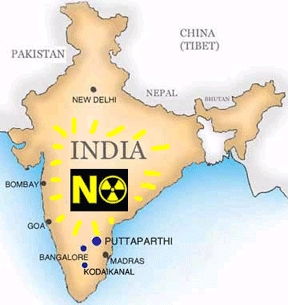 Stop building nuclear plants: CPI-M http://www.oneindia.com/india/stop-building-nuclear-plants-cpi-m-2044121.html, March 17, 2016 New Delhi, : The leakage of heavy water in the Kakrapar Atomic Power Station (KAPS) in Gujarat must impel the government to stop building new nuclear projects in the country, the CPI-M has said. “The harmful policy of importing nuclear reactors and diluting the liability law to facilitate the foreign nuclear companies must (also) be reversed,” CPI-M journal People’s Democracy said in an editorial.
Seven key areas for concern in South Africa’s nuclear build plan
 SA nuclear build plan requires a close study, IOL BUSINESS/OPINION/COLUMNISTS /17 March 2016By: Pierre Heistein Should South Africa build more nuclear power plants?…….. These are seven key areas that need to be assessed.
First, construction time. South Africa is in desperate need of extra electricity generation capacity and the proposed nuclear projects plan to add 9 600 megawatts to the grid. But how long will it take to get this online? On average, nuclear reactors take about 10 to 15 years to build, although nuclear construction worldwide is notorious for being behind schedule……
It is not only the cost that needs to be considered but also the consequences of the cost. If the money needs to be borrowed, how long will it take to pay back and how will this additional debt affect our credit rating and ability to borrow for other projects? If the project is funded by external parties, what trade and political conditions will be attached to these deals?
Third, the cost of energy generation. This is nuclear’s saving grace – relative to other methods its production of electricity per unit is cheap once the plant is built. Will this still be the case in 15 to 20 years?
Fourth, waste and disposal consequences. Nobody has yet figured out a way to produce nuclear energy without producing radioactive waste. This waste needs to be stored for 200 to 1 000 years before humans and other life can safely be exposed to it.
Fifth, decommission costs. Nuclear reactors have a lifespan of 40 to 80 years and thereafter need to be removed and replaced……
Sixth, transparency and corruption. As the government has shown, the majority of negotiations necessary in mega-infrastructure projects can take place behind closed doors without public consultation.
Megaprojects also typically work with few suppliers and include fewer and more lucrative trade deals. Compare this to the more transparent and decentralised process behind the independent power producers procurement programme used for smaller energy projects and it is easy to see that megaprojects are more vulnerable to corruption and theft of investment funding.
Seventh, disaster risk. Even if measures could be put in place to eliminate the chance of human error, technological failure and the risk of terror attacks, there is no way that constructors can guarantee that reactors will be safe from natural disasters. While terror attacks and natural disasters may not feel familiar in South Africa’s current climate, the nuclear reactors will exist for almost a century of change.
If nuclear is our best option then we have to be consulted and convinced on all accounts because it is the South African people that will carry the consequences if it’s not. http://www.iol.co.za/business/opinion/columnists/sa-nuclear-build-plan-requires-a-close-study-1998735
Nuclear power station reactor shut down after fault
STV News Kaye Nicolson, 17 Mar 16 Workers act after problem with valve in Reactor Two at Torness in East Lothian.A reactor has been shut down at the Torness nuclear power plant due to a problem with a valve.
Reactor Two at the plant, near Dunbar, was closed on Thursday morning after workers found a fault.
EDF Energy said there were no safety or environmental impacts associated with the closure, which is expected to be short term……..http://stv.tv/news/east-central/1346829-reactor-shut-down-at-east-lothian-nuclear-power-plant/
1 This Month

of the week – Shut Down Drone Warfare!


Tell the Ukrainian Government to Drop Prosecution of Peace Activist Yurii Sheliazhenko

Petition to revoke the licensing of the Near Surface Nuclear Disposal Facility (NSDF) at Chalk River. https://www.ourcommons.ca/petitions/en/Petition/Details?Petition=e-7247
To see nuclear-related stories in greater depth and intensity – go to https://nuclearinformation.wordpress.com
-
Archives
- April 2026 (57)
- March 2026 (251)
- February 2026 (268)
- January 2026 (308)
- December 2025 (358)
- November 2025 (359)
- October 2025 (376)
- September 2025 (257)
- August 2025 (319)
- July 2025 (230)
- June 2025 (348)
- May 2025 (261)
-
Categories
- 1
- 1 NUCLEAR ISSUES
- business and costs
- climate change
- culture and arts
- ENERGY
- environment
- health
- history
- indigenous issues
- Legal
- marketing of nuclear
- media
- opposition to nuclear
- PERSONAL STORIES
- politics
- politics international
- Religion and ethics
- safety
- secrets,lies and civil liberties
- spinbuster
- technology
- Uranium
- wastes
- weapons and war
- Women
- 2 WORLD
- ACTION
- AFRICA
- Atrocities
- AUSTRALIA
- Christina's notes
- Christina's themes
- culture and arts
- Events
- Fuk 2022
- Fuk 2023
- Fukushima 2017
- Fukushima 2018
- fukushima 2019
- Fukushima 2020
- Fukushima 2021
- general
- global warming
- Humour (God we need it)
- Nuclear
- RARE EARTHS
- Reference
- resources – print
- Resources -audiovicual
- Weekly Newsletter
- World
- World Nuclear
- YouTube
-
RSS
Entries RSS
Comments RSS
 nuclear-news