Fukushima misery continues – thyroid cancer epidemic, and more
Fukushima: The misery piles up https://pursuit.unimelb.edu.au/articles/fukushima-the-misery-piles-up
 Five years on from the Fukushima nuclear disaster there is now an emerging thyroid cancer epidemic and 174,000 people are still displaced By Associate Professor Tilman Ruff, Nossal Institute for Global Health, University of Melbourne
Five years on, the Fukushima nuclear disaster is far from over – the dispersed fallout continues to irradiate and move around the environment; in the water, in the plants and animals, and blown on the wind.
Every day 300 tons of contaminated water leak from the wrecked nuclear plants into the soil and eventually the ocean. The Reconstruction Agency estimates 174,000 people remain displaced, with many families disrupted having lost their land and livelihoods and now facing an uncertain future.
Despite inadequate health monitoring of exposed people, ultrasound screening of almost 370,000 children in Fukushima has yielded clear evidence of an emerging thyroid cancer epidemic among children and adolescents in Fukushima.
Whereas across Japan three cases of thyroid cancer per million per year would be expected in children, a total of 166 have been identified in Fukushima children. Rates are up to 50 times the national average in the most contaminated regions. Nor are these cases of little long-term consequence, detected earlier than usual because of an active screening program. Post-operative findings indicate that over 90 per cent had spread outside the thyroid gland, to local lymph nodes, or with distant metastases.
It is highly likely that this emerging thyroid cancer epidemic will be the harbinger of increases in other cancers and chronic illness. However, there is regrettably no register of people exposed from the disaster or of the doses they are likely to have received to enable long-term follow-up of health outcomes and appropriate targeting of health screening services.
The Japanese government is acting as if it wishes the Fukushima nuclear disaster could be quietly swept under the carpet before the 2020 Tokyo Olympics. It has announced cuts to housing and other assistance for displaced people by this time next year, and plans to clear the public evacuation orders for areas still contaminated at more than 20 times the internationally recommended and previous Japanese radiation limit.
Along with limited subsidies for those who choose to return to evacuated areas, these measures serve to push those whose lives have already been disrupted and health harmed by the disaster back into areas that remain significantly contaminated. No other government has failed in its first duty to protect its citizens by accepting such a high level of radiation exposure in the long term, including for pregnant women and young children.
We should not be at all surprised about emerging evidence of human health damage from a disaster which most Japanese and some international agencies, like the United Nations Scientific Committee on the Effects of Atomic Radiation – but not the World Health Organisation – claimed would have no discernible adverse radiation-related health impacts. Extensive evidence from a large number of plant and animal species in Fukushima confirm earlier findings from the region of the Chernobyl nuclear disaster in Ukraine showing high rates of genetic damage and a wide variety of illnesses and abnormalities in direct proportion to the level of contamination in essentially every species studied. In none of these studies was a threshold identified below which no damage occurred.
In Fukushima, malformations have been demonstrated in fir trees, butterflies, reduced diversity and numbers of birds and mammals, and reduced diversity of a wide variety of intertidal marine species, including anemones, worms, sponges, crustaceans and bivalves. Since 2012 rock shells within 30 km of the damaged reactors have completely disappeared.
Australians bear a special responsibility to ensure that the consequences of the Fukushima nuclear disaster and its victims are not forgotten or neglected. The fallout contaminating Japan comes in part from uranium mined in our country. Once mined and processed, there are only three ways that uranium can end up: as nuclear waste, in nuclear weapons, or as radioactive fallout.
The most important lesson from Fukushima is that sustaining global health demands a renewable energy future, not a radioactive one. Along with prohibiting and eliminating nuclear weapons, this is the only way to ensure that massive radioactive releases spreading around the world causing indiscriminate harm to present and future generations are prevented.
Nuclear expansion in Asia – sounds great – BUT
it’s unclear whether such plans will ever see the light of day. “It will be very difficult to find people willing to invest billions of dollars in this area, especially given the likelihood of another accident taking place in another part of the world,”
Nuclear energy booming in Asia, DW 12 Mar 16 Five years after the Fukushima nuclear disaster, India and China have embraced nuclear power. Other countries in the region also want to build more plants – even in high-risk areas prone to earthquakes and tsunamis…..
China: on track to becoming number 1 Following the Fukushima disaster, China’s government initially suspended the construction of additional nuclear power plants. Instead, comprehensive security policies were adopted. But in the autumn of 2012, Beijing lifted the moratorium on future development – and since then, has pursued a more ambitious nuclear program……….
Nuclear power is considered a relatively “clean” alternative to coal. In daily congressional meetings, the Communist Party has been discussing plans for a massive expansion of nuclear energy. By 2030, a total of 110 nuclear power plants will be in operation.
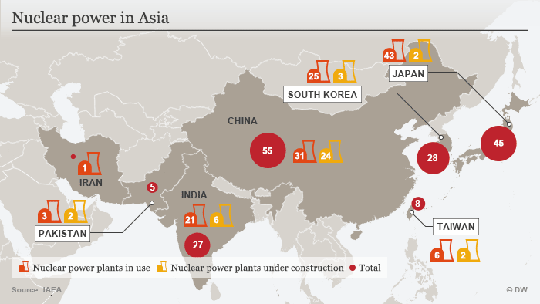
China would overtake the US as the country with the most nuclear power plants connected to the grid. Greenpeace nuclear expert Heinz Smital views the speed at which the reactors are being developed as problematic: “The Chinese safety authorities do not have the capacity to examine the buildings properly,” said Smital. “They will likely wave things through, rubber-stamp everything and not mess with the state-run construction consortiums. There is a big security risk.”……..
India. Delhi is planning a far-reaching expansion of nuclear power. Prime Minister Narendra Modi wants to build dozens of new reactors in the next 15 years.
The technical know-how is sourced internationally. Over the past decade, India has reached civil nuclear agreements with the United States, Canada, France and Russia. 21 nuclear power plants are already in operation. Two of the plants are in Kudankulam and Kalpakkam, located on the southeast coast of the country – areas prone to tsunamis. In December 2006, a tsunami hit Kalpakkam causing extensive damage, but not to the nuclear power plant, according to its operator.
Pakistan: Reactors in flood-prone areas
India’s neighbor, Pakistan, is also struggling with blackouts and outdated infrastructure. The country currently operates three small reactors, with the nuclear plant west of Karachi – located in a flood-prone area – being one of the oldest in the world. The remaining two reactors are situated in an earthquake-prone area some 300 kilometers (186.4 miles) south of the capital Islamabad. The government is planning to build two other reactors in the same area. According to Pakistan’s Atomic Energy Commission, Islamabad wants to build a total of seven new reactors by 2030 – with assistance from China.
South Korean expansion Although South Korea is about the size of the former German Democratic Republic (GDR), the country boasts 25 active nuclear plants. Three additional ones are under construction, while two others are set to be completed by 2029. The government plans to increase the share of nuclear power in the country’s overall energy mix from currently 30 to 40 percent.
Still, South Koreans are becoming increasingly skeptical about nuclear energy – and not just because of the 2011 Fukushima disaster. In 2012 and 2013, a scandal related to the use of fake safety certificates rocked the country’s nuclear industry lobby. State-owned (KHNP) had thousands of small components featuring falsified certificates fitted into the country’s nuclear plants. As it turns out, large amounts of bribe money changed hands between KHNP employees, construction firms and politicians.
This led not only to Korean media speaking of a “nuclear mafia,” but also to a massive drop in the approval ratings for nuclear energy – from 70 percent before the Fukushima disaster to 35 percent. In spite of this, Seoul is sticking to its plans to expand the use of nuclear power in the East Asian country.
Southeast Asia pigeonholes nuclear plans
In Southeast Asia, the production of nuclear energy is a hotly debated issue. For instance, while Vietnam wants Russian assistance to build eight nuclear plants, Hanoi has yet to make a final decision. Thailand is planning to build five reactors, whereas Malaysia and the Philippines each want a nuclear reactor to go online.
However, it’s unclear whether such plans will ever see the light of day. “It will be very difficult to find people willing to invest billions of dollars in this area, especially given the likelihood of another accident taking place in another part of the world,” said Greenpeace nuclear expert Smital.
“The costs related to the production of nuclear energy are only likely to increase, whereas renewable energy is becoming increasingly affordable. This is why the free market can only barely manage to finance nuclear plants at the moment,” Smital added. http://www.dw.com/en/nuclear-energy-booming-in-asia/a-19110848
Major leak shuts down India’s Gujarat Nuclear Plant

 Gujarat Nuclear Plant Shut Down After Major Leak, All Workers Safe http://www.ndtv.com/india-news/gujarat-nuclear-plant-shut-down-after-major-leak-workers-isolated-but-safe-1286198 NDTV, All India | Written by Pallava Bagla March 12, 2016 NEW DELHI:
An emergency has been declared within the nuclear plant at Kakrapar in Gujarat after a major heavy water leak in a nuclear reactor. No worker has been exposed to radiation, said officials, adding that the employees remained sequestered till their shift ended, which is standard operating procedure for a crisis.
The workers were allowed to go home after they had been counted and accounted for as officials checked to ensure that no radioactivity was reported outside the plant.
Officials at India’s nuclear operator, Nuclear Power Corporation of India Limited (NPCIL), told NDTV “The reactor has shut down safely and no radiation has leaked out”. According to Nalinish Nagaich a senior official at NPCIL, no worker was stationed in the affected area.
The nuclear reactor is slowly cooling down and is in a “safe stage” confirmed Dr Sekhar Basu, Chairman of the Atomic Energy Commission.
The heavy water leak affected the reactor’s cooling system. If emergency cooling systems do not kick in after this sort of glitch, the temperature can rise so much that the core of the reactor can melt down completely.
Heavy water, formed with a hydrogen isotope, is used in Indian reactors as a preferred cooling agent.
Comprehensive report on Chernobyl – 30 years on

 TORCH, Ian Fairlea, March 10, 2016 First of all, apologies to the many readers who have written complaining about the lack of new blogs/information on this website.
The explanation is that I’ve been busy for the past 5 months writing a new report on the health effects of the 1986 Chernobyl nuclear disaster -TORCH-2016. This is an update of the 2006 TORCH report. (TORCH means The Other Report on Chernobyl.)
The report (120 pages) was commissioned by Global 2000/Friends of the Earth Austria and funded by the Vienna City Council Environmental Ombuds Office.
The report updates the new health evidence which has been published in peer-reviewed journals during the 10 year period 2006-2016.
In a nutshell, the report finds
- 5 million people in Belarus, Ukraine and Russia still live in highly contaminated areas
- 400 million people in less contaminated areas
- 37% of Chernobyl’s fallout deposited on western Europe; 42% of western Europe contaminated
- 40,000 fatal cancers predicted
- 6,000 thyroid cancer cases to date, 16,000 more expected
- increased radiogenic thyroid cancers now seen in Austria
- increased radiogenic leukemia, cardiovascular disease, breast cancers confirmed
- new evidence of radiogenic birth defects, mental health effects and diabetes
- new evidence that children in contaminated areas suffer radiogenic illnesses https://www.global2000.at/sites/global/files/TORCH%20-%20The%20other%20Report%20of%20Chernobyl.pdf

Further nuclear tests, threats, from North Korea’s Kim Jong-un
 North Korea’s Kim Jong-un orders further nuclear tests, threatens to turn US, South Korea ‘into ashes’ North Korean leader Kim Jong-un has ordered further nuclear tests, state media says, adding to military tensions on the Korean peninsula., ABC News 11 Mar 16
Key points:
- North Korea orders more nuclear tests
- Pyongyang talking up nuclear capabilities as US, South Korea hold joint military exercises
- The North carried out a nuclear test in January
Pyongyang has issued daily warnings and statements talking up its nuclear strike capabilities since US and South Korean forces began joint military exercises on Monday.
In one statement, it threatened to turn Seoul and Washington into “flames and ashes”.
Just days after he was photographed posing in front of what state media described as a miniaturised nuclear warhead, Mr Kim said the weapon required further testing.
Overseeing a ballistic missile launch, Mr Kim ordered “more nuclear explosion tests to estimate the destructive power of the newly produced nuclear warheads”, the North’s official KCNA news agency said.
Experts are divided as to just how far the North may have gone in shrinking warheads to a size capable of fitting on a ballistic missile ……..http://www.abc.net.au/news/2016-03-11/north-korean-leader-orders-further-nuclear-tests/7240344
A Jewish Law insight on the ethics of keeping crumbling Indian Point nuclear power plant
 What Jewish Law Says About Crumbling Indian Point Nuclear Plant, Forward, Jay Michaelson 11 Mar 16, What does an ox’s propensity for violence have to do with a leaky nuclear reactor? One is an ancient, Jewish example of negligence; the other is a very contemporary one. But the ethical imperative is the same:
When there’s an imminent risk of danger to the public, it’s morally wrong to do nothing.
Let’s start with the present. Twenty-five miles north of New York City, the crumbling Indian Point nuclear power plant is leaking radioactive water. And yet what has been the government’s response? Forge ahead with a 42-inch natural gas pipeline right underneath that power plant.
Although The New York Times published an excellent op-ed on the plant this week, that article omitted the pipeline entirely, focusing only on the need to close Indian Point………
New York Governor Andrew Cuomo, to his credit, believes that it’s time to retire the Indian Point plant and, among other things, invest in renewables. So did that New York Times op-ed.
But it seems that one of those “other things” is Spectra Energy’s Algonquin Incremental Market project, a web of natural gas pipelines that stretches from New Jersey to Boston.
In other words, fracking. The AIM pipeline, if completed, will pipe fracked natural gas (that is, methane) from the Appalachians to New England. Cuomo has so far been silent on the AIM pipeline, giving it his tacit approval. FERC, the federal agency responsible for the pipeline, approved it in 2015.
Now, common sense would seem to disagree. Natural gas pipelines rupture all the time; there were 119 pipeline accidents in 2014. Right now, a gas storage leak outside Los Angeles is spewing 62 million cubic feet of methane into the atmosphereevery day. And the AIM pipeline would run just 105 feet away from the Indian Point plant. Twenty million people live within 50 miles.
The icing on the cake? Both the plant and the pipeline lie less than a mile from a fault line.
How is any of this possible?
First, for all the common-sense objections to a huge natural gas pipeline passing underneath a crumbling nuclear power plant on a fault line 25 miles north of the largest city in America, the fact is that both the pipeline and the plant have continually obtained regulatory approvals. And Spectra, the company building the pipeline, points out that it has older, smaller pipelines across the Indian Point property already, and they’ve operated without incident for decades……..
Here’s where that goring ox comes in. Jewish law is clear, in general and in detail, that it is negligent to create a risk to the public. If you let an ox loose, and it gores someone, you are responsible, because you placed the risk in the public domain.
The Indian Point plan is a modern-day ox. But as long as it remains open, or its waste remains on site, so is the Spectra Pipeline.
Indeed, the Pipeline-plus-Plant risk gets even worse. Perversely, the NRC includes terrorism in its purview, but only for the plant itself. The pipeline, meanwhile, has not been deemed a terrorist target at all, even though if you can blow up the pipeline, you might be able to blow up the plant……..
We need religious, as well as environmentalist, voices on this issue. We need to reframe our public discussion of environmental risk to include ethical, moral and religious traditions within it. And if we don’t, we may not be legally liable for what might happen, but I wouldn’t be able to sleep at night. http://forward.com/opinion/335647/what-jewish-law-says-about-crumbling-indian-point-nuclear-plant/#ixzz42dEdxuQo
Research into nuclear strikes – considering possibility of terrorism
Surprise nuclear strike? Here’s how we’ll figure out who did it, Science By Richard Stone Mar. 11, 2016 “……..The most likely nuclear terrorism scenario, experts say, is a bomb set off on a city street. Past experience offers only a sketchy picture of the resulting devastation. The atomic bombs the United States dropped on Hiroshima and Nagasaki in 1945 detonated about 500 meters above those cities. During the subsequent half-century, while the United States refined its atomic arsenal, nearly all tests were in the air or underground, not in citylike environments. …….http://www.sciencemag.org/news/2016/03/surprise-nuclear-strike-heres-how-well-figure-out-who-did-it
Russia to disarm huge aging nuclear ballistic missile submarine
Russia to disarm world’s largest nuclear ballistic missile submarine Rt.com 11 Mar, 2016 In 2016 Russia is set to disarm the missile system of the Typhoon-class Arkhangelsk submarine, the largest in the world. The disarmament will be carried out in accordance with the New START agreement between Moscow and Washington.
Working in accordance with the New START treaty between Russia and US, the country’s leading Zvezdochka shipyard in the northern Russian city of Severodvinsk will disarm the missile system of the Arkhangelsk submarine, the shipyard’s press service told TASS news agency on Friday.
“We will remove the covers of the submarine’s missile launchers and seal them, thus making it impossible to use the vessel’s missile weapons,” the press service said. “We are not talking yet about dismantling the submarine itself. The tender for this procedure has not yet been announced.”
According to the data published by the Russian nuclear agency Rosatom, the sub’s disarmament is estimated to cost some 28 million rubles (about US$ 400,000).
The nuclear-powered ballistic missile submarine Arkhangelsk TK-17 was designed in 1987 under the Project 941 ‘Shark’ (or ‘Typhoon’ according to NATO classification). The project was aimed to equip the Soviet Navy with nuclear-powered ballistic missile submarines, and resulted in the creation of the largest class of submarines ever built – large enough to accommodate decent living facilities for the crew of 179 when submerged for months on end, and to stock an arsenal of 20 intercontinental ballistic missiles.
Three of the six Typhoon-class submarines built in the 1980s have already been dismantled at the shipyards in Severodvinsk. Of the three that remain, Arkhangelsk and Severstal are set to be dismantled. Dmitri Donskoi just recently underwent a modernization procedure and is now equipped to test the latest sea-based missile system Bulava.
The New START treaty (on Measures for the Further Reduction and Limitation of Strategic Offensive Arms), which was designed to reduce American and Russian nuclear stockpiles, came into force in 2011. It replaced the previous 1991 agreement, introducing lower ceilings for the numbers of warheads and delivery systems deployed……….https://www.rt.com/news/335300-russia-disarms-nuclear-sub/
Cities can thrive nuclear free – Seoul shows the way
Seoul’s success provides testimony that a nuclear free energy supply can be a reality for a densely populated city, through innovative measures in terms of policy making and public land use.
Seoul’s initiative shows that it is possible to mobilise communities within a short period of time and achieve significant results. It demonstrates that even one city can fulfill the vision of energy self-reliance.

 Can Hong Kong become nuclear-free? https://www.hongkongfp.com/2016/03/11/can-hong-kong-become-nuclear-free/ 11 March 2016 10:27 Greenpeace By Frances Yeung, Greenpeace Senior Campaigner
Today marks the 5th anniversary of the Fukushima nuclear disaster and with it, five years of struggle by Japan to improve energy efficiency as it strives to go nuclear-free. As the repercussions of Fukushima were felt around the world, making governments and communities re-evaluate their dependency on nuclear power, here in Hong Kong we’ve spent the past five years stuck in the same nuclear debate. Nuclear-free naysayers continue think going nuclear-free in Hong Kong is meaningless if the Chinese government is pro-nuclear in its energy policy.
To those who have thrown up their hands and turned their backs on safe, sustainable energy solutions, I urge them to look to Seoul and the solution one city government successfully rolled out in opposition to national energy interests. South Korea’s central government actively develops nuclear power, yet the Seoul Metropolitan Government (SMG) has been exploring a sustainable energy solution as a nuclear alternative since the immediate aftermath of the Fukushima nuclear accident.
To better understand South Korea’s reliance on nuclear energy one must only look at the numbers. There are 25 reactors in South Korea supplying 30 per cent of the country’s demand; and the government is planning to build 14 more in the next 20 years, arguing that it is necessary in order to meet growing power consumption. To encourage and promote a nuclear-free environment after the Fukushima disaster, Seoul citizens initiated energy-saving campaigns in their communities. That same year, , a human rights lawyer and an independent candidate, became mayor of Seoul, winning against the ruling party’s campaign. Shortly after taking office, Park and the SMG pushed forward the ‘One Less Nuclear Power Plant’ initiative, opposing the national government’s policy. It is important to note that Seoul accounts for 10 per cent of national nuclear energy consumption.
The first phase of ‘One Less Nuclear Power Plant’ was implemented in 2012 and ran through 2014, to boost renewables production in Seoul and achieve energy conservation of 2 million TOE (tonnes of oil equivalent), an amount equal to the average annual electricity production of one nuclear plant. The goal was achieved six months ahead of schedule. During the three-year implementation of the first phase of the initiative, the overall electricity consumption in South Korea rose by 5%, even as it dropped by 4% in Seoul. The SMG, led by Park, then launched the second phase, to reduce energy consumption by a further 4 million TOE by 2020.
Seoul’s success shows that energy conservation and renewable electricity production can replace nuclear power while meeting energy demand. Regardless of these results, the South Korean government continues to build new reactors to meet the “continued increase in national electricity demand”.
Seoul’s anti-nuclear policy has created interest both at home and abroad. The heads of local governments from Seoul, Gyeonggi, and Jeju released a joint statement in November to reaffirm their commitment to stepping up the development of renewable energy. At the same time, Taiwan’s newly-elected president, Tsai Ing-wen, announced last year that the nation’s Democratic Progressive Party would initiate a similar plan in the cities and counties it governs.
Seoul’s initiative shows that it is possible to mobilise communities within a short period of time and achieve significant results. It demonstrates that even one city can fulfill the vision of energy self-reliance. The SMG launched 23 measures and 71 programmes over three years including offering vacant public space to businesses and community groups at low rents to build solar power stations; introducing the Energy Self-reliant Community movement to provide funds to residents to promote energy efficiency and installing small renewable energy facilities; and cooperating with enterprises to assist property owners to improve energy efficiency in buildings, by means of LED lights, insulated windows, and other energy-saving equipment, as well as low-interest government loans.
Seoul’s success provides testimony that a nuclear free energy supply can be a reality for a densely populated city, through innovative measures in terms of policy making and public land use. For instance, the SMG installed steel structures in water treatment plants to support solar panels on top of water pools. It also implemented the Eco-Mileage programme in which citizens who save energy can receive mileage points for buying eco-friendly products, cinema tickets, and recharging transportation cards. So far, 42% of the city’s households (1.48 million) have taken part in the programme.
As we mourn the Fukushima disaster we also note that the Hong Kong government has shirked its responsibility to create a proactive renewable energy strategy and chosen instead to highlight land issues and cost effectiveness. We have an immediate opportunity, however, since the electricity supply contract with the Daya Bay nuclear plant ends in 2034. The plant will have been operating for over 40 years and will reach the end of the average lifespan of a nuclear plant by then. The plant should be closed for the sake of safety.
We can also make great strides towards nuclear free safety by carrying out the Hong Kong government’s plan to replace coal with natural gas. Along with reducing electricity use by 20% in the coming 20 years and boosting renewable energy use to 10%, Greenpeace calculates that a halt in the use of nuclear energy is achievable.
When he met with Greenpeace, Seoul mayor Park Won-soon said firmly that nuclear power is far from safe and is expensive, especially in regard to the cost of nuclear waste disposal. The underlying stance of ‘One Less Nuclear Power Plant’ might differ from the energy policy of the South Korean government, yet he suggested that it is the responsibility of the city government to reduce the use of nuclear power to safeguard the wellbeing of its citizens. Hong Kong enjoys no lesser degree of autonomy than Seoul in energy policy making. As long as the government is willing to step outside of its comfort zone and take action on behalf of its communities, a nuclear free Hong Kong will immediately become a real and vivid possibility.
Japan’s anti nuclear movement still in there, but it’s not easy
Down but not out: Japan’s anti-nuclear movement fights to regain momentum, Japan Times, BY MIZUHO AOKI STAFF WRITER , 11 Mar 16 Five years after the horrific nuclear meltdowns at the Fukushima No. 1 power plant stunned the nation as a result of the March 2011 earthquake and tsunami, Japan’s once highly motivated anti-nuclear movement is struggling to maintain momentum.
The disaster prompted tens of thousands of people who had never participated in demonstrations to take to the streets demanding that the government shut down the nation’s nuclear reactors over safety fears.
That public anger and energy, however, seems to have lost steam over the past few years, especially after the pro-nuclear Liberal Democratic Party returned to power in December 2012.
The anti-nuclear rallies held every Friday in front of the Prime Minister’s Office staring in March 2012 once were able to draw some 200,000 protesters, according to the organizer, Metropolitan Coalition Against Nukes. The crowds were comprised of people of all stripes and ages, including students and young mothers with little children.
But these days, to see the face of a newcomer is a rarity, with most people having simply stopped coming. In “Friday rallies” held in February, there were less than 1,000 people each time, according to data provided by the organizers.
On Friday, as the nation marked the fifth anniversary of the Great East Japan Earthquake and tsunami and subsequent nuclear disaster, anti-nuclear civic groups held rallies nationwide, hoping to reignite public interest and momentum to bring about a tangible change in energy policy.
But at a gathering in Tokyo on Friday to remember Fukushima, which was organized by the anti-nuclear, non-governmental organization Friends of the Earth Japan (FoE), some of the more than 300 participants voiced their concerns over the fading interest in nuclear energy policy.
“I have a sense of crisis about the current state of things,” said Chie Otake, 50. “I guess people are tired of speaking up, as nobody (in the government) seems to listen to them,” she added.
Eisuke Naramoto, 74, who lives in Kanagawa Prefecture, agreed, saying he understood that it is tiring to participate in anti-nuclear rallies when no visible progress can be seen.
“If you look at media polls, a majority of people are still against restarting Japan’s idled nuclear reactors,” he said. “But such opinions didn’t seem to be reflected in the elections………
I’m not pessimistic about the situation,” Mitsuta of FoE said. “I don’t think the movement is dead.
“We should never forget that people are still suffering from the disaster.” http://www.japantimes.co.jp/news/2016/03/11/national/not-japans-anti-nuclear-movement-fights-regain-momentum/#.VuMhtn197Gh
1 This Month

of the week – Shut Down Drone Warfare!


Tell the Ukrainian Government to Drop Prosecution of Peace Activist Yurii Sheliazhenko

Petition to revoke the licensing of the Near Surface Nuclear Disposal Facility (NSDF) at Chalk River. https://www.ourcommons.ca/petitions/en/Petition/Details?Petition=e-7247
To see nuclear-related stories in greater depth and intensity – go to https://nuclearinformation.wordpress.com
-
Archives
- March 2026 (251)
- February 2026 (268)
- January 2026 (308)
- December 2025 (358)
- November 2025 (359)
- October 2025 (376)
- September 2025 (257)
- August 2025 (319)
- July 2025 (230)
- June 2025 (348)
- May 2025 (261)
- April 2025 (305)
-
Categories
- 1
- 1 NUCLEAR ISSUES
- business and costs
- climate change
- culture and arts
- ENERGY
- environment
- health
- history
- indigenous issues
- Legal
- marketing of nuclear
- media
- opposition to nuclear
- PERSONAL STORIES
- politics
- politics international
- Religion and ethics
- safety
- secrets,lies and civil liberties
- spinbuster
- technology
- Uranium
- wastes
- weapons and war
- Women
- 2 WORLD
- ACTION
- AFRICA
- Atrocities
- AUSTRALIA
- Christina's notes
- Christina's themes
- culture and arts
- Events
- Fuk 2022
- Fuk 2023
- Fukushima 2017
- Fukushima 2018
- fukushima 2019
- Fukushima 2020
- Fukushima 2021
- general
- global warming
- Humour (God we need it)
- Nuclear
- RARE EARTHS
- Reference
- resources – print
- Resources -audiovicual
- Weekly Newsletter
- World
- World Nuclear
- YouTube
-
RSS
Entries RSS
Comments RSS
 nuclear-news