Nuclear expansion in Asia – sounds great – BUT
it’s unclear whether such plans will ever see the light of day. “It will be very difficult to find people willing to invest billions of dollars in this area, especially given the likelihood of another accident taking place in another part of the world,”
Nuclear energy booming in Asia, DW 12 Mar 16 Five years after the Fukushima nuclear disaster, India and China have embraced nuclear power. Other countries in the region also want to build more plants – even in high-risk areas prone to earthquakes and tsunamis…..
China: on track to becoming number 1 Following the Fukushima disaster, China’s government initially suspended the construction of additional nuclear power plants. Instead, comprehensive security policies were adopted. But in the autumn of 2012, Beijing lifted the moratorium on future development – and since then, has pursued a more ambitious nuclear program……….
Nuclear power is considered a relatively “clean” alternative to coal. In daily congressional meetings, the Communist Party has been discussing plans for a massive expansion of nuclear energy. By 2030, a total of 110 nuclear power plants will be in operation.
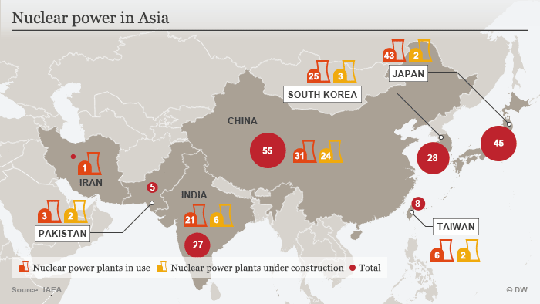
China would overtake the US as the country with the most nuclear power plants connected to the grid. Greenpeace nuclear expert Heinz Smital views the speed at which the reactors are being developed as problematic: “The Chinese safety authorities do not have the capacity to examine the buildings properly,” said Smital. “They will likely wave things through, rubber-stamp everything and not mess with the state-run construction consortiums. There is a big security risk.”……..
India. Delhi is planning a far-reaching expansion of nuclear power. Prime Minister Narendra Modi wants to build dozens of new reactors in the next 15 years.
The technical know-how is sourced internationally. Over the past decade, India has reached civil nuclear agreements with the United States, Canada, France and Russia. 21 nuclear power plants are already in operation. Two of the plants are in Kudankulam and Kalpakkam, located on the southeast coast of the country – areas prone to tsunamis. In December 2006, a tsunami hit Kalpakkam causing extensive damage, but not to the nuclear power plant, according to its operator.
Pakistan: Reactors in flood-prone areas
India’s neighbor, Pakistan, is also struggling with blackouts and outdated infrastructure. The country currently operates three small reactors, with the nuclear plant west of Karachi – located in a flood-prone area – being one of the oldest in the world. The remaining two reactors are situated in an earthquake-prone area some 300 kilometers (186.4 miles) south of the capital Islamabad. The government is planning to build two other reactors in the same area. According to Pakistan’s Atomic Energy Commission, Islamabad wants to build a total of seven new reactors by 2030 – with assistance from China.
South Korean expansion Although South Korea is about the size of the former German Democratic Republic (GDR), the country boasts 25 active nuclear plants. Three additional ones are under construction, while two others are set to be completed by 2029. The government plans to increase the share of nuclear power in the country’s overall energy mix from currently 30 to 40 percent.
Still, South Koreans are becoming increasingly skeptical about nuclear energy – and not just because of the 2011 Fukushima disaster. In 2012 and 2013, a scandal related to the use of fake safety certificates rocked the country’s nuclear industry lobby. State-owned (KHNP) had thousands of small components featuring falsified certificates fitted into the country’s nuclear plants. As it turns out, large amounts of bribe money changed hands between KHNP employees, construction firms and politicians.
This led not only to Korean media speaking of a “nuclear mafia,” but also to a massive drop in the approval ratings for nuclear energy – from 70 percent before the Fukushima disaster to 35 percent. In spite of this, Seoul is sticking to its plans to expand the use of nuclear power in the East Asian country.
Southeast Asia pigeonholes nuclear plans
In Southeast Asia, the production of nuclear energy is a hotly debated issue. For instance, while Vietnam wants Russian assistance to build eight nuclear plants, Hanoi has yet to make a final decision. Thailand is planning to build five reactors, whereas Malaysia and the Philippines each want a nuclear reactor to go online.
However, it’s unclear whether such plans will ever see the light of day. “It will be very difficult to find people willing to invest billions of dollars in this area, especially given the likelihood of another accident taking place in another part of the world,” said Greenpeace nuclear expert Smital.
“The costs related to the production of nuclear energy are only likely to increase, whereas renewable energy is becoming increasingly affordable. This is why the free market can only barely manage to finance nuclear plants at the moment,” Smital added. http://www.dw.com/en/nuclear-energy-booming-in-asia/a-19110848
No comments yet.
-
Archives
- February 2026 (228)
- January 2026 (308)
- December 2025 (358)
- November 2025 (359)
- October 2025 (376)
- September 2025 (258)
- August 2025 (319)
- July 2025 (230)
- June 2025 (348)
- May 2025 (261)
- April 2025 (305)
- March 2025 (319)
-
Categories
- 1
- 1 NUCLEAR ISSUES
- business and costs
- climate change
- culture and arts
- ENERGY
- environment
- health
- history
- indigenous issues
- Legal
- marketing of nuclear
- media
- opposition to nuclear
- PERSONAL STORIES
- politics
- politics international
- Religion and ethics
- safety
- secrets,lies and civil liberties
- spinbuster
- technology
- Uranium
- wastes
- weapons and war
- Women
- 2 WORLD
- ACTION
- AFRICA
- Atrocities
- AUSTRALIA
- Christina's notes
- Christina's themes
- culture and arts
- Events
- Fuk 2022
- Fuk 2023
- Fukushima 2017
- Fukushima 2018
- fukushima 2019
- Fukushima 2020
- Fukushima 2021
- general
- global warming
- Humour (God we need it)
- Nuclear
- RARE EARTHS
- Reference
- resources – print
- Resources -audiovicual
- Weekly Newsletter
- World
- World Nuclear
- YouTube
-
RSS
Entries RSS
Comments RSS
 nuclear-news
Leave a comment