Nukes are cursed with cost escalation everywhere

“An international comparative assessment of construction cost overruns for electricity infrastructure,” examined the cost history of 180 large nuclear reactors worldwide, and found, “these overruns afflicted more than 97 percent of nuclear projects and led to a mean cost escalation of 117 percent per project.
Nuclear plants have large cost overruns, and it appears to be an intrinsic feature of them. The authors of “Revisiting the Nuclear Power Construction Costs Escalation Curse,” had a very important conclusion in their analysis of escalating costs for French nuclear reactors:
Our last result says that those reactors with better safety performance were more expensive. Then achieving higher safety levels also helped to explain the cost escalation in the French nuclear fleet.
I’m pretty sure the vast majority of Americans, like the vast majority of French, would prefer we built reactors with the best safety performance. That doesn’t come cheap
The Nuclear Industry Prices Itself Out Of Market For New Power Plants, Climate Progress, BY JOE ROMM MAR 8, 2016 In the modern era, nuclear power plants have almost always become more and more expensive over time. They have a “negative learning curve” — along with massive delays and cost overruns in market economies. This is confirmed both by recent studies and by the ongoing cost escalations of nuclear plants around the world, as I’ll detail in this post.
The cost escalation curse of nuclear power
WAGYU BEEF FARMERS’ ‘NUCLEAR REBELLION’
Inside the Fukushima nuclear power plant, five years after the disaster was triggered by an earthquake and tsunami, news.c om.au, MARCH 10, 2016 [EXCELLENT PHOTOS] “…….Protesters have staged rallies across the world against the restarting of the reactors.
Since the 2011 meltdowns ended their future as prized black “wagyu” beef, a rancher near the Fukushima nuclear power plant has given his cattle a new mission: They’ve become protesters.
Defying both government evacuation and slaughter orders, 62-year-old Masami Yoshizawa returned to his ranch 14 kilometres from the plant to keep his cattle alive as living proof of the disaster.
He and his cattle are no doubt a nuisance for the government as Japan gears up to showcase Fukushima’s recovery ahead of the 2020 Tokyo Olympics.
“An effort to eliminate a negative reputation is nothing but a cover-up,” he said. “This is a farm that chronicles and tells the story of Fukushima’s radiation contamination disaster. We’ll stay here at the Ranch of Hope, and keep sending our message.”…………….
“I said I was not going to let any more cows die on my ranch,” said Yoshizawa.
His mostly lone resistance hasn’t been easy. Authorities tried to block his feed transport, and kept trying to persuade him to kill his cows.
The location of his ranch, on the border between two towns — Namie and neighbouring Minamisoma — may have worked in his favour. Both towns have looked the other way and virtually given up. A prefabricated hut on a driveway to the Ranch of Hope — which Yoshizawa renamed after the accident with the hope of establishing a nuclear-free society — serves as a tiny office for what he calls his “nuclear rebellion.” Skulls of cattle that died early in the crisis decorate the exterior. His cows keep him company, mooing and grazing.
Radiation levels at the ranch measure about 10 times the safe benchmark………http://www.news.com.au/technology/environment/inside-the-fukushima-nuclear-power-plant-five-years-after-the-disaster-was-triggered-by-an-earthquake-and-tsunami/news-story/f80b140e5505709a55ab6ee6cc5a9228
Never mind Fukushima. Japan’s Prime Minister Abe is all for more nuclear power
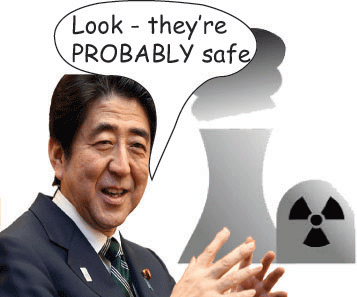 Japanese premier defends nuclear power’s necessity on eve of Fukushima anniversary, DW, 10 Mar 16 Prime Minister Shinzo Abe has said Japan “cannot do without” nuclear power ahead of the fifth anniversary of the earthquake and tsunami. Japan’s leader also pledged to bolster decontamination efforts in irradiated areas. Abe pledged Thursday to accelerate reconstruction efforts in tsunami-hit northern Japan and the wrecked Fukushima nuclear plant ahead of the 2020 Olympic Games.
But in the wake of an unprecedented court ruling that ordered two reactors to remain offline due to safety fears, he argued that Japan needed nuclear power to feed its energy needs…….
Public anger over the meltdown of the Fukushima Daiichi reactor and skepticism in general toward authorities in the wake of the 9.0 earthquake that struck March 11, 2011, triggering a massive tsunami – remains intense……
The institutionally cozy ties between politicians, bureaucrats and the nuclear industry has left unresolved calls for reform and widespread distrust among members of the public who continue to be told that nuclear power is safe.
“Ties between the bureaucracy and industry are still very strong – it’s a legacy of government-led development when the country was underdeveloped (after World War II),” Muneyuki Shindo, an honorary politics professor at Chiba University, told the AFP news agency………
A national ceremony will be held Friday to commemorate the fifth anniversary of the disaster to be attended by Abe, the emperor and empress and other dignitaries.
Official investigations laid the blame on plant operator Tokyo Electric Power – three former executives are facing a criminal trial – and Fukushima has been labeled a “man-made” disaster.
Already some changes are evident; a number of tsunami-struck communities have been moved to higher ground, while bigger seawalls are going up along the coast and higher barriers are being erected to protect at-risk reactors.
Scientists note that timing is important as the country experiences about 20 percent of the world’s biggest quakes annually, and recently has been more seismically active than usual. http://www.dw.com/en/japanese-premier-defends-nuclear-powers-necessity-on-eve-of-fukushima-anniversary/a-19106430
Marshall Islands legal case puts nuclear weapons back on the world agenda
 Tiny Marshall Islands Taking On 3 World Nuclear Powers In Court http://www.npr.org/sections/thetwo-way/2016/03/07/469521887/tiny-marshall-islands-taking-on-3-world-nuclear-powers-in-court
March 8, 2016 MERRIT KENNEDY The Marshall Islands is on an unlikely mission — trying to press India, Pakistan and the United Kingdom to curb their nuclear programs.
The Pacific archipelago, which was the site of dozens of U.S. nuclear tests in the ’40s and ’50s, is suing the three countries in the U.N.’s International Court of Justice. The Marshall Islands says the three countries haven’t carried out in good faith their obligations to pursue negotiations leading to nuclear disarmament.
It says the U.K. is obligated to do so because it is a signatory to the Nuclear Non-Proliferation Treaty. India and Pakistan haven’t signed the NPT, but the Marshall Islands argues that this principle is sufficiently well-enshrined in international law to be considered customary law.”Nobody expects the Marshall Islands to force the three powers to disarm, but the archipelago’s dogged campaign highlights the growing scope for political minnows to get a hearing through global tribunals,” Reuters reports.
So why isn’t the Marshall Islands suing the U.S., the country that was actually testing its nukes on their territory? The short answer: It tried. As the Two-Way reported when the case was filed in 2014, the island chain attempted to file suit against all nine countries believed to possess a nuclear arsenal:
“Besides the U.S., the Marshall Islands is also suing Russia, China, France and the U.K., which have all signed the Non-Proliferation Treaty, or NPT, as well as four other countries that have never signed — India, Pakistan, North Korea and Israel, which has never acknowledged possessing nuclear weapons. …
“In court documents, the Marshall Islands argues that the 1968 NPT, which did not come into force until 1970, amounts to a compact between nuclear haves and have-nots. Non-weapons states essentially agreed not to try to acquire nuclear weapons in exchange for weapons states moving toward disarmament, the Marshalls says.”
However, only the cases against India, Pakistan and the U.K. are still proceeding. That’s because these are the only three countries that have “made a commitment to respond to suits brought at the ICJ,” Reuters reports. Preliminary hearings against India started on Monday in The Hague, with sessions on Pakistan and the U.K. scheduled in the coming weeks.
The Marshall Islands is pursuing global disarmament as a result of its “particular awareness of the dire consequences of nuclear weapons,” according to court documents.In 2014, the Two-Way reported on the lasting impact of those tests:
“Although islanders were relocated from Bikini and Eniwetok atolls — ground zero for the majority of the tests — three other Marshall atolls underwent emergency evacuations in 1954 after they were unexpectedly exposed to radioactive fallout. The Marshallese say they’ve suffered serious health issues ever since.
“The Marshall Islands were governed by the U.S. until 1979 and won full independence in 1986.”
The International Court of Justice hasn’t issued an opinion on nuclear weapons since 1996. As Dapo Akande, professor of international law at Oxford University, tells Reuters: “The success will be in putting the issue back on the agenda. … This is as much as the Marshall Islands can hope for.”
The Takahama injunction – a damaging blow to Japan’s nuclear industry hopes
The Otsu ruling also calls on the national government to take the lead in formulating evacuation plans for residents within 30 km of a nuclear plant, and not just leave such planning to local governments.
That raises the possibility of further lawsuits seeking injunctions against other reactors on the grounds that the central government has not taken the lead in formulating evacuation plans. Nationwide, there are 135 cities, towns, and villages in 21 prefectures within 30 km of nuclear power plants.

 Takahama injunction delivers body blow to Japan’s nuclear power industry http://www.japantimes.co.jp/news/2016/03/10/national/takahama-injunction-delivers-body-blow-to-japans-nuclear-power-industry/#.VuHaZ3197Gh
BY ERIC JOHNSTON OSAKA – Wednesday’s decision by an Otsu District Court judge to slap a provisional injunction on the restart of the No. 3 and 4 reactors at Kansai Electric Power Co.’s Takahama nuclear plant has sent a shock through the nuclear power industry.
Moreover, pro-nuclear politicians fear that the nation’s push to restart as many reactors as possible as quickly as possible has come to a halt.
On the eve of the fifth anniversary of the 2011 disaster, which included the meltdown of three reactors at the Fukushima No. 1 plant and led to the nation suspending its use of nuclear power for an extended period, only two reactors, Kyushu Electric Power Co.’s Sendai No. 1 and 2 reactors, were generating electricity.
The Takahama No. 3 reactor was restarted in January. Kepco officials said it would be shut down in accordance with the court order by Thursday evening. Continue reading
Dead nuclear reactors floating in space – a hazard for the future
Dozens of dead nuclear reactors are floating in space and they’ll eventually hit the Earth http://www.techinsider.io/nuclear-powered-satellites-space-2016-3
Rebecca Harrington At the height of our adoration of atomic energy, space agencies experimented with launching nuclear-powered spacecraft into orbit around the Earth.
It makes sense if you think about it.
Radioactive materials, like uranium-235, can power a tiny satellite for years. They’re more reliable than batteries and provide more energy than solar panels.
But back then, space-faring nations weren’t as concerned with radioactive waste. Nuclear disasters like Three Mile Island and Chernobyl hadn’t happened yet, and now we’re much more worried about radiation exposure.
That’s why the last nuclear-powered satellite, launched by the Soviet Union, blasted into orbit in 1988.
More than 30 different nuclear reactor-powered satellites still orbit the Earth. The US only ever launched one while the USSR launched all the rest.
Those nuclear reactors are similar to the ones in nuclear power plants on the ground. Uranium-235 undergoes fission, where its nucleus splits, giving off energy. This energy can be converted into electricity to power satellite instruments, or your house.
America’s uranium-fueled SNAP-10A entered into an orbit of 575 miles above the Earth in 1965. It operated for 43 days before it stopped responding. It’s now in a slow trajectory to hit the ground in about 3,000 years. By then, hopefully its radioactive cargo will be mostly harmless.
But if any of these nuclear reactor-powered satellites collide with another object in space, or suddenly crash to the ground, they could release radioactivity.
The Soviet Union had a few such mishaps since it launched all those nuclear satellites. In 1978, its spy satellite COSMOS 954 crashed into the Northwest Territories, scattering radioactivity across almost 48,000 square miles. Russia had to pay Canada $10 million for the damage.
And in 1995, NASA scientists found a cloud of liquid, radioactive sodium and potassium coolant in orbit. The space agency eventually figured out it came from the Soviet satellite Cosmos 1900. Something else in space crashed into it, causing the nuclear reactor to leak. The cloud of radioactive fluids is still floating up there, and space agencies continue to monitor it.
The good news is that all these dead nuclear reactor-powered satellites are in orbits higher than 430 miles. There’s barely any air molecules at that height to slow down the satellites, so it should take them hundreds or thousands of years to wind their way back to Earth — at which point much of their radioactive contents will have significantly decayed.
But NASA and Roscosmos, Russia’s space agency, are reportedly looking into building nuclear engines again: This time they want to build hyper-efficient rockets that might one day take humans to Mars.
If this sounds like science fiction, it’s not. NASA built several perfectly functional nuclear rocket engines from 1955 through 1973.
Here’s one called NERVA being test-fired in the desert: https://www.youtube.com/watch?v=j6gKFvPjGpQ
Those programs ended abruptly, however, because of environmental and budget concerns.
It remains to be seen if NASA or Roscosmos can keep funding, public support, and safety moving in its favor.
Fukushima’s forestry industry cannot be revived, due to radiation
FIVE YEARS AFTER: Radioactive forests prevent logging revival in Fukushima http://ajw.asahi.com/article/0311disaster/recovery/AJ201603090060March 09, 2016 By YOSUKE FUKUDOME/ Staff Writer
TAMURA, Fukushima Prefecture–The once-thriving industry of log production for shiitake mushroom farming remains virtually nonexistent in Fukushima Prefecture after the 2011 nuclear disaster contaminated extensive mountain areas.
A year before the Great East Japan Earthquake and tsunami triggered the triple meltdown at the Fukushima No. 1 nuclear power plant on March 11, 2011, the prefecture produced logs for cultivating shiitake totaling 47,800 cubic meters, the third largest volume among Japanese prefectures.
But radioactive fallout from the nuclear accident meant that shiitake log production in the prefecture dwindled to about 1 percent of the pre-disaster level in 2014, which is having a serious impact on local industry.
In the Miyakoji district of Tamura, located about 20 kilometers inland from the crippled nuclear power plant, the lumber industry shipped around 200,000 logs annually before the 2011 disaster.
“More than 80 percent of this area’s land is covered by forests, and we cannot think of any other business opportunities that don’t involve forestry,” said Shoichi Yoshida, a 60-year-old executive of the Fukushima Central Forestry Association.
While the evacuation order covering an eastern strip of the district was lifted in 2014, radioactive levels of trees in the district remain above target levels, and the resumption of shipments is still nowhere in sight.
However, local forestry workers still routinely cut down oak and other trees, which are more than 20 years old, to maintain the mountain area’s capability of producing quality logs.
Court injunction stops Takahama nuclear reactors
Court issues surprise injunction to halt http://www.japantimes.co.jp/news/2016/03/09/national/court-issues-surprise-injunction-halt-takahama-nuclear-reactors/ BY ERIC JOHNSTON
STAFF WRITER MAR 9, 2016 OTSU, SHIGA PREF. – In a surprise ruling that is likely to delay efforts to restart nuclear power generation nationwide, the Otsu District Court on Wednesday issued a provisional injunction ordering Kansai Electric Power Co. to shut down its No. 3 and No. 4 reactors at its Takahama facility in Fukui Prefecture.
While Kepco is expected to appeal the ruling, company officials said at a news conference that was hastily called after the decision that they would begin operations to shut down the No. 3 reactor on Thursday morning, and expected to complete the process by the evening.
The No. 3 reactor was restarted in January, and the No. 4, which had been scheduled to restart last month, was delayed due to technical problems.
“There are doubts remaining about both the tsunami response and the evacuation plan,” the ruling said.
The Otsu ruling comes just two days before the fifth anniversary of the Great East Japan Earthquake and the resulting tsunami and triple meltdown at Tokyo Electric Power Co.’s Fukushima No. 1 plant.
The jubilant plaintiffs expressed surprise and relief following the ruling, which emphasized technical problems regarding the two reactors, including issues concerning an outside power supply source in the event of an emergency. The ruling also raised concerns over the emergency protocol.
“This is a huge victory for the safety of children, people with disabilities, and the society and economy of not only the Fukui-Kansai region of Japan but the entire country,” said Aileen Mioko Smith of Kyoto-based Green Action, an anti-nuclear group. Smith was not a plaintiff in the case.
The lawsuit that sought the injunction was filed by Shiga residents who are fearful that an accident at the Takahama plant, which lies less than 30 kilometers from the northern part of Shiga Prefecture, would impact Lake Biwa, the nation’s largest freshwater body and the source of water for about 14 million people in the Kansai region, including Kyoto and Osaka.
The judgment — the first of its kind affecting reactors that were fired up under strengthened safety regulations following the March 2011 disaster — is a blow to the government’s renewed push for atomic power. The ruling could also cast doubt on the stringency of the new safety regulations.
Chief Cabinet Secretary Yoshihide Suga, however, told reporters following the ruling the government would not change its basic stance of promoting restarts.
In a separate case concerning the two reactors, the Fukui District Court issued an injunction last April banning Kansai Electric from restarting the units, citing safety concerns.
But the same court later lifted the injunction in December, allowing the utility to resume operations at both reactors. Plaintiffs appealed the court decision to the Kanazawa branch of the Nagoya High Court, where the case is pending.
Under the revamped safety regulations, which took effect in 2013, utilities are for the first time obliged to put in place specific countermeasures in the event of severe accidents such as reactor core meltdowns and huge tsunami — which was the initial cause of the crisis at the Fukushima nuclear plant.
Call to scrap costly Hinkley Point nuclear project
Government must scrap nuclear new-build plan News and Star 10 March 2016
THE government has to scrap its new nuclear build plans…..It has to bin the multi-billion deal it has signed with French power firm EDF for the Hinkley Point plant at Somerset.
Surely, if the company’s own finance chief thinks the deal is too expensive we should listen?Thomas Piquemal says the French-Chinese deal will wreck EDF and has resigned from his post in protest.It’s estimated the cost has already ballooned from £14bn to £24.5bn. All this at a time when energy firms are reporting major losses and cutting jobs.
Do we honestly have to commit to decades of excessive overpayments?
How can the government complain about the cost of subsidies to wind farm companies and solar panel firms when they are prepared to pay this much for nuclear plants?……..
Netherlands. Iodine tablets to be issued to communities near Belgian nuclear reactors
 Minister Expands Nuclear Power Plant Iodine Zone http://www.dutchnews.nl/news/archives/2016/03/minister-expands-nuclear-power-plant-iodine-zone/
Schippers said she is currently developing a distribution system based on local chemists and health board offices.
There have been several recent incidents at the Belgian reactors in Doel, on the banks of the Westerschelder estuary. The power plant was first opened in 1975 and should have been decommissioned last year. However, the Belgian authorities have agreed to keep it operational for a further 10 years because of a shortage of capacity.
Exceptionally high level of radioactive caesium-137 in Helsinki.

 Huge radioactive caesium detected in Helsinki http://www.finlandtimes.fi/health/2016/03/08/25649/Huge-radioactive-cesium-detected-in-Helsinki FTimes-STT Report, Mar 8 The Radiation and Nuclear Safety Authority (STUK) on Monday said it has detected an
Exxon’s scandalous dishonesty about climate change
 Scandal! Exxon knew about climate change, boosted denialism, misled shareholders, went carbon heavy, Ecologist Bill McKibben 9th March 2016 One of the world’s biggest energy companies has been caught out in what may be the biggest ever climate scandal, writes Bill McKibben. Way back in the 1980s ExxonMobil knew of the ‘potentially catastrophic’ and ‘irreversible’ effects of increasing fossil fuel consumption, but chose to cover up the findings, spread misinformation on climate change, and go for high carbon energy sources……….
Exxon twisted the facts to further its own agenda
So here’s what happened. Exxon used its knowledge of climate change to plan its own future. The company, for instance, leased large tracts of the Arctic for oil exploration, territory where, as a company scientist pointed out in 1990, “potential global warming can only help lower exploration and development costs.”
Not only that but, “from the North Sea to the Canadian Arctic,” Exxon and its affiliates set about “raising the decks of offshore platforms, protecting pipelines from increasing coastal erosion, and designing helipads, pipelines, and roads in a warming and buckling Arctic.”In other words, the company started climate-proofing its facilities to head off a future its own scientists knew was inevitable.
But in public? There, Exxon didn’t own up to any of this. In fact, it did precisely the opposite. In the 1990s, it started to put money and muscle into obscuring the science around climate change. It funded think tanks that spread climate denial and even recruited lobbying talent from the tobacco industry.
It also followed the tobacco playbook when it came to the defence of cigarettes by highlighting ‘uncertainty’ about the science of global warming. And it spent lavishly to back political candidates who were ready to downplay global warming.
Its CEO, Lee Raymond, even travelled to China in 1997 and urged government leaders there to go full steam ahead in developing a fossil fuel economy. The globe was cooling, not warming, he insisted, while his engineers were raising drilling platforms to compensate for rising seas.
“It is highly unlikely”, he said, “that the temperature in the middle of the next century will be significantly affected whether policies are enacted now or 20 years from now.” This wasn’t just wrong, but completely and overwhelmingly wrong – as wrong as a man could be.
Sins of omission
In fact, Exxon’s deceit – its ability to discourage regulations for 20 years – may turn out to be absolutely crucial in the planet’s geological history. It’s in those two decades that greenhouse gas emissions soared; as did global temperatures until, in the twenty-first century, ‘hottest year ever recorded’ has become a tired cliché.
And here’s the bottom line: had Exxon told the truth about what it knew back in 1990, we might not have wasted a quarter of a century in a phony debate about the science of climate change, nor would anyone have accused Exxon of being ‘alarmist.’ We would simply have gotten to work.
But Exxon didn’t tell the truth. A Yale study published last fall in the Proceedings of the National Academy of Sciences showed that money from Exxon and the Koch Brothers played a key role in polarizing the climate debate in this country.
The company’s sins – of omission and commission – may even turn out to be criminal. Whether the company ‘lied to the public’ is the question that New York Attorney General Eric Schneiderman decided to investigate last fall in a case that could make him the great lawman of our era if his investigation doesn’t languish.
There are various consumer fraud statutes that Exxon might have violated and it might have failed to disclose relevant information to investors, which is the main kind of lying that’s illegal in this country of ours. Now, Schneiderman’s got back up from California Attorney General Kamala Harris, and maybe – if activists continue to apply pressure – from the Department of Justice as well, though it’s highly publicized unwillingness to go after the big banks does not inspire confidence.
Here’s the thing: all that was bad back then, but Exxon and many of its Big Energy peers are behaving at least as badly now when the pace of warming is accelerating. And it’s all legal – dangerous, stupid, and immoral, but legal.
Exxon finally admits global warming is occurring – but there’s no big problem………
The carbon tax and the political stonewall
In other words, we’re no longer talking about outright denial, just a denial that much really needs to be done. And even when the company has proposed doing something, its proposals have been strikingly ethereal. Exxon’s PR team, for instance, has discussedsupporting a price on carbon, which is only what economists left, right, and centre have been recommending since the 1980s.
But the minimal price they recommend – somewhere in the range of $40 to $60 a ton – wouldn’t do much to slow down their business. After all, they insist that all their reserves are still recoverable in the context of such a price increase, which would serve mainly to make life harder for the already terminal coal industry.
But say you think it’s a great idea to put a price on carbon – which, in fact, it is, since every signal helps sway investment decisions. In that case, Exxon’s done its best to make sure that what they pretend to support in theory will never happen in practice…….
Now the cover ups are being investigated – could Exxon be liable?
As with the tobacco companies in the decades when they were covering up the dangers of cigarettes, there’s a good chance that the Big Energy companies were in this together through their trade associations and other front groups.
In fact, just before Christmas, Inside Climate News published some revealing new documents about the role that Texaco, Shell, and other majors played in an American Petroleum Institute study of climate change back in the early 1980s. A trial would be a transformative event – a reckoning for the crime of the millennium.
But while we’re waiting for the various investigations to play out, there’s lots of organizing going at the state and local level when it comes to Exxon, climate change, and fossil fuels – everything from politely asking more states to join the legal process to politely shutting down gas stations for a few hours to pointing out to New York and California that they might not want to hold millions of dollars of stock in a company they’re investigating. It may even be starting to work.
Vermont Governor Peter Shumlin, for instance, singled Exxon out in his state of the state address last month. He called on the legislature to divest the state of its holdings in the company because of its deceptions:
“This is a page right out of Big Tobacco, which for decades denied the health risks of their product as they were killing people. Owning ExxonMobil stock is not a business Vermont should be in.”
The question is: Why on God’s not so green Earth any more would anyone want to be Exxon’s partner?
Action: BreakFree2016, May 4-15 – a global wave of mass actions will target the world’s most dangerous fossil fuel projects, in order tokeep coal, oil and gas in the ground and accelerate the just transition to 100% renewable energy. Across the world, people are showing the courage toconfront polluters where they are most powerful – from the halls of power to the wells and mines themselves. http://www.theecologist.org/News/news_analysis/2987359/epic_scandal_how_exxon_boosted_climate_change_denial_infiltrated_politics_misled_shareholders.html
World is warming faster than expected – Australian study
 Dangerous global warming will happen sooner than thought – study, Guardian, Joshua Robertson, 10 Mar 16 Australian researchers say a global tracker monitoring energy use per person points to 2C warming by 2030. The world is on track to reach dangerous levels of global warming much sooner than expected, according to new Australian research that highlights the alarming implications of rising energy demand.
University of Queensland and Griffith University researchers have developed a “global energy tracker” which predicts average world temperatures could climb 1.5C above pre-industrial levels by 2020.
That forecast, based on new modelling using long-term average projections on economic growth, population growth and energy use per person, points to a 2C rise by 2030.
The UN conference on climate change in Paris last year agreed to a 1.5C rise as the preferred limit to protect vulnerable island states, and a 2C rise as the absolute limit.
The new modelling is the brainchild of Ben Hankamer from UQ’s institute for molecular bioscience and Liam Wagner from Griffith University’s department of accounting, finance and economics, whose work was published in the journal Plos One on Thursday.
It is the first model to include energy use per person – which has more than doubled since 1950 – alongside economic and population growth as a way of predicting carbon emissions and corresponding temperature increases.
The researchers said the earlier than expected advance of global warming revealed by their modelling added a newfound urgency to the switch from fossil fuels to renewables.
Hankamer said: “The more the economy grows, the more energy you use … the conclusion really is that economists and environmentalists are on the same side and have both come to the same conclusion: we’ve got to act now and we don’t have much time.”……..
The researchers suggested switching $500bn in subsidies for fossil fuels worldwide to renewables as a “cost neutral” way to fast-track the energy transition.
Wagner said pulling the rug from out under the fossil fuels industry was a move of “creative destruction” and “more a political issue rather than an economic issue”…….http://www.theguardian.com/environment/2016/mar/10/dangerous-global-warming-will-happen-sooner-than-thought-study
Iran says that its missile tests don’t violate nuclear agreement, U.N. resolution
Iran: Missile tests don’t violate nuclear agreement, U.N. resolution John Bacon, USA TODAY March 10, Iran on Thursday rejected claims that missile tests conducted this week violate the nuclear agreement it reached with the U.S. and other nations or a United Nations resolution.
Iran Foreign Ministry spokesman Hossein Jaberi Ansari said the missiles were conventional armaments for “legitimate defense” and not designed for carrying nuclear warheads, the state-controlled IRNA news agency reported……..
The nuclear deal does not directly address missile restrictions. The U.N. Security Council lifted its ban on such testing when the deal was struck, but passed a resolution that “calls upon Iran not to undertake any activity related to ballistic missiles … including launches using such ballistic missile technology.”……….. http://www.usatoday.com/story/news/world/2016/03/10/iran-missile-tests-violate-no-deals/81578348/
Costs, technical hitches – it’s time that UK abandoned Hinkley Point nuclear project
Time for the UK to end attachment to Hinkley Point nuclear plant, Ft.com, 10 Mar 16
The costs and technical uncertainty were a warning to ministers.
When George Osborne, touring China in September, announced the UK’s commitment to a new power station at Hinkley Point, he intended it as a cornerstone of Britain’s drive for Chinese investment.
No matter that, the following month, protesters inflated a giant white elephant near the site for a visit by Xi Jinping, China’s president.
Not easy, then, for the chancellor to announce that the deal should not go ahead. Yet that is what he should do.
The resignation of Thomas Piquemal, chief financial officer of EDF, the French utility building the plant — apparently because of the threat that the project poses to EDF’s financial stability — gives him the chance.
If the plant is ever built, it would have claim to the title of the most expensive object in Britain. The cost is £18bn but could rise to £24bn. It is meant to produce 7 per cent of Britain’s energy needs.
The costs and the technical uncertainty of Hinkley C should have been decisive in prompting ministers to find another way. The plans make a nonsense of Britain’s fitful attempts to give itself an energy policy. Instead they promise unnecessarily expensive energy for consumers and businesses………
EDF is stalling on a “final investment decision” despite lavish commitment from the UK. The contract promises to pay £92.50 per megawatt hour of electricity produced for 35 years — index linked, too. This is extraordinarily expensive, almost three times today’s wholesale price and three times as much as from new gas-fired power stations………
EDF is struggling with the European pressurised reactor (EPR). It has had to bail out Areva, the French reactor maker behind the design, while two smaller nuclear plants in Finland and France are behind schedule and over budget. Two others of similar design, in China, are also running late; no others have been ordered. If Hinkley C is built, it would be among the first of its kind and very likely the last.
This repeats the mistake that has dogged British nuclear power: of reinventing the model each time a new plant is built.
1 This Month

of the week – Shut Down Drone Warfare!


Tell the Ukrainian Government to Drop Prosecution of Peace Activist Yurii Sheliazhenko

Petition to revoke the licensing of the Near Surface Nuclear Disposal Facility (NSDF) at Chalk River. https://www.ourcommons.ca/petitions/en/Petition/Details?Petition=e-7247
To see nuclear-related stories in greater depth and intensity – go to https://nuclearinformation.wordpress.com
-
Archives
- April 2026 (91)
- March 2026 (251)
- February 2026 (268)
- January 2026 (308)
- December 2025 (358)
- November 2025 (359)
- October 2025 (376)
- September 2025 (257)
- August 2025 (319)
- July 2025 (230)
- June 2025 (348)
- May 2025 (261)
-
Categories
- 1
- 1 NUCLEAR ISSUES
- business and costs
- climate change
- culture and arts
- ENERGY
- environment
- health
- history
- indigenous issues
- Legal
- marketing of nuclear
- media
- opposition to nuclear
- PERSONAL STORIES
- politics
- politics international
- Religion and ethics
- safety
- secrets,lies and civil liberties
- spinbuster
- technology
- Uranium
- wastes
- weapons and war
- Women
- 2 WORLD
- ACTION
- AFRICA
- Atrocities
- AUSTRALIA
- Christina's notes
- Christina's themes
- culture and arts
- Events
- Fuk 2022
- Fuk 2023
- Fukushima 2017
- Fukushima 2018
- fukushima 2019
- Fukushima 2020
- Fukushima 2021
- general
- global warming
- Humour (God we need it)
- Nuclear
- RARE EARTHS
- Reference
- resources – print
- Resources -audiovicual
- Weekly Newsletter
- World
- World Nuclear
- YouTube
-
RSS
Entries RSS
Comments RSS
 nuclear-news