Fukushima’s dead zone: the abandoned towns
five years on, an area 12 miles around the plant remains a dead zone, abandoned and uninhabited.
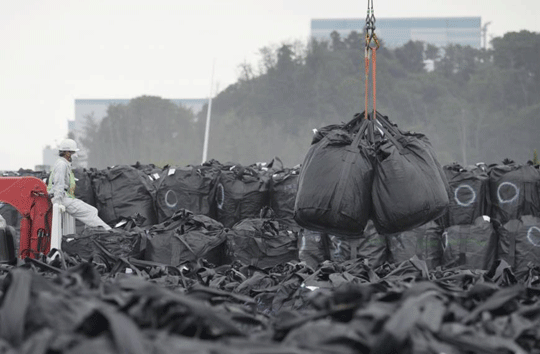 At intervals beside the roads, heaped up in huge piles, lie half a million black plastic bags containing radioactive topsoil, scraped off the surface of the land in an effort to persuade farmers to start work here again.
Some of the dead zone will never return to life. Futaba, the closest town to the plant, will probably be turned into a radioactive waste dump.
thousands of workers are now being bussed in to the cleanup effort at the power station, the radioactive fuel rods which melted down are all still there. Even after five years, radiation levels inside the reactor buildings are still too high for workers to enter, making it hard to even plan the task that needs to be done, let alone carry it out.
Fukushima: Inside the dead zone where the legacy of nuclear disaster still rulesFive years since a tsunami led to disaster at Japan’s Fukushima nuclear plant, Andrew Gilligan explores the ghost towns left in its wake, Telegraph UK, By Andrew Gilligan, in Fukushima, video by Julian Simmonds, additional editing by Charlotte Krol 06 Mar 2016
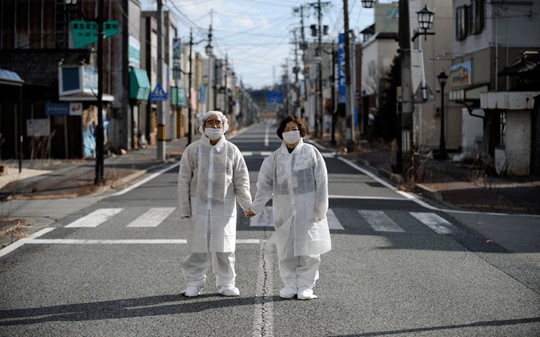
Along the rest of the country’s blasted east coast, the wreckage has been at least cleared away, even if not much has yet been put in its place. But in Futaba, time stopped on the night of 11 March 2011, when those residents who’d survived the giant wave fled, as they thought, for their lives from something even more frightening.
The buildings which collapsed in the earthquake have simply been left – rubble, roof tiles and all. The ceremonial torii gate of the Shinto shrine is lying exactly where it fell, on its side jutting out into the street. But most of the town is physically intact. It was just abandoned, and clearly in a very great hurry…..
As Japan’s prime minister at the time, Nato Kan, told The Telegraph in an interview published on Saturday, the country came within a “paper-thin margin” of a disaster requiring the evacuation of 50 million people. What did happen was bad enough. Inside the plant, a skeleton staff – the so-called “Fukushima 50” – battled to avert total catastrophe, reading emergency manuals by torchlight and at one stage asking workers to bring their car batteries to power the crippled cooling systems.
Outside, there was mass panic, with compulsory evacuation for 400,000 local residents and much of the rest of northern Japan cramming roads and railway stations to get out, too. In the end, the worst was avoided, with seawater pumped to cool the reactors and not a single immediate death from radiation exposure.
But five years on, an area 12 miles around the plant remains a dead zone, abandoned and uninhabited. You can still go there. Anyone can drive on the main road, route 6, which runs through it. Even this is an eerie experience. As well as the traffic signs, route 6 has geiger counters above the carriageway, displaying the radiation readout in the same way that others display roadworks information.
Most of the buildings here are wrecked or empty, too: an entire wall of the Segaworld games arcade has been ripped off, showing all the machines still inside. The side turnings, to get into the hearts of the towns, are blocked and mostly guarded, accessible only with passes (or, as we did, by finding an unguarded one and slipping through.)
At intervals beside the roads, heaped up in huge piles, lie half a million black plastic bags containing radioactive topsoil, scraped off the surface of the land in an effort to persuade farmers to start work here again.
Some of the dead zone will never return to life. Futaba, the closest town to the plant, will probably be turned into a radioactive waste dump. But six months ago, a few miles to the south, the authorities declared that Naraha, another town in the evacuation area, was now safe and everyone should come back.
It was hailed as the first stage in the area’s return to normality. Virtually nobody is buying. Before the disaster, Naraha had a population of 7,000. But for now, poisoned as much by mistrust of the government as by radioactivity, the place remains almost as spectral as Futaba.
“Once it’s dark, there’s only about ten houses with lights on,” said Nawasaki Yoshihiro, who was repairing the tsunami damage at his lovely traditional Japanese home opposite Tatsuma railway station. “You see wild boar running about the streets. I’m fixing this up because my parents kept pestering me not to waste the house. But even we are only here until 6 o’clock.”…….
In the station car park, dozens of commuters’ bikes give an appearance of normality. But look closer, and their chains are rusty, their tyres flat. “They have been there since 2011,” says Mr Yoshihiro. “The owners are probably dead.” Up the street, there are lights in a supermarket, a bright plastic sign above the door. But go up to the door, and you realise the place is some sort of government office, not a supermarket at all. It’s the perfect symbol of this nuclear Potemkin village.
Twenty miles further to the south, in the provincial centre of Iwaki, we find the reason why so few want to return. It’s the twice-yearly “update session” for residents of one of the temporary resettlement camps where much of Naraha’s population – and at least 20,000 other people from the radiation area alone – still live, five years on……….
From the audience, Yoshitaka Matsumoto, a local farmer, is politely angry: “You should fight the government, stop them bullying people,” he tells the mayor. Afterwards, he tells us that contamination of the water is people’s main concern. “The water comes from the taps, but it comes from a reservoir which has radioactive mud at the bottom,” he says. “The people who are back in Naraha now, they buy their drinking water from the shop, but they still have to wash in the tapwater.”…….
Though thousands of workers are now being bussed in to the cleanup effort at the power station, the radioactive fuel rods which melted down are all still there. Even after five years, radiation levels inside the reactor buildings are still too high for workers to enter, making it hard to even plan the task that needs to be done, let alone carry it out.
Around 300 to 400 tons of contaminated water is generated every day as groundwater flows into the plant filled with radioactive debris. To contain the tainted water, TEPCO, the plant’s operator pumps up the water and stores it in tanks, adding a new tank every three to four days.
There are now 1,000 tanks, containing 750,000 tons of contaminated water. “If I may put this in terms of mountain climbing, we’ve just passed the first waystation on a mountain of 10 stations,” said Akira Ono, head of the Fukushima plant, last month. The full cleanup, he admitted, may take as long as 40 years.
Back in Futaba, a banner has been erected protesting against the removal of the “nuclear power, our bright future” sign. “Save the sign, remember our folly,” it says. “Preserve it as a negative legacy.”
In truth, in Japan’s radioactive disaster zone, the reminders of the folly and the memorials of the disaster are everywhere inescapable.http://www.telegraph.co.uk/news/worldnews/asia/japan/12182635/Return-to-Fukushima.html
Occasionally, some of your visitors may see an advertisement here
No comments yet.
1 This Month

of the week – Shut Down Drone Warfare!


Tell the Ukrainian Government to Drop Prosecution of Peace Activist Yurii Sheliazhenko

Petition to revoke the licensing of the Near Surface Nuclear Disposal Facility (NSDF) at Chalk River. https://www.ourcommons.ca/petitions/en/Petition/Details?Petition=e-7247
To see nuclear-related stories in greater depth and intensity – go to https://nuclearinformation.wordpress.com
-
Archives
- April 2026 (68)
- March 2026 (251)
- February 2026 (268)
- January 2026 (308)
- December 2025 (358)
- November 2025 (359)
- October 2025 (376)
- September 2025 (257)
- August 2025 (319)
- July 2025 (230)
- June 2025 (348)
- May 2025 (261)
-
Categories
- 1
- 1 NUCLEAR ISSUES
- business and costs
- climate change
- culture and arts
- ENERGY
- environment
- health
- history
- indigenous issues
- Legal
- marketing of nuclear
- media
- opposition to nuclear
- PERSONAL STORIES
- politics
- politics international
- Religion and ethics
- safety
- secrets,lies and civil liberties
- spinbuster
- technology
- Uranium
- wastes
- weapons and war
- Women
- 2 WORLD
- ACTION
- AFRICA
- Atrocities
- AUSTRALIA
- Christina's notes
- Christina's themes
- culture and arts
- Events
- Fuk 2022
- Fuk 2023
- Fukushima 2017
- Fukushima 2018
- fukushima 2019
- Fukushima 2020
- Fukushima 2021
- general
- global warming
- Humour (God we need it)
- Nuclear
- RARE EARTHS
- Reference
- resources – print
- Resources -audiovicual
- Weekly Newsletter
- World
- World Nuclear
- YouTube
-
RSS
Entries RSS
Comments RSS
 nuclear-news
Leave a comment