Solar power powers up; London – with World’s biggest floating solar farm

 World’s biggest floating solar farm powers up outside London Five years in planning and due to be finished in early March, more than 23,000 solar panels will be floated on the Queen Elizabeth II reservoir near Heathrow and used to generate power for local water treatment plants, Guardian, Fiona Harvey 29 Feb 16 On a vast manmade lake on the outskirts of London, work is nearing completion on what will soon be Europe’s largest floating solar power farm – and will briefly be the world’s biggest.

But few are likely to see the 23,000 solar panels on the Queen Elizabeth II reservoir at Walton-on-Thames, which is invisible to all but Heathrow passengers and a few flats in neighbouring estates.
“This will be the biggest floating solar farm in the world for a time – others are under construction,” said Angus Berry, energy manager for Thames Water, which owns the site. “We are leading the way, but we hope that others will follow, in the UK and abroad.”
Five years in planning and due to be finished in early March, the £6m project will generate enough electricity to power the utility’s local water treatment plants for decades. The energy will help provide clean drinking water to a populace of close to 10 million people in greater London and the south-east of England, a huge and often unrecognised drain on electricity, rather than nearby homes.
Why put solar panels on water? The answer, according to Berry, is that the water is there, and might as well be used for this purpose. Floating panels, covering only about 6% of the reservoir, will have no impact on the ecosystem, he says……..
A similar floating solar farm with around half the capacity of the Thames Water project is being built by water company United Utilities on a reservoir near Manchester. Construction of an even bigger farm – at 13.7MW more than twice the QEII farm – is underway on a reservoir in land-scarce Japanand due to finish in 2018.
Putting solar panels on the water for the QEII scheme has not required planning permission, though big arrays of similar panels on land require official sanction. The government has decided to ban farmers who put solar arrays on agricultural land from receiving EU subsidies for the land.
More than 23,000 solar panels will be floated by developer Lightsource Renewable Energy at the reservoir near Walton-on-Thames, representing 6.3MW of capacity, or enough to generate the equivalent electricity consumption of about 1,800 homes………http://www.theguardian.com/environment/2016/feb/29/worlds-biggest-floating-solar-farm-power-up-outside-london
Death throes of the nuclear industry as renewables move towards 80 percent penetration in the U.S.
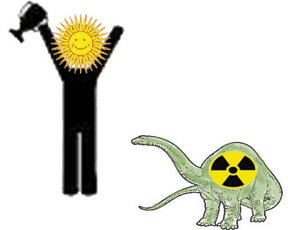 NUCLEAR POWER – A DINOSAUR IN A DEATH SPIRAL?, Dan Levitan, 29 Feb 16 ………….Mark Jacobson, director of the Atmosphere/Energy Program at Stanford University, has published state-specific plans showing how 100-percent renewables penetration would be achievable. The National Renewable Energy Laboratory, part of the U.S. Department of Energy, published its “Renewable Electricity Futures Study” in 2012 and explained a clear path to 80 percent penetration in the U.S. Others have shown similar routes forward.
When it comes to any energy source, it is cost that sits at the root of the discussion. Nuclear proponents argue that there are impediments to having a grid entirely run on renewables. Buongiorno, for example, says that the intermittency of solar and wind can realistically only be addressed by adding large amounts of electricity storage (in the form of large batteries or other newer tech such as compressed air) to the grid, and that would change the ongoing “renewable prices are plummeting” narrative.
“When I hear people say ‘Oh, the costs are coming down,’ the costs for generation may be coming down, but if installing that capacity forces me to have energy storage, you have to add those costs,” he says. Think of it like buying a car: The baseline price sounds okay, but it’s all the options and add-ons that’ll get you. Buongiorno says he expects the costs of nuclear construction will come down, and that when storage costs for renewables are factored in, nuclear — with its reliable, 24/7 output — starts to look much more attractive as an alternative.
Billions and Billions
When it comes to any energy source, it is cost that sits at the root of the discussion. Adding more nuclear to the grid could reduce some of the burden on renewables and storage, but the economics of nuclear itself could prove an insurmountable roadblock.
In general, the more experience accumulated with a given technology, the less it costs to build. This has been dramatically illustrated with the falling costs of wind and solar power. Nuclear, however has bucked the trend, instead demonstrating a sort of “negative learning curve” over time.
According to the Union of Concerned Scientists, the actual costs of 75 of the first nuclear reactors built in the U.S. ran over initial estimates by more than 200 percent. More recently, costs have continued to balloon. Again according to UCS, the price tag for a new nuclear power plant jumped from between US$2 billion and US$4 billion in 2002 all the way US$9 billion in 2008. Put another way, the price shot from below US$2,000 per kilowatt in the early 2000s up to as high as US$8,000 per kilowatt by 2008.
Steve Clemmer, the director of energy research and analysis at UCS, doesn’t see this trend changing. “I’m not seeing much evidence that we’ll see the types of cost reductions [proponents are] talking about. I’m very skeptical about it — great if it happens, but I’m not seeing it,” he says.
Some projects in the U.S. seem to face delays and overruns at every turn. In September 2015, a South Carolina effort to build two new reactors at an existing plant was delayed for three years. In Georgia, a January 2015 filing by plant owner Southern Co. said that its additional two reactors would jump by US$700 million in cost and take an extra 18 months to build. These problems have a number of root causes, from licensing delays to simple construction errors, and no simple solution to the issue is likely to be found.
In Europe the situation is similar, with a couple of particularly egregious examples casting a pall over the industry. Construction began for a new reactor at the Finnish Olkiluoto 3 plant in 2005 but won’t finish until 2018, nine years late and more than US$5 billion over budget. A reactor in France, where nuclear is the primary source of power, is six years behind schedule and more than twice as expensive as projected.
“The history of 60 years or more of reactor building offers no evidence that costs will come down,” Ramana says. “As nuclear technology has matured costs have increased, and all the present indications are that this trend will continue.”……….
Cousins to the fear of a massive meltdown are both the worry over nuclear weapons proliferation and concerns over waste disposal. Spent nuclear fuel is currently stored on the site of nuclear plants in pools of water or sealed in dry cask storage, anddecades-old arguments over geologic repositories are unlikely to be resolved any time soon. With regard to weapons, nuclear plants produce plutonium during the course of their reactions, which can be made into bombs if enough is accumulated; terrorism and theft are thus constant worries. Both of these issues work to extend the shadow of risk stretching out behind nuclear power, and both lack immediate solutions………….
[Small nuclear reactors ] Allison Macfarlane, director of George Washington University’s Center for International Science and Technology Policy and the former chairman of the U.S. Nuclear Regulatory Commission, notes that of the various companies working on these only one (NuScale Power) is currently expected to actually submit application materials to regulators in 2016 — a step that is still years removed from actual functioning reactors.
Dramatic improvement in solar cell technology

 Researchers make key improvement in solar cell technology, EurekAlart, 29 Feb 16 Low-cost alternative boosts maximum voltage WASHINGTON STATE UNIVERSITY PULLMAN, WASH. – RESEARCHERS HAVE REACHED A CRITICAL MILESTONE IN SOLAR CELL FABRICATION, HELPING PAVE THE WAY FOR SOLAR ENERGY TO DIRECTLY COMPETE WITH ELECTRICITY GENERATED BY CONVENTIONAL ENERGY SOURCES.
Led by the U.S. Department of Energy’s National Renewable Energy Laboratory and in collaboration with Washington State University and the University of Tennessee, the researchers improved the maximum voltage available from a cadmium telluride (CdTe) solar cell, overcoming a practical limit that has been pursued for six decades and is key to improving its efficiency. The work is published in the Feb. 29 issue of Nature Energy……..
The research was funded by the Energy Department’s SunShot Initiative, which aims to make solar cost-competitive with traditional energy sources. It was also supported in part by Oak Ridge National Laboratory’s Center for Nanophase Materials Sciences.
The research is in keeping with Washington State University’s Grand Challenges initiative stimulating research to address some of society’s most complex issues. It is particularly relevant to the challenge of “Sustainable Resources for Society” and its theme of meeting energy needs while protecting the environment. http://www.eurekalert.org/pub_releases/2016-02/wsu-rmk022616.php
The horrendous truth about just how big a mess nuclear corporation EDF is in

 EDF’s leaked Board Agenda: Zombie nuclear projects and ‘beyond the grave’ reactors http://www.theecologist.org/blogs_and_comments/Blogs/2987305/edfs_leaked_board_agenda_zombie_nuclear_projects_and_beyond_the_grave_reactors.html Jonathon Porritt 29th February 2016
French nuclear parastatal EDF is facing problem after problem – zombie nuclear projects in the UK, Finland, China and France, a fleet of ‘beyond the grave’ reactors, a dropping share price and its drooping credit rating. But is it really as bad as all that? Jonathon Porritt has exclusive access to the leaked Agenda of its latest board meeting. And the answer is – no. It’s even worse.
You seriously wouldn’t want to be a Director of EDF at the moment. The agenda for an average Board Meeting must be seriously gloomy on each and every occasion.
And thanks to an EDF mole (and to judge by the number of leaks to the French press and the UK’sFT there’s a lot of them) I can now state this as fact, not mere opinion.
An annotated copy of the Agenda items for their last meeting on 16th February mysterious showed up in my email today, helpfully summarised byAlexandre Perra, EDF’s Executive Committee Secretary.
Item 1: Existing EPR construction projects
1.1 Olkiluoto (Finland)
Continuing, horrendous cost overruns, leading to ongoing legal stand-off with Finnish partners. Already delayed by seven years, but (hopefully!) could be finished by 2018.
1.2 Flamanville (France)
Continuing, horrendous cost overruns. Already delayed by nine years, but (hopefully!) could be finished by 2018.
1.3 Taishan (China)
Serious problems with both reactors under construction, but, this being China, everything’s shrouded in secrecy. WARNING: This could be much worse than we currently understand.
1.4 Pressure vessels
Still waiting for final safety assessment from French regulators. WARNING: There could be really serious problems here, despite our best efforts to ‘work with’ the regulator.
1.5 Deadlines/UK Treasury
These deadlines are now CRITICAL – as in EXISTENTIAL.
UK Treasury’s loan guarantees are linked to Flamanville operating successfully. And if it is not working properly by 2020, loan guarantee will be completely withdrawn.
Item 2: New reactors at Hinkley Point, Somerset
2.1 Final investment decision
Postponed again – for the eighth time. Still unable to raise the €23.3bn (£18bn), despite our Chinese backers agreeing last year to provide one-third of the total sum, and despite the UK Government offering all but limitless subsidies.
CAUTIONARY NOTE: The true cost is of course much closer to €31 (£24.5bn) taking into account both the cost of construction and the costs of finance. This has been recognised by the EU Commission.
Have just released new announcement: construction will now not start until 2019. We should know by then whether the EPR will ever produce any electricity, with Olkiluoto and Flamanville both due to come on stream in 2018.
2.2 Media strategy
Must keep up a good front: have blamed the latest delay on the Chinese New Year. Crucial that CEO maintains the line: “We estimate the investment decision is very close.”
‘Stop Hinkley Point’ protesters occupied our offices in Bridgewater yesterday. Need to handle with care. Negative coverage increasing all the time, and people have started to talk about our ‘zombie reactors‘ at Hinkley Point.
Regrettably, our cohort of ‘green ambassadors’ (led by renowned UK environmentalist George Monbiot) has fallen silent. Very few advocates now for EPR. Even the FT has now joined the ranks of the critics stating “Politically painful it may be, but the case for halting Hinkley Point C is becoming hard to refute.”
Item 3: Extending the life of our UK reactors
3.1 Some good-ish news: we’ve negotiated extensions for four of our eight reactors in the UK: Heysham 1 and Hartlepool, through to 2024, and Heysham 2 and Torness through to 2030. There will be a significant financial outlay here, which has not yet been properly accounted for, but still relatively ‘small beer’ (as the English say) when looking at our overall finances.
3.2 The longer we keep these reactors ticking over, more or less safely, the better it will be. As soon as they come offstream, all the liabilities associated with decommissioning kick in. Reminder to the Board: managing our rising liabilities is now our most critical priority!
Item 4: Extending the life of our French reactors
Current operating fleet: 58 reactors. The Board has already signed off on a major life extension programme, with an estimate of €55bn of costs. Recent external assessments have put total costs at €100bn. Crucial to hold the line in the media at €55bn. In reality, we have no idea what the total outlay will be.
Item 5: Energy Transition Law (France)
5.1 This now represents A MAJOR RISK, with a direct mandate from our principal shareholder (the French Government) that the country must reduce its dependence on nuclear generation from 75% to 50% of total electricity demand by 2025.
5.2 The Cour des Comptes (state Audit Office) has just issued a new report challenging our long-held expectation that demand for electricity in France will continue to grow significantly through to 2025. If they are right, the energy transition law will mean:
- Worst-case scenario: 20 reactors (35% of the fleet) will need to close.
- Best-case scenario: 17 reactors (29% of the fleet) will need to close.
5.3 Lobbying relevant Ministers and Prime Minister to amend the Energy Transition Law now a TOP PRIORITY.
tem 6: Financial position
- Current share price: down 50% on January 2015 position.
- Current market cap: €22.5 (symbolically and very uncomfortably, less than the total projected costs of the Hinkley Point project).
- Our €37bn net debt load also dwarfs our €18.5bn market capitalisation.
- Current credit rating still at risk. Standard & Poors and Moody’s both looking wobbly.
- Growing concern about perceived splits on the Board, especially as regards increasingly forceful hostility from our Trade Union representatives to Hinkley Point.
Merde alors! And now the FT reports that they have two EDF sources telling them that the final investment decision will be delayed until 2017! Nous sommes trahis! It will be soon! Very very soon! Call security!
The Champagne has lost its fizz
See what I mean? Not exactly a cheery occasion, even with the best of French lunches, and it must be a bit like that Board meeting after Board meeting.
So now shift the focus to London, to the Department of Energy and Climate Change. Imagine for a moment the Permanent Secretary, metaphorically shitting himself as the single biggest element in the UK’s future electricity supply slides, slowly but ever more inexorably, down the pan. Wouldn’t he just love to get access to the (real) Minutes of EDF’s Board meetings!
The implications of all this for the UK couldn’t possibly be more severe. Initially, Hinkley Point was meant to be on stream by 2025, generating a whacking great 7% of total electricity supply. Earlier delays meant that this had already slipped to 2030. Now that the start date has slipped again, to 2019, at the earliest, that 2030 date looks insanely optimistic.
And that’s just the start. EDF’s meltdown at Hinkley Point is already having a significant knock-on impact on other would-be nuclear prospects in the UK – with Horizon, NuGen and even China General Nuclear Corporation beginning to get cold feet.
If Hinkley Point does go down the pan, a project that has been given every conceivable financial inducement by both the UK and the French Government, who the hell is going to invest in different but equally dodgy reactor designs?
If the Permanent Secretary isn’t shitting himself about such a state of affairs, one has to ask where he’s getting his metaphorical Imodium from.
Jonathon Porritt is Co-Founder of Forum for the Future, and a writer, broadcaster and commentator on sustainable development. He is also Trustee of the Ashden Awards for Sustainable Energy, and is involved in the work of many NGOs and charities as Patron, Chair or Special Adviser.
This blog was originally published on Jonathon’s website.
The danger of flying nuclear materials between UK and USA
MoD admits flying nuclear materials http://www.theguardian.com/uk-news/2016/mar/01/mod-admits-flying-nuclear-materials-between-uk-and-us
Campaigners highlight safety risks after defence minister admits there have been 23 such flights in the last five years, Guardian, Rob Edwards, 1 Marc 16 , Materials used in nuclear weapons have been flown between the UK and the US 23 times in the last five years, the Ministry of Defence has admitted.
Though the MoD does not give details, the flights are believed to have carried tritium, plutonium and enriched uranium, all vital ingredients of Tridentwarheads. They probably started or ended at the RAF base at Brize Norton in Oxfordshire.
The flights have alarmed politicians and campaign groups, who are worried about accidents causing widespread radioactive contamination. The MoD, however, insists that the transports complied with stringent safety rules.
The Guardian reported on 9 February that two MoD emergency exercises in 2011 and 2012 codenamed Astral Bend envisaged planes carrying nuclear materials crashing. One imagined a leak of enriched uranium and plutonium spreading up to five kilometres across south Wales.
That prompted a question about the nuclear flights in the House of Commons last week by the Scottish National party’s defence spokesman, Brendan O’Hara MP. In response, the government admitted the frequency of such flights for the first time. “In the last five years, 23 flights carrying defence nuclear materials were undertaken,” the defence minister, Penny Mordaunt, told MPs in a written answer.
“All flights were between the UK and the United States on fixed-wing aircraft under the control of UK armed forces.” Details of the cargoes were kept secret “as disclosure would or would be likely to prejudice national security,” she said.
O’Hara said: “This answer is alarming and highlights a practice most of the public are unaware of. The MoD need to outline what risk and safety assessments they made about these flights and precisely when and what areas of UK airspace were used. I fear the MoD does not have a great track record on transparency when it comes to nuclear issues – and this answer clearly begs more questions.”
Experts say that the UK and the US regularly exchange tritium, plutonium and enriched uranium under a mutual defence agreement. Anti-nuclear campaigners have tracked road convoys transporting nuclear materials between the nuclear bomb plants at Aldermaston and Burghfield in Berkshire and RAF Brize Norton.
The independent nuclear engineer, John Large, argued that the MoD’s air shipments would not comply with international safety regulations for civil nuclear transports. A crash could “contaminate large tracts of land with potential radiological consequences for unprotected members of the public”, he said.
Tom Clements, who heads a group monitoring a nuclear weapons plant at Savannah River in South Carolina, claimed that the MoD flights would not meet US standards for civil nuclear shipments. The flights had “disturbing” implications for the world’s attempts to reduce the proliferation of nuclear weapons, he said.
Peter Burt from the UK Nuclear Information Service, a not-for-profit group, highlighted the high risks of air shipments. “The RAF regularly fly nuclear materials over large urban areas such as Bristol, Cardiff, and Swansea, which raises serious questions about what would happen in the event of an accident involving one of these flights,” he said.
The MoD maintained that the air transports were safe. “The transport of defence nuclear materials is carried out to the highest standard in accordance with stringent safety regulations,” said an MoD spokeswoman.
“In over 50 years of transporting defence nuclear materials in the UK, there has never been an incident that has posed any radiation hazard to the public or to the environment.”
Radioactive leak just one of many nuclear problems at Indian Point, USA
 Indian Point Leak Foreshadows the End of the Nuclear Age, Fortune by David Z. Morris @davidzmorris
FEBRUARY 28, 2016, New York could be the next Fukushima as world governments roll back nuclear power.
The Indian Point nuclear power plant in New York State is leaking radioactive contaminant into nearby groundwater, and despite plant operator Entergy’s ELA 0.08% assurances that the leak has “no health or safety consequences,” Governor Andrew Cuomo called earlier this month for a full investigation by state environment and health officials.
The latest revelations add to a mounting list of recent accidents and problems at Indian Point, and Cuomo’s hard stance is nothing new, either. As of November of last year, Cuomo’s office actively opposed the continuing operation of Indian Point.
The plant’s problems are not isolated—leaks have been found at as many as 75% of U.S. nuclear plants. And closing Indian Point would put New York, and the U.S., in line with a sharp global move away from nuclear power following 2011’s meltdown at Japan’s Fukushima Daichi reactor. Japan shut down all of its nuclear plants after the disaster, and only began tentatively restarting a handful in 2015……..http://fortune.com/2016/02/28/indian-point-end-of-nuclear-age/
Climate Change Champion – Leonardo Di Caprio
How Leonardo DiCaprio became one of the world’s top climate change champions,Guardian. Suzanne Goldenberg, 1 Mar 16 The Oscar-winning actor’s environmental activism may not quite stretch back to What’s Eating Gilbert Grape but he has steadily schooled himself on the oceans and climate change since the 1990s

Leonardo DiCaprio was a climate champion long before the actor wrapped himself in an animal carcass, vomited up raw bison liver, and risked hypothermia for his Oscar-winning role in Revenant.
DiCaprio used his acceptance speech for best actor to urge a global audience to reject the “politics of greed”, and support leaders willing to take action against climate change.
“Climate change is real, it is happening right now, it is the most urgent threat facing our entire species, and we need to work collectively together and stop procrastinating,” the actor said.
The Oscars was probably the biggest audience to date for DiCaprio’s activism – but campaigners who have worked with the actor said he has been steeped in the issue for years, and is desperate about the need for action.
Over the last few years, DiCaprio has steadily donated his celebrity – and at least $30m in funding according to his foundation – to help advance the United Nations climate negotiations, protect coral reefs and tigers, and spread public awareness about the dangers of climate change.
The actor has become a fixture at events focused on global challenges since 2014, dropping in at the Davos economic forum to pick up an award last January, and holding a private chat on the sidelines with Ban Ki-Moon, the United Nations secretary general, on the sidelines of the Paris climate negotiations last December.
DiCaprio marched with 400,000 through the streets of Manhattan and addressed the United Nations about the dangers of climate change in 2014, and has had private tutorials in climate science from some of the world’s best researchers.
Other actors – notably Mark Ruffalo, the best supporting actor nominee on Sunday – are avowed climate campaigners, and other wealthy individuals give to environmental causes. But DiCaprio operates at a different level of fame, campaigners said.
“There are many foundations and non-governmental organisations interested in oceans and many do great work. He has a megaphone that nobody else on the planet has. He is so respected and admired and influential all around the world from the general public to head of state, so when he says something people listen,” said Enric Sala, explorer-in-residence for National Geographic, who has worked with DiCaprio……….
The actor is currently at work on a climate change documentary that took him to Baffin Island in the Arctic last summer – and by DiCaprio’s own account that is highly unlikely to be the end of his activism.
“I am consumed by this,” DiCaprio told Rolling Stone last January. “There isn’t a couple of hours a day where I’m not thinking about it. It’s this slow burn. It’s not ‘aliens invading our planet next week and we have to get up and fight to defend our country,’ but it’s this inevitable thing, and it’s so terrifying.” http://www.theguardian.com/environment/2016/feb/29/how-leonardo-dicaprio-oscar-climate-change-campaigner
Danger of an aging nuclear power plant next to a natural gas pipeline.
There’s a proposed natural gas pipeline next to a nuclear power plant. What could go wrong? Grist By Katie Herzog on 29 Feb 2016 What’s scarier than an aging nuclear power plant? An aging nuclear power plant next to a natural gas pipeline.
That could be the new reality for the Indian Point Energy Center, a nuclear power station located in Westchester County, just 45 miles north of Manhattan. A proposed expansion of a natural gas pipeline across the power station’s property has environmentalists and other groups concerned that an accident could turn the power plant into an unrivaled disaster. It’s a bit like smoking next to a gas tank — a gas tank filed with nuclear fuel near one of the densest population centers on the planet.
Despite how ill-advised this sounds, the pipeline has already been approved by the Federal Energy Regulatory Commission. Why would they allow such a thing? Well, as the New York Times notes, approval was partly based on reviews carried out by the Entergy Corporation — which happens to be the same company that owns the plant.
New York Gov. Andrew Cuomo, a resident of Westchester County, is not having any of it. Cuomo recently directed his administration to conduct an independent safety analysis of the pipeline project after hearing that radioactive water had leaked from the aging plant and into the groundwater. This is just the latest strike against Indian Point by the Cuomo administration, which called for the plant’s closure last year. “The safety of New Yorkers is the first responsibility of state government when making any decision,” said the governor in a statement.
Cuomo isn’t alone. In Nov. 2015, a group of climate activists known as the Montrose 9 blocked construction of the pipeline, which would transport natural gas from Texas to Massachusetts. In addition to the activists’ concerns about the affects of burning natural gas on the climate, they targeted the Spectra-owned pipeline for its proximity to Indian Point, which the federal government previously listed among the nation’s worst power plants.
The Nuclear Regulatory Commission, however, seems unconcerned. ……http://grist.org/business-technology/theres-a-proposed-natural-gas-pipeline-next-to-a-nuclear-power-plant-what-could-go-wrong/
Offshore wind parks: Interactions and local climate,
Science Daily February 29, 2016
- Source:
- Karlsruhe Institute of Technology
- Summary:
- In 2015 alone, more than 500 offshore wind turbines were connected to the grid in Germany. So far, mutual interactions of wind parks and their potential effects on local climate have been approximated with models only. Thanks to their wide installation, however, it is now possible for the first time to study their effects in reality……..https://www.sciencedaily.com/releases/2016/02/160229082420.htm
China marketing nuclear reactors to Pakistan and beyond
 China plans to build 30 overseas nuclear plants by 2030 China is building two 1000 mg nuclear power plants in Pakistan’s port city of Karachiat a cost of $6.5 billion. Business Standard, Press Trust of India | Beijing March 1, 2016 China aims to build 30 nuclear power units in countries involved with its Silk Road Initiative by 2030 as it looks to cash in its new 1000 mw nuclear reactor technology being built in Pakistan.
The China National Nuclear Corp (CNNC) has reached bilateral agreements on nuclear energy cooperation with countries including Argentina, Brazil, Egypt, Britain, France and Jordan, its President Sun Qin said today.
China is building two 1000 mgnuclearpower plants inPakistan’s port city of Karachiat a cost of $6.5 billion……..http://www.business-standard.com/article/pti-stories/china-plans-to-build-30-overseas-nuclear-plants-by-2030-116030101086_1.html
President Obama’s doublespeak on nuclear weapons
 Barack Obama’s Broken Nuclear Promise The president made non-proliferation a centerpiece of his administration. What happened?, Pacific Standard, JARED KELLER, 1 Mar 16 In the early days of his presidency, during a visit to Prague’s Hradčany Square, Barack Obama launched what observers saw as a centerpiece of his foreign policy: a doctrine for a nuclear free world. “The Cold War has disappeared but thousands of those weapons have not,” President Obama announced, pointing out the paradoxical twist of the modern nuclear dilemma—as the threat of global nuclear war has subsided, the risk of a singular nuclear attack has only intensified.
“More nations have acquired these weapons. Testing has continued. Black market trade in nuclear secrets and nuclear materials abound. The technology to build a bomb has spread. Terrorists are determined to buy, build, or steal one,” Obama continued. “Our efforts to contain these dangers are centered on a global non-proliferation regime, but as more people and nations break the rules, we could reach the point where the center cannot hold.”
Taken in the context of his other campaign promises—the closure of Guantanamo, (which has only truly blossomed in the twilight hours of his presidency) and the end of the two costly wars he inherited—Obama’s nuclear promise seemed both heroic and unimpeachable, especially given its tacit support by past foreign policy luminaries. Mere months after his Prague address, Obama was awarded the 2009 Nobel Peace Prize—a symbolic endorsement of his nascent doctrine—with the Nobel Committee specifically citing the “special importance to Obama’s vision of and work for a world without nuclear weapons.”………
The minute things went south with Russia, the United States went back on it’s promise to work toward a nuclear-free world.But six years later, in a book released last year, the former Pulitzer director wrote that the prize “didn’t have the desired effect” of helping to catalyze such change. He’s not wrong. The Obama administration certainly made historic steps in unifying the international community on the issue of nuclear weapons, particularly the historic nuclear deal between Iran and the P5+1 countries. But at the same time, despite promises to pursue new restrictions on nuclear technology and decrease the nation’s nuclear stockpile, the American military’s nuclear posture has remained largely static. Obama’s dream of non-proliferation is, it seems, long dead………
Obama’s nuclear budget has swollen in recent years. In his proposed $620.9 billion defense budget for 2017, Obama called for a $1.8 billion increase in nuclear spending “to overhaul the country’s aging nuclear bombers, missiles, submarines and other systems,” according to Reuters. The budget request allocates millions in taxpayer dollars for the development of a new nuclear-tipped cruise missile, replacing the military’s arsenal of air-launched missiles, and almost doubling the military’s nuclear cruise missile collection to nearly 1,000 missiles—all initiatives seemingly in contradiction to the 2010 Nuclear Posture Review and Obama’s early-term non-proliferation rhetoric. And this isn’t a sudden change, but the latest jump in nuclear arms spending at the cost of non-proliferation efforts since 2011, according to reporting from Mother Jones.
Data from the Center for Arms Control & Non-Proliferation shows a steady increase in nuclear spending in Obama’s defense budget since 2012, all while non-proliferation spending has been on the decline:
“What’s more problematic is the decrease in nuclear nonproliferation programs by over $100 million,” Global Zero executive director Derek Johnson wrote for the Hill. “These are highly functional programs dedicated to keeping the world’s nearly 16,000 nuclear weapons out of terrorist hands and locking down vulnerable nuclear material…. In a global security climate traumatized by the rise of ISIS, decreasing nuclear nonproliferation programs seems a dangerously misguided trade-off.”………
In retrospect, we should have known better. In his Nobel address, Obama didn’t just lay out a doctrine that would define his foreign policy; he delivered a masterclass in doublespeak, using the validation of his campaign rhetoric of a utopian, nuclear-free world while recognizing the permanent reality of modernrealpolitik and nuclear terrorism. And while the promise of a nuclear-free world is an inherently naïve proposition, his doctrine of just war was prescient: Obama has expanded the field of battle against terrorism with a deadly drone program while in turn touching off a “modernization” arms race with Russia, as the Interceptputs it.
The administration is trumpeting its success with Iran—and with good reason—but Obama’s record on nuclear weapons is hardly an affirmation of his Nobel Peace Prize. The dream of a world without nukes, it turns out, was always really just that: a dream, and nothing more. http://www.psmag.com/politics-and-law/broken-nuclear-promise-of-barack-obama
John Kerry asked Pakistan to reduce nuclear arsenal
Kerry asks Pak to reduce nuclear arsenal, Business Standard, 1 Mar 16 Citing the example of the US and Russia which are working to further reduce their nuclear arsenals, Secretary of State John Kerry asked Pakistan to understand this reality and review its nuclear policy
Press Trust of India | Washington March 1, 2016 The US has pressed Pakistan to reduce its growing nuclear arsenal but Islamabad has refused to accept any curbs on it saying America must show “greater understanding” of its security concerns in South Asia. Citing the example of the US and Russia which are working to further reduce their nuclear arsenals, Secretary of State John Kerry asked Pakistan to understand this reality and review its nuclear policy.
The nuclear issue was discussed during security talks held here yesterday as part of the US-Pakistan strategic dialogue.
“I think, it is important for Pakistan to really process that reality and put that front and centre in its policy,” Kerry said in an apparent reference to the reports that Pakistan has the fastest growing stockpile of nuclear weapons in the world.
His remarks come ahead of this month’s Nuclear Security Summit to be hosted here by President Barack Obamathat would be attended by Pakistan Prime Minister Nawaz Sharif……..http://www.business-standard.com/article/pti-stories/kerry-asks-pak-to-reduce-nuclear-arsenal-116030100761_1.html
Engineers concerned at design flaw in US nuclear reactors
U.S. NRC engineers urge fix for nuclear power stations Reuters, By Timothy Gardner 1 Mar
A group of engineers within the U.S. nuclear power regulator is concerned that a design flaw in nearly all U.S. nuclear plants could endanger emergency core cooling systems. The group has urged the regulator to order power station operators to either fix the problem or face mandatory shutdowns.
Seven engineers in late February petitioned the Nuclear Regulatory Commission to order immediate enforcement actions against licensees of U.S. nuclear power plants, in a little-noticed, but public move.
The petition, filed under a standard NRC process, urges the agency to respond by March 21.
The engineers are concerned that a design flaw in nearly all U.S. nuclear facilities leaves them vulnerable to so-called open phase events in which an unbalanced voltage, such as an electrical short, could cause motors to burn out and reduce the ability of a reactor’s emergency cooling system to function. If the motors are burned out, backup electricity systems would be of little help, the petition said.
In early 2012 an unbalanced voltage event forced Exelon Corp’s Byron 2 reactor in Illinois to shut down automatically. The unit was shut for about a week.
Later that year, the NRC alerted nuclear power plant operators in a bulletin to a potential design vulnerability concerning open phase and collected feedback from the operators.
But the agency never ordered the plants to make changes to reduce any open phase vulnerabilities. The petition said 13 open phase events have occurred at U.S. and international nuclear plants over the last 14 years……http://www.reuters.com/article/usa-nuclear-regulator-idUSL2N1692BF
Theft of radioactive material in Mexico
Mexico issues alert after theft of radioactive material, ABC News 29 Feb 16 Five Mexican states have been put on alert after a truck carrying a container of potentially dangerous radioactive material was stolen, the Interior Ministry says.
The National Co-ordination of Civil Protection issued the warning after a company in the central state of Queretaro reported that a ute carrying radioactive iridium-192 had been stolen.
The Ministry said the material “can be dangerous for people if not handled safely” and could cause “permanent or serious injury to a person who is handling or in contact with it for a short time”.
Such damage could occur after contact lasting anywhere from minutes to hours, it added.
Officials said the radioactive material represented a significant health risk if taken outside its container, but was not dangerous if kept sealed…….http://www.abc.net.au/news/2016-02-29/mexico-issues-alert-after-theft-of-radioactive-material/7209140
The Suspected Syrian Nuclear Reactor
Red Teaming Nuclear Intelligence: The Suspected Syrian Reactor, Council on Foreign Relations by Micah Zenko March 1, 2016 In former CIA and NSA director Gen. Michael Hayden’s new memoir,Playing to the Edge: American Intelligence in the Age of Terror, he describes the case of Al Kibar, in which Israeli officials informed the United States in 2007 about a building under construction in Syria that they thought was a nuclear reactor. Hayden writes, “Then we gave the data to a red team, dedicated contrarians, and directed they come up with an alternative explanation. Build an alternative case as to why it’s not a nuclear reactor; why it’s not intended to produce plutonium for a weapon; why North Korea is not involved.” (p. 258)
For the full story of the red teaming of Al Kibar, read this excerpt from my book—based upon interviews with senior Bush administration officials—Red Team: How to Succeed by Thinking Like the Enemy.
Red teaming is not only about using a devil’s advocate to scrutinize and challenge day-to-day operations. For institutions facing a significant decision, red teaming may also be a one-time effort. We can see how a properly administrated red team can help ensure that a crucial decision is the right one by studying the following example found in recent national security decision making.
In April 2007, Israeli national security officials surprised their American counterparts by informing them about a large building under construction at Al Kibar in a valley in the eastern desert of Syria. In oneon- one briefings, the Israeli officials provided dozens of internal and external color photographs dating back to before 2003. The evidence strongly suggested that the building was a nuclear reactor, remarkably similar to the gas-cooled, graphite-moderated reactor in Yongbyon, North Korea. Israeli Prime Minister Ehud Olmert then delivered his request to President George W. Bush: “George, I’m asking you to bomb the compound.”………http://blogs.cfr.org/zenko/2016/03/01/red-teaming-nuclear-intelligence-suspected-syrian-reactor/
1 This Month

of the week – Shut Down Drone Warfare!


Tell the Ukrainian Government to Drop Prosecution of Peace Activist Yurii Sheliazhenko

Petition to revoke the licensing of the Near Surface Nuclear Disposal Facility (NSDF) at Chalk River. https://www.ourcommons.ca/petitions/en/Petition/Details?Petition=e-7247
To see nuclear-related stories in greater depth and intensity – go to https://nuclearinformation.wordpress.com
-
Archives
- April 2026 (103)
- March 2026 (251)
- February 2026 (268)
- January 2026 (308)
- December 2025 (358)
- November 2025 (359)
- October 2025 (376)
- September 2025 (257)
- August 2025 (319)
- July 2025 (230)
- June 2025 (348)
- May 2025 (261)
-
Categories
- 1
- 1 NUCLEAR ISSUES
- business and costs
- climate change
- culture and arts
- ENERGY
- environment
- health
- history
- indigenous issues
- Legal
- marketing of nuclear
- media
- opposition to nuclear
- PERSONAL STORIES
- politics
- politics international
- Religion and ethics
- safety
- secrets,lies and civil liberties
- spinbuster
- technology
- Uranium
- wastes
- weapons and war
- Women
- 2 WORLD
- ACTION
- AFRICA
- Atrocities
- AUSTRALIA
- Christina's notes
- Christina's themes
- culture and arts
- Events
- Fuk 2022
- Fuk 2023
- Fukushima 2017
- Fukushima 2018
- fukushima 2019
- Fukushima 2020
- Fukushima 2021
- general
- global warming
- Humour (God we need it)
- Nuclear
- RARE EARTHS
- Reference
- resources – print
- Resources -audiovicual
- Weekly Newsletter
- World
- World Nuclear
- YouTube
-
RSS
Entries RSS
Comments RSS
 nuclear-news