Sen. Tom Udall, D-N.M., is among a group of federal lawmakers who have called for an investigation into the program following McClatchy’s probe, which revealed 7,762 workers died after being denied compensation by the government.
The McClatchy DC investigation found that nuclear worker safety remains an issue: Since 2001, more than 186,000 workers have been exposed to radiation.
 Efficacy of compensation program for nuclear workers under scrutiny By Rebecca Moss
The New Mexican, 20 Feb 16, “………Due to the commingling of his exposure during the war and his work on various sites at Sandia, Thompson is one of at least 10,273 New Mexicans who have applied for a federal program that compensates individuals with a $150,000 lump sum payment for serious illness or death that can be attributed to work at the state’s nuclear defense facilities since 1943.
Since Congress passed the Energy Employees Occupational Illness Compensation Program Act in 2000, the government has spent $12 billion in financial restitution for more than 100,000 workers whose onset of cancer, beryllium disease, neurological disorders and other ailments is a result of careers in the more than 300 nuclear facilities across the country.
As of March 2015, New Mexico had received the second-highest compensation of any state under the fund, with $1.64 billion paid out to workers for compensation and medical bills.
But the program has come under scrutiny lately. An investigation by the McClatchy DC news service found that fewer than half of the people who have applied for benefits have received them, and workers’ complaints are often suspended in the complex process of paperwork or court hearings, with some claims languishing in the system for up to 10 years. A new documentary coming out in March, titled Safe Side of the Fence, questions why side-by-side workers with similar ailments would receive different judgments from the Department of Labor on the validity of their claims.
At least 5,400 workers in New Mexico have been denied financial assistance, according to the Department of Labor, which issues the compensation.
The department recently added new language to the regulations, which is intended to clarify who is eligible for relief. A 60-day public comment period for the proposal ended Thursday. But critics say the new language could make it even more difficult for ailing workers to receive compensation. Continue reading →
February 22, 2016
Posted by Christina Macpherson |
employment, health, USA |
Leave a comment
Westinghouse ditches small reactors http://funologist.org/2014/02/06/westinghouse-ditches-small-reactors/ 5 Feb 2014 The nuclear industry is often referred to as a priesthood, by critics and supporters alike. The thought is that the followers of the belief in nuclear power have to have a strong faith in the technology and a willingness to sacrifice themselves to advance the ideology. Some of the hardest working people I have ever met, promote nuclear power.
 Part of the understanding within the priesthood is that you try to never harm the position of others in the industry when you change your plans. So it was with special interest I read the recent news that Westinghouse had dropped out of the small reactor market. In this news story the Westinghouse spokes people (who are always very careful what they say to the press) tell us that the only reason they are dropping out of this technology is “there are no customers.” They go on to elaborate that the only way they can actually make money on small reactors is by selling a bunch of them. The Westinghouse CEO confessed, “Unless you’re going to build 30 to 50 of them, you’re not going to make your money back.”
Worldwide, no one is building reactors without huge financial incentives from the manufacturer or their supporting country. The idea that small reactors are going to be snapped up by utilities without external generous financing is as fanciful as the notion that nuclear power will be “too cheap to meter.”

But what is really going on here? My guess is that Westinghouse has done the economic math and they see that “they can’t get there from here.” That the persistent experience of the nuclear navy is repeating itself in the non-military world . That being that reactors do not shrink in an economically advantageous way. Nuclear power is fantastically complex stuff, the French EdF/Areva have put a lot of time and money into going the other way and building even larger reactors, hoping to get economies of scale.
The problem is not that you have to sell 50 of them, the problem is that no matter how many you sell, other energies are going to be cheaper, and so it is likely a loosing game from the get go.
February 22, 2016
Posted by Christina Macpherson |
technology, USA |
Leave a comment
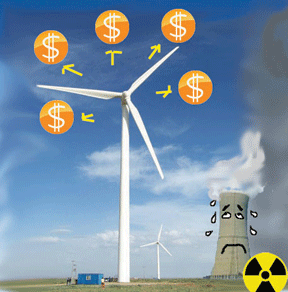
 Global wind power capacity tops nuclear energy for first time, Japan Times, 20 Feb 16 The capacity of wind power generation worldwide reached 432.42 gigawatts (GW) at the end of 2015, up 17 percent from a year earlier and surpassing nuclear energy for the first time, according to data released by global industry bodies.
The generation capacity of wind farms newly built in 2015 was a record 63.01 GW, corresponding to about 60 nuclear reactors, according to the Global Wind Energy Council based in Brussels. The global nuclear power generation capacity was 382.55 GW as of Jan. 1, 2016, the London-based World Nuclear Association said…….
Wind power is the leading energy source in the transition from fossil fuels to renewables, the wind energy council said as it released the data last week.
China led all other countries in wind energy generation capacity with 145.10 GW. Beijing is promoting wind power to shift from coal and other fossil fuels to combat air pollution and global warming.
Coming in second behind China is the United States with 74.47 GW, followed by Germany with 44.95 GW, then India with 25.09 GW and then Spain with 23.03 GW. Japan produced 3.04 GW. http://www.japantimes.co.jp/news/2016/02/20/national/global-wind-power-capacity-tops-nuclear-energy-for-first-time/#.VsoiRX197Gh
February 22, 2016
Posted by Christina Macpherson |
2 WORLD, renewable |
Leave a comment
 Kincardine nuclear waste site’s paused timeline not enough for opponents, The Star.com
Environment and Climate Change Minister Catherine McKenna has said the environmental assessment is insufficient. By: Jennifer Wells Business Columnist, Feb 21 2016
For opponents of the Deep Geologic Repository proposed by Ontario Power Generation, the news that Environment and Climate Change Minister Catherine McKenna has “paused the timeline” on the project is not good news enough.
Opposition voices have been crying for an outright “no” from Ottawa, as the deadline loomed for what had been promised as a March 1 decision on the plan to bury 200,000 cubic metres of low and intermediate-level radioactive waste approximately 1.2 km from the Lake Huron shore.
Yet in asking for further studies McKenna has signalled that the Environmental Assessment Report of the joint review panel, four years in the making, is insufficient, a decision that hardly seemed likely in the Stephen Harper era. And her request for additional technical studies and information on potential environmental effects highlights what has always been a fundamental flaw in OPG’s proposal: that no other site was drill-tested and environmentally assessed.
February 22, 2016
Posted by Christina Macpherson |
Canada, wastes |
Leave a comment
The US Defense Department has declassified the fact that US nuclear weapons were deployed on Okinawa before the island prefecture was returned to Japanese administration in 1972.
The National Security Archive at George Washington University published on its website on Friday 3 photographs taken of nuclear weapons in Okinawa along with the declassified documents. The institute welcomed the declassification.One photo shows US military personnel working on a Mark-7 atomic bomb at US Kadena Airbase on October 23rd, 1962.
The second photo shows a Mark 28 nuclear weapon before being loaded onto a US Air Force plane.
The third photo shows a Mace B cruise missile loaded with a nuclear weapon. It was deployed in Okinawa from 1961 until 1970. See more at: http://newsonjapan.com/html/newsdesk/article/115407.php#sthash.qsfupVq5.dpuf
February 22, 2016
Posted by Christina Macpherson |
history, Japan, weapons and war |
Leave a comment

 Nuclear deal might push SA into junk Things aren’t looking up for Africa’s second largest economy, with markets on edge awaiting the country’s budget speech, on February 24.
February 19, 2016 This is according to Busisiwe Radebe, an economist at Nedbank Limited, who addressed a group of local business people at the Ebotse Golf and Country Estate clubhouse recently.
She painted a slightly grim picture of the coming year for South Africa (SA) and its potential effects on local businesses.
Radebe spoke at the latest networking breakfast of the Ebotse Captains of Industry, which is organised by the Ekurhuleni Business Initiative (EBI).
The EBI was founded and is run by Chris van Biljon, who also resides in the Rynfield country estate and expressed his excitement at welcoming Radebe.
Among other concerns, Radebe raised the subjects of a looming credit ratings downgrade, the weaker-than-ever national currency and the repercussions of China’s slowing economic growth.…….Credit rating agencies measure and determine the credit reliability and, with it, the investment grade of companies and countries across the globe.
Standard and Poor’s (SnP), Moody’s Investors Service and Fitch Ratings are the three most influential, with the largest global market share.Currently, SA is rated by Fitch and SnP as only one level above junk status, which is essentially regarded as below investment grade.
“We have many investors who hold SA debt; if we’re downgraded to junk, they have to divest from us and sell our debt, which will weaken the Rand quite a bit and could have dire consequences for the economy,” said Radebe.
According to her, the big national budget deficit is another reason to be wary of the “big three”.
“We are at a scary point in the South African economy,” Radebe said.
“I think if the nuclear deal goes through, we will be downgraded to junk, because we can’t afford it at the moment…….. http://benonicitytimes.co.za/245690/nuclear-deal-might-push-sa-into-junk/
February 22, 2016
Posted by Christina Macpherson |
business and costs, South Africa |
Leave a comment
Earlier this week a Saudi political analyst told RT’s Arab network the kingdom has a nuclear weapon. Dahham Al-‘Anzi made the claim while saying Saudi Arabia is engaged in an effort to “minimize the Iranian threat in the Levant and Syria.”
Although Saudi Arabia has officially denied it has a nuclear weapons program and has publicly stated it opposes nuclear weapons in the Middle East, it has funded a military nuclear program and received scientific assistance from the United States and Pakistan.
Despite this cooperation, US Secretary of State John Kerry told the Saudis in January there would be “all kinds of NPT consequences” if Riyadh received a nuclear weapon from Pakistan.
The Saudis began financing Pakistan’s atomic weapons project in 1974. “Our achievements are yours,” the Pakistani president, General Zia-ul-Haq, told the Saudis in the 1980s.
In the late 1980s the Saudis secretly bought dozens of CSS-2 ballistic missiles from China. The CSS-2, also known as the Dong Feng, is based on the Russian 9K720 Iskander missile. The intercontinental ballistic missile is designed to carry a 3 megaton nuclear warhead to a distance up to 12,000 kilometers.
I do think that the Saudis believe that they have some understanding with Pakistan that, in extremis, they would have claim to acquire nuclear weapons from Pakistan,” said Gary Samore, Obama’s former counter-proliferation adviser.
In 2013 a senior NATO spokesman told the BBC nuclear weapons made in Pakistan on behalf of Saudi Arabia are ready to be delivered. In 2009 King Abdullah warned visiting US special envoy to the Middle East Dennis Ross Saudi Arabia “will get nuclear weapons” if Iran pursued a nuclear weapons program.
Following the P5+1 nuclear deal with Iran, the Saudis reasserted their desire to obtain a nuclear weapon.
“I think Saudi Arabia would seriously try to get the bomb if Iran did. It’s just like India and Pakistan. The Pakistanis said for years they didn’t want one, but when India got it, so did they,”said Jamal Khashoggi, the head of a Saudi news channel owned by the Saudi royal family.
February 22, 2016
Posted by Christina Macpherson |
Saudi Arabia, weapons and war |
Leave a comment
 No bliss in this ignorance: the great Fukushima nuclear cover-up, Extra Sensory News, Media Propaganda Reanalysis Linda Pentz Gunter, 21 Feb 16 The great repatriation lie
“……..”It’s the big cover-up,”Iida told his Westminster audience. “People are being told it’s quite safe to have a little [radiation] exposure.”
Indeed, at a recent conferences of prefectural governors, young people in particular were urged to return to Fukushima. “If you come to live with us in Fukushima and work there, that will facilitate its post-disaster reconstruction and help you lead a meaningful life”, said Fukushima Gov. Masao Uchibori.
Young people in Japan, however, appear not to be cooperating. Where evacuees are returning, the majority are senior citizens, who have less to lose from a health perspective and are more traditionally tied to the land and their ancestral burial grounds.
“They want to die where they were born and not in an unfamiliar place”, said Yoshiko Aoki, an evacuee herself who now works with others, and who also spoke at the London conference.
All of this impacts revenue from the inhabitants’ tax which constitutes 24.3% of all local tax sources and is collected by both prefectures and municipalities. It is levied on both individuals and corporations but with the bulk of revenue coming from individuals.
Senior citizens who have retired do not contribute to income tax, so the onus is on governors and mayors to lure as many working people as possible back to their towns and regions in order to effectively finance local public services………
To return or not to return is the question of the hour – or it will be come March 2017, when the Abe government has announced
it will revoke many evacuation orders. At that point, government compensation to evacuees would be lifted, putting them under financial pressure to return. Cue more confusion.
People are confronted, said Iida, with “two extreme views, either that it’s very dangerous or quite safe. So it’s very difficult to decide which is the truth and it has been left up to individuals.”
One of those towns that could be declared ‘safe’ is Tomioka, Japan’s Pripyat, formerly home to close to 16,000 people but now uninhabited.
“It’s like a human experiment, that’s how we feel,” said Aoki in London, herself a former Tomioka resident. “The Governor of Fukushima spoke about a safe Fukushima. We want it to become safe, but our thoughts and reality are not one and the same.”
Observes Kyoto University professor of nuclear physics, Koide Hiroaki, in the Vice film, who has been outspoken for decades against the continued use of nuclear energy:
“Once you enter a radiation controlled area, you aren’t supposed to drink water, let alone eat anything. The idea that somebody”, he pauses, ” … is living in a place like that is unimaginable.”
Linda Pentz Gunter is the international specialist at Beyond Nuclear, a Takoma Park, MD environmental advocacy group. http://extrasensoryprecepts.blogspot.com.au/2016/02/no-bliss-in-this-ignorance-great.html
February 22, 2016
Posted by Christina Macpherson |
Japan, secrets,lies and civil liberties |
Leave a comment
to make this huge investment even begin to make sense you need to do it in a big way. It is unclear if the mass production savings of SMRs will offset the economy of scale advantages of current designs. what is clear is that attempts to use modular components in the four AP1000s currently under construction in the US have utterly failed to keep costs down, or even controlled.
And similarly this supposed benefit will not help the first handful of SMRs. The non-partisan group Taxpayers for Common Sense gave SMR’s their Golden Fleece Award for using taxpayer money where business should be paying.

The small reactors we find in nuclear military vessels produce electricity at ridiculously high prices per kilowatt. This is why no engineering firm is proposing these well understood designs for mass production. The cost of naval small reactor power never becomes competitive, even if mass produced.
Small reactors reduce costs by eliminating the secondary containment,increasing the chances nuclear accidents will not be contained. There is still no rad-waste solution for these reactors. Oh, and there are not even any finished designs for these reactors, much less prototypes.
Small is Ugly – the case against Small Modular Reactors http://funologist.org/2012/12/09/small-is-ugly-the-case-against-small-modular-reactors/
[With apologies to E.F. Schumacher, who wrote the important book Small is Beautiful] January 2016
“Don’t bet against technology.” is the advice i give to people who are saying certain industrial developments won’t happen, or will not happen soon. There are breakthroughs everyday and most of them are not forecasted much in advance. So why am I not excited about the recent Department of Energy’s decision to fund the development of Small Modular Reactor (SMR) designs?
So the hype runs like this. Continue reading →
February 22, 2016
Posted by Christina Macpherson |
Reference, technology |
Leave a comment
Radioactive material missing in Iraq found dumped near service station in Zubair http://www.abc.net.au/news/2016-02-22/dangerous-radioactive-material-missing-in-iraq-found-dumped/7188158 A “highly dangerous” radioactive material that went missing in Iraq has been found dumped near a petrol station in the country’s south.
Environment Ministry spokesman Ameer Ali said it had not been damaged and there were no concerns about radiation from the material, the loss of which raised concerns it could be used to create a “dirty bomb” if acquired by Islamic State militants.
A dirty bomb combines nuclear material with conventional explosives to contaminate an area with radiation, in contrast to a nuclear weapon, which uses nuclear fission to trigger a vastly more powerful blast.
Reuters reported last week the material had been stolen in November from a storage facility belonging to US oilfield services company Weatherford near the southern city of Basra.
It was not immediately clear how the material ended up in Zubair, around 15 kilometres south-west of Basra.
“A passer-by found the radioactive device dumped in Zubair and immediately informed security forces which went with a special prevention radiation team and retrieved the device,” the chief of security panel in Basra provincial council Jabbar al-Saidi said.
“After initial checking I can confirm the device is intact 100 per cent and there is absolutely no concern of radiation.”
The material, which uses gamma rays to test flaws in materials used for oil and gas pipelines in a process called industrial gamma radiography, is owned by Istanbul-based SGS Turkey, according to the document and officials.
The material is classed as a Category 2 radioactive source by the IAEA, meaning that if not managed properly it could cause permanent injury to a person in close proximity to it for minutes or hours, and could be fatal to someone exposed for a period of hours to days. Reuters
February 22, 2016
Posted by Christina Macpherson |
general |
Leave a comment
 Why nuclear energy is on the ropes: It belongs there, Grand Forks Herald, 21 Feb 16 By Scott Stapf ” a former North Dakotan, I have read with interest in recent days the Herald editorial board’s endorsement of nuclear power for North Dakota and now the board’s boosterism for the deep borehole testing……..
Molten salt reactors have been an expensive bust everywhere they have been tried. Small modular reactors are untested, have no guarantee of scalability to bring down costs, have not survived the regulatory review process, pose additional risks of terrorist attacks … and, like all new nuclear construction prone to lengthy delays and massive cost overruns, would arrive on the scene far too late to impact the climate change “tipping point” now upon us.
The board’s new push in favor of the borehole testing ignores the fact the Department of Energy did not pick the site randomly. As someone who has been in Washington for more than 30 years, trust me when I say that officials picked a site where they thought it might work.
I know of no reason to believe that a successful test will not result in the federal government seeking the go-ahead to use the North Dakota site……..
Nuclear is a dead-end 20th-century technology. Just because there is an industry that wants to be kept alive on the dole of taxpayer financing and other backing is no reason for the rest of us to remain shackled to a costly, inefficient energy source that produces toxic waste that will threaten hundreds of generations to come. http://www.grandforksherald.com/opinion/letters/3951505-letter-why-nuclear-energy-ropes-it-belongs-there
February 22, 2016
Posted by Christina Macpherson |
general |
Leave a comment
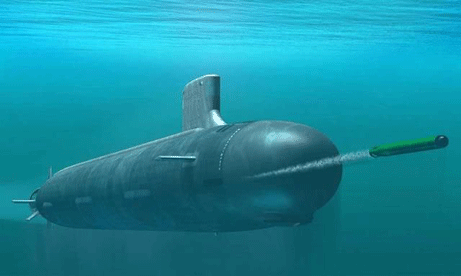
 Reactor incidents on new nuclear subs double in one year, Herald Scotland, 21 Feb 16 The Royal Navy’s new nuclear-powered submarines have been plagued by 69 safety incidents and “near misses” over the last four years.
The Astute class of submarines based at Faslane on the Clyde has seen reported reactor incidents at sea or on shore almost double from 12 in 2014 to 21 in 2015. Though the MoD insists that the incidents are all minor, critics warn that they undermine the boats’ reliability and safety………
According to the independent nuclear engineer John Large, the submarines were suffering serious problems. “This continuing experience of the Astute class reactor problems not only imperils the boats when at sea but is likely to result in cutbacks to the number of patrols, voyage durations and the extent of roaming of the high seas,” he said.
John Ainslie, coordinator of the Scottish Campaign for Nuclear Disarmament, pointed out that Astute submarines had been involved in a series of mishaps, including running aground on the Isle of Skye. “It is only a matter of time before one of these incidents results in a serious nuclear accident,” he said……..http://www.heraldscotland.com/news/14291467.Reactor_incidents_on_new_nuclear_subs_double_in_one_year/
February 22, 2016
Posted by Christina Macpherson |
incidents, UK |
Leave a comment
How American Penalties Dwarf the Liability US Nuclear Firms Will Face in India, The Wire BY AMIT BHANDARI, INDIASPEND.ORG ON 21/02/2016 A $48-billion (Rs 3.26 lakh crore) penalty claimed by the US government from Volkswagen for cheating on diesel-car emissions is about 200 times as large as the $225 million (Rs 1,500 crore) insurance pool set up by Indian insurance companies to compensate US nuclear companies for mishaps in India.
If a US nuclear company were to build a reactor in India that suffered a catastrophe, and people were to die in India, the US government’s position seems to be that American suppliers shouldn’t face . The US believes the Indian civil nuclear liability law, which calls for both penalties, is unduly harsh. Rather than say so directly, US officials keep repeating that the “Indian law is inconsistent with the international liability regime.”
The Indian civil nuclear liability law holds the equipment supplier responsible for any incident caused by the supplier or its employees. The Indian liability law differs from those of other countries because it was drafted keeping in mind the 1984 Bhopal tragedy – where despite 5,000 deaths and effects across generations, no one was held criminally liable.
The penalty demanded in the Volkswagen case is about 100 times the compensation of $470 million – ($907 million in 2014 dollars) – paid by US firm Union Carbide after the
Bhopal Gas tragedy, which also left 70,000 people maimed or injured. Volkswagen’s cover-up caused no injuries or deaths.
Although the Indian government wants to protect US nuclear companies against the Indian liability law, critics argued that these companies are using India’s eagerness to avoid any liability, if something goes wrong…….
Indian firms also fined in the US
While the US nuclear industry wants to avoid any liability in India for acts of omission or commission, Indian companies have often been slapped with large fines for violations of US law.
February 22, 2016
Posted by Christina Macpherson |
Legal, marketing, politics international |
Leave a comment
 Negotiations over establishment of Dabaa nuclear plant ongoing: Minister of Electricity, Daily News, Egypt, 21 Feb 16 Egyptian minister of Electricity and Renewable Energy, Mohamed Shaker, said the ministry is still negotiating with Russia’s Rosatom over technical, financial, and technological agreements to establish the first Egyptian nuclear power plant in the Dabaa area.
He told Daily News Egypt the Russian offer has better features than other offers from French, Chinese, and Korean companies. The offer includes providing nuclear fuel supply to the nuclear power plant throughout its operating period, which is estimated to be 60 years. In addition, it will be responsible for the management of spent nuclear fuel, operation and maintenance, and training human resources……http://www.dailynewsegypt.com/2016/02/21/negotiations-over-establishment-of-dabaa-nuclear-plant-ongoing-minister-of-electricity/
February 22, 2016
Posted by Christina Macpherson |
Egypt, marketing, Russia |
Leave a comment












 nuclear-news