The week to February 20, in Nuclear News
 UN ruling on Julian Assange, and Constitutional Law.
Paris terrorist attackers had planned to target Belgian nuclear reactors. Belgian terror suspect had video of high ranking nuclear official.
Stolen nuclear material in Iraq – risk of an Islamic State “dirty bomb”.
EUROPE is more than 118 billion euros short of funds needed to decommission its nuclear reactors.Limited liabilityfor Germany’s nuclear operators in nuclear phaseout.
BRITAIN’s nuclear project Hinkley Point C staggers again. UK public conned by vested interests into funding Trident nuclear weapons system.
Call on the British govt to hold a public enquiry on the murder of Hilda Murrell. The unsolved murder of Hilda Murrell, Anti-Nuclear Activist.
FRANCE: EDF in its financial woes, extends the life of four nuclear reactors. EDF dodges making a decision on UK Hinkley nuclear station. Defective pressure vessel could seal the tomb of the EPR nuclear reactor.
UKRAINE. Radiation causing Chernobyl’s wild animals to lose their sight.
JAPAN.
- 16 new child thyroid cancers confirmed in Fukushima’s children.
- Fukushima couple wins landmark case against TEPCO. Fukushima evacuees urged to individually file suits against TEPCO. 9,600 members of Fukushima plaintiff association suing Japanese govt and TEPCO.
- TEPCO Turning Off Radiation Monitors While Testing Contaminated Waste Incinerators. Fukushima’s nuclear waste problems piling up. More than 1,100 water storage tanks at Fukushima plant … and counting.
USA.
- St Louis underground fire moves closer to radioactive trash dump.
- Radioactive groundwater a difficult problem at Vermont Yankee nuclear site.
- Nuclear industry funded under the mask of “clean energy” – the Breakthrough Institute. USA Government quietly funding billionaires’ nuclear folly.
- Nuclear crooks prosper in USA.
- Moapa Band of Paiute Indians fear a nuclear waste dump being imposed at Yucca Mountain. Native Americans’water supply contaminated by uranium mining.
- US Energy Dept cites two companies for violations at Waste Isolation Pilot Plant (WIPP).
- Tennessee Valley Authority considers selling its unfinished Bellefonte Nuclear Plant. New nuclear reactors plan abandoned in Alabama.
- USA had nuclear weapons on Okinawa- declassified information, but everyone knew anyway.
CANADA Push to not just postpone nuclear waste burial near Great Lakes, but to stop it altogether. Official Canadian report reveals Fukushima radioactive iodine in rain reached West Coast of America.
INDIA . Corporate elites push their toxic nuclear products onto India
SOUTH AFRICA . President’s very proble
How to warn future generations about waste dumps? – Nuclear Semiotics
they established the field of nuclear semiotics……. an “atomic priesthood”

The message walls would have the faces as well as simple messages

Temple of Doom: How do we warn the future about nuclear waste?, Triple J Hack, by James Purtill, 19 Feb 16 This week the South Australian Royal Commission released “tentative findings” recommending the state take more than 100 tonnes of high-level radioactive waste and store it in the desert for hundreds of thousands of years.
……..If the facility goes ahead, the designers may consider a problem that has baffled linguists and semioticians (sign experts): how to tell the distant future don’t dig up the dump?
Atomic priesthoods and ‘ray cats’
In 1991, the Department of Environment hired linguists, scientists and anthropologists at a cost of about $1 million to answer what is basically a conundrum of labelling. How do you warn far-off civilisations or scattered bands of post-apocalyptic survivors that invisible beams of energy emanating from the earth could kill them, and this was not a trick, there’s no buried treasure?
The report runs to 351 pages and has the (rather dry) title: Expert Judgement on Markers to Deter Inadvertent Human Intrusion into the Wasteland Isolation Pilot Plant.
Here’s some of the problems they identified:
- Languages evolve too fast to communicate with the future: Few English speakers understand Old English, which was spoken about 1000 years ago.
- The meanings of symbols is too ambiguous: For example, the physicist Carl Sagan was invited to join the researchers, couldn’t make it, and wrote to suggest they simply use the skull-and-crossbones symbol to signify danger. But this symbol has only been current for a few hundred years, has meant ‘poison’ for the last 100, and is no longer very threatening. It’s on ‘pirate theme’ drink bottles.
- Even if they understand the warnings, future trespassers might not believe them. Curses associated with the burial sites of the Egyptian Pharaohs did not deter grave robbers.
In 1981 the Department of Energy assembled a gun team of engineers, anthropologists, nuclear physicists, and science fiction authors to figure out how to prevent future access to a proposed deep geological repository at a place called Yucca Mountain in Nevada.
They were known as the Human Interference Task Force and they established the field of nuclear semiotics.
One of the team suggested creating an “artificial myth” that a certain area was dangerous and should be avoided. There was no need to explain radioactivity, but just convince people it was dangerous and they should avoid the place.
But how to ensure the myth was preserved? He suggested “a commission, relatively independent of future political currents, self-selective in membership, using whatever devices for enforcement at its disposal, including those of a folkloristic character.”
This effectively meant, he admitted, an “atomic priesthood”……….
‘This place is not a place of honour’
The 1990s study for WIPP eschewed ray cats and atomic priesthood in favour of gargantuan architecture, message walls in many languages, and faces contorted in expressions of pain and sickness.
The names of the enormous earthworks proposals are evocative: ‘landscape of thorns’, ‘black hole’, and ‘rubble landscape’, ‘forbidding blocks’ and ‘menacing earthworks’, ‘leaning stone spikes’ and ‘spike field’. There are animated versions of these designs in the documentary Contamination.
The message walls would have the faces as well as simple messages in the six languages of the United Nations (Arabic, English, Spanish, French, Russian, and Chinese), as well as Navajo. There would be a blank area for the message to be inscribed in another language when these other seven languages grow too ancient “to read comfortably”.
The authors boiled down what they wanted to tell the future to key points, including:
Though it may have been discredited, nuclear semiotics has entered the popular imagination through movies like Alien, Mad Max, The Road, Terminator and even Waterworld.
If the South Australian repository goes ahead, it’s likely it will play into public debate.
It popped up in Finland with the 2010 feature documentary film Into Eternity, about the construction of the country’s new deep geological repository.
These visions of hell – landscape of thorns and walls of screaming faces – are a graphic representation of the fear inspired by nuclear waste, but also of the need to find the safest possible repository.
A potential ‘scare campaign’ cuts both ways.
Most of the world’s high level nuclear waste is currently stored above ground in thick steel and concrete casks. Some say a relay system of these casks will be sufficient.
“The problem I see with dry casks technically is they last for some decades, maybe for 100 years even, but at some point they fall apart and we have to change out the waste into other casks,” says Macfarlane.
“The problem is you’re not sure of the control of this material. You can make the assumption you’re going to have caretaker governments like we have now in the US and Australia, and they’re going to monitor and make sure these don’t leak.”
“But do we have any guarantee of it?
“The institutional control side of things is unknown.”
Temporary storage is only as good as the government responsible for monitoring and upkeep. And as nuclear semiotics proves, you can’t predict the future. http://www.abc.net.au/triplej/programs/hack/temple-of-doom-how-do-we-warn-the-future-about-nuclear-waste/7181278
Britain’s nuclear project Hinkley Point C staggers again
 U.K.’s Nuclear Project Falters Again http://www.truthdig.com/report/item/uks_nuclear_project_falters_again_20160219 Feb 19, 2016 By Paul Brown / Climate News Network This Creative Commons-licensed piece first appeared at Climate News Network.
LONDON—The future of the nuclear industry in Europe took another blow this week when the French state-owned power company EDF again postponed a final decision on whether to build two large nuclear power stations in the UK. Construction will now not start before 2019, the company said.
This is the eighth time a “final investment decision” on building two European Pressurised Water Reactors (EPRs) has been postponed because the company has still to secure enough backing to finance the £18 billion (€23.26 bn) project.
The excuse this time was that the Chinese New Year celebrations had held up negotiations with the Chinese backers, who have agreed to put up one-third of the money.
Preparation of the site at Hinkley Point in the west of England was stopped last year while EDF sought partners for the project. Each time there has been a postponement the company has issued a statement saying it remains “fully committed” to building two 1,650 MW reactors (1 MW is enough to power 750-1,000 average US homes).
Decision close
This week was no different. “We have the intention to proceed rapidly with the investment decision for Hinkley Point,” EDF’s chief executive Jean-Bernard Levy told reporters. Adding that EDF had not yet finalised talks with its Chinese partners, he said: “Today we estimate this final decision is very close.”
Levy said it would take about three years, possibly a bit more, of study and work with sub-contractors before EDF will begin building the first permanent structures on the Hinkley Point C site, though it will do preparatory work between now and then.
“Definitive construction of what will be built on the site, what we call the first concrete, is on the horizon for 2019,” Levy said.
This date is a year after the reactors were originally due to be completed. The timetable has gradually slipped backwards. Last year the date for power to start being generated was put back to 2025, but this new date for pouring concrete makes 2030 more likely—if the reactors are built at all.
Problematic record
The new proposed start date of 2019 is very significant for reasons the company dare not spell out. This is because there is no evidence yet that these so-called Evolutionary Power Reactors will operate effectively. Four are under construction, but are years behind schedule, and costs have tripled. In Europe their earliest proposed start date is 2018—so it looks as though EDF is being careful not to begin building another one until it can prove the design actually works.
The EPRs are “third generation European Pressurised Water Reactors”—the largest nuclear plants in the world. They have a chequered history, even before any has actually produced a single watt of electricity. Construction of the first prototype began in 2005 in Finland: expected to be finished in 2009, it is still under construction.
The same is true of the second, at Flamanville in France, where construction began in 2007. It has also hit delays and cost over-runs of staggering proportions. It too is due to start in 2018.
The other two EPRs are being built in China. Both should have been in operation by this year, but both also have undergone unspecified delays.
Safety question
The biggest problem for EDF, which owns and is building the Flamanville reactor, is that there are safety issues over the strength of the steel used to build the pressure vessel. It contained too much carbon and is undergoing stress testing to see if it is safe. While the outcome of these tests remains unknown, a question mark hangs over the station’s future.
This, plus the vast amount of remedial safety work required by the French safety regulators from EDF on its fleet of 58 ageing reactors in France itself, has put the company under severe financial strain. It needs to find €100 bn for repairs, and to improve safety following the Fukushima disaster in Japan, to keep the plants operating until 2030.
As a result of fears that the company might overstretch itself and jeopardise jobs in France the six trade union representatives on EDF’s board have expressed opposition to the company going ahead with building reactors on British soil.
Unfilled gap
This further postponement of a start date for the new reactors leaves the UK government with a gaping hole in its energy policy, despite it offering to pay double the existing price of electricity for the output from Hinkley Point, a subsidy that will continue for 35 years.
The Conservative government has been relying on nuclear energy to replace fossil fuels from 2025, when it plans to phase out all its coal stations. Some renewable energy subsidies have been scrapped to make way for new nuclear stations.
In all, the Conservative government wants ten new nuclear stations in the UK—four EPRs and the rest from Japan and the US. None of these now seems likely to be built before 2030, if at all.
Perhaps to divert attention from the postponement of the new reactors, EDF announced that it was going to extend the life of four of the nuclear power stations it already operates in Britain. It bought eight ageing stations of British design in 2009 for £12.5 billion.
Longer lives
Some were already due to close in 2018 but have had their lives extended. Now another four will be kept open to bridge the gap left by the failure to build the new stations at Hinkley Point.
These are the Heysham 1 plant in northwest England and another at Hartlepool in the northeast, both of which had been due to be switched off in 2019 because of their advanced age. They will be allowed to keep producing electricity for another five years.
Two other reactors, Heysham 2 and Torness in Scotland, have been granted extensions of seven years to 2030. There is no reason—as long as the stations are deemed safe – why further life extensions should not be applied for, and granted.
Continuing to apply for life extensions for old nuclear stations also saves the company from technical bankruptcy. Once a station is closed its decommissioning costs become company liabilities. With the company’s debts already high, it would not take many closures for EDF’s liabilities to exceed its assets.
Paul Brown, a founding editor of Climate News Network, is a former environment correspondent of The Guardian newspaper, and still writes columns for the paper.
Radioactive groundwater a difficult problem at Vermont Yankee nuclear site

 ENTERGY GRAPPLES WITH GROUNDWATER INFILTRATION AT VERMONT YANKEE, VT Digger [good photos] FEB. 18, 2016, BY MIKE FAHER “……….Vermont Yankee stopped power production in December 2014, and the NRC last year removed its resident inspector from the site. But the federal agency has continued periodic inspections, and the groundwater issue first surfaced in the NRC’s fourth-quarter report released in January.
That document says that “radioactive water inventories were increasing due mainly to the intrusion of groundwater.” Officials wrote that Entergy had been considering options both to stem the flow of groundwater and to eventually dispose of it.
After the inspection report was released, Sheehan said the problem is occurring on the lowest level of the plant’s turbine building. Groundwater intrusion has been averaging a few hundred gallons daily, Sheehan said, but there had been “occasional spikes” that on one day rose to 1,500 gallons.
Entergy has a water-management plan and has been pumping and storing groundwater, which is considered contaminated due to its contact with the building. In early February, a total of 90,000 gallons had been collected.
Groundwater intrusion was anticipated and in some ways is a symptom of the plant’s shutdown, since heat from power generation previously had caused some of the liquid to evaporate. But officials said they had not expected so much water to arrive so quickly……..
Regardless of any short-term storage solutions, Entergy must come up with a plan for getting radioactive water off the property eventually. And that plan stretches beyond the groundwater issue, as the NRC has said there are more than 1 million gallons of water at Vermont Yankee including liquid stored in a large, donut-shaped reservoir at the base of the reactor building.
Entergy has requested NRC approval to ship about 200,000 gallons of radioactive water to Idaho for disposal. There also has been preliminary talk of possible discharges into the Connecticut River, though any such plan would come under intense scrutiny by state regulators.
Sheehan said Thursday that the NRC is still “awaiting additional information from Entergy on its broader plans for addressing radioactive water at the site.”……http://vtdigger.org/2016/02/18/entergy-stores-contaminated-vermont-yankee-water-in-swimming-pools/
Nuclear wastes will outlast the repositories by thousands of years!
Temple of Doom: How do we warn the future about nuclear waste?, Triple J Hack, by James Purtill, 19 Feb 16 “…….This week the South Australian Royal Commission released “tentative findings” recommending the state take more than 100 tonnes of high-level radioactive waste and store it in the desert for hundreds of thousands of years…….
Finland is building the world’s first deep underground repository for high level nuclear waste and Sweden is close behind. The Finnish site is scheduled for completion in 2023.
A better example of the kind of repository proposed for South Australian is the United States’ Waste Isolation Pilot Plant (WIPP), deep in the New Mexico desert. It’s the only working long-lived nuclear waste repository in the world. It holds barrels of gloves and masks and machines and bomb parts contaminated by nuclear testing. The site is designed to last for 10,000 years.
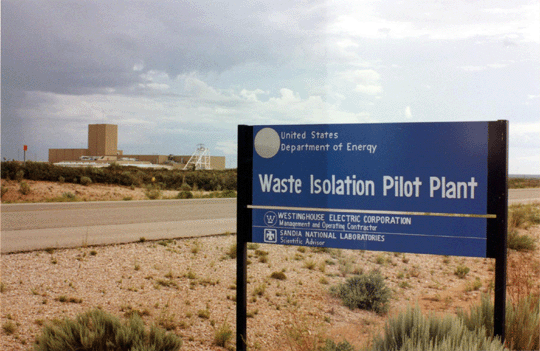
WIPP is scheduled to close in the 2040s. It will be sealed up and left alone. Centuries will pass and become millennia. On the surface, civilisations will rise and fall.
China, the world’s oldest continuous civilisation, stretches back about 5,000 years. The world’s oldest inscribed clay tablets date from about the same time.
 The half-life of plutonium-239, which can produce fatal radiation doses during short periods of direct exposure, is 24,000 years – the time it takes to decay to half its level of radioactivity. In 10 times that period, or 240,000 years, it decays to uranium-234, which is fairly harmless.
Homo sapiens began to evolve about 200,000 years ago………..http://www.abc.net.au/triplej/programs/hack/temple-of-doom-how-do-we-warn-the-future-about-nuclear-waste/7181278
Fukushima evacuees urged to individually file suits against TEPCO

 Lawyer urges Fukushima evacuees to individually file suits against TEPCO, Mainichi, 19 Feb 16— A Kyoto District Court ruling on Feb. 18 that ordered Tokyo Electric Power Co. (TEPCO) to pay a man in his 40s and his family redress for damages due to voluntary evacuation has drawn mixed reactions from voluntary evacuees and other parties. The ruling marked the first time that TEPCO, the operator of the disaster-stricken Fukushima No. 1 Nuclear Power Plant, was deemed responsible for damages stemming from voluntary evacuation by local residents……..
Evacuees from the Fukushima nuclear disaster have filed class action lawsuits across the country. Akiko Morimatsu, 42, co-leader of a national coalition of groups of plaintiffs in Fukushima nuclear disaster lawsuits, fled from Koriyama to Osaka with her two children. She says, ”The ruling is epoch-making for ordering a far bigger amount of compensation than the ADR norms by taking individual circumstances of voluntary evacuees into consideration. If many people raise their voices in the future, the reality of damages will come to light more clearly.”
But she expressed her displeasure with the ruling in that it limited the reasonable period of voluntary evacuation to the end of August in 2012, saying, ”It’s wrong because it’s based on government propaganda.” The ruling reflects a decision by the governmental Dispute Reconciliation Committee for Nuclear Damage Compensation to set the deadline for local residents to continuously evacuate rationally, arguing there was not enough information about dangers from the nuclear disaster up until that deadline.
Violation notices issued to Nuclear Waste Partnership and Los Alamos National Security
Department of Energy Cites Nuclear Waste Partnership, LLC and Los Alamos National Security, LLC for Violations Related to Worker Safety and Health and Nuclear Safety Energy.Gov 19 Feb 16 WASHINGTON, D.C. – The U.S. Department of Energy (DOE) today issued a Preliminary Notice of Violation (PNOV) to Nuclear Waste Partnership, LLC (NWP) for violations of DOE worker safety and health and nuclear safety requirements. Concurrently, DOE’s National Nuclear Security Administration (NNSA) issued a PNOV to Los Alamos National Security, LLC (LANS) for violations of DOE’s nuclear safety requirements. Issuance of these PNOVs marks the completion of DOE’s investigations and enforcement process regarding two events in 2014 at DOE’s Waste Isolation Pilot Plant (WIPP).
NWP is the management and operating contractor for WIPP, located in Carlsbad, New Mexico. LANS is the management and operating contractor for NNSA’s Los Alamos National Laboratory (LANL), located in Los Alamos, New Mexico. Worker safety and health and nuclear safety are priorities for the Department, and DOE’s enforcement program, implemented by the Office of Enterprise Assessments’ Office of Enforcement on behalf of the Secretary of Energy, supports these priorities by holding contractors accountable for meeting regulatory requirements and maintaining a safe and healthy workplace.
The violations by NWP at WIPP are associated with two events that occurred in February 2014. The first event involved a fire in a salt haul truck in the WIPP underground, and the second event involved a radiological release. The violations by LANS at LANL are associated with processes used by LANS to package and remediate transuranic waste drums, one of which has been linked to the WIPP radiological release.
The NWP PNOV cites four Severity Level I violations and seven Severity Level II violations related to worker safety and health and nuclear safety requirements enforceable under Title 10 C.F.R. § 851, Worker Safety and Health Program; 10 C.F.R. § 820.11, Information requirements; 10 C.F.R. § 830, Nuclear Safety Management, and 10 C.F.R. § 835, Occupational Radiation Protection. The LANS PNOV cites two Severity Level I violations and two Severity Level II violations related to nuclear safety requirements enforceable under 10 C.F.R. § 830.
In FY 2014, actions taken by DOE and NWP’s inability to earn fee resulted in NWP failing to receive 93 percent of the available fee, or approximately $7.6 million. NNSA reduced the total contract fee that was awarded to LANS by more than 90 percent, or approximately $57 million, with most of this reduction due to deficiencies in the processing and handling of transuranic waste and the resultant impact on operations at WIPP. NNSA also reduced the potential length of the LANS contract by a total of 2 years. Due to these significant adverse contract and fee actions taken against NWP and LANS, DOE is proposing no civil penalties for the violations cited in the two PNOVs………..http://energy.gov/articles/department-energy-cites-nuclear-waste-partnership-llc-and-los-alamos-national-security-llc
With energy storage renewables now have the lead over fossil fuel and nuclear energy
 Energy storage gives renewables a jump-start Independent Australia, David Suzuki 20 February 2016, Given the speed at which technology and inventions are advancing, it’s a no-brainer to see that the barriers to a clean energy shift are more political and psychological than technological, argues Dr David Suzuki.
REMOTE AUSTRALIAN communities often use diesel generators for power. They’re expensive to run and emit pollution and greenhouse gases. Even people who don’t rely entirely on generators use Australia’s power grid, which is mostly fuelled by polluting, climate-altering coal.
Now, one company is showing that supplying Australia’s energy needn’t be expensive or polluting.
AllGrid Energy produces 10 kilowatt-hour solar-power batteries that take advantage of Australia’s abundant sunlight and growing demand for solar panels. Their lead-acid gel battery is less expensive than Tesla’s lithium Powerwall, also available in Australia.
Many AllGrid systems are sold in indigenous communities, providing affordable energy independence.
It’s an example of the rapid pace of renewable energy development — one that clears a hurdle previously confronting many clean-energy technologies: their variable nature. One advantage of fossil fuels is that they’re both source and storage for energy; renewables such as wind and solar are only sources.
Many argue that because solar and wind energy only work when sun shines or winds blow, and output varies according to cloud cover, wind speed and other factors, they can’t replace large “baseload” sources like coal, oil, gas and nuclear.
But batteries and other energy storage methods, along with power-grid improvements, make renewables competitive with fossil fuels and nuclear power — and often better in terms of reliability, efficiency and affordability.
With storage and grid technologies advancing daily, renewable energy could easily and relatively quickly replace most fossil fuel–generated electricity. In Canada, Ontario’s Independent Electricity System Operator contracted five companies to test a number of storage systems, including batteries, hydrogen storage, kinetic flywheels and thermal systems that store heat in special bricks.
Ontario is aiming to get about 50 per cent of its installed generating capacity from renewable sources by 2025……..
Because renewables don’t pollute or create greenhouse gas emissions, they also help lower costs for health care and the ever-increasing impacts of climate change. Although every energy source comes with consequences, the damage and risks from mining, processing, transporting and using coal, oil, bitumen and uranium, and from fracking and other extraction methods, are far greater than for clean energy.
And fossil fuels will eventually run out, becoming increasingly expensive, difficult to obtain, and ridden with conflict as scarcity grows. https://independentaustralia.net/environment/environment-display/energy-storage-gives-renewables-a-jump-start-,8692
Fukushima couple wins landmark case against TEPCO
Fukushima disaster: Tepco to pay couple in landmark damages case BBC News 19 Feb 16 A court in Japan has ordered the operator of the tsunami-hit Fukushima nuclear plant to compensate a couple who fled radiation, even though they lived outside the evacuation zone.
Tokyo Electric Power Company (Tepco) will pay 30m yen ($265,000; £185,00) for financial losses and poor health.
It is thought to be the first time Tepco has been found liable for people outside the mandatory evacuation area………Analysts say Thursday’s ruling could pave the way for many more compensation claims from such evacuees…….
The sum awarded to the couple, who have not been named but are in their 40s, is also far greater than the 11m yen proposed by a government-established centre to mediate settlements for compensation cases.
According to the written submission, the husband became depressed and developed pleurisy after the evacuation and their children were stigmatised for their association with the Fukushima nuclear disaster.
Tepco has already been embroiled in a number of compensation claims. In 2011, the government ordered Tokyo Electric to pay 1m yen to every family within 30km of the plant. http://www.bbc.com/news/world-asia-35610249
Summary of Australia’s Nuclear Fuel Chain Royal Commission Report
the waste-to-fuel fantasies of Senator Edwards and Ben Heard are dead and buried.
[Wastes storage] timeframes – 150 years in the U.S. report and 120 years in the Royal Commission study – are nothing compared to the lifespan of nuclear waste. It takes 300,000 years for high level waste to decay to the level of the original uranium ore. The Royal Commission report notes that spent nuclear fuel (high level nuclear waste) “requires isolation from the environment for many hundreds of thousands of years.”
the Waste Isolation Pilot Plant (WIPP) in the U.S. state of New Mexico. WIPP was closed in 2014 because of a chemical explosion which ruptured a nuclear waste barrel and resulted in 23 workers being exposed to radiation. Before WIPP opened, the government estimated one radiation release accident every 200,000 years. But there has been one radiation release accident in the first 15 years of operation of WIPP.
 The Royal Commission’s report is silent about WIPP. It is silent about the Asse repository in Germany, where massive water infiltration has led to the decision to exhume 126,000 barrels of radioactive waste. The report is silent about the fire at a radioactive waste repository in the U.S. state of Nevada last year. And the report is silent about many other problems with the nuclear industry that it should have squarely addressed
Summary of ‘Tentative Findings’ of SA Nuclear Fuel Cycle Royal Commission Friends of the Earth Australia, by Jim Green, national nuclear campaigner, Friends of the Earth 20 Feb 16 What does the report say?
In a nutshell, the Royal Commission is negative about almost all of the proposals it is asked to consider – but positive about the proposal to import high-level nuclear waste from nuclear power plants for disposal in South Australia. Continue reading
US Energy Dept cites two companies for violations at Waste Isolation Pilot Plant (WIPP)
Two Contractors Cited for Radioactive Release at Nuclear Waste Sites http://sputniknews.com/us/20160219/1035057063/us-nuclear-waste-contactors.html The companies responsible for nuclear waste are Nuclear Waste Partnership (NWP), which operates an Energy Department facility to store nuclear waste and Los Alamos National Security (LANS), the contractor that manages the nearby Los Alamos National Laboratory, according to the US Department of Energy.
“The violations by NWP… are associated with two events that occurred in February 2014. The first event involved a fire in a salt haul truck in the [waste storage facility] underground, and the second event involved a radiological release,” the release explained.
The violations by LANS are associated with the packaging of nuclear waste containers, according to the release.
The two events took place in February 2014 at the Energy Department’s Waste Isolation Pilot Plant, an underground storage facility at a 600 meter deep salt bed, the release explained. Both companies have already been heavily penalized, losing 90 percent of their fees.
In the second event ten days later, air monitors detected unusually high levels of radiation, later traced to an exploding barrel of nuclear waste from Los Alamos.
The storage facility has been closed for the past two years, but the Energy Department expects to reopen the plant later this year with improved safety measures, according to an earlier posting on the department’s website.
Los Alamos is best known as the site where the United States developed the atomic bombs dropped on Japan at the end of World War II. http://sputniknews.com/us/20160219/1035057063/us-nuclear-waste-contactors.html#ixzz40eL2SilO
USA had nuclear weapons on Okinawa- declassified information, but everyone knew anyway
“Fact of” Nuclear Weapons on Okinawa Declassified http://fas.org/blogs/secrecy/2016/02/okinawa-nuclear/ Feb.19, 2016 The Department of Defense revealed this week that “The fact that U.S. nuclear weapons were deployed on Okinawa prior to Okinawa’s reversion to Japan on May 15, 1972” has been declassified.
While this is indeed news concerning classification policy, it does not represent new information about Okinawa.
According to an existing Wikipedia entry, “Between 1954 and 1972, 19 different types of nuclear weapons were deployed in Okinawa, but with fewer than around 1,000 warheads at any one time” (citing research by Robert S. Norris, William M. Arkin and William Burr that was published in 1999 in the Bulletin of the Atomic Scientists). As often seems to be the case, declassification here followed disclosure, not the other way around.
If there is any revelation in the new DoD announcement, it is that this half-century-old historical information was still considered classified until now. As such, it has been an ongoing obstacle to the public release of records concerning the history of Okinawa and US-Japan relations.
Because this information had been classified as “Formerly Restricted Data” under the Atomic Energy Act rather than by executive order, its declassification required the concurrence of the Department of Defense, the Department of Energy, and (in this case) the Department of State. Any one of those agencies had the power to veto the decision to declassify, or to stymie it by simply refusing to participate.
Instead, the information was declassified as a result of a new procedure adopted by the Obama Administration to coordinate the review of nuclear weapons-related historical material that is no longer sensitive but that has remained classified under the Atomic Energy Act by default. The new procedure had been recommended by a 2012 report from the Public Interest Declassification Board, and was adopted by the White House-led Classification Reform Committee.
Also newly declassified and affirmed this week was “The fact that prior to the reversion of Okinawa to Japan that the U.S. Government conducted internal discussion, and discussions with Japanese government officials regarding the possible re-introduction of nuclear weapons onto Okinawa in the event of an emergency or crisis situation.”
Such individual declassification actions could go on indefinitely, since there are innumerable other “facts” whose continued classification cannot reasonably be justified by current circumstances. A more systemic effort to recalibrate national security classification policy government-wide is to be performed over the coming year
Update: The National Security Archive posted the first officially declassified document on nuclear weapons in Okinawa, which was released in response to its request. See Nuclear Weapons on Okinawa Declassified, February 19, 201
Tennessee Valley Authority considers selling its unfinished Bellefonte Nuclear Plant
Unfinished TVA nuclear plant may hit the selling block Ty West Managing editor Birmingham Business Journal, 19 Feb 16 An unfinished nuclear power plant in northeast Alabama could soon hit the open market.The Tennessee Valley Authority is considering a sale of its unfinished Bellefonte Nuclear Plant, which is located on a 1,600-acre site near Hollywood on the Tennessee River. Work on the plant started in 1974, but it was never completed or used as a nuclear plant.TVA said the site could be used for commercial, industrial or residential developments, but could also be used as a nuclear plant………http://www.bizjournals.com/nashville/blog/2016/02/unfinished-alabama-nuclear-plant-may-hit-the.html
Push to not just postpone nuclear waste burial near Great Lakes, but to stop it altogether
Critics want feds to kill nuclear-waste bunker after time extension sought http://www.metronews.ca/news/canada/2016/02/19/critics-want-feds-to-kill-nuclear-waste-bunker-after-time-extension-sought.html By: Colin Perkel The Canadian Press Published on
TORONTO — Groups opposed to the burial of nuclear waste near Lake Huron are calling on the federal government to kill a proposal for an underground storage bunker rather than ask for more information on the project.
In a statement Friday, one group said the environmental credibility of the new Liberal government under Justin Trudeau is at stake.
“It is unfortunate that the government is not listening to what the people and Great Lakes communities are telling them: to reject this plan,” said Beverly Fernandez with Stop the Great Lakes Nuclear Dump.
“No matter what process is followed, burying and abandoning radioactive nuclear waste in the Great Lakes Basin will always be a bad idea.”
The statement comes after the federal government said it needs more information before deciding whether to approve plans to build a giant underground storage bunker for nuclear waste near the Lake Huron shoreline.
That means a decision on the project, decried by scores of communities around or near the Great Lakes, will be delayed well beyond what had been a March 1 deadline.
A notice posted by the Canadian Environmental Assessment Agency says Environment Minister Catherine McKenna wants more details and further environmental studies for the proposed deep geologic repository near Kincardine, Ont.
A review panel last May had given the go-ahead, but a decision rests with the McKenna.
“The minister has requested that the proponent, Ontario Power Generation, provide additional information on three aspects of the environmental assessment: alternate locations for the project, cumulative environmental effects of the project, and an updated list of mitigation commitments for each identified adverse effect,” the notice reads.
“The minister’s request for information from the proponent has paused the timeline for an environmental assessment decision to be issued.”
A decision had been expected in September, but the former Conservative government extended the deadline to March 1 to allow for last fall’s federal election.
McKenna has now given the utility until April 18 to provide the environmental assessment agency with a schedule for fulfilling the information request. When she might make a decision is still to be determined.
Ontario Power Generation proposes to construct and operate the underground facility for the long-term management of radioactive waste at the Bruce nuclear site.
The proposal calls for hundreds of thousands of cubic metres of so-called low- and intermediate-level nuclear waste to be buried 680 metres underground in the bedrock.
Proponents argue the rock is geologically stable and would provide a hermetic seal to prevent any radioactivity reaching the lake about 1.2 kilometres away for tens of thousands of years.
However, almost 200 communities and environmental groups have argued that such a facility, despite OPG’s arguments, would be too risky given the proximity to Lake Huron. Any contamination, they say, could threaten drinking water for millions of people.
Lightening Scrammed Nuclear Reactor Loss of Cooling; Off For Weeks; On Again, Now OFF; USNRC Inspection


One month after a thunderstorm led to a scram, the US NRC announced that there had been a loss of cooling the next day (which could have led to a nuclear meltdown, if not corrected quickly enough) and promised investigation: “The plant was operating at full power when a lightning strike caused a momentary surge in the plant’s offsite power supply, triggering an unplanned shutdown. Operators subsequently took appropriate actions to place the plant in a safe shutdown condition. The following day, operational errors led to a one hour loss of shutdown cooling.
The purpose of this special inspection is to better understand the circumstances surrounding the loss of shutdown cooling, determine if operator response was appropriate…“http://www.nrc.gov/reading-rm/doc-collections/news/2016/16-002.iv.pdf See statement at bottom of our blog post.
Note that the Three Mile Island Nuclear Disaster was well underway within 2 hours (6 am) of the reactor trip and SCRAM (4 am)…
View original post 1,167 more words
1 This Month
Chernobyl: The Lost Tapes – A good documentary on Chernobyl on SBS available On Demand for the next 3 weeks– https://www.sbs.com.au/ondemand/tv-program/chernobyl-the-lost-tapes/2352741955560

of the week–London Campaign for Nuclear Disarmament

Tell the Ukrainian Government to Drop Prosecution of Peace Activist Yurii Sheliazhenko
To see nuclear-related stories in greater depth and intensity – go to https://nuclearinformation.wordpress.com
-
Archives
- April 2026 (126)
- March 2026 (251)
- February 2026 (268)
- January 2026 (308)
- December 2025 (358)
- November 2025 (359)
- October 2025 (376)
- September 2025 (257)
- August 2025 (319)
- July 2025 (230)
- June 2025 (348)
- May 2025 (261)
-
Categories
- 1
- 1 NUCLEAR ISSUES
- business and costs
- climate change
- culture and arts
- ENERGY
- environment
- health
- history
- indigenous issues
- Legal
- marketing of nuclear
- media
- opposition to nuclear
- PERSONAL STORIES
- politics
- politics international
- Religion and ethics
- safety
- secrets,lies and civil liberties
- spinbuster
- technology
- Uranium
- wastes
- weapons and war
- Women
- 2 WORLD
- ACTION
- AFRICA
- Atrocities
- AUSTRALIA
- Christina's notes
- Christina's themes
- culture and arts
- Events
- Fuk 2022
- Fuk 2023
- Fukushima 2017
- Fukushima 2018
- fukushima 2019
- Fukushima 2020
- Fukushima 2021
- general
- global warming
- Humour (God we need it)
- Nuclear
- RARE EARTHS
- Reference
- resources – print
- Resources -audiovicual
- Weekly Newsletter
- World
- World Nuclear
- YouTube
-
RSS
Entries RSS
Comments RSS
 nuclear-news