Scientific Investigation Into Fukushima Disaster’s Effect On Pacific Ocean,
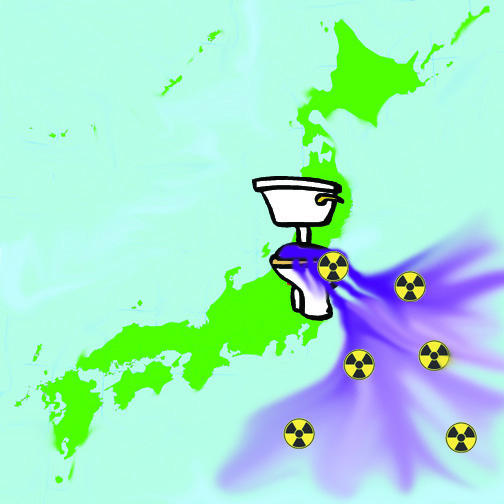 Clean Technica, February 26th, 2016 by Joshua S Hill Nearly five years after the Fukushima nuclear disaster, Greenpeace has launched a high-tech investigation into the radiation effects of the meltdowns on the Pacific Ocean. “…… Greenpeace Japan announced Thursday that it is conducting an underwater investigation into radiation contamination of the Pacific Ocean caused by the disaster. According to Greenpeace, the investigation will be conducted aboard a Japanese research vessel using a one of a kind Remotely Operated Vehicle fitted with a sensitive gamma radiation spectrometer and sediment sampler.
Mr Naoto Kan, the former Prime Minister of Japan and leader at the time of the nuclear accident, joined the crew of the Greenpeace Flagship, the Rainbow Warrior, on the opening day of the investigation, and called for a complete phase out of nuclear power.
“I once believed Japan’s advanced technology would prevent a nuclear accident like Chernobyl from happening in Japan,” said Mr. Kan. “But it did not, and I was faced with the very real crisis of having to evacuate about 50 million people at risk from the Fukushima Daiichi nuclear accident. I have since changed my mind. We do not need to take such a big risk. Instead we should shift to safer and cheaper renewable energy with potential business opportunities for our future generations.”
Since the disaster, the Tokyo Electric Power Company, which has maintained the plant, has produced over 1.4 million tonnes of radioactive contaminated water in an effort to cool down the three reactors that went critical. Furthermore, in addition to the initial release of liquid nuclear waste during the first weeks of the accident, and the daily releases ever since, contamination has also flowed from the land itself, particularly nearby forests and mountains of Fukushima, and are expected to continue to contaminate the Pacific Ocean for at least the next 300 years.
“The Fukushima disaster is the single largest release of radioactivity into the marine environment in history,” said Shaun Burnie, Senior Nuclear Specialist with Greenpeace Germany. “There is an urgent need to understand the impacts this contamination is having on the ocean, how radioactivity is both dispersing and concentrating and its implications.
“TEPCO failed to prevent a multiple reactor meltdown and five years later it’s still an ongoing disaster. It has no credible solution to the water crisis they created and is failing to prevent the further contamination of the Pacific Ocean.”
Greenpeace’s investigation will continue into March along the coast of the Fukushima prefecture, and will protrude into the 20 kilometer radius of the Fukushima Daiichi nuclear plant.
“There is still no end in sight for communities in Fukushima, many of whom can’t return home due to radiation contamination,” said Mamoru Sekiguchi, Energy Campaigner with Greenpeace Japan. “Rather than pushing for the restart of nuclear power, the Japanese government should put these people first and focus on managing the Fukushima Daiichi site. Many people in Japan have rejected nuclear power and are demanding the only safe and clean technology that can meet Japan’s needs – renewable energy.”
Shaun Burnie, Senior Nuclear Specialist with Greenpeace Germany, explained more about the crisis in a recent blog post, and the role that Greenpeace has played, and continues to play. http://cleantechnica.com/2016/02/26/greenpeace-launches-scientific-investigation-fukushima-disasters-effect-pacific-ocean/
No comments yet.
1 This Month


Tell the Ukrainian Government to Drop Prosecution of Peace Activist Yurii Sheliazhenko

Petition to revoke the licensing of the Near Surface Nuclear Disposal Facility (NSDF) at Chalk River. https://www.ourcommons.ca/petitions/en/Petition/Details?Petition=e-7247


of the week – STOP SMALL MODULAR REACTORS IN CANADA
To see nuclear-related stories in greater depth and intensity – go to https://nuclearinformation.wordpress.com
-
Archives
- March 2026 (204)
- February 2026 (268)
- January 2026 (308)
- December 2025 (358)
- November 2025 (359)
- October 2025 (376)
- September 2025 (258)
- August 2025 (319)
- July 2025 (230)
- June 2025 (348)
- May 2025 (261)
- April 2025 (305)
-
Categories
- 1
- 1 NUCLEAR ISSUES
- business and costs
- climate change
- culture and arts
- ENERGY
- environment
- health
- history
- indigenous issues
- Legal
- marketing of nuclear
- media
- opposition to nuclear
- PERSONAL STORIES
- politics
- politics international
- Religion and ethics
- safety
- secrets,lies and civil liberties
- spinbuster
- technology
- Uranium
- wastes
- weapons and war
- Women
- 2 WORLD
- ACTION
- AFRICA
- Atrocities
- AUSTRALIA
- Christina's notes
- Christina's themes
- culture and arts
- Events
- Fuk 2022
- Fuk 2023
- Fukushima 2017
- Fukushima 2018
- fukushima 2019
- Fukushima 2020
- Fukushima 2021
- general
- global warming
- Humour (God we need it)
- Nuclear
- RARE EARTHS
- Reference
- resources – print
- Resources -audiovicual
- Weekly Newsletter
- World
- World Nuclear
- YouTube
-
RSS
Entries RSS
Comments RSS
 nuclear-news
Leave a comment