TEPCO now burning thousands of radioactive work clothes
TEPCO begins burning radiation-tainted work clothes at Fukushima plant Asahi Shimbun, February 26, 2016 By HIROMI KUMAI/ Staff Writer OKUMA, Fukushima Prefecture--Tokyo Electric Power Co. has started to incinerate the thousands of boxes of lightly contaminated waste, including clothing used by workers, at the Fukushima No. 1 nuclear power plant to reduce the amount of tainted waste on the site.
TEPCO, the plant operator, fired up a special on-site incinerator on Feb. 25 to burn protective suits, gloves, socks and other work clothes worn by plant workers that became contaminated with low-level radiation.
The operation will reduce the amount of tainted work clothing accumulating at the plant during decommissioning operations since the nuclear disaster unfurled in March 2011. The garments cannot be processed outside the plant due to the radiation.
The clothing being incinerated are items with the lowest levels of contamination that have been stored in tens of thousands of 1 cubic-meter special boxes. The number of containers reached 66,000 at the end of last year…….http://ajw.asahi.com/article/0311disaster/fukushima/AJ201602260071
Germany’s nuclear utilities will have to transfer nuclear clean-up cash by 2022
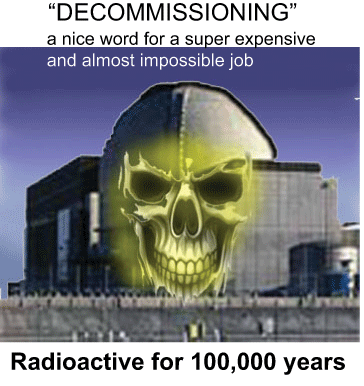 Nuclear commission proposes firms transfer cash by 2022 to pay for clean-up http://af.reuters.com/article/commoditiesNews/idAFB4N10000F
Mon Feb 22, 2016BERLIN Feb 22 (Reuters) – Germany’s utilities will have to transfer provisions set aside to pay for the interim and final storage of nuclear waste to a fund in cash by 2022, according to a draft report from a government-appointed committee seen by Reuters on Monday.
The report recommends that Germany’s “big four” utilities — E.ON, RWE, EnBW and Vattenfall — remain liable for the cost of up to double the 18 billion euros ($19.8 billion) allocated so far to pay for interim and final storage.
The companies will also have to set aside a further 1.3 billion euros in provisions, according to the report which is due to be presented at the end of the month. ($1 = 0.9084 euros) (Reporting by Markus Wacket; Writing by Caroline Copley; Editing by Christoph Steitz)
France promises more compensation to Pacific nuclear test victims
France pledges more compensation for Polynesia nuclear tests http://www.reuters.com/article/us-france-nuclear-idUSKCN0VV1XW, 28 Feb 16 PAPEETE, FRENCH POLYNESIA Residents of French Polynesia who suffered due to 30 years of French nuclear tests in the Pacific archipelago have a legitimate right to compensation, President Francois Hollande said on his first visit to the region on Monday.
The sensitive issue of reparations for damage caused by the atomic testing between 1966 and 1996 at Mururoa Atoll is top of the agenda of Hollande’s tour of French Pacific territories. “If France is what it is today, with this deterrent capability, it is because there were nuclear tests for a very long period,” he said on arrival in Papeete.
“It’s quite legitimate that France should make good for a number of consequences, whether social, health-related or economic,” he said in a joint news conference with Polynesian president Edouard Fritch.
Regional authorities say compensation approved by a 2010 law has been slow to arrive. An anti-nuclear pressure group said only 19 people, of whom just five Polynesians, had received payments.
An annual 150 million euro ($165.2 million) subsidy fixed when President Jacques Chirac ended nuclear tests in 1996 is set to shrink to 84 million euros this year.
Employers and trade unions that manage the regional health fund are demanding 450 million euros in costs for treating people they say are suffering from cancer due to radiation.
(Reporting by Daniel Pardon; Writing by Paul Taylor)
Growth of renewable energy rendering nuclear power obsolete
The End of the Nuclear Age, Handelsblatt, BY KLAUS STRATMANN, 28 Feb 16
Even before the Fukishima disaster, it was clear that nuclear power was dangerous, unreliable and too risky for civil use. The growth of renewable energy is now rendering them obsolete, argues Handelsblatt’s energy expert. The pictures from Fukushima are etched on the collective memory of mankind. They drastically changed the perception of civil use of nuclear power, especially in Germany.
And yet work continues on new nuclear reactors worldwide. Isn’t that paradoxical?
Five years after the reactor catastrophe caused by an earthquake, there are still unsolved problems at the site of the Japanese nuclear power station, underlining the fact that nuclear accidents render helpless even the most technically sophisticated societies.
To this day, there is still no convincing concept for the recovery of melted fuel rods in the destroyed reactors. Nor are there realistic estimates of the costs caused by the catastrophe. However, nobody seriously doubts that they will ultimately amount to a figure in the high triple-digit billions…..(registered readers only) https://global.handelsblatt.com/edition/375/ressort/opinion/article/end-of-the-nuclear-age
Crisis mode continues at Fukushima nuclear wreck
5 Years Later, the Fukushima Nuclear Disaster Site Continues to Spill Waste
The cleanup effort could take decades; meanwhile the amount of radioactive material the plant leaks grows, Scientific American By Madhusree Mukerjee on March 1, 2016 “……..
Today the disaster site remains in crisis mode. Former residents will not likely return anytime soon, because levels of radioactivity near their abodes remain high. Even more troublesome, the plant has yet to stop producing dangerous nuclear waste: its operator, the Tokyo Electric Power Company (TEPCO), currently circulates water through the three melted units to keep them cool—generating a relentless supply of radioactive water. To make matters worse, groundwater flowing from a hill behind the crippled plant now mingles with radioactive materials before heading into the sea.
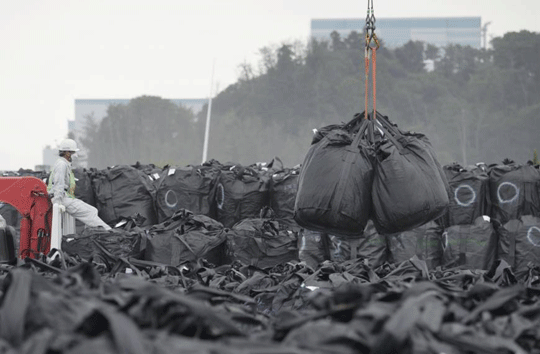
TEPCO collects the contaminated water and stores it all in massive tanks at the rate of up to 400 metric tons a day. Lately the water has been processed to reduce the concentration of radionuclides, but it still retains high concentrations of tritium, a radioactive isotope of hydrogen. Disputes over its final resting place remain unresolved. The same goes for the millions of bags of contaminated topsoil and other solid waste from the disaster, as well as the uranium fuel itself. Health reports, too, are worrisome. Scientists have seen an increase in thyroid cancers among the children who had lived in Fukushima at the time, although it is too early to tell if those cases can be attributed to the accident…….http://www.scientificamerican.com/article/5-years-later-the-fukushima-nuclear-disaster-site-continues-to-spill-waste/
Now more likely than ever – nuclear Armageddon
 Is nuclear Armageddon more likely than ever? Thye Week, 28 Feb 16 New weapons, unstable nations, and terrorism are raising the nuclear stakes. Is a doomsday attack more likely? Here’s everything you need to know about the new nuclear arms race:
How many nuclear weapons are there?
About 16,000. Russia and the U.S. have 93 percent of them, with more than 7,000 each; the rest are split between France, China, the U.K., Pakistan, India, Israel, and North Korea. The global stockpile is much smaller than it was at the height of the Cold War: In 1986, Russia and the U.S. had 64,000 nukes pointed at each other — enough to devastate every square inch of the entire globe. But there are growing fears that nuclear catastrophe is becoming increasingly likely. The established nuclear powers are modernizing their arsenals with smaller, more sophisticated weapons. The unstable regime in nuclear-armed North Korea is trying to develop a hydrogen bomb. ISIS, which is richer and more ambitious than any previous terrorist group, is trying to get hold of a nuclear device. The Doomsday Clock, the symbolic countdown to Armageddon, was last year moved from five minutes to midnight to three minutes. “We are facing nuclear dangers today that are in fact more likely to erupt into a nuclear conflict than during the Cold War,” says former Secretary of Defense William Perry……..
They’re becoming smaller and more advanced, and thus more likely to be used. Last fall, the U.S. Air Force tested its first precision-guided atom bomb, which can be remotely guided like a cruise missile to zero in on small targets. Its explosive power can be dialed up or down, from 50 kilotons to 0.3 kilotons. Critics argue that nuclear weapons should never be used as battlefield weapons — only as a deterrent. “What going smaller does,” says retired Gen. James Cartwright, “is make the weapon more thinkable.” Russia’s new weapons are also causing concerns. Last November, the Kremlin leaked plans for a nuclear torpedo designed to sneak under traditional nuclear defenses and hit cities or military installations along the coasts.
Could terrorists acquire a nuke?
It’s possible……. http://theweek.com/articles/608163/nuclear-armageddon-more-likely-than-ever
Russia and USA Pointing Nuclear Missiles at Asteroids – bonanza for Lockheed Martin etc
Why Is Russia Pointing Nuclear Missiles at Asteroids?Motley Fool 28 Feb 16
Surprise! Russia’s not the only one painting a bull’s-eye on space rocks. “…….Solid-fueled nuclear missiles, being on launch alert 24/7, are admirably suited for a last-minute launch to blast an asteroid before it turns into a meteor. Russia’s ICBMs aren’t currently programmed to aim at targets above the Earth, however, and will need to be repurposed for such missions. That’s what Russia hopes to do — and with Apophis swinging ’round in just over a decade, Russia thinks the asteroid makes a tempting target for testing its redesign.
Such an ambitious goal will cost money. Indeed, according to website DigitalTrends.com, “millions … in federal money is set to pour into detection efforts” over the coming years.National Defense magazine puts the number at at least $50 million annually, citing the recently passed fiscal year 2016 budget. This naturally raises the question in investors’ minds:
Who will get the loot?
ND identifies several likely suspects who could win these funds, including big defense contractors Lockheed Martin (NYSE:LMT) and Raytheon (NYSE:RTN). Lockheed is the company in charge of building NASA’s Space Fence, designed to keep track of man-made junk orbiting Earth. Lockheed and Raytheon both bid on the contract in 2013 — but only Lockheed won it. Similarly, Lockheed Martin and Ball Aerospace (NYSE:BLL) helped to build NASA’s NEOWISE infrared telescope,specifically designed to detect and track NEOs.
Multiple historic contract wins in the field of space-object detection make Lockheed Martin a logical beneficiary of any new contracts coming out of the PDCO office. Granted, $50 million might not sound like much to a company like Lockheed (which pulled down $46 billion last year, and is NASA’s single biggest publicly traded contractor). It might seem even less significant, given that Lockheed won’t win all the contracts coming up for bid, and might have to share some of the loot with Raytheon, Ball, or others. But $50 million could be only the starting point.
ND calls $50 million “a drop in the bucket” compared to what it will ultimately cost to categorize all NEO threats, much less develop a means of defeating them. To cite just one example of contracts moving in that direction, in 2022, NASA aims to send a spaceship to asteroid 65803 Didymous in an ambitious experiment to try to push the object into a new orbit far from Earth’s own………http://www.fool.com/investing/general/2016/02/28/why-russia-pointing-nuclear-missiles-at-asteroids.aspx
France prepared to extend life of nuclear reactors: energy minister
28 Feb 16 PARIS (Reuters) – The French government is willing to support a 10-year extension to the life of the country’s nuclear reactors, operated by utility EDF, Energy Minister Segolene Royal told France 3 television on Sunday……http://news.yahoo.com/france-prepared-extend-life-nuclear-reactors-energy-minister-140401525–finance.html
Big win for Rouhani and Reform in Iran elections
While gains by moderates and reformists in Friday’s polls were most evident in the capital, where they won all Tehran’s 30 seats according to early results, the sheer scale of the advances there suggests a legislature more friendly to the pragmatist Rouhani has emerged as a distinct possibility.
A loosening of control by the anti-Western hardliners who currently dominate the 290-seat parliament could strengthen his hand to open Iran further to foreign trade and investment following last year’s breakthrough nuclear deal.
A reformist-backed list of candidates aligned with Rouhani was on course to win all 30 parliamentary seats in Tehran, initial results released on Sunday showed. Top conservative candidate Gholamali Haddad Adel was set to lose his seat.
“The people showed their power once again and gave more credibility and strength to their elected government,” Rouhani said, adding he would work with anyone who won election to build a future for the industrialised, oil-exporting country.
“The competition is over and the phase of unity and cooperation has arrived,” state news agency IRNA quoted his key ally, Akbar Hashemi Rafsanjani, as saying. “The time after elections is the time for hard work to build the country”.
There was silence from the conservative camp.
The polls were seen by analysts as a potential turning point for Iran, where nearly 60 percent of its 80 million population is under 30 and eager to engage with the world following the lifting of most sanctions…..http://www.huffingtonpost.com/entry/rouhani-and-reformers-wins-big-in-first-irans-post-nuclear-deal-election_us_56d2e76ce4b0bf0dab326d46
1 This Month


Tell the Ukrainian Government to Drop Prosecution of Peace Activist Yurii Sheliazhenko

Petition to revoke the licensing of the Near Surface Nuclear Disposal Facility (NSDF) at Chalk River. https://www.ourcommons.ca/petitions/en/Petition/Details?Petition=e-7247


of the week – STOP SMALL MODULAR REACTORS IN CANADA
To see nuclear-related stories in greater depth and intensity – go to https://nuclearinformation.wordpress.com
-
Archives
- March 2026 (204)
- February 2026 (268)
- January 2026 (308)
- December 2025 (358)
- November 2025 (359)
- October 2025 (376)
- September 2025 (258)
- August 2025 (319)
- July 2025 (230)
- June 2025 (348)
- May 2025 (261)
- April 2025 (305)
-
Categories
- 1
- 1 NUCLEAR ISSUES
- business and costs
- climate change
- culture and arts
- ENERGY
- environment
- health
- history
- indigenous issues
- Legal
- marketing of nuclear
- media
- opposition to nuclear
- PERSONAL STORIES
- politics
- politics international
- Religion and ethics
- safety
- secrets,lies and civil liberties
- spinbuster
- technology
- Uranium
- wastes
- weapons and war
- Women
- 2 WORLD
- ACTION
- AFRICA
- Atrocities
- AUSTRALIA
- Christina's notes
- Christina's themes
- culture and arts
- Events
- Fuk 2022
- Fuk 2023
- Fukushima 2017
- Fukushima 2018
- fukushima 2019
- Fukushima 2020
- Fukushima 2021
- general
- global warming
- Humour (God we need it)
- Nuclear
- RARE EARTHS
- Reference
- resources – print
- Resources -audiovicual
- Weekly Newsletter
- World
- World Nuclear
- YouTube
-
RSS
Entries RSS
Comments RSS
 nuclear-news