Whistleblower Bob Rowen took on corporate nuclear power in the 1970s

 The Not-So-Peaceful Atom Bob Rowen accidentally took on corporate nuclear power in the 1970s. Four decades later he remembers what it was like to be Humboldt County’s most infamous whistleblower. North Coast Journal, BY JAPHET WEEKS, 20 MARCH 2008 On a summer day in 1969,Bob Rowen, a nuclear control technician at the Humboldt Bay nuclear power plant, realized that for his employer, Pacific Gas and Electric, the bottom line was everything — it was even more important than the community’s safety.
It wasn’t the first time Rowen, a burly former Marine, had witnessed safety violations at the plant, but it was the first time he had the gumption to record the violation in a logbook, which would eventually be reviewed by the nuclear industry’s then government watchdog the Atomic Energy Commission (AEC).
As for PG&E management, they were getting pretty fed up. Rowen was proving to be a real pain in the ass.
On Aug. 6, an 80-ton lead-shielded container arrived at the power plant to transport spent nuclear fuel across the country to New York State for reprocessing. The cask was placed into the plant’s spent fuel pool and spent fuel rods were secured inside. When it was lifted out, it was drenched in radioactive water, which had to be hosed off and the entire cask scrubbed down with alcohol and detergent so that it would be clean enough to ship. Problem was, no matter how hard the techs scrubbed, they kept getting readings that were way above the Department of Transportation radiation limits. They staggered their coffee breaks so that the decontamination process could go on non-stop. But even that wasn’t enough — the cask was still “crapped up.” In some places it gave readings of 4,000 to 6,000 disintegrations per minute per 100 square centimeters (more than twice the federal limit). At the seal, it read 20,000 per minute.
Holding the cask over for another day would have cost the company an extra $70,000. Rowen’s supervisor, Gail Allen, came up with a solution. He took samples from the cask using a very light touch and recorded measurements just outside the federal limit. Then he told Rowen to sign the release papers.
Shortly after doing so, Rowen recorded the incident in the plant’s radiation control log: “G. Allen asked Rowen to sign the release papers for the spent fuel shipping cask stating that the contamination level of the cask to be less than 2,200 disintegrations per minute, when in fact, they were greater than 2,600 disintegrations per minute ”
Rowen had worked his way quickly up the ranks at PG&E from a laborer to a nuclear control technician, the person responsible for maintaining the plant’s monitoring system. He didn’t realize it at the time, but by recording the shipping cask incident in the plant’s logbook, he had signed away a promising career in the nuclear industry and set off a chain of events that would end with his discharge from the company in 1970. In the eyes of his supervisors, Rowen would later reflect, his safety consciousness was tantamount to industrial sabotage. The local police would be called in to investigate him, and he and his so-called co-conspirators would be branded dissidents.
The day after the shipping cask incident, Plant Engineer Edgar Weeks called Rowen into his office. “I reminded [Rowen],” Weeks wrote in a confidential memo, cited in William Rodgers’ 1973 book on corporate malfeasance, Corporate Country, “that he had a responsibility to promote harmony, not disrupt it.”…….
“Anyone who criticized [PG&E] was criticizing America,” an older, wiser Rowen recalled last month.
The Humboldt Bay nuclear plant, which went live in 1963, was the first commercial boiling water reactor west of the Mississippi and therefore a test case for the industry. But only a year into the plant’s operation cracks had already begun to show in the stainless steel cladding that housed the nuclear fuel pellets. The plant produced electricity by heating water into steam, which drove a turbine — in newer, cleaner nuclear facilities, the steam that runs the turbine doesn’t come from water directly heated in the reactor core, but by water heated in a secondary loop…….
Rowen wasn’t on the job long before he started noticing inconsistencies between plant protocol and things he’d learned in the Marines, where he received nuclear weapons training. In particular he was confused by PG&E’s sanguine take on exposure to low-level radiation. Rowen copied down a passage from a PG&E textbook he’d been given when he started working. It read, “There is no evidence that shows that continuous low-level irradiation contributes any appreciable amount of life span shortening.” He contrasted that with a passage from a book he found at the Humboldt State University library, Radiation: What it is and how it affects you: “Small doses of radiation below the permissible levels produce significant though small depression of the white blood cell numbers. … Although the very small changes in blood-cell numbers do not seem to produce any immediate ill-effects, they may be the forerunners of anemia, leukemia, and other serious and fatal blood diseases.”
When Rowen brought this up at work, he was discouraged from pursuing the matter further. He just assumed that doing his job right entailed making the plant safer and cleaner. But as far as plant management was concerned, the take-charge attitude Rowen had learned as a Marine Pathfinder (a Green Beret-like unit) ought to be kept in check.
“I started to ask questions which were met with a lot of resistance,” Rowen said. “I never found a way to question anything with PG&E. There was the PG&E party line, and that was it.”
At the same time, the plant itself started coming apart almost as soon as it was built. Cracks in the reactor’s cladding meant that in 1965 the facility was releasing almost twice as much radioactive vapor per second as was permitted by the AEC (now known as the Nuclear Regulatory Commission). By 1966 the plant was operating at just 40 percent of rated capacity. Eventually, the cladding was replaced with a more expensive material, zircaloy, but not before radioactive vapor had already been spouted out the plant’s stacks and carried downwind to who knows where.
A public opinion poll from February 1956 showed that 69 percent of Americans had “no fear” of having a nuclear power plant located in their community. By 1978, things had changed drastically. A poll of college students and members of the League of Women Voters in Oregon were asked to rank thirty sources of risk “according to the present risk of death from each,” and both rated nuclear power as number one, more dangerous even than handguns, motorcycles and smoking.
What happened in the intervening two decades? Accidents at Three Mile Island and Chernobyl had yet to occur. The change in public opinion can be attributed in part to former employees of the nuclear industry like Bob Rowen, who, acting in the best interest of their community rather than their employer, went public with information about unsafe practices going on inside nuclear power plants…
The August 1969 incident with the lightly swabbed shipping cask was far from the first time Bob Rowen had noticed that plant management was habitually cutting corners……..
After he was fired, Rowen filed numerous allegations of safety violations at the power plant with the AEC. The agency, whose ranks were notoriously filled with former employees of power utilities, conducted their investigation and concluded that PG&E hadn’t done enough to make sure its employees weren’t being overexposed to radiation, that there was a potential for the contamination of the area’s domestic water system from the plant and that Rowen had been discouraged from talking to the AEC. Rowen described the probe as a “public whitewash and a utility wrist-slap.” http://www.northcoastjournal.com/humboldt/the-not-so-peaceful-atom/Content?oid=2126811
No comments yet.
1 This Month
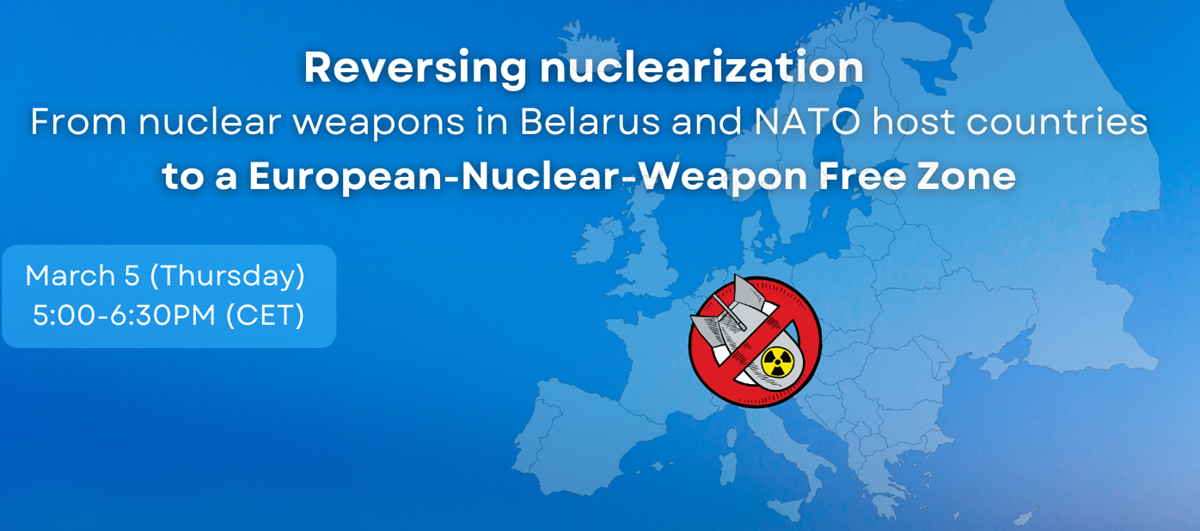
5 March -Online – Reversing nuclearization:
From nuclear weapons in Belarus and NATO host countries to a European-Nuclear-Weapon Free Zone
11am-12:30pm Eastern Time USA / 5pm-6:30pm CET

of the week – Advocating for a
nuclear free beach – https://www.samuellawrencefoundation.org/
The Samuel Lawrence Foundation advocates for a Nuclear Waste Free Beach at San Onofre, join us and take action!

10 March A LIVE WEBINAR THE REAL EFFECTS OF NUCLEAR POWER
What the Industry Isn’t Telling Us
1:00 PM Mountain, 2 pm Central, 3 pm Eastern. Live on the Keepers of the Water Facebook page

18 March Webinar @ 1 PM EST: An Assessment of SMR Projects: The Case of Canada
register for the zoom:
https://us02web.zoom.us/webinar/register/WN_o8BIIOUvQ2ONJR1nta65DQ#/registration

of the week – STOP SMALL MODULAR REACTORS IN CANADA
To see nuclear-related stories in greater depth and intensity – go to https://nuclearinformation.wordpress.com
-
Archives
- March 2026 (38)
- February 2026 (268)
- January 2026 (308)
- December 2025 (358)
- November 2025 (359)
- October 2025 (376)
- September 2025 (258)
- August 2025 (319)
- July 2025 (230)
- June 2025 (348)
- May 2025 (261)
- April 2025 (305)
-
Categories
- 1
- 1 NUCLEAR ISSUES
- business and costs
- climate change
- culture and arts
- ENERGY
- environment
- health
- history
- indigenous issues
- Legal
- marketing of nuclear
- media
- opposition to nuclear
- PERSONAL STORIES
- politics
- politics international
- Religion and ethics
- safety
- secrets,lies and civil liberties
- spinbuster
- technology
- Uranium
- wastes
- weapons and war
- Women
- 2 WORLD
- ACTION
- AFRICA
- Atrocities
- AUSTRALIA
- Christina's notes
- Christina's themes
- culture and arts
- Events
- Fuk 2022
- Fuk 2023
- Fukushima 2017
- Fukushima 2018
- fukushima 2019
- Fukushima 2020
- Fukushima 2021
- general
- global warming
- Humour (God we need it)
- Nuclear
- RARE EARTHS
- Reference
- resources – print
- Resources -audiovicual
- Weekly Newsletter
- World
- World Nuclear
- YouTube
-
RSS
Entries RSS
Comments RSS
 nuclear-news
Leave a comment