China’s nuclear fusion experiment – it’s still decades away from practical application
 Chinese Fusion Test Hits A Milestone By Creating 90 Million °F For 102 Seconds http://www.techworm.net/2016/02/chinese-fusion-test-hits-milestone-creating-90-million-f-102-seconds.html BY KAVITA IYER ON FEBRUARY 9, 2016
 Chinese scientists create record by hitting 90 Million °F For 102 Seconds which is three times hotter than the Sun
Scientists in China were able to heat plasma to three times the temperature of the core of our sun using nuclear fusion – a temperature of 90 million °F – for an impressive 102 seconds, as they continued their search to derive energy from nuclear fusion.
They have surpassed the nuclear fusion experimental device referred to as the Wendelstein 7-X (W7-X) stellerator developed by a team of German researchers from the Max Planck Institute that managed to heat hydrogen gas to 80 million degrees Celsius, and sustain a cloud of hydrogen plasma for a quarter of a second.
According to a statement on the institute’s website last Wednesday, the experiment was conducted on a magnetic fusion reactor at the Institute of Physical Science in Hefei, capital of Jiangsu province.
The experiments were carried out in a donut-shaped reactor, officially known as the Experimental Advanced Superconducting Tokamak (EAST). The reactor was able to heat a hydrogen gas – a hot ionised gas called plasma – to about 50 million Kelvins (49.999 million degrees Celsius). The interior of our sun is calculated to be around 15 million Kelvins.
The plasma can be contained by careful control of intense magnetic fields in a tight ring by running through the center of the donut’s circular cross section. In other words, the walls of the structure are never directly exposed to the high temperatures of the plasma.
For the long term goal of such fusion reactors, it is very necessary to make sure that those temperatures can be sustained for long period of time, as a huge input of energy is required to get them started. But, if they end up stopping too soon, the reaction is net negative in energy terms. Such high energies cause great instabilities making it difficult to confine them, as controlling such intense heat is tough. Therefore, it is a positive step indeed for running an experiment at such temperatures for 102 seconds.
It’s not the hottest temperature ever created on Earth. So far, the hottest temperature to have been created artificially in the lab remains that reached by the gargantuan Large Hadron Collider (LHC) at CERN, which managed to achieve temperatures of 4 trillion degrees Celsius back in 2012. However, those conditions last for the sheer flicker of time, which is inadequate for creating energy.
The ultimate goal of China’s team is to hit 100 million degrees Celsius now, and sustain the resulting hydrogen plasma for over 1,000 seconds, or 17 minutes. In the meantime, now that their ‘proof of concept’ experiment is out of the way, the German team says it could possibly sustain its plasma for as long as 30 minutes.
However, most scientists who are in agreement advocate that the long-yet-intense burn required for fusion needs to be around 180 million °F, which means we are likely decades away from actually connecting nuclear fusion to solve humanity’s energy problems.
New Texas nuclear reactors not going to happen anytime soon, despite Fed approval
 Feds approve new nuclear reactors near Houston Fuel Fix, February 9, 2016 | By Jordan Blum The federal government on Tuesday approved the construction of two new nuclear reactors at the South Texas Project nuclear plant southwest of Houston.
But the massive cost of the project coupled with cheap Texas power prices mean that NRG Energy and its partners have no plans to build the new nuclear reactors anytime soon, if at all.
The partnership is continuing to look for new U.S. investors to eventually move the stalled project forward, said NRG spokesman David Knox. NRG said five years ago it wasn’t investing any more money in the expansion. Near that time, NRG estimated the project would cost about $14 billion with financing……..
The potential expansion project is through the Nuclear Innovation North America, or NINA, which is 90 percent owned by NRG and 10 percent by Toshiba. NINA owns 92.4 percent of the expansion. NRG has sought additional partners in the expansion since CPS Energy, once a 50 percent partner, reduced its stake to 7.6 percent.
After several years of review, the Nuclear Regulatory Commission said Tuesday it approved the issuance of the licenses to build two new nuclear reactors. The plant in Matagorda County already has two reactors. The South Texas Project, one of two nuclear power plants in Texas, opened in 1988, but is still one of the nation’s newer nuclear plants.
The project previously faced delays in the wake of the 2011 Fukushima nuclear disaster in Japan. The NRC said Tuesday the new licenses would include the agency’s upgraded post-Fukushima safety requirements. http://fuelfix.com/blog/2016/02/09/feds-approve-new-nuclear-reactors-near-houston/
The decline of the South Carolina Mixed Oxide Fuel Fabrication (MOX) Nuclear Reprocessing Facility
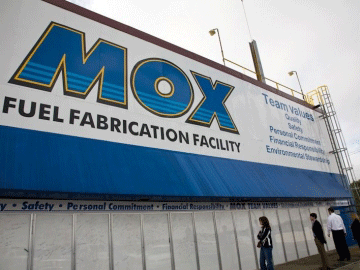 Half-Built Nuclear Fuel Plant in South Carolina Faces Test on Its Future, NYT, By JAMES RISEN FEB. 8, 2016 WASHINGTON — Time may finally be running out on the Mixed Oxide Fuel Fabrication Facility, a multibillion-dollar, over-budget federal project that has been hard to kill.
The Energy Department has already spent about $4.5 billion on the half-built plant near Aiken, S.C., designed to make commercial reactor fuel out of plutonium from nuclear bombs. New estimates place the ultimate cost of the facility at between $9.4 billion and $21 billion, and the outlay for the overall program, including related costs, could go as high as $30 billion.
Officials warn that the delays in the so-called MOX program are so bad that the plant may not be ready to turn the first warhead into fuel until 2040.
So in the budget that the Obama administration will present on Tuesday, the Energy Department proposes abandoning it. Energy officials want to spend only the money necessary to wind down the MOX program while the government shifts to a different method of disposing of the plutonium……..
The struggle is a case study in the difficulty of cutting unnecessary or wasteful federal programs, with the added twist that proponents of keeping the plant include some of the Republican Party’s most determined opponents of government spending, like Representative Joe Wilson, a South Carolina Republican whose district includes Aiken……..
Two companies involved with the plant’s construction are among Mr. Wilson’s biggest contributors, according to campaign records. Chicago Bridge and Iron, one of the two companies that own the main contractor for the facility, gave $10,000 to Mr. Wilson’s 2014 re-election campaign, and the other owner, Areva Group, donated $8,000, according to campaign records.
“Programs like this stay in the budget when they become jobs programs, and then senior members of Congress try to protect them, even if they have no redeeming value,” said David Hobson, a former Republican congressman from Ohio who said he tried and failed to kill the MOX program while he was in the House. “Where are all the budget hawks on this?”……..
The Obama administration has wanted to get rid of the program for years. In a budget request three years ago, it said the idea of making reactor fuel “may be unaffordable.” But Congress has repeatedly restored funding.
The plant is being built to comply with an agreement with Russia in 2000, when both countries said they would eliminate 34 metric tons of weapons-grade plutonium from their nuclear arsenals. Construction started during the George W. Bush administration, but has been plagued by long delays, cost overruns and little interest from commercial nuclear plants in buying the fuel that the plant was designed to produce.
Giving up on the plant means the administration will abandon plans to turn the weapons-grade plutonium into fuel for commercial nuclear reactors, and will instead switch to a process that dilutes the plutonium into nuclear waste.
The Energy Department would like to move that nuclear waste to a facility near Carlsbad, N.M., where it would be stored deep underground in salt formations. The administration says it can get rid of the weapons material under the alternative approach for about $300 million to $400 million a year, compared with $800 million to $1 billion a year under MOX………. http://www.nytimes.com/2016/02/09/us/politics/half-built-nuclear-fuel-plant-in-south-carolina-faces-test-on-its-future.html?_r=0
Busting the obsolete “baseload” myth, and other myths that hold back renewable energy

 nuClear News No 82 Feb 16 Towards 100% Renewables As Shadow Secretary of State for Energy and Climate Change, Lisa Nandy, re-iterates the myth that nuclear power is an “important as part of the energy mix [if] we’re going to meet the commitments we made in Paris” we investigate how the UK could move to a 100% renewable energy system. Although Nandy says she is not happy with the Hinkley deal she says “we know we will need nuclear power as part of the mix”, but is she right? (1)
Nuclear lobby’s “makeover” of the industry’s bad reputation
The Not-So-Peaceful Atom Bob Rowen accidentally took on corporate nuclear power in the 1970s. Four decades later he remembers what it was like to be Humboldt County’s most infamous whistleblower. North Coast Journal, BY JAPHET WEEKS, 20 MARCH 2008 “……….The makeover is industry-wide. Proponents of nuclear power are touting it as our natural next step, a clean, endless supply of energy. And they’ve latched onto fears of global warming and concerns over the skyrocketing price of oil to usher energy consumers into a new nuclear century. They also argue that today’s reactors are far cleaner and more economic than the dirty, atavistic behemoths of yore.
In their promotional materials, the Nuclear Energy Institute, the leading lobby group for the U.S. nuclear industry, points out that America’s nuclear reactors already produce 20 percent of the electricity we use, and according to the Department of Energy, electricity demand will rise 45 percent by 2030.
In another brochure aimed at debunking myths about radiation, one section header reads, “Radiation: Helping All of Us.” The brochure, which features a nuclear family of four watching the sunset at the beach cites the 1991 National Cancer Institute report, which indicates no increased rate of mortality in communities with nuclear power plants.
But Manetas and Welch don’t buy the hype. They argue that a lack of economic viability has and always will be one of nuclear power’s biggest drawbacks. A nuclear power plant is very expensive to build, Manetas said, and even more expensive to decommission. The Humboldt facility is a case in point. It cost $33 million to construct and he estimates the price tag for decommissioning to be around $380 million. Every nuclear facility across the country has a lifespan of about 30 years. Manetas argues that without significant subsidies from the U.S. government, nuclear power plants wouldn’t be able to break even.
There are also hidden costs to nuclear energy like dealing with the waste it produces as well as extracting and processing the uranium required to run the plants in the first place. “Eventually power plants would be cannibalizing themselves,” Manetas said, “producing just enough energy to produce more power plants.”
As open as PG&E has become over the years to the local community, Manetas is still concerned that “floating over that is cooperate PG&E.” The company owns and operates one of California’s two remaining nuclear power plants, the Diablo Canyon facility in San Luis Obispo.
How would someone like Bob Rowen expect to be treated at a nuclear power plant today? Manetas speculates that “his ability to whistle-blow and make that information public … is more viable in today’s environment.”
Still, Manetas warns that there is a nation-wide nuclear renaissance underway, and the zeitgeist could quickly change back to what it was when Rowen first started working at the Humboldt Bay nuclear power plant. That was a time when the nuclear industry was anxious to prove that their energy prices could compete with those of fossil fuel plants, and they had few qualms about silencing their naysayers. http://www.northcoastjournal.com/humboldt/the-not-so-peaceful-atom/Content?oid=2126811
Nuclear plant near New York leaks waste into three wells
Nuclear plant near New York leaks waste into three wells – making the water 65,000 per cent more radioactive than normal
- Indian Point nuclear power plant has leaked water contaminated with ‘alarming’ radioactive tritium into groundwater below facility
- Governor Andrew Cuomo has launched an investigation after learning about the levels of radioactivity at three monitoring wells
- Cuomo said the first concern is for ‘the health and safety of residents’
- Plant’s operator, Entergy Corp, said the tritium likely reached the ground at Indian Point during recent work at the site
- Entergy said contaminated water has not migrated off the site and poses no public health risk
- One well showed a nearly 65,000 per cent spike in radioactivity
North Korea rocket launch: UN Security Council condemns Pyongyang, vows ‘serious consequences’
The UN Security Council has strongly condemned North Korea’s rocket launch, saying it will speed up work on a sanctions resolution “in response to these dangerous and serious violations”.
http://www.abc.net.au/news/2016-02-08/un-security-council-condemns-north-korea-missile-launch/7147354
Should Georgia’s electricity customers get hit with the ballooning costs of Vogtle nuclear power plant?
 Are our Georgia Power bills set to be nuked? Feb. 8, 2016 By Matt Kempner – The Atlanta Journal-Constitution Warm up your checkbook and get your debit and credit cards ready. Reckoning day is coming on the most gigantic construction project in Georgia and, in particular, on its blown budget.
This spring the expansion of the Vogtle nuclear power plant near Augusta was supposed to be finished, with the first of two new reactors cranking out electricity for businesses and homes all over Georgia.
Not going to happen.
It’s not going to happen next year either. Best case at this point is that it will be more than three years late. And consultants for the state worry even that timeline is wishful thinking.
But elected state regulators – members of the Georgia Public Service Commission, which most Georgians probably don’t even know exists – recently decided it’s now time to try to figure out if customers of Georgia Power should be forced to swallow all the company’s costs, including what looks like at least $1.7 billion in higher-than-expected expenses. That could send monthly power bills up in years to come.
The alternative is that Georgia Power and its shareholders eat some or all of the overage.
Guess which option Georgia Power thinks is right?
Critics of the Vogtle project have for years demanded tough analysis of Vogtle spending, rather than waiting to do so when the project is essentially completed…….
Company executives didn’t like a column I wrote last year. Or an earlier news story about last-minute pay-for-performance changes that boosted bonuses for leaders at Georgia Power and parent Southern Company. Or a story showing how Georgia Power morphed from giving assurances about its original Vogtle cost projections to expressing surprise that anyone would be surprised by the project’s surging costs and delays.
Tough questions are reasonable and prudent. Let’s hope the PSC treats Vogtle costs as a topic worthy of rigorous scrutiny, not a way to try to bolster support for its past decisions.
Find Matt on Facebook (facebook.com/mattkempnercolumnist) and Twitter (@MattKempner) or email him atmkempner@ajc.com. http://www.myajc.com/news/business/are-our-georgia-power-bills-about-to-be-nuked/nqLhc/
NRC conducting ‘Special inspection’ at River Bend nuclear station
‘Special inspection’ underway at River Bend power plant http://www.wbrz.com/news/special-inspection-underway-at-river-bend-power-plant/ February 08, 2016 By: Hunter Robinson ST. FRANCISVILLE – The Nuclear Regulatory Commission announced they’ve begun a special inspection at the River Bend Station nuclear power plant following an unplanned shutdown of the reactor Jan. 9th.
According to a press released issued Monday, a lightning strike caused a “momentary surge” at the plant’s offsite power supply, forcing the shutdown. The NRC will be investigating onsite for a week and publish the results within the next 45 days.
This isn’t the plant’s first trouble with unplanned shutdowns. There were inspections following an unplanned shutdown of the reactor Christmas Day 2014 and another about three months later.
No need to rush for risky nuclear power while other climate options are better
The key to understand is that we have options in the transition to a low carbon economy and there’s no need to resort to the riskiest first. Indeed, the clean energy sector can be a economic bonanza: according to the Department of Energy, the U.S. solar workforce has increased 123 percentsince 2010 – and this is the third consecutive year of about 20 percent annual jobs growth in this sector.
There’s no need to continue to subsidize risky, proliferation-prone nuclear technology in a fight against climate change
 Don’t go nuclear on climate change just yet, The Hill, 9 Feb 16 “……A better understanding of the climate sensitivity to carbon emissions is crucial in making sensible policy decisions between the two types of risks at hand: the societal risks of from the man-made component of climate change versus the societal risks of any proposed solutions. No one wants the cure to be worse than the disease.
So do we just sit on our hands until we have more precise values for the climate sensitivity parameter? Certainly not – the large uncertainty of climate projections should not be an excuse for inaction. Quite apart from the issue of temperature increase due to carbon dioxide, there’s the additional problem of ocean acidification: Carbon dioxide dissolves in the ocean to make an acid which can degrade the ability of many marine organisms to make and maintain their shells and skeletons. Regardless of the temperature increase due to carbon emissions, ocean acidification could have potentially serious consequences for the entire marine ecosystem – and the humans that depend on it.
Luckily, there are several carbon mitigation strategies with few, if any, negative side-effects and these could be implemented right away while climate scientists work to refine their climate sensitivity estimates. For instance, a McKinsey study concluded that,“Energy efficiency offers a vast low-cost energy resource for the American economy….[A] holistic approach…is estimated to reduce end-use energy consumption in 2020 by…roughly 23 percent of the projected demand, potentially abating up to 1.1 gigatons of greenhouse gases annually”.
Residential and commercial buildings consume roughly 40 percent of the nation’s energy budget and there is enormous scope for making current and future building more efficient. Put another way, implementing strict energy efficiency standards alone could more than obviate the need for the 20 percent contribution nuclear power makes to the nation’s electricity budget.
Similarly, government policies could help boost the use of carbon capture and renewable energy sources like wind, hydro and solar which have few negative side effects and many upsides. Specifically, government policies could be tailored to help address the technological challengesfacing renewables: scale-up, storage, transmission, and backup capacity issues.
The key to understand is that we have options in the transition to a low carbon economy and there’s no need to resort to the riskiest first. Indeed, the clean energy sector can be a economic bonanza: according to the Department of Energy, the U.S. solar workforce has increased 123 percentsince 2010 – and this is the third consecutive year of about 20 percent annual jobs growth in this sector.
There’s no need to continue to subsidize risky, proliferation-prone 1960’s nuclear technology in a fight against climate change…….http://thehill.com/opinion/op-ed/268696-dont-go-nuclear-on-climate-change-just-yet
Creeping costs for Duke Energy’s proposed Lee Nuclear Station
Planning costs for Duke Energy’s Lee nuclear plant creep toward $500M, Charlotte Business Journal,
Feb 3, 2016, Duke Energy’s pre-construction costs for its proposed Lee Nuclear Station are creeping toward the half-billion dollar mark with no clear indication when the company will decide whether to go ahead and build the project.
From July through December, Charlotte-based Duke (NYSE:DUK) has spent more than $21.5 million on Lee. That brings total spending to more than $471.1 million on the project since it was announced in 2007.
Even at the greatly slowed pace of spending in the last couple of years, the project costs are on track to exceed $500 million before the end of this year.
Duke expects to get a combined construction and operating license for the $12 billion-plus project from the U.S. Nuclear Regulatory Commission this year. But the company has declined to put any deadline on when it will decide whether to build the project or when it might go to the S.C. Public Service Commission for state authority to proceed with the project, which would be built in Gaffney…….
Of the total spent since the project was announced, more than a third of it, almost $173.8 million, is interest expense……. http://www.bizjournals.com/charlotte/blog/energy/2016/02/planning-costs-for-lee-nuclear-plant-creep-toward.html
1 This Month


Tell the Ukrainian Government to Drop Prosecution of Peace Activist Yurii Sheliazhenko

Petition to revoke the licensing of the Near Surface Nuclear Disposal Facility (NSDF) at Chalk River. https://www.ourcommons.ca/petitions/en/Petition/Details?Petition=e-7247


of the week – STOP SMALL MODULAR REACTORS IN CANADA
To see nuclear-related stories in greater depth and intensity – go to https://nuclearinformation.wordpress.com
-
Archives
- March 2026 (193)
- February 2026 (268)
- January 2026 (308)
- December 2025 (358)
- November 2025 (359)
- October 2025 (376)
- September 2025 (258)
- August 2025 (319)
- July 2025 (230)
- June 2025 (348)
- May 2025 (261)
- April 2025 (305)
-
Categories
- 1
- 1 NUCLEAR ISSUES
- business and costs
- climate change
- culture and arts
- ENERGY
- environment
- health
- history
- indigenous issues
- Legal
- marketing of nuclear
- media
- opposition to nuclear
- PERSONAL STORIES
- politics
- politics international
- Religion and ethics
- safety
- secrets,lies and civil liberties
- spinbuster
- technology
- Uranium
- wastes
- weapons and war
- Women
- 2 WORLD
- ACTION
- AFRICA
- Atrocities
- AUSTRALIA
- Christina's notes
- Christina's themes
- culture and arts
- Events
- Fuk 2022
- Fuk 2023
- Fukushima 2017
- Fukushima 2018
- fukushima 2019
- Fukushima 2020
- Fukushima 2021
- general
- global warming
- Humour (God we need it)
- Nuclear
- RARE EARTHS
- Reference
- resources – print
- Resources -audiovicual
- Weekly Newsletter
- World
- World Nuclear
- YouTube
-
RSS
Entries RSS
Comments RSS
 nuclear-news