Hinkley Nuclear Project: trials and Tribulations Continue, and EDF is in dire financial straits
 nuClear News, No 82 Feb 2016, Hinkley’s Troubles Continue The resignation of the man in charge of building Hinkley Point C capped a month of very bad news for the proposed £18bn nuclear power plant. Chris Bakken announced that he would be returning home to the US to take up the post of chief nuclear officer for Entergy beginning on April 6 to “spend more time with his family.”
Massachusetts snowstorm causes Pilgrim nuclear station to be shut down
ENTERGY’S PILGRIM NUCLEAR POWER PLANT IS SHUT AS SNOWSTORM ENVELOPS MASSACHUSETTS, –Jim Ostroff, james.ostroff@platts.com Washington (Platts)–8 Feb 2016 Operators at Entergy’s 728-MW Pilgrim nuclear plant in Plymouth, Massachusetts, shut the unit early Monday morning as a precautionary measure, while a snowstorm swept through the state, a plant spokesman said.
The unit was operating at 12% of capacity just prior to being shut, according to the US Nuclear Regulatory Commission’s daily reactor status report Monday.
O’Brien declined to estimate when Pilgrim will restart and return to 100% capacity, saying this information “is market sensitive.”…(subscibers only ) http://www.platts.com/latest-news/electric-power/washington/entergys-pilgrim-nuclear-power-plant-is-shut-21901806?hootpostid=28068bc08898fb813f66296f084ba47f
Armed transport ships spotted in Panama Canal, headed for secret mission to later transport plutonium
 UK-Flagged Ships Set to Transport Plutonium from Japan to US Located in Panama Canal http://www.srswatch.org/uploads/2/7/5/8/27584045/srsw_news_on_plutonim_ships_in_canal_feb_6_2016.pdf Ships on Secret Mission to Carry 331 Kilograms of Plutonium to US DOE’s Savannah River Site in South Carolina as Part of Nuclear Security Summit Preparation; Plutonium to be Stranded at SRS
5,300 tons of Fukushima radioactive trash dumped in 5 prefectures
 5,300 tons of radioactive wood waste taken into 5 prefectures besides Shiga http://mainichi.jp/english/articles/20160208/p2a/00m/0na/004000c February 8, 2016 (Mainichi Japan) OTSU — Some 5,300 metric tons of wood chips contaminated with radioactive cesium from the Fukushima nuclear disaster was transported into Tochigi, Ibaraki, Chiba, Yamanashi and Kagoshima prefectures, documents from the Otsu District Public Prosecutors Office in Shiga Prefecture have shown.
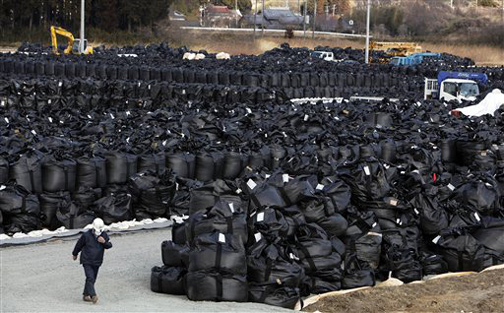
The waste had been held by a lumber company in the Fukushima Prefecture city of Motomiya. The president of a consulting firm in Tokyo took on the job of disposing of the waste, but came under suspicion of dumping around 310 cubic meters of it in Takashima. The president was subsequently convicted over violation of a waste disposal law.
According to a lawyer of a citizens group who had access to the information held by the Otsu public prosecutors, two intermediate processing companies in Tokyo and Gunma Prefecture removed the waste from Fukushima between December 2012 and September 2013. Later, other transporters took it into six prefectures including Shiga via 18 different routes. Roughly 3,437 tons was taken into Tochigi Prefecture, 1,214 tons into Yamanashi Prefecture, 344 tons into Kagoshima Prefecture, 280 tons into Chiba Prefecture and 10 tons into Ibaraki Prefecture, the documents reportedly showed.
Huge production of radioactive trash would come from Hinkley point C nuclear reactor

 nuClear News No 82 Feb 16 The Impact of a New Reactor Programme on the UK’s Radioactive Waste Inventory The proposed Hinkley Point C nuclear power station would produce radioactive wastes and spent fuel with a radioactivity inventory equal to roughly 80% of the radioactivity in all of the UK’s existing radioactive wastes put together.
A catelogue of safety failures revealed in mock nuclear accident tests
 Top secret mock nuclear accidents reveal catalogue of failures, The Ferret, Rob Edwards on February 9, 2016 Top secret mock nuclear accidents testing the responses of the military and emergency services have revealed numerous mistakes that would have led to “avoidable deaths”, according to official assessments.
The Ministry of Defence (MoD) was so concerned about the problems that it carried out “an overarching, fundamental review” of arrangements for handling serious nuclear weapons incidents behind closed doors last year.
Assessments of emergency exercises by the MoD’s internal watchdog, theDefence Nuclear Safety Regulator (DNSR), expose a string of mishaps including life-threatening delays, equipment shortages, coordination failures and communication breakdowns. One report criticises officials for “substantially understating” the scale of the dangers facing the public in a staged briefing for the media.
The MoD took more than two years to agree to hand over reports on three nuclear bomb exercises in 2011 and 2012, despite freedom of information lawrequiring documents to be released within 20 working days. The reports, redacted by the MoD to keep details confidential, are being published today by The Ferret, in tandem with The Guardian (see below).
Two of the exercises imagined aircraft carrying nuclear weapons ingredients crashing and spreading plutonium and other radioactive contamination up to five kilometres away. They were both codenamed Astral Bend, one taking place at the Caerwent military base in south Wales on 24 February 2011, the other at Heyford Park in Oxfordshire on 27 March 2012.
At the 2011 exercise there was a major mix-up over how to deal with contaminated casualties. The fire service was criticised by DNSR for refusing to allow ambulance teams to take away seriously injured people until they had been decontaminated.
“The interpretation of the absolute necessity to decontaminate every casualty or person from within the determined “hot zone” did, and would in the event of such an incident, lead to avoidable deaths,” concluded the DNSR report………
DNSR pointed out that exercises had shown the need for “an overarching, fundamental review” of emergency response arrangements. This review was carried out in 2015, according to the MoD, but it has not been published.
The independent nuclear consultant,John Large, argued that if there were an accident close to an urban area the emergency response “would be totally inadequate to protect many hundreds if not thousands of members of public.”……….
Anti-nuclear groups claimed that the exercise assessments exposed “major weaknesses” in the MoD plans for responding to nuclear accidents. “The MoD’s rickety old nuclear safety arrangements are not up to the job of keeping the public, emergency responders, or MoD personnel safe,” said Peter Burt from the Nuclear Information Network.
He added: “While ministers are racing ahead to replace the Trident nuclear weapons system, work on improving nuclear emergency plans seems to be a much lower priority and is proceeding at a much more sedate place.”
An earlier Astral Bend exercise on 12 May 2010 envisaged a US plane carrying nuclear weapons crashing and spreading radioactive contamination. Official assessments released in 2011 concluded that the MoD specialist response team “struggled to manage”…….
John Ainslie from the Scottish Campaign for Nuclear Disarmament suggested that a nuclear weapons accident was “inherently very dangerous” and the emergency response was likely to be inadequate. He said: “If there is a real incident then we can expect there to be fatal delays in treating casualties and misleading information provided to the public,” he said.
The reports released by the Ministry of Defence…….. Photos thanks to Nukewatch. https://theferret.scot/nuclear-bomb-accidents-could-cause-avoidable-deaths-say-mod-reports/
Japan’s steadfast anti nuclear scientists now at retiring age
 Defiant to the end, last of Group of Six anti-nuclear scientists about to retire, Asahi Shimbun, February 06, 2016 By HISASHI HATTORI/ Senior Staff Writer KUMATORI, Osaka Prefecture–Tetsuji Imanaka is the last of the so-called Kumatori Group of Six, a maverick band of nuclear scientists at an elite university here that spent decades speaking out against nuclear energy.
At 65, Imanaka is now ready to collect his pension and part company with Kyoto University’s Research Reactor Institute–and he remains as steadfast as ever in his beliefs. Imanaka cannot have found it easy to go against the government’s policy of promoting nuclear power, yet that’s what he’s done since he joined the institute in 1976.
He says he never experienced harassment, but then again he never got promoted beyond the post of research associate…..
Imanaka’s other colleagues in the group with the exception of one are all retired. They are: Toru Ebisawa, 77; Keiji Kobayashi, 76; Takeshi Seo, who died in 1994 at the age of 53; Shinji Kawano, 74; and Hiroaki Koide, 66. The group’s moniker came from the name of the town that hosts the research center.
Although all six scientists harbored doubts about promoting nuclear energy, Imanaka said, “We did not set out to become activists or form a clique.” Rather, “We acted according to our own beliefs as individuals.”
The group was relatively unknown before the 2011 Fukushima nuclear disaster. But in the aftermath of the triple meltdown at the Fukushima No. 1 nuclear power plant, the “rebels” increasingly came under the spotlight as civic groups scrambled to seek their expertise to grasp the ramifications of the nuclear accident and the potential dangers of nuclear energy.
Koide, who retired last year, has addressed 300 or so gatherings across the country since the catastrophe. But the group’s efforts to educate the public about the potential danger of, and challenges facing nuclear energy, date back to 1980 when it initiated a series of seminars at the institute. “Experts have a responsibility to explain science and technology in lay language to citizens,” Imanaka said of the endeavor.
With Imanaka’s departure, those seminars are about to end. After more than 35 years, the final 112nd session will be held on Feb. 10. The group’s commitment to continue sounding the warning against nuclear power has been widely appreciated by the public at large.
But the members have all had to pay a price for openly defying the “nuclear village,” as the program involving the government, powerful utilities enjoying regional monopolies and academia is called. None of the six ever got promoted to beyond the level of assistant professor……..
The catalyst for the group’s anti-nuclear activities was a lawsuit filed in 1973 by a citizens group over a license issued to Shikoku Electric Power Co. to build the Ikata nuclear power plant in Ehime Prefecture. In the suit, the plaintiffs demanded nullification of the license on grounds that safety screening of the plant by the government was insufficient. It was the nation’s first lawsuit involving the safety of a nuclear reactor. The researchers stood by the plaintiffs over 19 years of court battles, offering their technical expertise and testimony, right up until the Supreme Court finalized the verdict against them.
Kobayashi, an expert on reactors, also helped residents who sought to shut down the Monju prototype fast-breeder reactor in Fukui Prefecture. The money-guzzling, problem-plagued project is the centerpiece of the government’s vision to recycle spent nuclear fuel. But the reactor has rarely operated since it went online in 1995.
Imanaka specialized in assessing the spread of radioactive contamination. He traveled to Ukraine more than 20 times to examine the 1986 Chernobyl nuclear accident site for contamination.
He, along with Seo, also estimated how much radiation was released in the 1979 accident at the Three Mile Island nuclear power plant in the United States.
After the Fukushima disaster, Imanaka embarked on a project to detect radiation levels in Iitate, a village to the northwest of the plant whose residents are still living as evacuees due to high radiation levels…….http://ajw.asahi.com/article/0311disaster/fukushima/AJ201602060033
Court action against nuclear reactors in Belgium
 Lawsuits against nuclear reactors in Belgium kick off, DW 8 Feb 16 Cracked pressure vessels haven’t kept Belgium from restarting two nuclear reactors that many experts consider unsafe. Now, a lawsuit contesting that decision is underway. They are not safe: That is the basic argument brought forth by the Brussels-based lawyers Pierre and Maxime Chome on behalf of the NGO Nucleaire Stop Kernenergie, which is seeking to shut down two nuclear reactors in Belgium.
Last year, authorities turned off the reactors Doel 3, near Antwerp, and Tihange 2, close to the border with Germany, after tiny cracks were found in their pressure vessels. However, the reactors wererestarted at the end of 2015, when Belgium’s nuclear authority assessed that they were safe after all.
Public opposition to that decision has been building, and various legal actions have been launched.The German city and district of Aachen is planning to take its case to Belgium’s Constitutional Court.The Chomes are pursuing a different track and have taken Electrabel, the utilities operator running Doel 3 and Tihange 2, to court in Brussels. The trial is now adjourned, but a verdict is expected within a month. DW got some background from the lawyers after they appeared in court Monday.
DW: What are the legal grounds on which you are demanding that the Doel 3 and Tihange 2 reactors be stopped again?
Since 1993, Belgian law grants environmental NGOs that meet certain requirements the right to demand that the court find a solution for situations that create environmental dangers.
With regard to the reactors Doel 3 and Tihange 2, many scientists are saying that there is a risk of a nuclear accident – with all the consequences that would entail for the population – because of the cracks found in the pressure vessels. So we are asking the court to stop operations of these reactors or alternatively to appoint a panel of experts to re-examine the scientific evidence.
………We also argue that the authorization to restart the two reactors lacks a sound scientific basis because dissenting opinions among the scientists were not duly taken into account……. http://www.dw.com/en/lawsuits-against-nuclear-reactors-in-belgium-kick-off/a-19034309
South Carolina takes legal action against DOE over unfinished Nuclear Fuel Project

 SC Sues Energy Dept Over Unfinished Nuclear Fuel Project http://abcnews.go.com/US/wireStory/sc-sues-energy-dept-unfinished-nuclear-fuel-project-36812338 By MEG KINNARD, ASSOCIATED PRESS COLUMBIA, S.C. — Feb 9, 2016 South Carolina has again sued the federal government over an unfinished project to convert nuclear weapons components into reactor fuel, saying in a lawsuit filed Tuesday that the administration has acted unconstitutionally in failing to complete the mixed-oxide facility by a Jan. 1 deadline.
“The federal government has a responsibility to follow through with its promises,” state Attorney General Alan Wilson said in a statement provided to The Associated Press. “The Department of Energy has continually shown disregard for its obligations under federal law to the nation, the state of South Carolina and frankly the rule of law.”
Federal officials didn’t immediately return a message seeking comment.
The program is intended to turn weapons-grade plutonium into commercial nuclear reactor fuel to fulfill a nonproliferation deal with Russia. Under the agreement, Russia and the U.S. agreed to dispose of at least 34 metric tons apiece of weapons-grade plutonium, enough material for about 17,000 nuclear warheads, which would then be turned into commercial nuclear reactor fuel.
The project at the Savannah River Site, along the South Carolina-Georgia border, is years behind schedule and billions over its original budget. Because the facility wasn’t operational by a Jan. 1 deadline, the federal government was supposed to remove 1 metric ton of plutonium from South Carolina or pay fines of $1 million a day for “economic and impact assistance” — up to $100 million yearly — until either the facility meets production goals or the plutonium is taken elsewhere for storage or disposal.
The suit also seeks daily fines of $1 million and the plutonium removal.
The lawsuit has been expected. Last month, Gov. Nikki Haley told Wilson that she wanted to sue, also warning Energy Secretary Ernest Moniz in December that the state would be forced to sue if his agency didn’t start making payments. A clause in the law, however, makes the fine “subject to the availability of appropriations.”
The Obama administration has gradually scaled down funding for the project, proposing to mothball it in 2014, citing cost overruns and delays. That prompted a lawsuit, with the state saying the federal government had made a commitment to South Carolina and couldn’t use money intended to build the plant to shut it down.
The state ultimately dropped the suit when the administration committed to funding the project through that fiscal year. But the administration has since said it’s searching for an alternate, less expensive way to dispose of the plutonium, like immobilizing it in glass or processing it in different kinds of reactors.
In his budget submitted Tuesday, President Barack Obama included minimal funding for the mixed-oxide fuel project.
Kinnard can be reached at http://twitter.com/MegKinnardAP . Read more of her work athttp://bigstory.ap.org/content/meg-kinnard/
£100 billion Trident nuclear weapons system could all too soon become obsolete
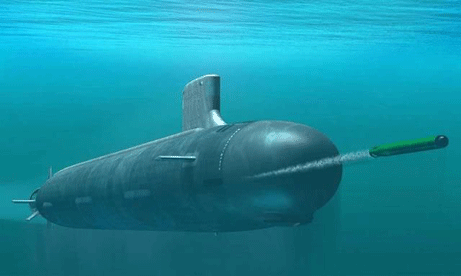 The Trident nuclear weapons system could become obsolete during its lifetime, Labour warns The shadow defence secretary says new technologies are being developed to expose submarines, Independent Jon Stone @joncstone 9 Feb 16 The Trident nuclear weapons system could become technologically obsolete within its lifetime, Labour’s shadow defence secretary has warned.
Emily Thornberry said that emerging technologies could render Trident ineffective as a nuclear deterrent during its 30-year lifetime. She said the development of under-sea drones and other technologies on the horizon might make a long-term lifetime spending commitment of between £100 billion and £160 billion unwise.
“The idea of the Trident replacement is that it can hide in the sea – if technology is moving faster than that then it may well be that Trident is not able to hide,” she told BBC Radio 4’s Today programme. “If that’s right and we are to bet everything on mutually assured destruction then we have to be assured that it’s going to work. If it can’t hide any more that is a problem.
“It is right for the opposition to make sure that it works before voting for a commitment that according to Crispin Blunt would cost £167 billion.”
The shadow defence secretary is currently leading a review of Labour’s policy on nuclear weapons………
The independent Trident Commission estimated that the system would cost £100 billion over its lifetime, though estimates compiled by Reuters with the help of Tory MP Crispin Blunt and official Ministry of Defence statistics suggest the cost could be as high as £167 billion http://www.independent.co.uk/news/uk/politics/trident-labour-policy-nuclear-weapons-deterrent-obsolete-emily-thornberry-a6862501.html
Whistleblower Bob Rowen took on corporate nuclear power in the 1970s
 The Not-So-Peaceful Atom Bob Rowen accidentally took on corporate nuclear power in the 1970s. Four decades later he remembers what it was like to be Humboldt County’s most infamous whistleblower. North Coast Journal, BY JAPHET WEEKS, 20 MARCH 2008 On a summer day in 1969,Bob Rowen, a nuclear control technician at the Humboldt Bay nuclear power plant, realized that for his employer, Pacific Gas and Electric, the bottom line was everything — it was even more important than the community’s safety.
It wasn’t the first time Rowen, a burly former Marine, had witnessed safety violations at the plant, but it was the first time he had the gumption to record the violation in a logbook, which would eventually be reviewed by the nuclear industry’s then government watchdog the Atomic Energy Commission (AEC).
As for PG&E management, they were getting pretty fed up. Rowen was proving to be a real pain in the ass. Continue reading
Call for closure of Indian Point Nuclear Station while radioactive leak is investigated
Environmental group wants Indian Point nuclear power plant closed during probe after radioactive water leak BY LISA L. COLANGELO NEW YORK DAILY NEWS, February 8, 2016, Environmental watchdogs are calling for the Indian Point nuclear power plant to shut down while investigators try to determine how an apparent overflow spilled highly radioactive water into an underground well.
“Indian Point had seven different malfunctions since May of 2015 . . . the next one could be a catastrophe,” Paul Gallay, president of Riverkeeper, said Sunday. “The stakes are just too high,” said Gallay, whose group is dedicated to protecting the Hudson River and the drinking water supply of 9 million city and Hudson Valley residents.
INDIAN POINT NUCLEAR FACILITY OPERATOR REPORTS ‘ALARMING LEVELS’ OF RADIOACTIVITY IN GROUNDWATER
Entergy Corp., which runs the plant, said three monitoring wells out of several dozen at Indian Point showed elevated levels of tritium after the leak, which was discovered Friday………
Gov. Cuomo ordered the state health and environmental conservation commissioners to investigate the incident.
“This is not the first such release of radioactive water at Indian Point, nor is this the first time that Indian Point has experienced significant failure in its operation and maintenance,” Cuomo said in a letter to acting Department of Environmental Conservation Commissioner Basil Seggos and Health Commissioner Howard Zucker.
“This failure continues to demonstrate that Indian Point cannot continue to operate in a manner that is protective of public health and the environment,” the governor’s letter said.
Officials at the Nuclear Regulatory Commission said the leak was caused by a drain that overflowed while workers were transferring water containing high levels of radioactive contamination.
If you are the 45-year-old Indian Point nuclear power plant, you malfunction — it’s just what you do,” said Gallay. “This plant isn’t safe anymore.”
Cuomo and his administration have asked federal officials not to extend the license of the Indian Point plants, noting that there is no effective safety and evacuation plan for the more than 20 million people who live within 50 miles of the site.
The nuclear plant located roughly 35 miles north of the city has a history of groundwater contamination.
A federal oversight agency issued a report after about 100,000 gallons of tritium-tainted water entered the groundwater supply in 2009, and elevated levels of tritium also were found in two monitoring wells at the plant in 2014. http://www.nydailynews.com/new-york/water-leak-ny-nuclear-plant-raises-call-shut-article-1.2523487?cid=bitly
Confusion about financing of UK’s Hinkley nuclear power project
 nuClear News, No 82 Feb 2016, Hinkley’s Troubles Continue ……..The original idea for financing Hinkley was for the promoters to put in £7.5bn in equity and then to borrow £17bn supported by UK Government Credit Guarantees (for which a premium would be paid). This £24.5bn total was made up of £16bn cost plus £8.5bn interest. Now the cost seems to have gone up to £18bn (or adjusted for today’s prices). But EDF Energy seems to be talking about largely funding this out of equity. EDF said on 21st October: “The project is due to be equity funded by each partner, at least during a first stage.” (19) Of course, there is no indication given by EDF of how long the “first stage” would last. However The Telegraph reported that EDF had originally been expected to use project financing for Hinkley, backed up by up to £16bn in UK Government guarantees via Infrastructure UK. But Mr Lévy announced in October a “radical change” to what he said was a “more efficient” option of delivering its £12bn share of the project from EDF’s own balance sheet. (20)
Sizewell A final investment decision on Hinkley is expected to trigger the launch of the next round of public consultation over plans for Sizewell C. (26) But if EDF is struggling to find its 66.5% share of Hinkley C, how will it ever find the 80% it is expected to put into Sizewell C? References ……http://www.no2nuclearpower.org.uk/nuclearnews/NuClearNewsNo82.pdf

Ukraine buying Western technology, plans to double its nuclear power
 Thirty Years After Chernobyl, Ukraine Doubles Down On Nuclear Power, Radio Free Europe, By Tony Wesolowsky February 08, 2016 Nearly 30 years after Chernobyl spewed nuclear dust across Europe and sparked fears of fallout around the globe, a strapped, war-torn Ukraine is opting for “upgrades” rather than shutdowns of its fleet of Soviet-era nuclear power reactors.
Kyiv is planning to spend an estimated $1.7 billion to bring the facilities, many of which are nearing the end of their planned life spans, up to current Western standards.
Ukrainian officials hope to further their energy independence from Moscow and potentially export some of the resulting electricity to Western Europe as part of an “EU-Ukraine Energy Bridge” that can further cement Kyiv’s ties with Brussels.
But can they allay fears, in Ukraine and beyond, that the plans will put Europe at risk of another Chernobyl?
The project has the backing of the West, including a $600 million contribution split evenly between the European Bank for Reconstruction and Development (EBRD) and Euratom, the EU’s nuclear agency…….
Most of the reactors came online in the 1980s, with the oldest — Unit 1 at the Rivne nuclear plant — generating power since December 1980, three years before the ill-fated reactor No. 4 at Chernobyl started churning out power……..
critics have their doubts.
They say Ukraine’s nuclear reactors should be shut down as soon as possible, noting that one of the reactors still churning out power is older than the unit that exploded at Chernobyl on April 26, 1986. They also raise doubts over whether the program will be carried out to the highest standards……..
The [Ukrainian] Nuclear Regulatory Commission is discussing the possibility of raising the extension period to 80 years.”
The upgrade work is just part of a bold plan to make Ukraine a major energy player in Europe beyond its decades-long role as a major transit country. In a state energy strategy document released in 2006 and covering the sector until 2030, Kyiv foresaw the construction of 11 new nuclear units.
Ukraine’s current financial straits could put such bold plans on hold. However, Kyiv appears to be moving ahead with intentions to make Ukraine part of the European power grid by 2017, a target set out by President Petro Poroshenko after he took office in mid-2014……..
Ukraine is also opening other doors with Western nuclear partners.
In November, Enerhoatom signed an agreement with the French engineering firm Areva “for safety upgrades of existing and future nuclear power plants in Ukraine, lifetime extension, and performance optimization.”
U.S.-based Westinghouse, which has been operating in Ukraine since 2003, signed a deal with Kyiv in December 2014 “to significantly increase” nuclear fuel deliveries to Ukraine until 2020.
Russia’s Foreign Ministry reacted to the deal between Westinghouse and Kyiv by calling it “a dangerous experiment.”
Ukraine still depends on TVEL, a nuclear-fuel subsidiary of Russia’s Rosatom, for fuel at 13 of its 15 reactors, highlighting Russia’s continuing sway over Ukraine’s nuclear program.
Westinghouse has been challenging TVEL for a bigger cut of the nuclear-fuel market in Eastern and Central Europe, where Russian-designed reactors are the norm.
The U.S. Export-Import Bank has offered significant loans for several Westinghouse projects in the region, and U.S. officials have lobbied governments to diversify away from dependence on TVEL, according to Statfor, a U.S.-based analytical center…….. http://www.rferl.org/content/thirty-years-after-chernobyl-ukraine-doubles-down-nuclear-power/27539152.html
UK govt spurns the success of renewable energy, follows the dodgy chimera of “Small Nuclear reactors”
 nuClearNews No 82 Feb 16 Progress on Small Modular Reactors as renewables head off the cliff , In response to a letter about energy policy in The Times on 26th January 2016, Energy and Climate Change Secretary Amber Rudd listed the top 10 things the government is doing to secure investment in clean secure energy. Besides committing to Hinkley Point C, Rudd also mentioned spending £250m for nuclear innovation and Small Modular Reactors. (1) Oddly enough there was no mention of the rest of the 19GW of new reactors proposed – (up from 16GW now that Bradwell B has been added to the theoretical list)…….
1 This Month


Tell the Ukrainian Government to Drop Prosecution of Peace Activist Yurii Sheliazhenko

Petition to revoke the licensing of the Near Surface Nuclear Disposal Facility (NSDF) at Chalk River. https://www.ourcommons.ca/petitions/en/Petition/Details?Petition=e-7247


of the week – STOP SMALL MODULAR REACTORS IN CANADA
To see nuclear-related stories in greater depth and intensity – go to https://nuclearinformation.wordpress.com
-
Archives
- March 2026 (193)
- February 2026 (268)
- January 2026 (308)
- December 2025 (358)
- November 2025 (359)
- October 2025 (376)
- September 2025 (258)
- August 2025 (319)
- July 2025 (230)
- June 2025 (348)
- May 2025 (261)
- April 2025 (305)
-
Categories
- 1
- 1 NUCLEAR ISSUES
- business and costs
- climate change
- culture and arts
- ENERGY
- environment
- health
- history
- indigenous issues
- Legal
- marketing of nuclear
- media
- opposition to nuclear
- PERSONAL STORIES
- politics
- politics international
- Religion and ethics
- safety
- secrets,lies and civil liberties
- spinbuster
- technology
- Uranium
- wastes
- weapons and war
- Women
- 2 WORLD
- ACTION
- AFRICA
- Atrocities
- AUSTRALIA
- Christina's notes
- Christina's themes
- culture and arts
- Events
- Fuk 2022
- Fuk 2023
- Fukushima 2017
- Fukushima 2018
- fukushima 2019
- Fukushima 2020
- Fukushima 2021
- general
- global warming
- Humour (God we need it)
- Nuclear
- RARE EARTHS
- Reference
- resources – print
- Resources -audiovicual
- Weekly Newsletter
- World
- World Nuclear
- YouTube
-
RSS
Entries RSS
Comments RSS
 nuclear-news