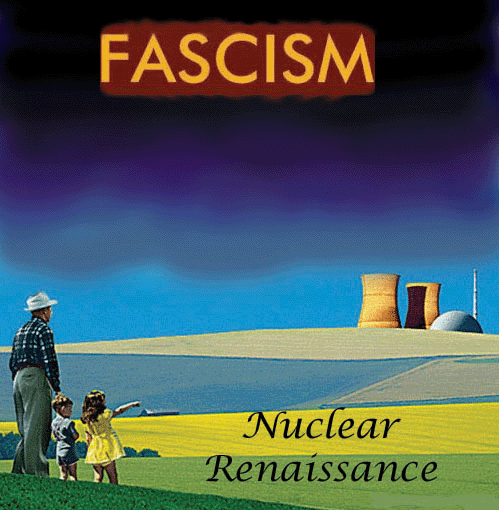
Nuclear “renaissance” to Nuclear Fascism
Nuclear energy does not ever exist in some neutral realm; it is always deeply enmeshed in political contexts, and (as South Africa’s own strange nuclear history shows) it is always linked intimately to state power.
Would the honourable member care to explain caesium, strontium and plutonium to the ancestors?
Power trip: where will Zuma’s nuclear dreams take us? SUNDAY TIMES OPINION BY HEDLEY TWIDLE, 2016-02-07 Hedley Twidle hiked from Cape Point to Koeberg power station. En route, while passing the traces of our ancient predecessors, he wondered what Zuma’s nuclear dreams might mean for our distant successors. Do we know what we are doing? And will they know what we did?…….
In secrecy and haste, the Zuma government is pushing a deal for a new fleet of reactors. It will be the biggest procurement in our history, with a projected starting price of more than R1-trillion – but nuclear builds are notorious for running over budget.
The reason for the firing of Nene, some analysts suggested, was that he was stalling on nuclear, trying to protect the fiscus from a “presidential legacy” project that threatens to contaminate our economy, and our whole national project, for the rest of our lives.
We all have things that keep us up at night, and the prospect of SA being locked into a “nuclear renaissance” with Vladimir Putin’s Russia (or Xi Jinping’s China, or François Hollande’s France) is mine.
One of the troubling things about the debate is the language in which it is conducted: the technocratic confidence and business-minded briskness that pretends it has everything figured out.
 Debates about energy policy happen in the language of developmental economics and financial modelling; in long and acronym-riddled policy documents; in boring technical reports. Decisions are taken amid the short-term cycles of party politics and cabinet reshuffles, not in mind of the long history of building and decommissioning nuclear plants, then disposing of their waste – a process that the world is only just beginning to grapple with. The massive expense and difficulty of it is only beginning to become apparent.
Journalistic expertise and coverage of these larger questions is thin; but beyond even this, do we have the imaginative capacity to understand what a nuclear future entails? I want to suggest that when it comes to nuclear power and its afterlives, we (in a deep sense) do not know what we are talking about.
what does it mean – culturally, philosophically – to produce isotopes that are invisible to our senses but lethal for thousands, hundreds of thousands, millions of years? What does it say about our civilisation, the geologic layer we will leave behind, the Anthropocene? What is the lifespan of a human “fact” when read across the expanse of deep time?……..
When Koeberg opened in 1984, the whole population of Cape Town was given iodine tablets, since any of the winter northwesterlies would carry the radioactive “plume” right towards the city. Iodine reduces the absorption of radionuclides by the thyroid gland: the first line of defence in a nuclear emergency. Looking at the evacuation plan, the city’s chief health officer accused Eskom of “absolute naivety” and moved out of the metro in protest………
Writing against India’s nuclear ambitions in her stinging 1998 essay The End of Imagination, Arundhati Roy registers a similar sense of rhetorical exhaustion. There can be nothing more humiliating for a writer, she says, than to restate a case that has, over the years, already been made by other people across the world, “and made passionately, eloquently and knowledgeably”. But she is prepared for this humiliation, she says, because silence would be indefensible.
“So those of you who are willing: let’s pick our parts, put on these discarded costumes and speak our second-hand lines in this sad second-hand play. But let’s not forget that the stakes are huge. Our fatigue and our shame could mean the end of us.”…….
Nuclear energy does not ever exist in some neutral realm; it is always deeply enmeshed in political contexts, and (as SA’s own strange nuclear history shows) it is always linked intimately to state power………
, it is an energy path that requires, that mandates, that fits perfectly with centralised state control and secrecy – hence its ongoing appeal to autocracies. It is the opposite of decentralised, small-scale technologies for renewable energy. Following the events at Fukushima Daiichi in 2011, most social democracies have turned away from nuclear. Russia, India, China and now SA are looking to major expansion in the sector, even as the rest of the world regards it as a dying, expensive industry – and one which has never solved the problem of the long-term toxicity it produces, or in its euphemism, its “legacy waste”.
The cleanness and bracing sea air of Koeberg are an illusion. Somewhere within that perimeter fence, the high-level waste of spent fuel rods is stored in cooling ponds. Low and medium level waste is driven up the N7 highway to be buried in an open pit at Vaalputs, in the dry landscape of Namaqualand.
But the most lethal waste – hundreds of tonnes of it – remains on the premises, too dangerous to move, or even to think about.
Outside the closed visitors centre, there were notices about the construction of a new “transient interim storage facility” within the grounds, using the dry casks in which the nuclear industry parks its most dangerous legacies.
The doubled-up adjective is telling: the strategy for this kind of waste is always temporary, transient, interim. It places an unasked-for burden not just on “future generations” (that bland and tired phrase), but even on future species of hominid that might evolve in the geographic space that is known (for now) by the bland name of South Africa………
The lethal time capsules being built deep underground are meant to reach as far into the future as human symbolic behaviour reaches back into the African past: 100,000 years.

To even begin to conceive of what the nuclear option means, you have to abandon opinion pieces, leave “rational” argument and enter the realms of speculative fiction. In 2116, 100 years from now, will the people required to take care of the waste of Koeberg (or Thyspunt, or Schulpfontein, or Duynefontein) understand what they are being asked to do, and why?
Will they have the technology to do it, and the money? Will they still be filing progress reports to a nuclear regulator? What language will be spoken here? Will those two grain silos still be there at the water’s edge, or will they be drowned by rising sea levels?
What about in 3016? Will “South Africa” still exist? Will there be any remnant of the national road system along which the dry casks will (supposedly) be transported to their final resting place at Vaalputs?
Will there be any trace of the companies that profited from the nuclear furnaces, after all the CEOs and the PAs and the PRs and the shareholders and their children’s children’s children, unto the 20th generation, are no more than ash on the wind?
Let’s go one further. What about 10,000 years from now?
Can any symbol or sign system speak across so many millennia of unstable above-ground conditions? And even if the hominids of 12016 AD do understand the warnings about a slow poison buried deep in the desert, will they heed them?
Could a question like this please be tabled among all the integrated resource plans and environmental impact assessments and risk assessments and costing exercises that go on for hundreds of pages but never get to the heart of the matter?
In those paper-thin arguments, language is used less to communicate than to disguise risk and evade the real questions posed by nuclear: questions of time, ethics, inter-generational responsibility. Questions about the kind of human experiment we want to be part of.
Would the honourable member care to explain caesium, strontium and plutonium to the ancestors?
What do you think? Write to letters@sundaytimes.co.za http://www.timeslive.co.za/sundaytimes/lifestyle/opinion/2016/02/07/Power-trip-where-will-Zumas-nuclear-dreams-take-us
No comments yet.
1 This Month

of the week – Shut Down Drone Warfare!


Tell the Ukrainian Government to Drop Prosecution of Peace Activist Yurii Sheliazhenko

Petition to revoke the licensing of the Near Surface Nuclear Disposal Facility (NSDF) at Chalk River. https://www.ourcommons.ca/petitions/en/Petition/Details?Petition=e-7247
To see nuclear-related stories in greater depth and intensity – go to https://nuclearinformation.wordpress.com
-
Archives
- April 2026 (103)
- March 2026 (251)
- February 2026 (268)
- January 2026 (308)
- December 2025 (358)
- November 2025 (359)
- October 2025 (376)
- September 2025 (257)
- August 2025 (319)
- July 2025 (230)
- June 2025 (348)
- May 2025 (261)
-
Categories
- 1
- 1 NUCLEAR ISSUES
- business and costs
- climate change
- culture and arts
- ENERGY
- environment
- health
- history
- indigenous issues
- Legal
- marketing of nuclear
- media
- opposition to nuclear
- PERSONAL STORIES
- politics
- politics international
- Religion and ethics
- safety
- secrets,lies and civil liberties
- spinbuster
- technology
- Uranium
- wastes
- weapons and war
- Women
- 2 WORLD
- ACTION
- AFRICA
- Atrocities
- AUSTRALIA
- Christina's notes
- Christina's themes
- culture and arts
- Events
- Fuk 2022
- Fuk 2023
- Fukushima 2017
- Fukushima 2018
- fukushima 2019
- Fukushima 2020
- Fukushima 2021
- general
- global warming
- Humour (God we need it)
- Nuclear
- RARE EARTHS
- Reference
- resources – print
- Resources -audiovicual
- Weekly Newsletter
- World
- World Nuclear
- YouTube
-
RSS
Entries RSS
Comments RSS
 nuclear-news
Leave a comment