Increasingly, it’s the “back end” of nuclear power that will be astronomically costly
 EU paints challenging picture of Europe’s nuclear future, Energy Post. February 2, 2016 by Sonja van Renssen “…..Paying for the aftermathIt is the back-end of the fuel cycle – waste management and decommissioning – that is going to claim a rising share of investments in the years ahead. More than 50 of the EU’s 131 reactors are likely to be shut down by 2025, the Commission says. Member States are moving “from research to action” on geological disposal. The first facilities are expected to be up and running in Finland, Sweden and France between 2020 and 2030 (Finland is in the lead with a due date of 2023). Almost all other Member States are at the “preliminary studies” stage. Public acceptance remains a challenge. So does deciding who is finally liable for the waste.
The projected costs of long-term geological storage depositories run from less than half a billion in Slovenia and Croatia to over €20 billion in France, the Commission says. It all adds up to €68 billion, or nearly half of the total estimated waste management costs of €142 billion out to 2050. For these, the average result of €3.23 per MWh is more than double what was estimated in recent studies, the Commission notes. Over a third of the total costs are for France.
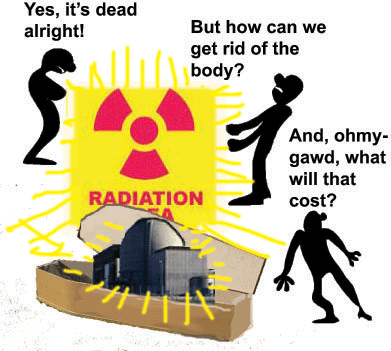 The other half of the end-of-life equation, decommissioning, is largely unknown terrain. When a nuclear site is decommissioned, it is released from regulatory oversight. Given “the ageing status of the European reactors, the capability of the industry and regulators to develop safe and cost effective decommissioning programs will determine to a great extent the future of nuclear commercial power in Europe”. This includes greater transparency in cost estimates, it adds. The Commission comes up with a total cost of €126 billion for decommissioning out to 2050. Some will argue that real costs are likely to be far higher.
Estimates of decommissioning costs per unit also vary “significantly” between Member States, from €0.20 billion in Finland to €1.33 billion in Lithuania. Germany and the UK are at the high end (€1.06 billion and €0.85 billion, respectively) while France is at the low end (€0.32 billion). The estimates depend on technology, the size and location of the reactor, and dismantling strategy, the Commission says.
Experience is scarce: although 89 reactors had been permanently closed in Europe as of October 2015, only three had been fully decommissioned. All three were in Germany. Worldwide, only 13 more have been decommissioned; all of them in the US. The Commission suggests a “European Centre of Excellence” to exchange best practice might help. http://www.energypost.eu/exclusive-eu-paints-challenging-picture-europes-nuclear-future/
EU paints challenging picture of Europe’s nuclear future, Energy Post. February 2, 2016 by Sonja van Renssen Not the full picture
In theory, the money for waste management and decommissioning is being accumulated throughout reactors’ lifetimes, primarily through a fixed contribution based on electricity sales. In most Member States, regulators define the method for securing funds (some, such as Germany however, rely on commercial law to require companies to build up reserves in their balance sheets).
Of the €268 billion needed in the EU by 2050, there is already €150 billion in the bank. In other words, as of 2014, European nuclear operators had dedicated assets that would cover 56% of the total estimated nuclear end-of-life costs, for reactors that were 64% of the way through their lives. A “possible explanation” for the difference is that some Member States are anticipating lifetime extensions.
The Commission concludes that “as a reliable low carbon technology and a major contributor to security of supply”, nuclear energy “is expected to remain an important component of the EU’s energy mix”. Maintaining EU technological leadership, including through the nuclear fusion project ITER, is “essential”. But this does not make nuclear energy competitive or affordable, nor does it ensure it can play a useful role in an EU power system dominated by renewables, where flexibility is central.
There are a few other things the draft PINC does not (yet) do. It does not advise on the involvement of foreign firms in supposedly strategic energy projects (e.g. China in Hinkley Point C). It does not draw lessons from recent upheavals in the nuclear industry (e.g. Areva’s bankruptcy). It does not tackle liability, although a former PINC suggested setting up a harmonised system of liability and financial mechanisms in case of an accident. And finally, it does not discuss harmonising strategies for decommissioning funds – also suggested in the former PINC – beyond proposing a European Centre of Excellence. http://www.energypost.eu/exclusive-eu-paints-challenging-picture-europes-nuclear-future/
No comments yet.
1 This Month

of the week – Shut Down Drone Warfare!


Tell the Ukrainian Government to Drop Prosecution of Peace Activist Yurii Sheliazhenko

Petition to revoke the licensing of the Near Surface Nuclear Disposal Facility (NSDF) at Chalk River. https://www.ourcommons.ca/petitions/en/Petition/Details?Petition=e-7247
To see nuclear-related stories in greater depth and intensity – go to https://nuclearinformation.wordpress.com
-
Archives
- March 2026 (237)
- February 2026 (268)
- January 2026 (308)
- December 2025 (358)
- November 2025 (359)
- October 2025 (376)
- September 2025 (257)
- August 2025 (319)
- July 2025 (230)
- June 2025 (348)
- May 2025 (261)
- April 2025 (305)
-
Categories
- 1
- 1 NUCLEAR ISSUES
- business and costs
- climate change
- culture and arts
- ENERGY
- environment
- health
- history
- indigenous issues
- Legal
- marketing of nuclear
- media
- opposition to nuclear
- PERSONAL STORIES
- politics
- politics international
- Religion and ethics
- safety
- secrets,lies and civil liberties
- spinbuster
- technology
- Uranium
- wastes
- weapons and war
- Women
- 2 WORLD
- ACTION
- AFRICA
- Atrocities
- AUSTRALIA
- Christina's notes
- Christina's themes
- culture and arts
- Events
- Fuk 2022
- Fuk 2023
- Fukushima 2017
- Fukushima 2018
- fukushima 2019
- Fukushima 2020
- Fukushima 2021
- general
- global warming
- Humour (God we need it)
- Nuclear
- RARE EARTHS
- Reference
- resources – print
- Resources -audiovicual
- Weekly Newsletter
- World
- World Nuclear
- YouTube
-
RSS
Entries RSS
Comments RSS
 nuclear-news
Leave a comment