New doubts hang over future of Britain’s Hinkley Nuclear Plan

 New threat to Hinkley nuclear plant cash,Sunday Times, Danny Fortson 31 January 2016 BRITAIN could withdraw financial support for the controversial £18bn nuclear power station at Hinkley Point, Somerset, if a similar plant being built by France’s EDF is not running by 2020, The Sunday Times can reveal.
The condition, attached to a Treasury loan guarantee, raises fresh questions about the future of Britain’s first new atomic power plant in a generation.
Last week EDF, which is 84% owned by the French state, postponed a board meeting in Paris to approve Hinkley Point, amid concerns about the heavily indebted company’s ability to fund the project. The plant will be financed by EDF and its Chinese partner CGN, with the backing of a 35-year contract to sell power to households at above-market rates.
The arrangement hinges on a Treasury agreement to guarantee up to 17 billion pounds in loans…. (registered readers only) http://www.thesundaytimes.co.uk/sto/business/energy_and_environment/article1662807.ece?CMP=OTH-gnws-standard-2016_01_30
Radio Ecoshock on THE DEATH OF NUCLEAR POWER
 THE DEATH OF NUCLEAR POWER http://www.ecoshock.info/2016/01/the-death-of-nuclear-power.html


It isn’t happening. As you’ll hear, nuclear power is shrinking, not expanding. World-wide, major nuclear companies are going bankrupt, or soaking up billions more of your taxes, or both.
Expert Mycle Schneider looks into secrets of the Great Nuclear Leap Forward in China. Remember, after Chernobyl and Fukushima, an accident anywhere in the world can irradiate the Northern Hemisphere. China’s new untested reactors are your reactors. Their radiation can land in your backyard.
All our lives, we’ve been told the problem of storing nuclear waste for a million years will be solved by science and technology. Instead, you will hear how hot waste from 70 years ago continues to threaten and poison a suburb of St. Louis Missouri. Dr. Helen Caldicott also reports on the mad rush to turn beautiful South Australia into a nuclear waste dump for the world.
Boiling water with reactors has become a time-bomb, a failed technology, a path better not taken, a threat and a burden to all succeeding generations.
This is Radio Ecoshock. I’m Alex Smith.
Listen to/download this Radio Ecoshock show in CD Quality (56 MB) or Lo-Fi (14 MB).
Or listen on Soundcloud right now!
International Court of Justice sets March dates for Marshall Islands’ nuclear case

 Marshalls nuclear case set for ICJ hearing http://www.radionz.co.nz/international/pacific-news/295377/marshalls-nuclear-case-set-for-icj-hearing 1 Feb 16, The Marshall Islands’ legal battle against the world’s nuclear powers has inched forward after an international court announced dates for hearings involving India, Pakistan and Britain.
The UN’s highest court, the International Court of Justice, set dates between 7 March and 16 March for separate hearings for the three cases.
The Marshall Islands, where the United States tested 67 nuclear weapons between 1946 and 1958, launched action in 2014 against nine nuclear states.
It has accused them of flagrant violation of international law for failing to pursue the negotiations required by the 1968 Nuclear Non-Proliferation Treaty.
In the cases against India and Pakistan, the court at The Hague will examine whether it is competent to hear the lawsuits.
The hearing involving Britain will look at preliminary objections raised by Britain.
The Marshall Islands’ case against the US hit a stumbling block last year when it was thrown out by the Federal District Court in San Francisco.
An appeal is underway. The Marshall Islands also filed suits against Russia, France, China, Israel and North Korea.
Nuclear industry crisis: Generation IV reactors to the rescue?
Nuclear renaissance? Failing industry is running flat out to stand still Jim Green, 30 Jan 2016, The Ecologist, “………Rhetoric about ‘super safe’ Generation IV reactors will likely continue unabated. That said, critical reports released by the US and French governments last year may signal a slow shift away from Generation IV reactor rhetoric.
The report by the French Institute for Radiological Protection and Nuclear Safety (IRSN) – a government authority under the Ministries of Defense, the Environment, Industry, Research, and Health – states: “There is still much R&D to be done to develop the Generation IV nuclear reactors, as well as for the fuel cycle and the associated waste management which depends on the system chosen.”
IRSN is also sceptical about safety claims: “At the present stage of development, IRSN does not notice evidence that leads to conclude that the systems under review are likely to offer a significantly improved level of safety compared with Generation III reactors … “
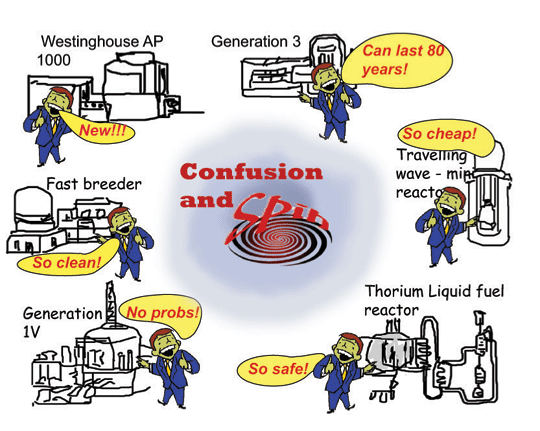
The US Government Accountability Office released a report in July 2015 on the status of small modular reactors (SMRs) and other ‘advanced’ reactor concepts in the US. The report concluded:
“While light water SMRs and advanced reactors may provide some benefits, their development and deployment face a number of challenges … Depending on how they are resolved, these technical challenges may result in higher-cost reactors than anticipated, making them less competitive with large LWRs [light water reactors] or power plants using other fuels … Both light water SMRs and advanced reactors face additional challenges related to the time, cost, and uncertainty associated with developing, certifying or licensing, and deploying new reactor technology, with advanced reactor designs generally facing greater challenges than light water SMR designs. It is a multi-decade process, with costs up to $1 billion to $2 billion, to design and certify or license the reactor design, and there is an additional construction cost of several billion dollars more per power plant.”
 Even SMR boosters are struggling to put a positive spin on the situation. Launching a Nuclear Energy Insider report on SMRs, lead author Kerr Jeferies said: “From the outside it will seem that SMR development has hit a brick wall, but to lump the sector’s difficulties together with the death of the so-called nuclear renaissance would be missing the point.”
According to a US think tank, 48 companies in north America, backed by more than US$1.6 billion (€1.5b) in private capital, are developing plans for advanced nuclear reactors. But even if all that capital was invested in a single R&D project, it would not suffice to commercialise a new reactor type.
The UK government also sees a big future for SMRs and has even promised to spend £250 million on “nuclear innovation and Small Modular Reactors”. But it will face two big problems. First, the money won’t go far. And second, nuclear power is already being outcompeted by wind and solar, which are getting cheaper all the time.
Dan Yurman notes in his review of nuclear developments in 2015: “Efforts by start-up type firms to build advanced reactors will continue to generate a lot of media hype, but questions are abundant as to whether this activity will result in prototypes.
“For venture capital firms that have invested in advanced designs, cashing out may mean licensing a design to an established reactor vendor rather than building a first-of-a-kind unit.”
Dr Jim Green is the national nuclear campaigner with Friends of the Earth Australia and editor of the Nuclear Monitor newsletter, where this article was originally published. Nuclear Monitor is published 20 times a year. It has been publishing deeply researched, often strongly critical articles on all aspects of the nuclear cycle since 1978. A must-read for all those who work on this issue! disaster……. www.theecologist.org/News/news_analysis/2987010/nuclear_renaissance_failing_industry_is_running_flat_out_to_stand_still.html
Hinkley nuclear fiasco puts the wind up Hitachi, concerning investment in UK
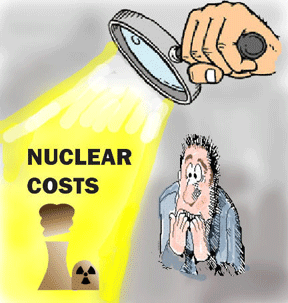 Hinkley Point nuclear fiasco spooks Hitachi boss, Telegraph, 31 Jan 16
Hitachi boss raises concerns about funding of its own Wylfa Newydd project with foreign secretary during visit to Japan The head of Hitachi has warned that the debacle surrounding the construction of Hinkley Point nuclear plant throws up “very serious concerns” about its own investment in the UK.
Hiroaki Nakanishi, chairman and chief executive of the Japanese industrial giant, said the setbacks experienced by Hinkley’s developer EDF raised questions about how future plants including its Wylfa Newydd project are funded.
Hitachi’s subsidiary Horizon is planning to build a nuclear plant on Anglesey that is expected to start generating power by the mid-2020s.
In an interview with The Telegraph, Mr Nakanishi revealed that he had expressed concerns about the expected costs of the project with Philip Hammond during the Foreign Secretary’s visit to Japan this month.
Horizon is in talks with the Government to ensure the Wylfa deal presents value for money for both sides.
Mr Nakanishi said Hitachi had set out “very fair conditions for the making of our investment”, but could only commit to a deal it believed was viable.
“Hinkley Point [raises questions] about what are the real solutions for setting up financial support,” he said.
“Nuclear power construction requires huge money … we need to arrange a financial plan for which the kind of money needed can be introduced.
“Some part is government endorsement, some is more preferable investment conditions from the part of the finance industry.” Mr Nakanishi said the challenges faced by Hinkley Point could also affect Horizon. “The DECC worries about the stability of the scheduled construction of the [Hinkley Point] nuclear power plant, so some of the conditions – the credit requirements – those kind of things may affect us.
“In order to set up the financial conditions [to build Hinkley], Chinese capital was introduced, but what the real result will be – we have a very serious concern about that.”
Asked if the firm might step back if it believed a viable deal was not on the table, Mr Nakanishi replied: “Yes”.
Horizon is in negotiations with the Department of Energy and Climate Change (DECC) on issues such as the strike price, or the amount the Government will guarantee per unit of electricity produced, which will be key to attracting additional finance…….. http://www.telegraph.co.uk/finance/newsbysector/energy/12128405/Hinkley-Point-nuclear-fiasco-spooks-Hitachi-boss.html
Will the government listen to 92,000 Petitioners against Great Lakes Nuclear Dump?
Group opposed to nuclear waste facility presents petition containing
92,000 signatures, January 31, 2016 By Jim Bloch, The Voice, Ontario As a single individual, it’s often hard to imagine that you can affect national events. But if you join together with 92,000 others, your impact can grow.
That’s the hope of Beverly Fernandez, founder of Stop the  , the nonprofit organization dedicated to derailing the plans of Ontario Power Generation to bury 200,000 cubic yards of low- and intermediate-level nuclear waste in a 2,200-foot-deep repository in Kincardine, Ontario, within a mile of Lake Huron.
On Jan. 19, Fernandez, on behalf of STGLND, delivered a petition containing more than 92,000 signatures and more than 31,000 comments to new Minister of the Environment and Climate Change Catherine McKenna.
“The signatures and comments send a very clear message to the Canadian government,” Fernandez said. “OPG’s nuclear waste burial and abandonment plan poses unacceptable risks to the drinking water of 40 million Canadians, Americans and Indigenous Peoples and must be rejected.”
McKenna is scheduled to make a decision about the proposal by March 1. ……….
“This petition stands alongside the more than 22 million people represented by 184 resolutions opposed to OPG’s plans to bury and abandon nuclear waste, some of which will stay toxic for 100,000 years,” said the letter to McKenna.
Resolutions opposing the nuclear waste facility have been passed by nearly every city, township and county in the Blue Water Area, as well as the Michigan Senate. Continue reading
Dangerous and toxic – Small Modular Nuclear Reactors
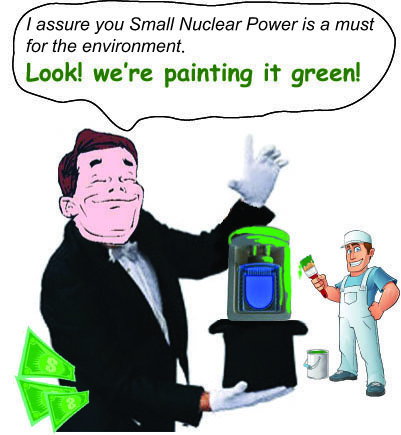 SMR – Small Modular Nuclear Reactor Meltdown And Explosion SL-1 – Idaho, United States, And Lucens Switzerland; MOX Or Thorium Fueled Small Modular Nuclear Reactors Too Dangerous, Toxic.
What are the downsides to this fantasmic plan to populate the whole world with toxic, heavy metal radiation emitting small buried nuclear reactors and why are they too dangerous to put in the ground, basically anywhere in the world?
SMALL MODULAR REACTORS DO MELT DOWN AND HAVE NUMEROUS TERMINAL ISSUES, EVEN WORSE THAN THE LARGE NUCLEAR REACTORS
They emit radioactive heavy metal poisonous gases and liquids, just like large ones do.
Radioactive fuel such as thorium and uranium must still be mined, which then causes radioactive tailing piles, just like the large nuclear reactors.
Zero Rads Extraction Project; Uranium Mining, Enrichment, Nuclear Fuel Chain, Open Air Testing
http://agreenroad.blogspot.com/p/uranium-mining-and-enrichment.html
The small modular reactors produce radioactive heavy metal poison garbage that no one has a solution for, and no one wants in their backyard, just like the large ones do.
Zero Rad Waste Project; Long Term Storage Of Nuclear Waste, Decommissioning, Ocean Dumping, Incineration, Decontamination, Water Contamination, Dry Cask Storage
http://agreenroad.blogspot.com/p/recycling-or-long-term-storage-of.html …..http://agreenroad.blogspot.com.au/2013/10/the-paper-fantasy-and-real-dangers-of.html
Japan’s nuclear restarts- increase of deadly MOX wastes, but nowhere to put it
 Restarts threaten to increase amount of deadly MOX at Takahama plant to 18.5 tons, Japan Times, 1 Feb 16, JIJI Restarting a second reactor at the Takahama nuclear power plant in Fukui Prefecture will raise the amount of highly toxic spent mixed-oxide (MOX) fuel present there to an estimated 18.5 tons, Jiji Press has learned.
The plant run by Kansai Electric Power Co. in the town of Takahama had 5.3 tons of MOX — a blend of uranium and plutonium extracted from spent nuclear fuel — there before Friday’s restart of the No. 3 reactor.
But lingering problems threaten to ruin the government’s long-laid plans for recycling nuclear fuel, leaving spent MOX in need of a home. This means it is likely to join the standard uranium fuel being kept in the nation’s rapidly dwindling storage pools until a solution can be found.

The Takahama plant is set to hold the largest amount of spent MOX among domestic nuclear facilities that have engaged in so-called pluthermal power generation utilizing the blended fuel, which can contain weapons-grade plutonium……..
Among noncommercial facilities, the Japan Atomic Energy Agency currently has 63.9 tons stored at Fugen, an advanced converter reactor in Fukui, 23.1 tons at its nuclear fuel reprocessing facility in Ibaraki Prefecture, and 6.1 tons at the experimental Monju fast-breeder reactor in Fukui.
Takahama No. 3 is the nation’s third reactor to be rebooted under new safety standards compiled since the Fukushima nuclear disaster began in March 2011.
Kansai Electric plans to reactivate Takahama’s No. 4 reactor later this month. http://www.japantimes.co.jp/news/2016/01/31/national/restarts-threaten-increase-amount-deadly-mox-takahama-plant-18-5-tons/#.Vq5v39J97Gg
Global nuclear industry – stagnation and decline
 Nuclear renaissance? Failing industry is running flat out to stand still Jim Green, 30 Jan 2016, The Ecologist,
Despite the endless rhetoric about a ‘nuclear renaissance’, there are fewer power reactors today than there were a decade ago, writes Jim Green. The one country with a really big nuclear build program is China, but no one expects it to meet its targets. And with over 200 reactor shut-downs due by 2040, the industry will have to run very hard indeed just to stay put. Over the next 10-20 years, global nuclear capacity may increase marginally, with strong growth in China more than masking patterns of stagnation and decline elsewhere. Beyond that, the aging of the global fleet of power reactors will be sharply felt.
Ten new power reactors began supplying electricity last year (eight of them in China), and eight reactors were permanently shut down.
Nuclear power’s 20-year pattern of stagnation continues. In 1995 there were 434 ‘operable’ reactors – operating plus temporarily shut down reactors. In 2005 there were 441, and now there are 439. Thus there are fewer reactors today than there were a decade ago. Moreover the 439 figure includes 41 reactors in Japan that have been shut down for several years, and not all of them will be restarted.
The nuclear power industry’s malaise was all too evident at the COP21 UN climate change conference in Paris in December. Former World Nuclear Association executive Steve Kidd noted:
“It was entirely predictable that the nuclear industry achieved precisely nothing at the recent Paris COP21 talks and in the subsequent international agreement. … Analysis of the submissions of the 196 governments that signed up to the Paris agreement, demonstrating their own individual schemes on how to reduce national carbon emissions, show that nearly all of them exclude nuclear power. The future is likely to repeat the experience of 2015 when 10 new reactors came into operation worldwide but 8 shut down. So as things stand, the industry is essentially running to stand still.”
According to the International Atomic Energy Agency, only seven out of 196 countries mentioned nuclear power in their climate change mitigation plans prepared for the COP21 conference: China, India, Japan, Argentina, Turkey, Jordan and Niger.
A striking feature of the debates around the COP21 conference was the vitriol directed at the anti-nuclear and environmental movements. Tim Judson from the Nuclear Information and Resource Service noted:
“The industry’s rhetoric is getting increasingly desperate and personal. The industry rolled out a new front group called ‘Nuclear for Climate’, which handed out thousands of copies of a book attacking anti-nuclear activists and blaming us for the climate crisis. Needless to say, their efforts to intimidate activists are backfiring. In fact, they have given us a clear sign of how close we are to winning. Greenpeace International’s Kumi Naidoo reminded activists in a speech in December – in which he broadened the call for divestment to include nuclear, as well as fossil fuels – of the famous adage attributed to Gandhi about the path to victory: ‘First they ignore you. Then they laugh at you. Then they fight you. And then you win.'”
Perhaps the five stages of grief are relevant as nuclear lobbyists confront the reality that the nuclear renaissance didn’t eventuate and isn’t likely to. Denial and anger are very much in evidence, along with some bargaining (‘we need all low carbon power sources’), depression and, in time, acceptance.
China’s great leap forward
With 30 operable reactors, 24 under construction, and many more in the pipeline, China remains the only country with significant nuclear expansion plans. China is unlikely to meet any of its targets – 58 GW by 2020, 110 GW by 2030 and up to 250 GW by 2050 – but growth will be significant nonetheless.
Growth could however be derailed by a serious accident, which is all the more likely because of China’s inadequate nuclear safety standards, inadequate regulation, lack of transparency, repression of whistleblowers, world’s worst insurance and liability arrangements, security risks, and widespread corruption.
There are fears, for example, that China may press ahead with its twin-EPR project at Taishan despite fears over the metallurgy of its reactor vessels and heads. Similar components supplied to the EPR at Flamanville in France have been found to have areas of excessive carbon leading to brittleness and possible failure in use. The French project is now on hold and may never be completed.
Over the next 10-20 years, global nuclear capacity may increase marginally, with strong growth in China more than masking patterns of stagnation and decline elsewhere. Beyond that, the aging of the global fleet of power reactors will be sharply felt: the International Energy Agency anticipates almost 200 permanent shut-downs by 2040.
Steve Kidd notes that the industry is running to stand still, and it will have to run faster to stand still as the annual number of shut-downs increases.
Growth elsewhere?
India is the only other country where there is a possibility of significant nuclear growth in the nearish-future. But nuclear growth in India has been modest – six reactor start-ups over the past decade – and may remain so.
In early 2015, India claimed to have resolved one of the major obstacles to foreign investment by announcing measures to circumvent a liability law which does not completely absolve suppliers of responsibility for accidents. But those claims were met with scepticism and a capital strike by most foreign suppliers is still in effect. Strong public opposition – and the Indian state’sbrutal response to that opposition – will also continue to slow nuclear expansion.
India has just signed an ‘preliminary agreement’ with EDF to build a massive six-reactor EPR project at Jaitapur, 360km south of Mumbai. But given the still-unresolved liability issues and the EPR’s disastrous construction record to date, it’s hard imagine any but the most cautious of progress taking place.
Meanwhile renewables are surging ahead. One part of the Jaitapur deal that is likely to move ahead fast is 142 MW of wind power in Gujarat that EDF is to develop with its Indian partner, SITAC.
And in mid-January 2016, the latest auction of solar energy capacity in India achieved a new record low price of 4.34 rupees / kWh (US$0.064; €0.059). Energy minister Piyush Goyal said: “Through transparent auctions with a ready provision of land, transmission and the like, solar tariffs have come down below thermal power cost.”
Russia has 35 operating reactors and eight under construction (including two very low power floating reactors). Only six reactors have started up over the past 20 years, and only four over the past decade. The pattern of slow growth will continue.
As for Russia’s ambitious nuclear export program, Steve Kidd noted in October 2014 that it “is reasonable to suggest that it is highly unlikely that Russia will succeed in carrying out even half of the projects in which it claims to be closely involved”.
South Korea has 25 operable reactors and three under construction. Six reactors have started up over the past decade. Along with China, India and Russia, South Korea is supposedly one of the four countries driving the ‘nuclear renaissance’. But the best the industry can hope for in South Korea is slow growth.
South Africa plans 9.6 GW of new nuclear capacity to add to the two Koeberg reactors. But the nuclear program is more theatre than reality. Pro-nuclear commentator Dan Yurman states:
“South Africa’s plans to build 9.6 GW of nuclear power will continue to be embroiled in political controversy and be hobbled by a lack of realistic financial plans to pay for the reactors. Claims by both Rosatom and Chinese state nuclear firms that they have won the business are not credible. Even if written down on paper, these claims of contracts cannot be guaranteed in the long term due to the political twists and turns by South African President Jacob Zuma. Most recently, he burned through three finance ministers over differences about whether the country could afford the cost of the reactors said to be at as much as US$100 billion including upgrades to the electrical grid. Additionally, Zuma is distracted by political and personal scandals.”
Brazil’s nuclear industry provided some theatre in 2015 with the arrest of Othon Luiz Pinheiro da Silva, the former CEO of Brazil’s nuclear power utility Eletronuclear, for allegedly accepting bribes to fix the bidding process for the Angra 3 reactor under construction 100 km from Rio de Janeiro. Fourteen other people were also charged as a result of the federal police’s ‘Operation Radioactivity’.
“The arrest is a tragedy for the industry,” said former Eletrobras’ chief executive Luiz Pinguelli Rosa. “The industry was already in crisis, but now the corruption concerns are bound to delay Angra 3 further and cause costs to rise even more.”
Newcomer countries: The World Nuclear Association claims that “over 45 countries are actively considering embarking upon nuclear power programmes.” Balderdash. Only two ‘newcomer’ countries are actually building reactors – Belarus and the United Arab Emirates. Other countries might join the nuclear club but newcomers will be few and far between.
Moreover, some countries are phasing out nuclear power. Countries with nuclear phase-out policies include Germany, Belgium, Taiwan, and Switzerland. Other countries – e.g. Sweden – may phase out nuclear power partly as a result of deliberate government policy and partly because of natural attrition: aging reactors are being shut down without replacement.
Stagnation and decline
Patterns of stagnation or slow decline in North America and western Europe can safely be predicted. In 2014, the European Commission forecast that EU nuclear generating capacity of 131 GW in 2010 will decline to 97 GW in 2025.
The European Commission forecasts that nuclear’s share of EU electricity generation will decline from 27% in 2010 to 21% in 2050, while the share from renewables will increase from 21% to 51.6%, and fossil fuels’ share will decline from 52% to 27%.
The most important nuclear power story of 2015 was legislation enacted in the French Parliament in July that will reduce nuclear’s share of electricity generation from 75% to 50% by ‘around’ 2025, and caps nuclear capacity at the current level of 63.2 GW.
The legislation also establishes a target of 32% of electricity generation from renewables by 2030, a 40% reduction in greenhouse gas emissions and a 20% reduction in overall energy consumption by 2030.
In April 2015, a report by ADEME, a French government agency under the Ministries of Ecology and Research, shows that 100% renewable electricity supply by 2050 in France is feasible and affordable.
French EPR reactor projects in France and Finland are three times over budget and many years behind schedule. As already noted, in April 2015 it was revealed that EDF’s Flamanville EPR under construction in France has a weak pressure vessel and head, and that the same problem may afflict China’s twin-EPR project with EDF at Taishan.
A January 2016 update to the World Nuclear Industry Status Report discusses the miserable state of the French nuclear industry:
“The French state-controlled AREVA, having announced an outlook of a further ‘heavy loss’ in 2015, was downgraded by credit-rating agency Standard & Poor’s to B+ (“highly speculative”). On 29 December 2015, the company plunged to a new historic low on the stock market (€5.30 compared to €72.50 eight years ago). On 7 December 2015, Euronext ejected the French heavy weight Électricité de France (EDF), largest nuclear utility in the world and “pillar of the Paris Stock Exchange”, from France’s key stock market index, known as CAC40. One day later, EDF shares lost another four percent of their value, which led to a new low, a drop of over 85 percent from its 2007 level. … The French nuclear industry’s international competitors are not doing much better. AREVA’s Russian counterpart Atomenergoprom as well as the Japanese controlled Toshiba-Westinghouse were both downgraded to ‘junk’ (‘speculative’) by credit-rating agencies during the year.”
Next door in Belgium, ageing reactors at Doel and Tihange – shut down a year ago because of serious safety concerns over numerous leaks and, at Tihange, 16,000 reactor vessel cracks – are scheduled to start up shortly, triggering serious concern across Europe. An Avaaz petition to be delivered to Belgium by German Environment Minister Barbara Hendricks on Monday has already attracted almost 500,000 signatures.
In the United States, utilities announced two more reactor shut-downs in 2015: the FitzPatrick reactor in New York will be shut down in 2016, and the Pilgrim reactor in Massachusetts will be closed between 2017 and 2019.
Five reactors are under construction but a greater number have been shut down recently or will be shut down in the next few years. The last reactor start-up was in 1996. In August 2015 the Environmental Protection Agency released its final Clean Power Plan, which failed to give the nuclear industry the subsidies and handouts it was seeking.
A decade ago, the US Nuclear Regulatory Commission was flooded with applications for US$127 billion (€117b) worth of reactor projects. Now, obituaries for the US nuclear power renaissance are increasingly common.
The situation is broadly similar in the United Kingdom – the nuclear power industry there is scrambling just to stand still. It should be clear by the end of this year whether the extraordinarily expensive Hinkley C EPR project will go ahead. But the signs are not good for the project’s backers: EDF was due to make its ‘final investment decision’ this week, but flunked out owing to its inability to raise the necessary £18 billion.
According to the World Nuclear Association, most of the UK’s reactors are to be retired by 2023. If other projects prove to be as expensive and difficult as Hinkley C, it’s unlikely that new nuclear capacity will match retirements.
In Japan, only two of the country’s 43 operable reactors are actually operating. Perhaps half to two-thirds of the reactors willeventually restart. Five reactors were permanently shut down in 2015, and the six reactors at Fukushima Daiichi have been written off.
Before the Fukushima disaster, Tokyo planned to add another 15-20 reactors to the fleet of 55, giving a total of 70-75 reactors. Thus, Japan’s nuclear power industry will be at most half the size it might have been if not for the Fukushima disaster……. www.theecologist.org/News/news_analysis/2987010/nuclear_renaissance_failing_industry_is_running_flat_out_to_stand_still.html
Exploding the false claims of the thorium nuclear lobby
 The mythologies of thorium and uranium, Greenpeace, by Jan Beránek – 24 March, 2014 Thorium and uranium represent the heaviest naturally occurring elements on Earth. Both were named after ancient gods: Uranus was the principal Greek god of the sky while Thor was the Norse (and broadly Germanic) god of a thunder.
……What are the chances that replacing the Greek god with a Germanic one will help? Would Thor take his powerful hammer and nail it all down? Not likely….
Let’s look more closely at some of the hopeful claims around thorium.
Safer reactors? The risks inherent in nuclear reactors are due to the massive concentrations of radioactive materials and the huge amount of heat they produce (which is actually needed to generate electricity). No matter if the fuel is based on uranium or thorium, if it’s solid or liquid, this characteristic alone will inevitably continue to be the Achilles heel of any nuclear reactor. As you can read in the Union of Concerned Scientists’ briefing on this issue, the truth is that the U.S. Department of Energy concluded in 2009 after a review that “the choice between uranium-based fuel and thorium-based fuel is seen basically as one of preference, with no fundamental difference in addressing the nuclear power issues [of waste management, proliferation risk, safety, security, economics, and sustainability].”
Less nuclear waste? It’s obvious that fission applied to different nuclear fuel results in a different composition of radioactive waste. But it’s still radioactive waste and whether the waste produced by thorium reactors is less problematic (because there’s no plutonium in it) remains a question. Spent thorium fuel still contains long-lived isotopes such as proactinium-231 (with a half-life 32,000 years which is even longer than plutonium Pu-239) which implies the need for long term management in timescales comparable to typical high level waste from uranium reactors. Not surprisingly, a chart published in Nuclear Engineering International magazine in November 2009 shows that the radiotoxicity of spent thorium fuel is actually higher than uranium spent fuel over the long term, ie after first 10,000 years:

No proliferation? Yes, thorium can’t itself be used to build nuclear weapons but it can’t be used directly as a nuclear fuel either. In fact, it has to be first converted into the fissile uranium isotope, U-233. That’s an isotope that is suitable for nuclear weapons. The US successfully detonated a nuclear bomb containing U-233 in 1955.
Even the UK Department of Energy and Climate Change commissioned a report which concluded in 2012 that the claims by thorium proponents who say that the radioactive chemical element makes it impossible to build a bomb from nuclear waste, leaves less hazardous waste than uranium reactors, and that it runs more efficiently, are “overstated”.
Thorium reactors exist only in blueprints and early experiments, which means there could be other issues not yet detected that would complicate their large scale implementation. In any case, this also means that it would take much longer than a decade before thorium reactors would potentially become available for a larger commercial deployment……. http://www.greenpeace.org/international/en/news/Blogs/nuclear-reaction/the-mythologies-of-thorium-and-uranium/blog/48625/

Renewables are a better bet than expensive, risky nuclear power
Should the United States rely heavily on nuclear power in seeking to address climate change?
Renewables are a better bet than expensive, risky nuclear power, Missoulian, 1 Feb 16
MICHAEL E. KRAFT Michael Kraft is professor emeritus of political science and public and environmental affairs at the University of Wisconsin-Green Bay.“……Nuclear power will have an important role to play, but it is unlikely to replace much fossil fuel use. It is still too expensive and too risky.
A better bet is to invest in renewables and energy efficiency, which most of the world is now doing. Despite construction of new reactors by China and other Asian nations, globally nuclear electricity production has been leveling off while wind and solar power are soaring. There are good reasons for these trends.
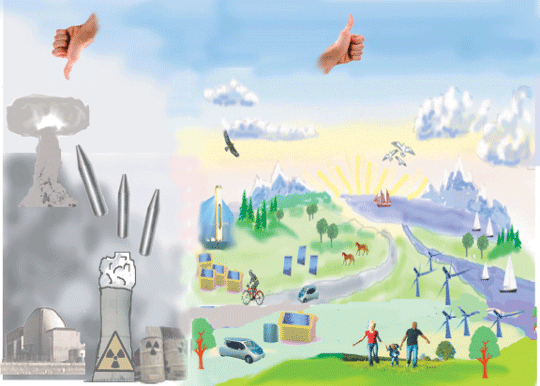
One is cost. The nuclear plants under construction in the U.S., the first after more than three decades, are expected to cost $8 billion to $9 billion each, possibly more, and the eventual decommissioning of reactors remains expensive.
These very high costs make it difficult for private utilities to increase nuclear power generation despite generous federal loan guarantees. They see more promise and lower costs in natural gas-powered plants or in turning to renewable energy.
Other reasons include dealing with waste and safety. Even if the industry can reduce costs through improved technology and reactor design, what do we do about high-level waste disposal, for which no acceptable solution is in sight? And how should we address public concerns over reactor safety after the Fukushima disaster?
A better way forward is to invest heavily in renewables as well as in energy conservation and efficiency, which can cut energy demand sharply.
This includes improved building design, greater reliance on public transit, enhanced transportation efficiency, modernization of the electrical grid and storage technologies, and better lighting, heating and cooling systems……….
The federal government has long favored and heavily subsidized nuclear power and fossil fuels. For the past decade, renewables and efficiency finally have begun to receive significant support. We should accelerate that trend. http://missoulian.com/news/opinion/renewables-are-a-better-bet-than-expensive-risky-nuclear-power/article_7c5328fc-645a-5e84-82d0-b6e896a831e3.html
Takahama town tries to stop its heavy dependence on the nuclear industry
Town tries to shift away from heavy dependence on nuclear plant, Japan Times, 31 Jan 16 JIJI TAKAHAMA, FUKUI PREF. – In the wake of the disastrous nuclear accident in northeastern Japan nearly five years ago, the Fukui Prefecture town of Takahama has been seeking ways to reduce its heavy dependence on a nuclear power plant for its livelihood.
“It is true that we’ve depended on the nuclear industry,” said a local official responsible for community buildings in the municipality, home to Kansai Electric Power Co.’s Takahama nuclear plant.
The town and the nuclear power station have “become inseparable” since the plant’s No. 1 reactor started operations in 1974, according to the official.
The plant has provided jobs for the community, with the much of the town’s economy geared towards providing services for those who work at the facility.
On Friday, the plant’s No. 3 reactor was brought back online after a hiatus of nearly four years, becoming the third reactor in the nation to restart operations under the country’s new safety standards compiled after the March 2011 accident at Tokyo Electric Power Co.’s Fukushima No. 1 nuclear power plant. Kansai Electric plans to reactivate the No. 4 reactor at the plant in late February.
In fiscal 2014, which ended in March last year, the town’s revenues related to the nuclear plant, including subsidies and fixed-asset tax income, totaled ¥5,072 million, accounting for 51 percent of its total general-account revenue.
However, the Fukushima No. 1 plant accident changed the town’s way of thinking.
“We’ve come to think seriously that the town must not depend solely on the nuclear industry,” the town official said. “We are now aiming to reshape the town into a community that does not rely on nuclear power.”
As part of its effort, the town is looking to its beaches with their beautiful landscapes and pristine waters…… http://www.japantimes.co.jp/news/2016/01/31/national/town-tries-shift-away-heavy-dependence-nuclear-plant/#.Vq5u4tJ97Gh
Anglesey nuclear plant project under threat over funding fears
Hitachi has warned it could walk away from Wylfa Newydd scheme unless it receives viable subsidy from UK Government 31 JAN 2016 BY OWEN HUGHES The Japanese firm behind Wylfa Newydd warned they could walk away from the £14bn nuclear project unless a viable funding deal could be found……..http://www.dailypost.co.uk/business/business-news/anglesey-nuclear-plant-project-under-10813851
1 This Month


Tell the Ukrainian Government to Drop Prosecution of Peace Activist Yurii Sheliazhenko

Petition to revoke the licensing of the Near Surface Nuclear Disposal Facility (NSDF) at Chalk River. https://www.ourcommons.ca/petitions/en/Petition/Details?Petition=e-7247


of the week – STOP SMALL MODULAR REACTORS IN CANADA
To see nuclear-related stories in greater depth and intensity – go to https://nuclearinformation.wordpress.com
-
Archives
- March 2026 (176)
- February 2026 (268)
- January 2026 (308)
- December 2025 (358)
- November 2025 (359)
- October 2025 (376)
- September 2025 (258)
- August 2025 (319)
- July 2025 (230)
- June 2025 (348)
- May 2025 (261)
- April 2025 (305)
-
Categories
- 1
- 1 NUCLEAR ISSUES
- business and costs
- climate change
- culture and arts
- ENERGY
- environment
- health
- history
- indigenous issues
- Legal
- marketing of nuclear
- media
- opposition to nuclear
- PERSONAL STORIES
- politics
- politics international
- Religion and ethics
- safety
- secrets,lies and civil liberties
- spinbuster
- technology
- Uranium
- wastes
- weapons and war
- Women
- 2 WORLD
- ACTION
- AFRICA
- Atrocities
- AUSTRALIA
- Christina's notes
- Christina's themes
- culture and arts
- Events
- Fuk 2022
- Fuk 2023
- Fukushima 2017
- Fukushima 2018
- fukushima 2019
- Fukushima 2020
- Fukushima 2021
- general
- global warming
- Humour (God we need it)
- Nuclear
- RARE EARTHS
- Reference
- resources – print
- Resources -audiovicual
- Weekly Newsletter
- World
- World Nuclear
- YouTube
-
RSS
Entries RSS
Comments RSS
 nuclear-news