USA’s Nuclear Regulatory Commission at risk of being hacked
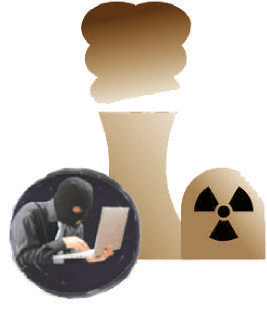 Nuclear commission risks being hacked because of organizational issues: watchdog report http://www.washingtontimes.com/news/2016/jan/13/nuclear-commission-risks-being-hacked-because-of-o/ By Andrew Blake – The Washington Times – Wednesday, January 13, 2016
Computer networks used by the U.S. Nuclear Regulatory Commissionpose a real possibility of being exploited by hackers as a result of inadequate organization among security personnel, a federal report found this week.
The NRC’s inspector general said in a 18-page assessment released on Tuesday that its Security Operations Center, or SOC, isn’t “optimized to protect the agency’s network in the current cyber threat environment.”
Weeks after new reports revealed that hackers had successfully compromised a hydroelectric dam in New York City in 2013, the government watchdog said the NRC’s unclassified computer networks risk being breached because the agency has failed to structure itself in a way that would ensure any unauthorized intrusions are handled appropriately.
NRC staffers told the inspector general that the SOC “does not meet agency needs” and singled out a lack of proactive analyses and timely, detailed reports that could otherwise provide the information necessary to keep its networks properly protected.
“There are no performance goals,” the watchdog found, meaning the NRCcannot possibly assess “whether agency needs are being met.”
More specifically, the report faulted “generic” contracts that have yielded “differing expectations” with respect to roles and responsibilities, as well as “inadequate definitions in agency policies and undifferentiated functional descriptions between different entities responsible for securing NRC’s network.”
“This occurs because although the contract performance criteria are aligned with National Institute of Standards and Technology and NRCinternal guidance, the contract does not clearly define SOC performance goals and metrics that can be used to determine whether agency needs are being met,” the inspector general concluded following a five-month audit of the NRC’s headquarters in Rockville, Maryland.
To keep the NRC’s unclassified networks safe from hackers, the agency must ensure that organizational roles and responsibilities are more clearly defined, the watchdog said.
In the meantime, the inspector general acknowledged in a footnote that the nuclear sector has not been spared from cyberattacks: While federal data has suggested a 9.7 percent surge between 2013 and 2014 with regards to computer security incidents across the board, the NRCexperienced an 18 percent increase in hack attacks during that same span, including instances in which hackers had attempted to gain unauthorized access through malicious code injections, social engineering, policy violations or other attempts.
“A dynamic cyber threat environment demands a high-performing SOC,” the inspector general wrote. “The sophistication and frequency of malicious activity targeting NRC has increased. These forces, combined with the need for NRC users to stay connected with stakeholders and partners through the Internet, make effective information security a critical capability.”
“Irresponsible” to restart Belgium’s nuclear reactors
Concerns over two Belgian nuclear reactors, News 24 2016-01-14 20:18 Brussels – Two Belgian nuclear reactors which were temporarily shut down due to structural problems should never have been restarted, according to a study commissioned by a pro-environmental group in the European Parliament and published on Thursday.
The study feeds into an ongoing debate about the safety of Belgium’s ageing nuclear plants, but the country’s nuclear regulator rejected the findings.
Technical problems with Belgium’s nuclear reactors have created tensions with neighbouring Germany, which is moving toward clean and sustainable energy sources and has passed legislation that requires the closure of all its commercial nuclear reactors by 2022.
The two reactors, Doel 3 and Tihange 2, were taken offline in 2012 after service checks indicated defects in the reactor pressure vessels. They were later found to be hydrogen flakes, formed when hydrogen bubbles became trapped during the manufacturing of the tank’s steel rings.
But the new study, carried out by material scientist Ilse Tweer on behalf of the Greens’ parliamentary group, challenges several of the FANC’s assessments and concludes that the decision to restart the two power plants is “not understandable.”
Tweer’s report says it is not certain that the flaws in the pressure vessels are hydrogen flakes, adding that there is no “explicit proof” that they have not grown during the 30 years that the reactors have been operational, or could do so in future.
“A reactor pressure vessel with thousands of flaws – and with these large flaw sizes – would not be licensable, neither today nor at the time of manufacture,” the report notes.
“Operating these two reactors, which contain thousands of cracks, is irresponsible,” Green EU lawmaker Rebecca Harms of the said on Wednesday. “Were the vessel to burst, the consequences for the densely populated region around the reactors would be catastrophic.”…… http://www.news24.com/World/News/concerns-over-two-belgian-nuclear-reactors-20160114
Another 6.7 Earthquake Warns that Japan is No Place for Nuclear

Japan doing it’s routine shaking and quaking. Another 6.7 earthquake warns that Japan is no place for nuclear power stations. Japan’s apparently homicidal and suicidal government doesn’t care and is restarting more and more. Even shut-down they constitute a menace, not only to Japan but to other countries.
Not satisfied with the Fukushima nuclear disaster, which still must be cleaned-up, and which has continued to belch lethal radionuclides into the environment by TEPCO’s own admission, PM Shinzo Abe-the Japanese government appear determined to experience another, or even an earthquake-volcano-nuclear disaster. No wonder that rumors surface now and again that Abe is a member of a death cult. Abe’s maternal grandfather is considered to have been a war criminal by many: http://en.wikipedia.org/wiki/Nobusuke_Kishi Easy to wonder if Abe has a Nuclear-kaze thing going.
http://ptwc.weather.gov/?region=2&id=hawaii.TIBHWX.2016.01.14.0336
(The time frame of this earthquake map isn’t clear, but it’s striking. No tsunami warning was issued.)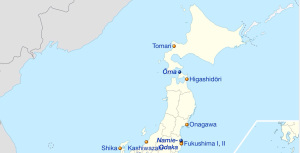
https://en.wikipedia.org/wiki/Nuclear_power_in_Japan
View original post 23 more words
January 14 Energy News

World:
¶ The Canadian Wind Energy Association has reported that Canada closed 2015 seventh in the world for total installed wind energy capacity with 11,205 MW, and sixth in the world for the amount of capacity added in 2015. Over the year, Canada added 36 wind projects totalling 1,506 MW of new capacity. [Windpower Engineering]
 Wind energy supplied approximately 5% of Canada’s electricity demand in 2015, or enough to power over three million Canadian homes. CanWEA
¶ Oil prices briefly have fallen below $30 a barrel on international markets for the first time since April 2004, before recovering again. Brent crude, used as an international benchmark, fell as low as $29.96, but bounced back to trade at $30.22. Oil prices have fallen by 70% in the past 15 months. [BBC]
¶ Growth in India’s coal-based installed generation capacity is on a decline, despite an increase in…
View original post 721 more words
Crisis in Britain’s nuclear safety regulator
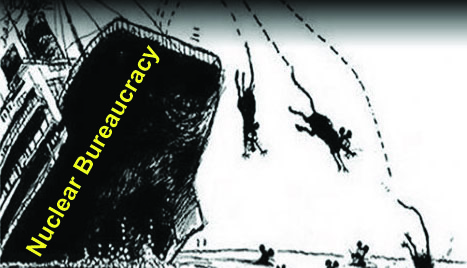
Nuclear watchdog risks meltdown, critics warn, The Times UK, 12 Jan 16 The nuclear safety regulator is facing a leadership crisis and is ill-equipped to deal with a mounting workload linked to China’s plans to invest £8 billion in the British industry, experts have warned.
The Office for Nuclear Regulation is responsible for ensuring the safety and security of 15 nuclear reactors, hazardous sites such as Sellafield and the transport and disposal of high-level nuclear waste. It also oversees the safety case for new reactors.
In recent months it has been plagued by desertions, including the departure of Andy Hall, the Chief Inspector, and Alasdair Corfield, the finance director. Neither has been….. – (Subscribers only)
http://www.thetimes.co.uk/tto/business/industries/utilities/article4662825.ece
Electricite de France (EDF) at new low with crippling financial problems
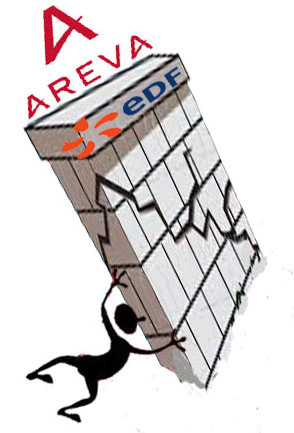 EDF already needs to borrow money just to pay its dividend and is set to spend tens of billions of euros on upgrading its ageing reactors, building new nuclear plants in Hinkley Point, Britain and buying the reactor arm of Areva.
“This report is clearly negative for all nuclear operators, and most specifically for EDF and Areva”
EDF shares are down more than 44 percent in the 12 months,
EDF sinks to all-time low as nuclear waste cost estimate soars http://uk.reuters.com/article/edf-nuclear-waste-idUKL8N14W2RO20160112 PARIS | BY GEERT DE CLERCQ Jan 12 Shares in French utility EDF sank to all-time lows on Tuesday after the country’s Andra nuclear waste agency said that storage costs could be higher than EDF’s estimates.
Mirroring German utilities E.ON and RWE , which saw their shares hit decade lows late last year over worries about nuclear decommissioning costs, EDF fell as much as 7.3 percent before recovering to 4.1 percent lower.
A string of brokerage price target downgrades and French forward power prices falling to new decade lows only added to the gloom.
In a report released late on Monday, Andra said costs for the Cigeo deep geological storage project could be as high as 30 billion euros or as low as 20 billion depending on assumptions about different cost factors in coming years.
“There are different views on the calculation, more or less conservative, depending on estimates for future technological progress and optimisation,” Andra said in a statement. n a letter to the energy ministry, posted on the ministry’s website, EDF, fellow state-controlled company Areva and the CEA (Atomic Energy Authority) said they estimated the cost at around 20 billion euros.
“Andra’s study only took into account a small number of possible optimisations,” said the letter, adding that a certain number of costs and ratios used by the state agency were not in line with their experience.
“We are waiting for a decision of the energy minister on the cost of storage,” an EDF spokesman said.
Energy Minister Segolene Royal’s decision on the 10 billion euro gap in estimates could have a huge impact on the already stretched balance sheet of EDF, which operates 58 nuclear plants in France and generates the bulk of the country’s nuclear waste.
EDF already needs to borrow money just to pay its dividend and is set to spend tens of billions of euros on upgrading its ageing reactors, building new nuclear plants in Hinkley Point, Britain and buying the reactor arm of Areva.
“This report is clearly negative for all nuclear operators, and most specifically for EDF and Areva,” Bryan, Garnier analyst Xavier Caroen said in a note, adding that the risk of a cost revaluation was not new.
EDF shares are down more than 44 percent in the 12 months, the second-worst performer in the Stoxx utilities index after RWE. The company has been replaced in France’s CAC-40 index of leading shares by shopping centre operator Klepierre . (Additional reporting by Benjamin Mallet; Editing by Keith Weir)
Jeremy Corbyn – inconveniently sensible on nuclear weapons
 Corbyn says the Trident isn’t worth the money. It is a costly weapon that can never be used. British security concerns should be focused on terrorism, economic turmoil and catastrophic climate change; nuclear weapons are irrelevant to all that. Corbyn argues, sensibly, that the Cold War era is long gone
Jeremy Corbyn talks common sense on nuclear weapons, WP. By Katrina vanden Heuvel January 12 The new leader of the British Labour Party, Jeremy Corbyn, has sparked a political firestorm by challenging the myths around nuclear weapons and Cold War deterrence. Corbyn announced that he would never use a nuclear weapon. He followed that apostasy by declaring that he opposed renewal of the British nuclear Trident submarine program.“I am opposed to the use of nuclear weapons. I am opposed to the holding of nuclear weapons. I want to see a nuclear-free world. I believe it is possible,” Corbyn declared.
Several Labour shadow ministers suggested they might resign if that became Labour’s policy. Conservative Prime Minister David Cameron and the right-wing British press have been pillorying Corbyn as a threat to national security for his heresy.
Corbyn’s aides argue this is not a new version of the debate over unilateral disarmament that wracked Labour in the 1980s. Rather, they insist the question is whether renewing the fleet is worth the money. Corbyn’s doubts are shared by some current and retired military officers. The British fleet of four Trident submarines is slated for retirement in the late 2020s. It will take almost that long to develop a successor. Renewing and operating the Trident program will cost an estimated 167 billion British pounds over the next four decades. The Army has already been reduced to below 82,000 soldiers, the lowest number since the 1700s. Renewing the Trident fleet would likely force more cuts.
Corbyn says the Trident isn’t worth the money. It is a costly weapon that can never be used. British security concerns should be focused on terrorism, economic turmoil and catastrophic climate change; nuclear weapons are irrelevant to all that. Corbyn argues, sensibly, that the Cold War era is long gone….
The Corbynites are sensitive about being accused of unilateral disarmament, since the party’s adoption of that position in the 1980s at the height of Cold War tensions was electorally damaging. Yet a British commitment to give up nuclear weapons unilaterally might just be the highest and best use of the Trident fleet…..
Corbyn is now taking a beating in the conservative tabloids for his blasphemies. Yet he is talking common sense. No leader in his right mind would use nuclear weapons. The British people would be better off spending the money that renewal would cost elsewhere. The reality is that the British nuclear arsenal will have greater global significance if it is dismantled rather than renewed. Corbyn is meeting fierce resistance, even inside his own party, but he is raising questions that deserve a full debate. https://www.washingtonpost.com/opinions/jeremy-corbyn-talks-common-sense-on-nuclear-weapons/2016/01/12/52e8c886-b88f-11e5-b682-4bb4dd403c7d_story.html
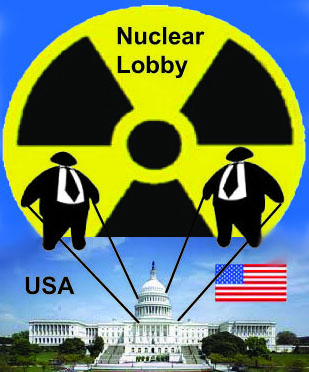
Nuclear lobby getting its way in USA Congress?
The Nuclear Energy Innovation Capabilities Act (H.R. 4084) directs the Department of Energy (DOE) to work with private companies and researchers to develop new nuclear reactors. The bill will help private investors demonstrate novel reactor concepts and designs such asmolten-salt or pebble-bed reactors……..

Is it just Hinkley that’s finished or the whole of EDF?
No2Nuclear Power Jan 2016 “………French utility EDF is considering selling assets  worth over 6 billion euros (£4.5 billion) this year, according to French daily Les Echos – notably it is considering selling a stake in its eight British nuclear plants to fund plans to build Hinkley Point C. But it could only sell a 29% share of EDF Energy (which is supposed to be worth 9 billion euros in total). This would leave EDF with a 51% stake, because Centrica already owns 20%. The paper said a sale had been studied but the process had not been launched. The company needs 55 billion euros to upgrade its ageing nuclear plants, plans to invest 18 billion pounds in Hinkley and spend several billion euros to buy Areva’s reactor unit. (1)
CLEAN UP TOXIC ABANDONED URANIUM MINES!

 PETITION http://diy.rootsaction.org/petitions/clean-up-15-000-toxic-abandoned-uranium-mines?bucket=&source=twitter-share-button Campaign created by Klee Benally
TO: MEMBERS OF CONGRESS
We urge you to prioritize passage of the Uranium Exploration and Mining Accountability Act, which will ensure clean up of thousands of hazardous abandoned uranium mines throughout the United States.
Why is this important?
According to the Environmental Protection Agency, more than 15,000 AUMs and exploratory sites are located throughout the United States, posing substantial public health and environmental hazards.
No existing federal laws require clean up of these toxic abandoned sites. Most of these AUMs were established under the “General Mining Law of 1872,” that does not require reclamation or remediation. Mining companies walked away from their clean up responsibilities after decades of mining, leaving the public to bear their toxic legacy. With 75% of AUMs located on public or Tribal lands, Indigenous communities have long faced disproportionate impacts from this toxic legacy.
According to EPA data, approximately 10 million people are estimated to live within 50 miles of a recorded AUM.
Radioactive pollution from AUMs have been linked to cancer, genetic defects, and increases in mortality. There is no minimum threshold for radiation damage (no dose which is harmless), and radiation causes cancer and other organ damage, especially during fetal development and in young children.
It’s time to clean up the mines!
James Hansen is so wrong about “new nuclear” as saviour of the world’s climate

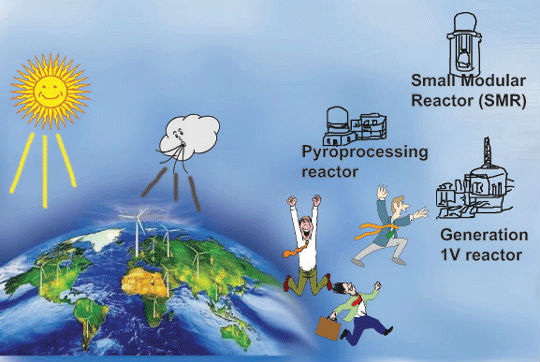 Stanford University engineering professor, Mark Z. Jacobson’s response to Hansen points out that it takes around 10-19 years from the start of planning for new reactors to the start of operation compared with 2-5 years for wind or solar. Nuclear is just too slow to help solve climate problems. (8) Bill Gates also made a lot of headlines with his “Breakthrough Energy Coalition” fund to come up with new energy solutions, including “advanced” nuclear reactors. It’s not that innovation isn’t welcome, but what the climate really needs right now is the large-scale deployment of existing technologies which, according to investment bank Goldman Sachs, are already cost-effective and climate-effective. The problem is, an Apollo-style push for what Gates has called “Energy Miracles” is not only a misguided strategy for mitigating climate change, it could also distract funders with the enticing idea that invention is going to rescue us from climate change. They really should be distributing funds to empower communities, and incentivize the massive deployment of energy efficiency and existing renewable technology now rather waiting for miracles which might never happen, or will happen too late to make a difference. (9) ……http://www.no2nuclearpower.org.uk/nuclearnews/NuClearNewsNo81.pdf
Against all reason, Republican hawks still trying to sabotage Iran nuclear agreement
 Opponents of Iran Nuclear Deal Just Won’t Quit http://www.huffingtonpost.com/alan-elsner/opponents-of-iran-nuclear_b_8962566.html?ir=Australia Opponents of the Joint Comprehensive Plan of Action (JCPOA) between Iran and six world powers to deal with Iran’s nuclear program mounted a massive campaign last summer, spending tens of millions of dollars to sabotage the agreement.
They failed — but they have not quit.
Days after reports that Iran has dismantled one of the most dangerous parts of its program by removing the core of its heavy-water reactor in Arak and filling it with cement, Republicans in the House of Representatives are mounting a new attempt to kill the agreement that has already made the world much safer.
The “Iran Terror Finance Transparency Act” would prevent the President from lifting sanctions imposed on Iranian individuals and entities unless the Administration can “certify the entity is not a terror financier, human rights abuser or involved in the proliferation of weapons of mass destruction.”
President Obama has already vowed to veto the bill, should it reach his desk, for the simple reason that it tangles up an agreement on Iran’s nuclear program with other issues that have nothing to do with it. The new bill is simply a poison pill, designed to kill the nuclear deal.
The deal was designed to do one very important thing — make the world safe from the threat of a nuclear-armed Iran. It does not aim to tackle Iran’s role in regional conflicts, or its sponsorship of terrorist groups or its domestic human rights abuses.
There are separate sanctions imposed on Iran to confront those issues, all of which will remain in place. And the United States and its partners should remain vigilant and take appropriate action when faced with Iranian provocations — like the ballistic missile test they conducted last October which violated UN Security Council resolutions. But none of these factors have anything to do with the nuclear deal.
If the latest bill passed, the White House warned, the legislation “could result in the collapse of a comprehensive diplomatic arrangement that peacefully and verifiably prevents Iran from acquiring a nuclear weapon.”
That would lead to the end of international inspections and monitoring of Iranian nuclear facilities and leave Iran free to restart its program. It would “lead to the unraveling of the international sanctions regime against Iran, and deal a devastating blow to America’s credibility as a leader of international diplomacy,” the White House said.
Republicans have the votes to pass this bill in the House. It will be more interesting to see how it fares in the Senate, where prominent Republicans expected to face strong Democratic challengers this year, like Mark Kirk of Illinois and Ron Johnson of Wisconsin, have been strong backers of previous efforts to sabotage the agreement.
What opponents don’t get is that the nuclear deal is already proving itself. The Iranians have moved faster than most experts believed would happen to fulfill their part of the agreement. Notably, they shipped 25,000 pounds of low-enriched uranium to Russia, leaving them without enough material for a bomb.
“This step is vital because it is irreversible, since the low-enriched uranium is never coming back and would instead need to be produced again,” said Ilan Goldenberg, who directs the Middle East security program at the Center for a New American Security, writing in The National Interest.
The Iranians have also removed centrifuges as required and allowed intrusive inspections of its facilities, as laid down by the JCPOA. And now they are rendering the Arak plant harmless.
It will soon be time for the United States and its partners to live up to their side of the agreement. Once the designated international authorities confirm that Iran has met its obligations, the international community must begin to lift sanctions originally imposed because of Iran’s nuclear program.
Opponents can be expected to continue their campaign to kill the agreement one way or another. That’s why supporters, and all those who believe in diplomatic solutions to tough international problems, must remain vigilant, ready to take political action whenever needed to preserve this important breakthrough.
Iran has removed the core of its Arak heavy water nuclear reactor

 Iran nuclear deal: heavy water nuclear reactor core filled with cement, SMH, January 12, 2016 Dubai: Iran has removed the core of its Arak heavy water nuclear reactor and filled it with cement as required under a nuclear deal signed with world powers last year, the semi-official Fars news agency has revealed, citing an informed Iranian source.
Any such move, reducing the plant’s ability to produce plutonium, might signal imminent implementation of the nuclear deal and clear the way for Tehran to receive relief from economic sanctions.
Separately, the European Union’s foreign policy chief said that EU nuclear-related sanctions on Iran could be lifted soon.
The fate of the reactor in central Iran was one of the toughest sticking points in the long nuclear negotiations that led to an agreement in July between Iran and six world powers, known as the Joint Comprehensive Plan of Action (JCPOA).
Under the deal’s terms, Iran accepted that the Arak reactor would be reconfigured so it could not yield fissile plutonium usable in a nuclear bomb.
China, the United States, France, Britain, Russia and Germany have agreed to participate in the redesign and the construction of the modernised reactor…….http://www.smh.com.au/world/iran-nuclear-deal-heavy-water-nuclear-reactor-core-filled-with-cement-20160112-gm3zkz.html
Nuclear Industry goes into Climate Overdrive
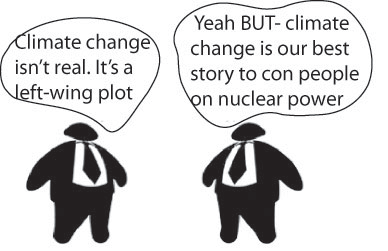 No 2 NuclearPower No 81 January 2016 “…….. “We are now in the midst of a fight between the past and the future”. Former Australian Greens’ Senator Christine Milne The nuclear industry and its champions went into overdrive during the Paris Climate Conference. Was it a last-ditch effort to convince us all that nuclear power is an important part of the answer to the climate crisis? It all seemed a bit desperate with blatant attacks (1) on those who envisage a future based on renewables and no nuclear.
1 This Month
Chernobyl: The Lost Tapes – A good documentary on Chernobyl on SBS available On Demand for the next 3 weeks– https://www.sbs.com.au/ondemand/tv-program/chernobyl-the-lost-tapes/2352741955560

of the week–London Campaign for Nuclear Disarmament

Tell the Ukrainian Government to Drop Prosecution of Peace Activist Yurii Sheliazhenko
To see nuclear-related stories in greater depth and intensity – go to https://nuclearinformation.wordpress.com
-
Archives
- April 2026 (152)
- March 2026 (251)
- February 2026 (268)
- January 2026 (308)
- December 2025 (358)
- November 2025 (359)
- October 2025 (376)
- September 2025 (257)
- August 2025 (319)
- July 2025 (230)
- June 2025 (348)
- May 2025 (261)
-
Categories
- 1
- 1 NUCLEAR ISSUES
- business and costs
- climate change
- culture and arts
- ENERGY
- environment
- health
- history
- indigenous issues
- Legal
- marketing of nuclear
- media
- opposition to nuclear
- PERSONAL STORIES
- politics
- politics international
- Religion and ethics
- safety
- secrets,lies and civil liberties
- spinbuster
- technology
- Uranium
- wastes
- weapons and war
- Women
- 2 WORLD
- ACTION
- AFRICA
- Atrocities
- AUSTRALIA
- Christina's notes
- Christina's themes
- culture and arts
- Events
- Fuk 2022
- Fuk 2023
- Fukushima 2017
- Fukushima 2018
- fukushima 2019
- Fukushima 2020
- Fukushima 2021
- general
- global warming
- Humour (God we need it)
- Nuclear
- RARE EARTHS
- Reference
- resources – print
- Resources -audiovicual
- Weekly Newsletter
- World
- World Nuclear
- YouTube
-
RSS
Entries RSS
Comments RSS
 nuclear-news