Protest repressed in India, as government panders to France, USA
the international nuclear industry has faced its worst crisis globally. The industry is looking at India as a big market where they can compensate for their losses and revive their fortunes. India has become an attractive market for global nuclear corporations

France Peddles Unsafe Nuclear Reactors to India, Drawing Protest , 29 January 2016 By Kumar 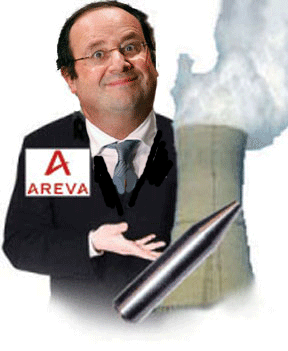 Sundaram, Truthout | News Analysis On January 26, French President François Hollande was the chief guest for India’s Republic Day ceremony, where India showcases its military hardware in a colonial-era parade in its capital. Meanwhile, in Jaitapur on India’s western coast, farmers and fisherfolk were protesting against Hollande’s visit, arguing that the nuclear reactors that India is importing from France threaten their lives, livelihoods and the local ecology.
The Joint Declaration: Localizing Risk, Siphoning Off Profit
In a joint declaration issued on January 25 in New Delhi, the two governments reaffirmed their commitment to go ahead with a long-pending nuclear deal. As per the declaration, the intense negotiations to finalize the commercial agreement are expected to conclude by the end of this year, and the construction of six European pressurized reactors (EPR) imported from France is to begin by early 2017.
The new twist in the declaration is the “maximum localization” of the project and “technology transfer” for the same. Although the government of Indian Prime Minister Narendra Modi seems to have proudly included these new terms and added a “Made in India” tag on the Jaitapur project, it actually means that the French industry would be transferring the burden of its most controversial reactor design at a time of its worst crisis.
The safety vulnerabilities of the reactor pressure vessel (RPV) – the huge iron core where radioactive fission takes place – came under serious questions, raised by France’s own nuclear safety regulator Autorité de Sûreté Nucléaire (ASN) in April 2015. Later in 2015, Areva, the French reactor builder, had to ask the US Nuclear Regulatory Commission to suspend certification review for EPR design. The United States has been postponing certification for EPR since 2007. The Finnish regulator has taken Areva to court on this issue, and Finland has canceled the order for its second EPR. Just two days after the publication of ASN’s report, Modi reaffirmed the EPR deal from France during his visit to Paris in April 2015. It is exactly this controversial component – the RPV – that an Indian private company L&T will now be building, with no experience in the nuclear sector at all.
The current phase of negotiations on Jaitapur is about the price of reactors, which remains a major sticking point. Although the former chief of India’s Atomic Energy Commission promised a tariff of a maximum of 10 US cents per unit for the electricity produced in Jaitapur, independent experts have claimed it will be much higher (20 to 30 cents per unit). This means the government of India would use taxpayers’ money to keep the price competitive. If we go by the cost of EPRs in the United Kingdom, each Indian reactor may cost as much as $8.9 billion. Two reactors in Jaitapur’s first phase will cost as much as India’s total expenditure on science and technology (including the departments of space, science and technology, biotechnology, and research for the entire country). A diplomatic cable revealed by WikiLeaks quoted the general manager of the Nuclear Power Corporation (NPCIL), saying that India is paying a “high” price for Jaitapur………….
The Indian government has managed to acquire land for the project by pressuring farmers and luring a handful of landlords. Despite land acquisition, the farmers in Jaitapur continue to resist. Most villagers either work on others’ land or provide rural services to the agrarian community and do not get any compensation when villages are dislocated for “development” projects. Tabrez Soyekar, a young fisherman, was killed in an indiscriminate police shooting in April 2011, during a peaceful protest. Hundreds of activists and eminent citizens, including the former Navy chief of India and retired justice of the Supreme Court of India, were detainedduring a protest march.
Thirteen village councils in Jaitapur passed unanimous resolutions against the project as recently as November 2015. It is utterly hypocritical for both countries to laud each other’s democratic credentials for international diplomacy if the democratically elected village councils are neglected violently……..
Independent energy experts in India, including a former top official in the Ministry of Power, have argued for a decentralized energy framework that would suit India better, as the majority of its population still lives in villages scattered across the country and transmission losses in centralized Indian grids are staggering.
The 2015 World Nuclear Industry Status Report concludes that, after the Fukushima accident, the international nuclear industry has faced its worst crisis globally. The industry is looking at India as a big market where they can compensate for their losses and revive their fortunes. India has become an attractive market for global nuclear corporations, where the government is mortgaging its financial and environmental health to welcome them. This includes channeling the accident liability to the public; undermining environmental, geological and safety laws; and ignoring the measured advice of independent experts.
Besides Jaitapur, massive and intense anti-nuclear protests have arisen in Koodankulam, Mithi Virdi and Kovvada, where Russian and US corporations are setting up nuclear power plants. Local communities in other places like Chutka, Fatehabad and Mahi Banswara have also been agitating against the nuclear projects. The government has resorted to brutal crackdowns and repression against these consistently peaceful protests. More than 8,000 people in Koodankulam are facing fabricated police cases under colonial-era sedition laws and charges of waging war against the Indian state. The police have killed, arrested and harassed villagers indiscriminately, including women and children. They surrounded the Idinthakarai village in 2012 and disrupted its vital supply lines that deliver goods, including food and milk for children and medicines, to force the village to surrender. One of the first steps that the new government under Modi took in 2015 was to come up with a “confidential” report by the Intelligence Bureau, naming Greenpeace, the Coalition for Nuclear Disarmament and Peace, and other anti-nuclear and environmentalist organizations “anti-national.”http://www.truth-out.org/news/item/34627-france-peddles-unsafe-nuclear-reactors-to-india-drawing-protest
No comments yet.
1 This Month

of the week – Shut Down Drone Warfare!


Tell the Ukrainian Government to Drop Prosecution of Peace Activist Yurii Sheliazhenko

Petition to revoke the licensing of the Near Surface Nuclear Disposal Facility (NSDF) at Chalk River. https://www.ourcommons.ca/petitions/en/Petition/Details?Petition=e-7247
To see nuclear-related stories in greater depth and intensity – go to https://nuclearinformation.wordpress.com
-
Archives
- April 2026 (79)
- March 2026 (251)
- February 2026 (268)
- January 2026 (308)
- December 2025 (358)
- November 2025 (359)
- October 2025 (376)
- September 2025 (257)
- August 2025 (319)
- July 2025 (230)
- June 2025 (348)
- May 2025 (261)
-
Categories
- 1
- 1 NUCLEAR ISSUES
- business and costs
- climate change
- culture and arts
- ENERGY
- environment
- health
- history
- indigenous issues
- Legal
- marketing of nuclear
- media
- opposition to nuclear
- PERSONAL STORIES
- politics
- politics international
- Religion and ethics
- safety
- secrets,lies and civil liberties
- spinbuster
- technology
- Uranium
- wastes
- weapons and war
- Women
- 2 WORLD
- ACTION
- AFRICA
- Atrocities
- AUSTRALIA
- Christina's notes
- Christina's themes
- culture and arts
- Events
- Fuk 2022
- Fuk 2023
- Fukushima 2017
- Fukushima 2018
- fukushima 2019
- Fukushima 2020
- Fukushima 2021
- general
- global warming
- Humour (God we need it)
- Nuclear
- RARE EARTHS
- Reference
- resources – print
- Resources -audiovicual
- Weekly Newsletter
- World
- World Nuclear
- YouTube
-
RSS
Entries RSS
Comments RSS
 nuclear-news
Leave a comment