Why the Nuclear Lobby and Australian Politicians want Australia as world’s radioactive trash dump
from CaptD 31 Jan 16 The first reason is MONEY and I mean BIG Money. Politicians are always gear for Nuclear  Payback*
* http://www.urbandictionary.com/define.php?term=Nuclear+payback
Those that support nuclear power because nuclear power somehow supports them; no matter what the health implications or other “costs” are for others.
The “other” reason is that the Nuclear Industry and their Utilities are desperate to create a radioactive waste dumping site for waste is that they are going to want to site Small Modular Reactors (SMRs) very soon, which companies like SD’s General Atomic are now working on. Since CA has a law that says no more nuclear reactors, until a waste site is developed, the lack of a disposal site is the biggest roadblock they face preventing them from deploying SMRs in CA.

I believe that most Utilities will want to phase out Nat. Gas fired Peaker plants and install SMR’s “because they don’t emit CO2.” That is, unless they are going to be making big money using nat. gas like SDG&E will be, since they already have a contract to import Nat. Gas from Mexico (which Sempra owns a share of, so they will be kind of buying Nat. Gas from themselves) for use in their two new state of the art Billion Dollar Peaker Plants that the CPUC just approved for them (despite the fact that the cost of Wind and Solar generation continues to drop almost monthly)!
SCE just had the CPUC decide against approving a Nat. Gas Peaker plant for them, so you can bet that they are now getting “very excited” about installing one or more SMR’s at San Onofre, since the grid wiring connection is already in place and they are going to be guarding that “nuclear waste” site for decades to come.
http://www.kpbs.org/news/2016/jan/08/oceanside-takes-stand-relocating-san-onofres-nucle/
BTW: All waste facilities should be run by the Government, that way they will always be responsible for it, since Big Waste Corp.’s can go out of business any time they want as as everybody knows Radiation is FOREVER since 50 or more than 100 years is forever to everyone living today.
High radiation levels, murky radioactive water, cause Japan to delay Fukushima robot survey
 TEPCO delays robotic surveys at Fukushima nuclear reactors http://ajw.asahi.com/article/0311disaster/fukushima/AJ201601290050 January 29, 2016 By HIROMI KUMAI/ Staff Writer
Tokyo Electric Power Co. has postponed inspections by robots to finally confirm the location and state of melted fuel at two damaged reactors of the Fukushima No. 1 nuclear plant.
The camera-equipped robots were scheduled to enter the containment vessels of the No. 1 and No. 2 reactors within fiscal 2015, which ends in March. But TEPCO said Jan. 28 that a series of unexpected circumstances, such as poor visibility caused by murky radioactive water, have ruined that plan.
The robot for the No. 1 containment vessel will be redesigned, and the remote-controlled survey will be conducted in fiscal 2016, the utility said, without offering a more specific timetable.
Nuclear fuel assemblies in the No. 1 to No. 3 reactors are believed to have melted and fallen to the bottom of the containment vessels following the March 2011 earthquake and tsunami.
Radiation levels inside the containment vessels remain extremely high, making them too dangerous to be approached by workers.The remote-controlled robotic probe was seen as crucial in determining conditions inside the containment vessels for the eventual decommissioning of the nuclear plant.
TEPCO conducted a preliminary survey using an industrial endoscope in the containment vessel of the No. 1 reactor. It found accumulated waste turned the water murky and blocked the view.
For the No. 2 reactor, TEPCO had planned to locate the melted nuclear fuel using a robot last summer. But decontamination and cleanup work near the entrance to the containment vessel proved difficult. That prevented TEPCO from carrying out robotic survey as planned.
Low dose ionising radiation takes its toll on living organisms – Timothy Mousseau
 Even low radiation dose can take toll: scientist http://www.chinapost.com.tw/taiwan/national/national-news/2016/01/27/457138/Even-low.htm By Enru Lin, The China Post TAIPEI, Taiwan–Animals exposed to even low doses of radiation suffer a higher incidence of physical abnormalities, a world-leading ecologist said in Taipei on Tuesday. Timothy Mousseau, an ecologist at the University of South Carolina, is a pioneering expert on what radiation does to organisms.
For decades, he and his research team have studied Chernobyl, Ukraine — site of the world’s worst nuclear disaster in 1986 — and Fukushima in Japan.
Their studies found that radiation exposure had significant effects on local populations, for instance causing tumors, small brain sizes, sterility and cataracts in birds in Chernobyl.
No Safe Dose?
Findings indicate that radiation, even at low doses, can increase mortality rates and the incidence of physical abnormalities.
“There is no threshold below which there is no effect on organisms,” Mousseau said.
“We need to be very concerned not only about the consequences of nuclear accidents, but also the regular day-to-day operations of nuclear power plants, where radiation is released on a regular basis.”
Call for Taiwan Research
Mousseau was speaking on invitation at a press briefing and forum at the Legislative Yuan, where he was joined by three Democratic Progressive Party (DPP) lawmakers including Tien Chiu-chin (田秋堇).
At the event, anti-nuclear activists called on the central government to commission an independent research team to study effects on people who live near Taiwan’s three operating nuclear power plants.
Birds, Butterflies First
Mousseau said his data suggested that some organisms were far more sensitive to radiation than others.
Studies from Chernobyl and Fukushima showed that the first significant effects of radiation occurred in the same taxonomic groups.
“Birds and butterflies are the two most sensitive groups — we saw immediate large responses in birds and butterflies in Fukushima,” he said.
Other animals, such as grasshoppers and spiders, are less susceptible to the effects of radiation.
On Humans
Meanwhile, there is insufficient research on the human population to make convincing assessments on the impact of low dose radiation.
Mousseau said that in the U.S., studies are thwarted when researchers can’t access the relevant health records.
“There are privacy issues related to health records that are so strong in the United States, and there is a lack of organization of the registries. That makes it very difficult to do solid, hard science,” he said.
Germany’s nuclear waste nightmare
Radioactive waste dogs Germany despite abandoning nuclear power https://www.newscientist.com/article/2075615-radioactive-waste-dogs-germany-despite-abandoning-nuclear-power/ Major problems at a salt mine where 126,000 drums of radioactive debris are stored are fuelling public distrust of long-term waste disposal plans, reports Fred Pearce from Asse, Germany
Half a kilometre beneath the forests of northern Germany, in an old salt mine, a nightmare is playing out. A scheme to dig up previously buried nuclear waste is threatening to wreck public support for Germany’s efforts to make a safe transition to a non-nuclear future.
Enough plutonium-bearing radioactive waste is stored here to fill 20 Olympic swimming pools. When engineers backfilled the chambers containing 126,000 drums in the 1970s, they thought they had put it out of harm’s way forever.
But now, the walls of the Asse mine are collapsing and cracks forming, thanks to pressure from surrounding rocks. So the race is on to dig it all up before radioactive residues are flushed to the surface.

“There were people who said it wasn’t a good idea to put radioactive waste down here, but nobody listened to them,” says Annette Parlitz, spokeswoman for the Federal Office for Radiation Protection (BfS), as we tour the mine.
This is just one part of Germany’s nuclear nightmare. The country is also wrestling a growing backlog of spent fuel. Continue reading
Pierce County, USA not happy with DOE plan for a deep bore feasibility study for nuclear waste
 Rocky road for nuclear waste bore hole study, http://bismarcktribune.com/news/state-and-regional/rocky-road-for-nuclear-waste-bore-hole-study/article_7698d465-0316-5031-83e9-bc727d3592b9.html By Lauren Donovan, 29 Jan 16 A plan to explore deep ancient rock in Pierce County for its potential to store nuclear waste hit a bumpy road if not a rock wall in its first introduction to state officials Thursday.
The State Board of University and School Lands heard from the Energy and Environmental Research Center at Grand Forks that its team was awarded $35 million by the federal Department of Energy to drill 16,000 feet down into crystalline rock to learn whether the rock could suitably store spent nuclear fuels.
John Harju, project liaison, said the bore hole is for study purposes only, no waste would be stored there and that such storage isn’t even yet legal under federal rules.
Harju said the bore hole would be an opportunity to analyze rock core that’s rarely ever been looked at for minerals or geothermal properties. The chance to go that deep, into the oldest rock on the planet, “may never present itself again,” Harju said.
The issue was presented to the land board because EERC is proposing to drill on 20 acres of state-owned land about 15 miles south of Rugby.
Pierce County commissioners were at the meeting and said they were startled to read about the project before anyone from EERC even came to the county.
Commissioner Duane Johnston said, if the issue had come up at a local zoning meeting, “half the county would have been there to say no.” Commission chairman Dave Migler said it was tough to take calls from residents and not have much information to share. “It’d be nice to be in the loop,” he said.
While there was no formal application on the table, land board members didn’t hesitate to weigh in with worries that a federal project could become a federal mandate.
In the end, it was far from clear how the EERC would proceed with getting approval to use public land for the project in Pierce County, or perhaps anywhere in the state.
Afterward, Harju said he was a little surprised by his reception. “Plan B? We don’t have one. If the project is not able to proceed, the DOE will have to evaluate” alternatives, he said.
The five-year project was awarded to the Battelle Memorial Institute of Ohio, along with EERC and Schlumberger, a familiar drilling service company in the Bakken. The crystalline rock formation underlies much of the continent.
Bernie Sanders calls for total phaseout of nuclear energy

Protest repressed in India, as government panders to France, USA
the international nuclear industry has faced its worst crisis globally. The industry is looking at India as a big market where they can compensate for their losses and revive their fortunes. India has become an attractive market for global nuclear corporations

France Peddles Unsafe Nuclear Reactors to India, Drawing Protest , 29 January 2016 By Kumar 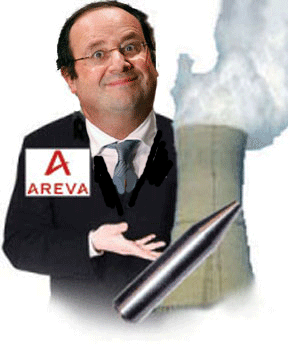 Sundaram, Truthout | News Analysis On January 26, French President François Hollande was the chief guest for India’s Republic Day ceremony, where India showcases its military hardware in a colonial-era parade in its capital. Meanwhile, in Jaitapur on India’s western coast, farmers and fisherfolk were protesting against Hollande’s visit, arguing that the nuclear reactors that India is importing from France threaten their lives, livelihoods and the local ecology.
The Joint Declaration: Localizing Risk, Siphoning Off Profit
In a joint declaration issued on January 25 in New Delhi, the two governments reaffirmed their commitment to go ahead with a long-pending nuclear deal. As per the declaration, the intense negotiations to finalize the commercial agreement are expected to conclude by the end of this year, and the construction of six European pressurized reactors (EPR) imported from France is to begin by early 2017.
The new twist in the declaration is the “maximum localization” of the project and “technology transfer” for the same. Although the government of Indian Prime Minister Narendra Modi seems to have proudly included these new terms and added a “Made in India” tag on the Jaitapur project, it actually means that the French industry would be transferring the burden of its most controversial reactor design at a time of its worst crisis.
The safety vulnerabilities of the reactor pressure vessel (RPV) – the huge iron core where radioactive fission takes place – came under serious questions, raised by France’s own nuclear safety regulator Autorité de Sûreté Nucléaire (ASN) in April 2015. Later in 2015, Areva, the French reactor builder, had to ask the US Nuclear Regulatory Commission to suspend certification review for EPR design. The United States has been postponing certification for EPR since 2007. The Finnish regulator has taken Areva to court on this issue, and Finland has canceled the order for its second EPR. Just two days after the publication of ASN’s report, Modi reaffirmed the EPR deal from France during his visit to Paris in April 2015. It is exactly this controversial component – the RPV – that an Indian private company L&T will now be building, with no experience in the nuclear sector at all.
The current phase of negotiations on Jaitapur is about the price of reactors, which remains a major sticking point. Although the former chief of India’s Atomic Energy Commission promised a tariff of a maximum of 10 US cents per unit for the electricity produced in Jaitapur, independent experts have claimed it will be much higher (20 to 30 cents per unit). This means the government of India would use taxpayers’ money to keep the price competitive. If we go by the cost of EPRs in the United Kingdom, each Indian reactor may cost as much as $8.9 billion. Two reactors in Jaitapur’s first phase will cost as much as India’s total expenditure on science and technology (including the departments of space, science and technology, biotechnology, and research for the entire country). A diplomatic cable revealed by WikiLeaks quoted the general manager of the Nuclear Power Corporation (NPCIL), saying that India is paying a “high” price for Jaitapur………….
The Indian government has managed to acquire land for the project by pressuring farmers and luring a handful of landlords. Despite land acquisition, the farmers in Jaitapur continue to resist. Most villagers either work on others’ land or provide rural services to the agrarian community and do not get any compensation when villages are dislocated for “development” projects. Tabrez Soyekar, a young fisherman, was killed in an indiscriminate police shooting in April 2011, during a peaceful protest. Hundreds of activists and eminent citizens, including the former Navy chief of India and retired justice of the Supreme Court of India, were detainedduring a protest march.
Thirteen village councils in Jaitapur passed unanimous resolutions against the project as recently as November 2015. It is utterly hypocritical for both countries to laud each other’s democratic credentials for international diplomacy if the democratically elected village councils are neglected violently……..
Independent energy experts in India, including a former top official in the Ministry of Power, have argued for a decentralized energy framework that would suit India better, as the majority of its population still lives in villages scattered across the country and transmission losses in centralized Indian grids are staggering.
The 2015 World Nuclear Industry Status Report concludes that, after the Fukushima accident, the international nuclear industry has faced its worst crisis globally. The industry is looking at India as a big market where they can compensate for their losses and revive their fortunes. India has become an attractive market for global nuclear corporations, where the government is mortgaging its financial and environmental health to welcome them. This includes channeling the accident liability to the public; undermining environmental, geological and safety laws; and ignoring the measured advice of independent experts.
Besides Jaitapur, massive and intense anti-nuclear protests have arisen in Koodankulam, Mithi Virdi and Kovvada, where Russian and US corporations are setting up nuclear power plants. Local communities in other places like Chutka, Fatehabad and Mahi Banswara have also been agitating against the nuclear projects. The government has resorted to brutal crackdowns and repression against these consistently peaceful protests. More than 8,000 people in Koodankulam are facing fabricated police cases under colonial-era sedition laws and charges of waging war against the Indian state. The police have killed, arrested and harassed villagers indiscriminately, including women and children. They surrounded the Idinthakarai village in 2012 and disrupted its vital supply lines that deliver goods, including food and milk for children and medicines, to force the village to surrender. One of the first steps that the new government under Modi took in 2015 was to come up with a “confidential” report by the Intelligence Bureau, naming Greenpeace, the Coalition for Nuclear Disarmament and Peace, and other anti-nuclear and environmentalist organizations “anti-national.”http://www.truth-out.org/news/item/34627-france-peddles-unsafe-nuclear-reactors-to-india-drawing-protest
Radioactive trash problem accelerates in Japan , with latest nuclear reactor restart
 Third reactor restart spurs fears over shaky Kansai evacuation plans BY ERIC JOHNSTON STAFF WRITER , JAPAN TIMES, TAKAHAMA, FUKUI PREF 29 JAN 16 . “……The restarts also mean Kepco must once again confront the question of what to do with spent fuel, an issue that is rapidly becoming one of local and national concern.
The spent-fuel storage pools for the Takahama No. 3 and 4 reactors are expected to be full in about eight years. Kepco plans to remove the fuel and nuclear waste to a mid-term storage facility for a half century before transporting them somewhere else for final storage.

In a recent meeting with Fukui Gov. Issei Nishikawa, Kepco President Makoto Yagi said Kepco wants to begin operating a mid-term storage facility outside the prefecture by around 2030. The utility aims to choose a site for the facility by 2020.
That presents a problem. Kepco promised Nishikawa that spent fuel from the Takahama reactors will not be stored within the prefecture but in one of the utility’s other service areas. This means Shiga, Kyoto, Nara, Hyogo, Osaka, Wakayama, Mie or Gifu.But there are certain conditions a potential storage site has to meet. For transportation reasons, Kepco wants it located in a prefecture with port facilities. That eliminates Nara, Shiga, and Gifu prefectures. Second, Yagi says that local consent to build and store the waste is crucial.
That is potentially an even bigger problem. Kyoto Gov. Keiji Yamada has strongly opposed building a facility in his prefecture. Osaka Gov. Ichiro Matsui appears opposed as well, saying he does not want Kepco in charge of the facility. Mie and Hyogo prefectures have said they are not considering hosting a facility at present.
Only Wakayama appears to be a possibility at the moment. In 2009, the port city of Gobo hinted it might be interested in hosting a mid-term facility. Kepco did a survey and agreed it was possible to build there, but nothing has happened since then.http://www.japantimes.co.jp/news/2016/01/29/national/third-reactor-restart-spurs-fears-over-shaky-kansai-evacuation-plans/#.VqvMftJ97Gg
LA gas disaster – a mini Chernobyl?
Breaking: They may have “lost control entirely of entire field” involved in LA gas disaster, and it’s coming up everywhere… We learned there’s many other leaks -Attorney — Officials: Loud sound of gas escaping heard half mile away; A “mini-Chernobyl” — AP: Leak “out of control”… amount released “seriously underestimated” (VIDEO)http://enenews.com/breaking-company-entirely-lost-control-entire-gas-field-involved-la-methane-disaster-leaking-everywhere-learned-many-other-wells-leaking-attorney-official-mini-chernobyl-ap-leak-control-tv-a?utm_source=feedburner&utm_medium=email&utm_campaign=Feed%3A+ENENews+%28Energy+News%29
Porter Ranch Town Hall Meeting, Jan 22, 2016 (emphasis added) — Patricia Oliver, attorney (at 11:30 in): “Now it’s kind of simple — if you have a well blow-out, you quit injecting [more gas] underground… No order had been issued [to stop this] though… We sent a letter [to the Division of Oil, Gas & Geothermal Resources (DOGGR)] saying, “Stop all of the injections, until you can stop the leak”… So we sent a letter on Dec. 1 asking them to stop all injections… Nine days later, they said, “Stop injecting gas”… You’d think that at least temporarily settled it — because if [SoCalGas] didn’t like that, SoCalGas could have temporarily appealed… I have no record of appeal… AQMD [Air Quality Management District] inspected the facility on Nov. 10… and they found all these wells that weren’t accessible — 16 approximately… We don’t know yet why they were inaccessible. We also learned that 15 wells were leaking. We also don’t know why that happened. I spoke at the AQMD hearing this last week and said, “I’m concerned that the fact that now you guys are looking at these injection wells — you don’t know what that means.” You see, DOGGR knows what that means — and that’s a sign that SoCalGas lost control entirely of the entire field and it’s leaking everywhere… So we were like, “We want proof. Now if it’s just coincidental, and you show us why that’s not what’s happening, that’s fine, but provide the evidence”… Families have a right to know what’s going on in that oil field.” (Audience applauds)
Rep. Brad Sherman, U.S. House of Representatives, Jan 21, 2016 (at 17:45): “This the largest natural gas leak in history. We were up there yesterday… what we heard was a loud sound of natural gas escaping that you could hear quite loudly from over half a mile away.”
The Guardian, Jan 11, 2016: Residents attack slow response to what official called ‘a mini-Chernobyl’… “This is a mini-Chernobyl,” Mike Antonovich, the LA county supervisor, told a public hearing at the weekend… [It] is the largest leak of… methane known to experts.
CBS/AP, Jan 15, 2016: A new report shows the level of toxins released… has been seriously underestimated, state regulators said… The findings were released in response to [SoCalGas’ admission that they] underestimated the number of times the cancer-causing chemical benzene has spiked.
AP, Jan 22, 2016: AP, Jan 22, 2016: Officials Waited Months To Monitor California’s Massive Gas Leak — A massive natural gas leak… had been out of control for more than a month when the county’s acting health director said in November that long-term impacts of the cancer-causing chemical benzene should be measured. It took many more weeks to implement the testing… “We can always look back and say, ‘Why didn’t we start with an expanded monitoring program?’” said Angelo Bellomo, deputy county director for health protection… Rob Jackson, an environmental scientist at Stanford University, said… it had undermined the ability to measure health impacts.
UK nuclear power project a bonanza for Japanese companies, Hitachi-GE and others
Hitachi sees over 1tn yen in business for Japan companies http://asia.nikkei.com/Business/Deals/Hitachi-sees-over-1tn-yen-in-business-for-Japan-companies
 TOKYO — A nuclear power project in the U.K. will generate more than 1 trillion yen ($8.42 billion) in orders for Japanese businesses, it was learned Sunday, giving a shot in the arm to exports by an industry suffering from a lack of orders at home since the Fukushima accident of 2011.
More than 3 trillion yen is budgeted for the project if joint venture Hitachi-GE Nuclear Energy constructs four advanced boiling water reactors — and an even higher sum if six reactors get the nod. Hitachi has invited 40 or so Japanese companies to a meeting at the British Embassy here to explain details.
Also expected are water supply pump manufacturer Ebara as well as Kurita Water Industries and Kubota. Shimizu and Kajima, which have experience building housing structures for nuclear plants in Japan, will also likely go.
While Hitachi-GE will handle the reactor core, Japanese companies are expected to undertake key technologies for operating the nuclear plant, giving Japan about 40% of the project total.
(Nikkei)
Japan: secret use of consumer’s money to fund pro nuclear political campaign
Utilities secretly buy tickets for pro-nuclear minister’s fund-raisers http://ajw.asahi.com/article/behind_news/politics/AJ201401270057 January 27, 2014 THE ASAHI SHIMBUN
Using money paid by consumers, nuclear plant operators have secretly bought tickets worth several million yen a year for fund-raising parties of Akira Amari, a pro-nuclear Cabinet minister, since 2006, The Asahi Shimbun learned.
The utilities have kept each ticket purchase at 200,000 yen ($2,000) or less to prevent their names from appearing in the political fund reports of Amari, the minister in charge of economic revitalization, sources said.
It was already reported that directors of electric power companies have made individual donations to the ruling Liberal Democratic Party, but the utilities were found for the first time to have bought fund-raising party tickets with electricity fees paid by consumers.
Amari, an LDP lawmaker with economic and industrial interests, exerts strong influence on energy policy and advocates reactivating idled nuclear reactors.
In July, he sought Niigata Governor Hirohiko Izumida’s approval of Tokyo Electric Power Co.’s application for safety screening in preparation for restarting two reactors at its Kashiwazaki-Kariwa nuclear plant.
Amari’s office told The Asahi Shimbun it handles and reports political funds appropriately. It declined to discuss details beyond those entered in reports.
Nine regional utilities that operate nuclear plants bought tickets for Amari’s parties in 2006, when he became minister of economy, trade and industry, according to senior officials of electric power companies. The electric power industry falls under the jurisdiction of that minister.
The companies together spent about 1 million yen for each party. Their share was determined based on the size of company operations, the sources said.
The arrangement was maintained for the following years, and affiliates of the utilities sometimes joined.
TEPCO dropped out of the framewor
Risky Plutonium-Mixed Fuel used in Japan’s new nuclear reactor restart
 Japan Restarts Nuclear Reactor Using Plutonium-Mixed Fuel http://abcnews.go.com/International/wireStory/japan-restarts-nuclear-reactor-plutonium-mixed-fuel-36593509, By MARI YAMAGUCHI, ASSOCIATED PRESS, 29 Jan 16, Japan on Friday restarted a nuclear reactor that uses riskier plutonium-based MOX fuel, the first of that type to resume operations under stricter safety rules introduced after the 2011 Fukushima disaster.
Japan’s large stockpile of plutonium has raised international nuclear security concerns, and the government has come up with the idea of burning it in reactors to reduce the amount.
The No. 3 reactor at Takahama nuclear plant in western Japan, operated by Kansai Electric Power Co., went back online Friday. Dozens of people protested outside the plant in Fukui prefecture, where preparations for a restart of another reactor, No. 4, are also underway.
Fukui has more than a dozen reactors, the biggest concentration in one prefecture, causing safety concerns for neighbors including Kyoto and Shiga, whose Lake Biwa is a major source of drinking water for western Japan.
Two reactors that use conventional uranium fuel were restarted last year in southern Japan. Japan started burning MOX, a plutonium-uranium hybrid fuel, in some of its conventional reactors in 2009. Experts say conventional reactors can safely burn MOX for up to one-third of their fuel, but it emits more radiation and could interfere with control rods when they are needed to suppress the nuclear chain reaction.
Japan has enough plutonium, mostly from reprocessed spent fuel, to make 6,000 bombs.
Nearly five years since a massive earthquake and tsunami caused meltdowns at the Fukushima Dai-ichi nuclear plant, about 100,000 people still cannot return to nearby areas. Workers at the plant continue to struggle with its decommissioning, which will take decades.
Aiming to help business by generating energy, Japan’s government is pushing to restart as many reactors as possible after they are deemed safe. Forty remaining workable reactors are still offline for safety checks.
Follow Mari Yamaguchi on Twitter at twitter.com/mariyamaguchi
Her work can be found at http://bigstory.ap.org/content/mari-yamaguchi
Community and environmental impact of the Jaitapur nuclear power project
 France Peddles Unsafe Nuclear Reactors to India, Drawing Protest , 29 January 2016 By Kumar Sundaram, Truthout | News Analysis “………the concerns of the local community in Jaitapur go beyond the cost of the project. Jaitapur is located in the stunningly beautiful Konkan region, replete with verdant plateaus, magical mountains and undulating hills, lagoons, creeks, the open sea and infinite greenery. The NPCIL has labeled nearly 65 percent of the land as “barren,” despite the fact that Konkan is one of the world’s 10 “biodiversity hotspots,” sheltering over 5,000 species of flowering plants, 139 of mammals, 508 of birds and 179 of amphibians, including 325 globally threatened species.

Altogether, the nuclear park would jeopardize the livelihoods of 40,000 people. The annual turnover of Jaitapur’s fishing villages is about $2.2 million. In Nate Village alone, there are 200 big trawlers and 250 small boats. Nearly 6,000 people depend directly on fishing and over 10,000 are dependent on ancillary activities.
The community is apprehensive that the elaborate security arrangements around the project would block the fisherfolks’ use of the two creeks of Jaitapur and Vijaydurg. The fish population will also be affected since the nuclear plant would release a massive 52 billion liters of hot water into the Arabian Sea daily, raising the local sea temperature by 5 to 7 degrees Celsius.
Jaitapur has highly fertile land, which produces rice and other cereals, and arguably the world’s most famous mango, the Alphonso. Cashews, coconuts, kokum, betel nuts, pineapples and other fruits are found in abundance. The land is also quite productive in terms of its use for cattle-grazing and rain-fed agriculture.
The environmental impact assessment (EIA) for Jaitapur, conducted by the government-run National Environmental Engineering Research Institute (NEERI), did not even look into the crucial aspects of radiological releases, decommissioning and nuclear waste, besides summarily neglecting the vital issues of ecosystems and livelihoods, terrestrial ecosystems and farming, mangrove forests and the fragile marine ecology and fisheries in the region.
NEERI admits it does not have any expertise in radiation-related issues and it just mentioned in its report that all the stipulations of the government’s nuclear regulator would be followed. The then-minister for environment and forests, Jairam Ramesh, had himself termed these EIA assessments a joke. Even that environmental clearance, granted on 35 absurdly weak conditions, was given only for a period of five years, which lapsed as of November 2015. Citizens groups and independent experts have demanded a fresh EIA in place of an extension……… http://www.truth-out.org/news/item/34627-france-peddles-unsafe-nuclear-reactors-to-india-drawing-protest
Crapo’s crap nuclear amendment passed by USA Senate
 Senate overwhelmingly approves Crapo nuclear energy legislation http://www.clearwatertribune.com/news/online_only_news/senate-overwhelmingly-approves-crapo-nuclear-energy-legislation/article_0ceb9f8e-c6c2-11e5-b5cf-871b59e94614.html
Washington, D.C. – The U.S. Senate today approved overwhelmingly legislation written by Idaho Senator Mike Crapo that would increase nuclear research efforts at the Idaho National Laboratory and other national labs through new partnerships between the public and private sectors. The vote of 87 to 4 to approve the amendment makes it a part of a larger energy policy reform bill before the Senate.
Crapo, along with Senators Jim Risch, Sheldon Whitehouse, (D-Rhode Island), Cory Booker (D-New Jersey) and Orrin Hatch (R-Utah), Mark Kirk (R-Illinois) and Dick Durbin (D-Illinois) originally introduced the Nuclear Energy Innovation Capabilities Act (NEICA), which was the foundation of the Crapo amendment voted on today. The legislation, S. 2461, directs the U.S. Department of Energy (DOE) to prioritize partnering with private innovators on new reactor technologies and the testing and demonstration of reactor concepts. Under the agreement today, the Nuclear Regulatory Commission (NRC) would report to Congress on any barriers that would prohibit the licensing of new reactors within a four-year time period……….. (registered readers only )
Anxieties over safety in the region, as Japan restarts 3rd nuclear reactor
Third reactor restart spurs fears over shaky Kansai evacuation plans BY ERIC JOHNSTON STAFF WRITER , JAPAN TIMES, TAKAHAMA, FUKUI PREF 29 JAN 16 . – Kansai Electric Power Co. on Friday restarted its Takahama No. 3 reactor, the nation’s third unit to go back online under new safety regulations but the first to run on mixed oxide (MOX) fuel, which contains plutonium extracted from spent nuclear fuel.
The restart has revived concerns, especially in neighboring Kansai, about the feasibility of plans to evacuate residents within 30 km of the plant in the event of an accident. It is also unclear where the spent fuel from the reactors will eventually be stored.
The restart was largely welcomed by local businesses and the town of Takahama, which rely on the subsidies and service industry trade that nuclear power brings…….
In the neighboring port city of Maizuru in Kyoto Prefecture, Mayor Ryozo Tatami said Kepco needs to make sure that restarting the reactor won’t lead to an accident. He also called on Tokyo to strengthen its disaster planning for such an event. The Takahama plant’s No. 4 reactor is expected to be restarted next month.
The Takahama plant lies on the Sea of Japan coast in southern Fukui Prefecture, with only a few access roads in and out of the area. About 180,000 people live in 12 towns and cities within 30 km of the site, in Fukui, Kyoto and Shiga.
While plans exist on paper to evacuate some Fukui residents to Hyogo, Kyoto, and Tokushima prefectures, many municipalities there don’t have detailed plans for receiving evacuees. This could possibly mean the only relief might come from Maizuru, which hosts the Japan Coast Guard and a Maritime Self-Defense Force base within 30 km of Takahama…….
the plans assume people will have the physical ability to flee. “There is no evacuation plan in place for the tens of thousands of people with special needs — inpatients and outpatients at hospitals and various facilities, those in day care, and those with handicaps living at home. When others can flee, there are no vehicles to transport these people nor medical care prepared at the evacuation site,” said Aileen Mioko Smith, executive director of the antinuclear group Green Action.
“Restart of the Takahama plant is a human rights injustice toward children and those with handicaps,” she said.
Kansai officials critical of the restart include Kyoto Gov. Keiji Yamada, who said Thursday he did not feel adequate local consent had been obtained due to concerns about evacuation issues. That same day, Shiga Gov. Taizo Mikazuki said there was a lack of sufficient disaster planning.
On Friday, Osaka Mayor Hirofumi Yoshimura added his voice to the opposition, saying the rules for disposing spent nuclear fuel — the lack of mid-term and final storage facilities — remained unclear. The city of Osaka owns about 9 percent of Kepco’s stocks.
Fukui hopes the two restarts will translate into more central government subsidies for hosting the plant. The prefecture received ¥30.6 billion in nuclear related subsidies in fiscal 2014. The latest available figures for Takahama show it received over ¥35 billion between 1974 and 2013……..
anti-nuclear activists say it is not just a matter of price, and that many people may choose to go with suppliers of electricity from renewable energy or other nonnuclear sources.
“The household electricity market will open up to more competition, especially from firms selling non-nuclear generated electricity. Customers will move away from Kepco if it tries to sell power from its nuclear plants, and the company won’t be able to survive,” said Kiyoko Kubo of Wakasa Net, an antinuclear group based near Takahama.http://www.japantimes.co.jp/news/2016/01/29/national/third-reactor-restart-spurs-fears-over-shaky-kansai-evacuation-plans/#.VqvMftJ97Gg
1 This Month

of the week – Shut Down Drone Warfare!


Tell the Ukrainian Government to Drop Prosecution of Peace Activist Yurii Sheliazhenko

Petition to revoke the licensing of the Near Surface Nuclear Disposal Facility (NSDF) at Chalk River. https://www.ourcommons.ca/petitions/en/Petition/Details?Petition=e-7247
To see nuclear-related stories in greater depth and intensity – go to https://nuclearinformation.wordpress.com
-
Archives
- April 2026 (79)
- March 2026 (251)
- February 2026 (268)
- January 2026 (308)
- December 2025 (358)
- November 2025 (359)
- October 2025 (376)
- September 2025 (257)
- August 2025 (319)
- July 2025 (230)
- June 2025 (348)
- May 2025 (261)
-
Categories
- 1
- 1 NUCLEAR ISSUES
- business and costs
- climate change
- culture and arts
- ENERGY
- environment
- health
- history
- indigenous issues
- Legal
- marketing of nuclear
- media
- opposition to nuclear
- PERSONAL STORIES
- politics
- politics international
- Religion and ethics
- safety
- secrets,lies and civil liberties
- spinbuster
- technology
- Uranium
- wastes
- weapons and war
- Women
- 2 WORLD
- ACTION
- AFRICA
- Atrocities
- AUSTRALIA
- Christina's notes
- Christina's themes
- culture and arts
- Events
- Fuk 2022
- Fuk 2023
- Fukushima 2017
- Fukushima 2018
- fukushima 2019
- Fukushima 2020
- Fukushima 2021
- general
- global warming
- Humour (God we need it)
- Nuclear
- RARE EARTHS
- Reference
- resources – print
- Resources -audiovicual
- Weekly Newsletter
- World
- World Nuclear
- YouTube
-
RSS
Entries RSS
Comments RSS
 nuclear-news