The week in nuclear news
 EUROPE. Nuclear hazards extend beyond a nation’s borders: Belgium a case in point
UK. Senior Tories agree with Jeremy Corbyn on ditching Trident nuclear weapons system. Jeremy Corbyn suggests submarines without warheads. Inquiry into Litvinenko’s radiation murder points to Putin as instigator. EDF Directors might delay UK Hinkley nuclear decision yet again.Nuclear waste plans an abuse of democracy in Britain.
China, Russia. Big anxieties with China and Russia’s plans for floating nuclear reactors
USA. Republican presidential candidates clueless on the danger of nuclear arms race. Bernie Sanders opposes the one $trillion nuclear weapons plan. “Modernisation” making nuclear war more likely: time to renew disarmament process. Best to store nuclear wastes locally in deep bores, not export it. Stanford experts warn on the nuclear risks for Waste Isolation Pilot Plant in southeastern New Mexico. Radioactive material constantly being emitted from LA gas blowout.
JAPAN. Fukushima cleanup will need underwater robots
CANADA. 92,000 petition Canada.Don’t store nuclear waste near Great Lakes
TAIWAN. Why is the media ignoring the anti nuclear success in Taiwan‘s election landslide?
SPAIN. Anniversary of a nuclear disaster in Spain.
IRAN. Sanctions lifted as Iran complies with nuclear deal
SOUTH AFRICA. Political connections in South Africa’s uranium energy drive. Radiation hazards in planned uranium mining in the Karoo, South Africa.
RENEWABLE ENERGY Record $329BN GLOBAL INVESTMENT IN 2015 in RENEWABLE ENERGY.
How the tax payer funds the nuclear industry – to keep it alive
The many ways of counting subsidies
Among the goodies routinely given away, according to the Concerned Scientists, are:
- Subsidies at inception, reducing capital costs and operating costs.
- Accounting rules allowing companies to write down capital costs after cost overruns, cancellations and plant abandonments, reducing capital-recovery requirements,
- Recovery of ‘stranded costs’ (costs to a utility’s assets because of new regulations or a deregulated market) passed on to rate payers.
 Yes, you read that last item correctly. Even when the energy industry receives its wish to be rid of regulation, it is entitled to extra money because of the resulting rigors of market pressures.
The ongoing environmental disaster at Fukushima is a grim enough reminder of the dangers of nuclear power. But nuclear does not make sense economically, either. Continue reading
Local medical cyclotrons, not nuclear reactors, best for producing medical isotopes
 Medical isotope production in Australia: Should we be using reactor based or cyclotron technology? 15th January 2016 Dr Margaret Beavis MBBS FRACGP MPH Medical Association for Prevention of War, Australia Health Professionals Promoting Peace “…….Cyclotron isotope production A cyclotron is an electromagnetic device (about the size of a four wheel drive car) used to accelerate charged particles (ions) to sufficiently high speed (energy) so that when it impinges upon a target the atoms in the target are transformed into another element. 10 In other words, it uses electricity and magnets to shoot a narrow beam of energy at elements, e.g. molybdenum-100, a natural material, and this produces technetium-99.
Senior Tories agree with Jeremy Corbyn on ditching Trident nuclear weapons system
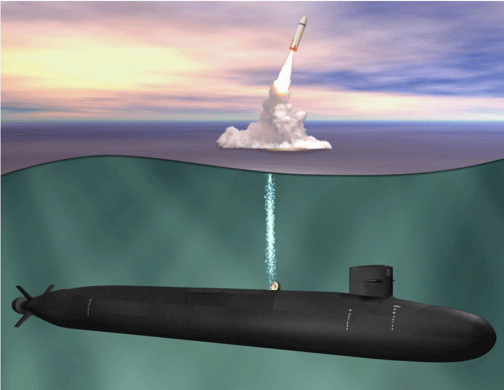
 Not just Jeremy Corbyn – senior Tories also think ditching Trident might be a good idea https://tompride.wordpress.com/2016/01/18/not-just-jeremy-corbyn-senior-tories-also-think-ditching-trident-might-be-a-good-idea/18 Jan 2016 by Tom Pride
Perhaps the Cameron government should be more careful before labelling Jeremy Corbyn a national security ‘threat’ just for saying Trident should be scrapped. Because there are several influential people in the Tory Party who think Trident should be scrapped too.
Former Conservative Defence Secretary Michael Portillo agrees with Jeremy Corbyn:
“Our independent nuclear deterrent is not independent and doesn’t constitute a deterrent against anybody that we regard as an enemy. It is a waste of money and it is a diversion of funds that might otherwise be spent on perfectly useful and useable weapons and troops. But some people have not caught up with this reality.”
And Tim Montgomerie – who has been called one of the most influential Tories outside the cabinet – has also floated ditching Trident (from the Times last March): In fact, in 2009 Montgomerie praised the willingness of the Tory Party to discuss the scrapping of Trident as “tough thinking”.
Veteran Tory MP and former Tory Party chairman David Davis has alsoquestioned the affordability of Trident.
And before he was Prime Minister, David Cameron himself refused to rule outscrapping Trident.
But it’s not just senior Tories who agree with Corbyn.
Field Marshal Lord Bramall, General Lord Ramsbotham, General Lord Ramsbotham and General Sir Hugh Beach have denounced Trident as “irrelevant”.
And in 2009, that well-known hotbed of radical socialism, the Daily Telegraphdiscussed reasons why Trident should be scrapped.
Even the Daily Mail has in the past pondered getting rid of Britain’s nuclear deterrent.
OK. I think I’ve just about got the hang of this Trident discussion thing now.
Scrapping Trident is only a threat to national security when it’s not being proposed by a Tory?
Oh shit. Our nuclear deterrent runs on Windows XP. No, really, it does.
Big anxieties with China and Russia’s plans for floating nuclear reactors
 China and Russia plan to cover the oceans with floating nuclear power plants http://www.marketwatch.com/story/china-and-russia-plan-to-cover-the-oceans-with-floating-nuclear-power-plants-2016-01-21 By JURICADUJMOVIC Jan 21, 2016
And the big problem: Human memory is short, even when it comes to disaster
In an effort to become the largest exporter of nuclear-energy technology, China has started building a reactor housed in a floating vessel, which is scheduled to be finished by 2020. If that sounds alarming, brace yourself: More than 100 additional nuclear reactors are planned for the next decade.
The idea behind this “micro” 200-megawatt reactor (1 megawatt can power 1,000 homes) was to create a mobile energy source for offshore oil and gas exploration, as well as provide electricity, heating, and facilitate desalination for islands and coastal areas.
I don’t know about you, but this certainly gets my Geiger counter beeping with unease. While some dismiss the danger, saying floating nuclear reactors aren’t all that dangerous — nuclear-powered submarines and aircraft carriers basically fit that description — the truth remains that it’s still a freaking nuclear reactor. History taught us the price we have to pay every time “highly unlikely” disasters happen, and now that another 100 of these will be built in the coming decade, the likelihood of yet another nuclear disaster will increase.
The Chinese government did its best to cover up the disaster, silencing local and foreign journalists. Now imagine if it were a floating nuclear reactor. Nothing would change, apart from more dire consequences and even more censorship.
Also looking to join the fun in the radioactive sun is Russia’s Akademik Lomonosov. This floating nuclear power plant will be ready for deployment in October. It’s going to be used to power port cities, industrial infrastructure, and oil and gas drilling rigs and refineries, which, according to Russian Deputy Prime Minister Dmitry Rogozin, will prove to be a great asset in Arctic exploration. The ship is 144 meters long with two reactors capable of producing 70 megawatts of electricity.
Although they have their fair share of nuclear “mishaps,” the Russians are kicking their nuclear efforts up a notch: Akademik Lomonosov is only the first of many floating nuclear power plants that will be built. Vessels will also be available to rent. So far, 15 countries have shown interest in having these power plants for their own use.
Here’s where things get scary: Imagine that out of hundreds of these floating nuclear power plants, just a dozen or so become targeted by terrorists or a military force. Regardless of the scenario, the resulting tragedy would be felt worldwide.
Of course, I could be wrong. Perhaps we’re ushering in a sort of a nuclear renaissance, an age in which nuclear energy really proves to be a safer and better solution than fossil-fuel sources.
But I doubt it. Humanity has proven that it understands the dangers of something only when the worst has already happened, and even then just for a brief while. ..
You can thank the Chernobyl disaster for 20 years of stagnation (1986-2006) during which time fewer nuclear power plants were built. In 2007, however, humanity tried its luck with nuclear energy again. Following a short increase, we saw yet another decline in 2011. Why? You guessed it: That was the year of the Fukushima disaster, and it took the world less than five years to forget the effects of the meltdown. It’s time for another adventure!
But what of Fukushima? As of 2013, the site in Japan remained highly radioactive, with some 160,000 evacuees still living in temporary housing, and tracts of land that will likely remain unsuitable for farming for centuries. The difficult cleanup job will take 40 years or longer to complete, and will cost tens of billions of dollars. Following the disaster, Japan shut down 54 nuclear power plants.
We’ve seen what happens when things go awry with just one nuclear power plant. Now, with hundreds in the making, will we live long enough to finally learn from our mistakes? Let’s hope so.
Best to store nuclear wastes locally in deep bores, not export it
The deep borehole project is particularly interesting because almost anywhere you look in America, there are deep rocks perfect for this method. Every state can have its own borehole repository, much to some of these state’s annoyance, since most political leaders would rather foist their waste off on someone else and claim victory for their constituents.
But Congress doesn’t exactly like the deep borehole idea because they would not be able to gang up on one state and force it down their throat. Each state would have its own deep nuclear disposal boreholes and wouldn’t be able to promise their citizens that the nuclear waste would ever leave their state
 DOE Tries To Change The Rules On Nuclear Waste Disposal http://www.forbes.com/sites/jamesconca/2016/01/21/doe-tries-to-change-the-rules-on-nuclear-waste-disposal/#2715e4857a0b28df073f561e James Conca , “……..DOE is funding a study to drill a borehole more than 3 miles deep into the Earth’s crust below North Dakota to test a disposal method for radioactive waste called Deep Borehole Disposal. In this scenario, waste would be placed in the lower mile of the borehole in crystalline rock that would isolate the waste from the surface and shallow environments.
The borehole would then be filled up with some special layers, including asphalt, bentonite, concrete and crushed rock that will isolate the waste for geologic time. The borehole would need a diameter of at least 17 inches at the bottom for placing containers, and would be lined with steel casing. Future boreholes will be wider as the technology evolves, which is has been doing lately.
These developments follow directly the recommendations of President Obama’s Blue Ribbon Commission on America’s Nuclear Future, and followed up in thePresident’s Memorandum on disposal of Defense High-Level Waste and the2013 Administration’s Strategy for the Management and Disposal of Used Nuclear Fuel and High-Level Radioactive Waste. Conca and Wright (2012)provide background on nuclear waste and interpretation of the three BRC recommendations pertaining to nuclear waste disposal that has led to these changes.
But the basic strategy of this new disposal initiative is: Continue reading
Don’t store nuclear waste near Great Lakes – 92,000 petition Canada
 92,000 petition Canada not to store nuclear waste near Great Lakes, Phys Org, January 21, 2016 Ninety-two-thousand people have pressed Ottawa to reject a proposal to store nuclear waste in an underground vault near the Great Lakes, fearing a spill would contaminate this source of drinking water for 40 million in Canada and the United States.

A 6,000-page petition signed by opponents of local utility Ontario Power Generation’s proposal to store waste in a deep limestone vault to be drilled beneath the world’s largest operating nuclear power plant on the Bruce Peninsula, more than 200 kilometers northwest of Toronto, was delivered to Environment Minister Catherine McKenna, her office confirmed Thursday.
McKenna is expected to rule on the project in March after an independent review panel in May 2015 recommended that it be approved………
any risk of contamination of the largest group of freshwater lakes, created by retreating glaciers 14,000 years go, and containing more than 20 percent of the world’s surface fresh water, is too great.
Cities and towns in the United States and Canada, including Chicago and Toronto, have passed 184 resolutions opposing the building of a nuclear waste repository here.
“No scientist, nor geologist can provide us with a 100,000-year guarantee that this nuclear waste dump will not leak and contaminate the Great Lakes,” Beverly Fernandez, who spearheaded the campaign against the storage facility, told AFP.
“So when we found out that OPG was trying to locate this nuclear waste right besides the Great Lakes—the drinking water for 40 million people in two countries—we felt compelled to do something,” she said http://phys.org/news/2016-01-petition-canada-nuclear-great-lakes.html#jCp
Green Cross assesses legacy of Fukushima and Chernobyl nuclear disasters
 FIVE YEARS AFTER FUKUSHIMA, GREEN CROSS ASSESSES LEGACY OF DISASTER Green Cross is organizing a dialogue with international experts in Zurich on 30 January to shed light on the consequences of nuclear disasters in Japan and the former Soviet Union. This year marks the fifth anniversary of the Fukushima catastrophe, and the 30th anniversary of the Chernobyl meltdown. Both of those incidents continue to affect the people and environment of surrounding regions to this day.
Green Cross has been working on the ground at Fukushima ever since the disaster hit, and has over 20 years’ experience helping victims of Chernobyl in Russia, Ukraine and Belarus. The Zurich conference brings together experts and practitioners from Japan, Russia and Switzerland to share their experiences and participate in a frank exchange about the state of atomic energy in the world today.
The event will run from 13h30 to 15h30 in the EPF’s Maximum auditorium (Ramistrasse 101, 8092 Zurich). It will feature former Japanese Prime Minister Naoto Kan, Swiss Professor Dr. Horst-Michael Prasser, Green Cross’ own Dr. Stephen Robinson, Prof. Jonathan Samet from the University of Southern California, and Professor Dr. Vladimir Kusnetsov from the Moscow Electrotechnical Institute.
The panelists will each make a presentation, after which they will respond to audience questions. Simultaneous translation will be provided in English, German, Japanese and Russian.
Inquiry into Litvinenko’s radiation murder points to Putin as instigator
 Vladimir Putin ‘probably’ ordered KGB defector Alexander Litvinenko’s death by radioactive poisoning: inquiry, SMH, January 22, 2016 Nick Miller London: Russian President Vladimir Putin “probably” ordered the murder of defected KGB spy Alexander Litvinenko in London, an official inquiry in Britain has found.
The finding will put pressure on the British government to take fresh measures against Russia, possibly including targeted sanctions and travel bans. It may also harm potential co-operation in military action against ISIS, and upcoming peace talks on the Syrian conflict.
Litvinenko died in November 2006 after a radioactive poison was slipped into his tea at a London hotel.
The inquiry examined expert evidence and heard testimony from forensic scientists and family members, as well as secret evidence that was not disclosed in the public report – but believed to be from Western intelligence agencies.
Sir Robert said he was “sure” that Litvinenko was deliberately poisoned with the radioactive element polonium 210, which he ingested on November 1, 2006.
That afternoon Litvinenko had met two men for tea at the Pine Bar of the Millennium Hotel in Mayfair, London.
The men were Andrey Lugovoy and his associate Dmitri Kovtun – former Russian army officers. Lugovoy was a former KGB agent.
Forensic evidence showed the Pine Bar was “heavily contaminated” with polonium 210, the inquiry found………http://www.smh.com.au/world/vladimir-putin-probably-ordered-kgb-defector-alexander-litvinenkos-death-inquiry-20160121-gmba0w
The fate of Chernobyl- affected victims – photojournalist exposes their tragedy
 Making the Chernobyl-affected kids ‘visible’ to Belarus http://www.bbc.co.uk/programmes/p03fzylg?ocid=socialflow_facebook
The Chernobyl nuclear disaster in Ukraine contaminated vast swathes of the surrounding area nearly 30 years ago. But Ukraine wasn’t even the worst hit. Belarus suffered about 70% of the nuclear fallout. And some of the radiation victims there are the focus of a project by Polish photojournalist Jadwiga Bronte. She hopes to change the way people in Belarus see its disabled children of Chernobyl.
EDF Directors might delay UK Hinkley nuclear decision yet again
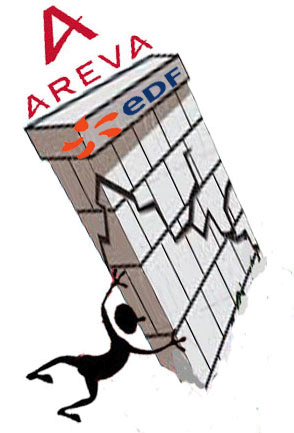 Hinkley Point – Edf to decide whether to build nuclear power station next week By Central Somerset Gazette January 19, 2016 A DECISION on whether a nuclear power station is built at Hinkley Point could be announced next week.
Reports in the French press indicate that the board of directors of the French state electricity generator EDF will meet on January 27 to make a final investment decision on the construction of two nuclear reactors at Hinkley Point near Bridgwater.
The final investment decision on the project has been delayed due to the lengthy negotiations with Chinese partners.
However even now there are concerns that the board might defer the decision for the ninth time……….
EDF is also locked in negotiations surrounding a complex deal to buy a French nuclear reactor builder, Areva, and in the disposal of it’s stake in eight current British nuclear power stations, five in the US, one in Finland and a number of Polish coal fired plants
Preparation of the site stopped last year when negotiations over the financing of the power station stalled.
Campaigners opposed to the building of Hinkley Point C are sceptical that the project will ever see the light of day.
Stop Hinkley spokesperson Roy Pumfrey said: “I’ll believe it when I see it. This is the ninth time EDF has said a final investment decision is imminent. Just last October the chairman of EDF, Jean-Bernard Levy, said work would be starting before the end of 2015. It would be completely reckless of the Board to give the go-ahead to this £25 billion project when the company is in such a parlous state.” http://www.centralsomersetgazette.co.uk/8203-Hinkley-Point-Edf-decide-build-nuclear-power/story-28559932-detail/story.html
Nuclear reactor Legal struggle continues between AREVA and Finland’s TVO
 Areva, TVO have month to settle nuclear reactor claims-minister http://af.reuters.com/article/commoditiesNews/idAFL8N154366 PARIS Jan 20 (Reuters) French nuclear reactor maker Areva and Finnish customer Teollisuuden Voima (TVO) will try to settle mutual claims over a long-delayed nuclear reactor within a month, French Economy Minister Emmanuel Macron said on Wednesday.
“I had the chance at the start of the week to speak to (Finnish Economy Minister) Olli Rehn, and we gave ourselves a month to let the companies and shareholders find the conditions for an agreement or way out,” Macron said on the sidelines of a New Year event.
Finnish utility TVO and an Areva-led consortium with Siemens are claiming billions of euros from one another in an arbitration suit over cost overruns and delays to the EPR reactor Areva is building in Olkiluoto, in Finland, for TVO.
The unsettled claims are holding up a planned takeover of Areva’s reactor arm by French utility EDF, which does not want to be responsible for them.
TVO has a 2.6 billion euro ($2.8 billion) claim against the Areva-Siemens consortium at the International Chamber of Commerce’s (ICC) arbitration court, while Areva-Siemens have a 3.4 billion euro counter-claim.
While the French state – which owns 85 percent of EDF and 87 percent of Areva – has a big stake in a speedy resolution of the Olkiluoto claims, TVO is a private company and the Finnish government’s position so far has been not to intervene.
TVO’s owners include paper companies UPM and Stora Enso as well as utility Fortum. (Reporting by Michel Rose and Yann Le Guernigou; Writing by Geert De Clercq; Editing by James Regan and Susan Thomas)
Canbada’s national security could be at risk in extending life of Pickering nuclear station
 Decisions at nuclear plant could compromise national security: safety commission, Global News, 20 Jan 16 By Monique Muise and Jacques Bourbeau
Ontario Power Generation Inc. was slapped with a $31,690 fine in a notice of violation issued on Jan. 12. The Canadian Nuclear Safety Commission states that on two occasions, the company “made unilateral decisions to cease corrective actions necessary for compliance with conditions of their Power Reactor Operating Licence” at the Pickering Nuclear Generating Station.
“If not corrected, this behavior could in the future result in unreasonable risks to national security, the health and safety of persons and the environment,” the notice says. “This (penalty) is issued to (Ontario Power Generation) to promote compliance with conditions of their licence and to deter reoccurrence.”……..
Nuclear power plants have always represented a potential security risk given the materials they contain, but in recent years it’s the risk of cyber-attacks that has governments concerned. Nuclear facilities are increasingly reliant on digital systems, which could potentially be hacked and – in a worst-case scenario – trigger a disaster……..
The notice was issued just one day after Ontario’s Liberal government announced that it wants to squeeze four more years of life out of the Pickering nuclear station. It will also start a $12.8 billion refurbishment of the Darlington power station this fall to extend that plant’s life by about 30 years.
Nuclear reactors at the stations were originally scheduled to be decommissioned in 2020. http://globalnews.ca/news/2466527/decisions-at-nuclear-plant-could-compromise-national-security-safety-commission/
Nuclear industry survived only because of ‘liability cap’
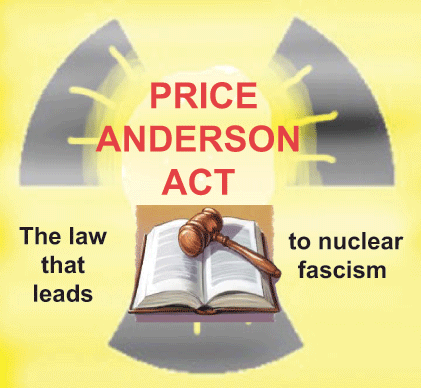
After 60 years of nuclear power, the industry survives only on stupendous subsidies, Ecologist, Pete Dolack 4th January 2016 Without ‘liability caps’ the industry would have been dead long ago
The British government, for instance, currently foots more than three-quarters of the bill for radioactive waste management and decommissioning, and for nuclear legacy sites. A report prepared for Parliament estimates that total public liability to date just for this program is around £50 billion, with tens of billions more to come.
Liability caps for accidents are also routine. In the US the Price-Anderson Act, in force since 1957, caps the total liability of nuclear operators in the event of a serious accident or attack to $10.5 billion. If the total is higher, as it surely would be, taxpayers would be on the hook for the rest.
As a further sweetener, the Bush II / Cheney administration, in 2005, signed into law new nuclear subsidies and tax breaks worth $13 billion. The Obama administration, attempting its own nuclear push, has offered an additional $36 billion in federal loan guarantees to underwrite new reactor construction, again putting the risk on taxpayers, not investors.
The Vermont Law School paper aptly sums up this picture with this conclusion: [page 69]
“If the owners and operators of nuclear reactors had to face the full liability of a nuclear accident and meet the alternatives in competition that is unfettered by subsidies, no one would have built a nuclear reactor in the past, no one would build a reactor today, and anyone who owned one would exit the nuclear business as quickly as they could.”
If we had a rational economic system, they surely would.http://www.theecologist.org/News/news_analysis/2986749/after_60_years_of_nuclear_power_the_industry_survives_only_on_stupendous_subsidies.html
Record $329BN GLOBAL INVESTMENT IN 2015 in RENEWABLE ENERGY
 CLEAN ENERGY DEFIES FOSSIL FUEL PRICE CRASH TO ATTRACT RECORD $329BN GLOBAL INVESTMENT IN 2015, Bloomberg New Energy Finance, JAN 14, 2016

View this press release in PDF.
2015 was also the highest ever for installation of renewable power capacity, with 64GW of wind and 57GW of solar PV commissioned during the year, an increase of nearly 30% over 2014.
London and New York, 14 January 2016 – Clean energy investment surged in China, Africa, the US, Latin America and India in 2015, driving the world total to its highest ever figure, of $328.9bn, up 4% from 2014’s revised $315.9bn and beating the previous record, set in 2011 by 3%.
The latest figures from Bloomberg New Energy Finance show dollar investment globally growing in 2015 to nearly six times its 2004 total and a new record of one third of a trillion dollars (see chart on page 3), despite four influences that might have been expected to restrain it.
These were: further declines in the cost of solar photovoltaics, meaning that more capacity could be installed for the same price; the strength of the US currency, reducing the dollar value of non-dollar investment; the continued weakness of the European economy, formerly the powerhouse of renewable energy investment; and perhaps most significantly, the plunge in fossil fuel commodity prices.
Over the 18 months to the end of 2015, the price of Brent crude plunged 67% from $112.36 to $37.28 per barrel, international steam coal delivered to the north west Europe hub dropped 35% from $73.70 to $47.60 per tonne. Natural gas in the US fell 48% on the Henry Hub index from $4.42 to $2.31 per million British Thermal Units.
Michael Liebreich, chairman of the advisory board at Bloomberg New Energy Finance, said: “These figures are a stunning riposte to all those who expected clean energy investment to stall on falling oil and gas prices. They highlight the improving cost-competitiveness of solar and wind power, driven in part by the move by many countries to reverse-auction new capacity rather than providing advantageous tariffs, a shift that has put producers under continuing price pressure.
“Wind and solar power are now being adopted in many developing countries as a natural and substantial part of the generation mix: they can be produced more cheaply than often high wholesale power prices; they reduce a country’s exposure to expected future fossil fuel prices; and above all they can be built very quickly to meet unfulfilled demand for electricity. And it is very hard to see these trends going backwards, in the light of December’s Paris Climate Agreement.”
Looking at the figures in detail, the biggest piece of the $328.9bn invested in clean energy in 2015 was asset finance of utility-scale projects such as wind farms, solar parks, biomass and waste-to-energy plants and small hydro-electric schemes. This totalled $199bn in 2015, up 6% on the previous year.[1]
The biggest projects financed last year included a string of large offshore wind arrays in the North Sea and off the coast of China. These included the UK’s 580MW Race Bank and 336MW Galloper, with estimated costs of $2.9bn and $2.3bn respectively, Germany’s 402MW Veja Mate, at $2.1bn, and China’s Longyuan Haian Jiangjiasha and Datang & Jiangsu Binhai, each of 300MW and $850m………
National trends
China was again by far the largest investor in clean energy in 2015, increasing its dominance with a 17% increase to $110.5bn, as its government spurred on wind and solar development to meet electricity demand, limit reliance on polluting coal-fired power stations and create international champions.
Second was the US, which invested $56bn, up 8% on the previous year and the strongest figure since the era of the ‘green stimulus’ policies in 2011. Money-raising by quoted ‘yieldcos’, plus solid growth in investment in new solar and wind projects, supported the US total……..http://about.bnef.com/press-releases/clean-energy-defies-fossil-fuel-price-crash-to-attract-record-329bn-global-investment-in-2015/
1 This Month
Chernobyl: The Lost Tapes – A good documentary on Chernobyl on SBS available On Demand for the next 3 weeks– https://www.sbs.com.au/ondemand/tv-program/chernobyl-the-lost-tapes/2352741955560

of the week–London Campaign for Nuclear Disarmament

Tell the Ukrainian Government to Drop Prosecution of Peace Activist Yurii Sheliazhenko
To see nuclear-related stories in greater depth and intensity – go to https://nuclearinformation.wordpress.com
-
Archives
- April 2026 (114)
- March 2026 (251)
- February 2026 (268)
- January 2026 (308)
- December 2025 (358)
- November 2025 (359)
- October 2025 (376)
- September 2025 (257)
- August 2025 (319)
- July 2025 (230)
- June 2025 (348)
- May 2025 (261)
-
Categories
- 1
- 1 NUCLEAR ISSUES
- business and costs
- climate change
- culture and arts
- ENERGY
- environment
- health
- history
- indigenous issues
- Legal
- marketing of nuclear
- media
- opposition to nuclear
- PERSONAL STORIES
- politics
- politics international
- Religion and ethics
- safety
- secrets,lies and civil liberties
- spinbuster
- technology
- Uranium
- wastes
- weapons and war
- Women
- 2 WORLD
- ACTION
- AFRICA
- Atrocities
- AUSTRALIA
- Christina's notes
- Christina's themes
- culture and arts
- Events
- Fuk 2022
- Fuk 2023
- Fukushima 2017
- Fukushima 2018
- fukushima 2019
- Fukushima 2020
- Fukushima 2021
- general
- global warming
- Humour (God we need it)
- Nuclear
- RARE EARTHS
- Reference
- resources – print
- Resources -audiovicual
- Weekly Newsletter
- World
- World Nuclear
- YouTube
-
RSS
Entries RSS
Comments RSS
 nuclear-news
