Jeremy Corbyn on scrapping Trident: I want Britain to bring about a nuclear-free world
Jeremy Corbyn on scrapping Trident: I want Britain to bring about a nuclear-free world
Labour leader suggests he is prepared to speak at an anti-Trident CND and Stop the War rally in February……
Nuclear power cannot be both “safe” and “cheap” for Wisconsin
John LaForge: Nuclear power might be safe or cheap, but never safe and cheap, The Cap Times, Madison, Wisconsin, JOHN LaFORGE | Nukewatch staffer, 11 Jan 16
Wisconsin legislators are seeking repeal of a 33-year-old moratorium on building nuclear reactors here without having  first found a solution for managing high-level radioactive waste. Since no solution is in hand, the state is permanently saddled with three large reactors on Lake Michigan (one at Kewaunee is closed), another shut-down reactor on the Mississippi River near La Crosse, and a research reactor on Madison’s University of Wisconsin campus. Radioactive waste just keeps accumulating onsite.
Yet in spite of the problem of corrosive, hot, cancer-causing, deadly waste that is radioactive for 1 million years, the Legislature has been captured by industry lobbyists who love a good yarn like the one about clean, safe, cheap nuclear power.
At a state Senate committee hearing Jan. 5, several dozen people testified for and against the repeal (S.B. 288), and the “what could go wrong?” crowd spoke up for a theoretical future of safe and cheap reactors. They forget that reactor safety costs an astronomical amount of money. Others complained that the Yucca Mountain, Nevada, waste dump proposal was canceled for political rather than scientific reasons, not recognizing that their own bill is thoroughly political and frighteningly anti-scientific. In fact, the Yucca Mountain plan faced over 290 unresolved scientific roadblocks that stood in the way of licensing approval at the time it was canceled.
At the hearing, Al Gedicks testified against the repeal bill with brevity and punch……..“The idea that nuclear power is clean defies common sense. Would a truly ‘clean energy’ source produce ‘one of the most hazardous substances on earth,’ according to the U.S. Government Accountability Office?
“Dr. Arjun Makhijani at the Institute for Energy and Environmental Research emphasizes that: ‘An objective assessment of the facts leads to the clear conclusion that nuclear power is already economically obsolete, quite apart from a number of other considerations. The same amount of money can produce far greater CO2 reductions with wind and solar energy than with nuclear.’”……. http://host.madison.com/ct/opinion/column/john-laforge-nuclear-power-might-be-safe-or-cheap-but/article_7d1ae5bc-40db-55d4-ac23-79f8bb62761b.html
Bangladesh: calls to stop Russia’s nuclear project
 Prominent Bangladeshis ask Russia not to build nuclear power plant, Bellona, January 11, 2016 by Andrei Ozharovsky, translated by Charles Digges ROOPUR, Bangladesh – Russian state nuclear corporation Rosatom and the government of Bangladesh have signed a deal to invest $12.65 billion in a project to build two 1200 MWe nuclear power units at Rooppur.
ROOPPUR, Bangladesh – Russian state nuclear corporation Rosatom and the government of Bangladesh have signed a deal to invest $12.65 billion in a project to build two 1200 MWe nuclear power units at Rooppur…….
Bangladesh, with its population of 150 million people, is one of the poorest countries in Southeast Asia, and is often rocked by political turbulence, terrorism and attacks on foreigners.
But in keeping with Rosatom’s practice of padding its foreign order book, the Bangladesh project looks like another in a long list of reactor export deals relying on huge credits financed by Russian taxpayers to countries that have scant chanced of repaying them.
Russia has already earmarked $500 million in credit to Bangladesh, and the start of construction will still require a few more loans from the Russian budget. That may be a hard sell, given Atomenergoprom, Rosatom’s foreign reactor building wing, last year suffered an embarrassing credit rating downgrade to a “BBB –.”
And where the deal earlier envisioned building Russia’s well-test work-horse VVER-1000 reactor, newer documents stipulate Bangladesh will receive the VVER-1200, which still has not been used for industrial-scale energy production ever.
Local’s who stand against the plan have also told Bellona that Bangladesh can fair fine on cheaper and readily available renewables and other climate friendly solutions it is now obligated to pursue as one of the 195 signatories of the Paris accord.
The plan for the Bangladesh has elicited criticism from experts in the local population, and Bellona has interviewed Bangladeshis who are against the import of Russian nuclear reactors.
One of these is Nusrat Islam Khan, a journalist from the city of Pabna in Bangladesh’s central district, which is where the plant would, in fact, be located. Her chief concern is that the plant’s construction was a political, not a popular decision…….
Another prominent Bangladeshi who spoke with Bellona was Arup Rahee, of the Center for Bangladeshi Studies…… http://bellona.org/news/nuclear-issues/2016-01-prominent-bangladeshis-ask-russia-not-to-build-nuclear-power-plant
Legal obstacle to South Africa’s nuclear energy plan

 Energy department faces legal ordeal on nuclear energy deal, Business Day Live, South Africa BY CAROL PATON, 11 JANUARY 2016 THE CURIOUS DEVELOPMENTS ON GOVERNMENT’S NUCLEAR ENERGY PROCUREMENT PROGRAMME LAST MONTH HAVE SUNK THE DEPARTMENT OF ENERGY DEEPER INTO A LEGAL MESS.
Already, an attempt to challenge the legality and constitutionality of the process has been lodged: Earthlife and the Southern African Faith Communities Environmental Initiative (Safcei) filed papers to oppose it in October.
Now, the muddled events that unfolded last month are likely to make matters worse, making an already controversial process even more contested.
It all began in the last Cabinet meeting of the year on December 7, when it took a decision to issue a request for proposals (RFP) to build 9,600MW of nuclear power-generation.
As important as it is, this decision was not communicated in the normal post-Cabinet media statement by Minister in the Presidency Jeff Radebe.
Official confirmation took place only on December 21 in a government gazette. Like the absence of an official announcement, the gazette, too, was strange. Apart from the fact that it was issued on December 21, when the holiday season was under way, the gazette made use of a two-year-old signature by previous minister Ben Martins to establish its legal basis.
In order to call for proposals for new generation, the minister of energy must first make an official determination in terms of the Electricity Regulation Act of 2006. To do so, she must obtain the concurrence of the National Energy Regulator of SA (Nersa). This, it seems, was done two years ago by Mr Martins and the paperwork then lay in a file in the Department of Energy for the next two years.
Last month, the old document was retrieved and slapped into the government gazette.
There are several reasons why the Department of Energy decided to use an old document to make the determination rather than getting a fresh one from serving Energy Minister Tina Joemat-Pettersson. None of them, though, will make the nuclear deal any smoother……..
key to the legal arguments will be the difference of opinion over whether public consultation to build nuclear power stations has taken place. The department says that it has as it consulted widely over the IRP 2010 and has also engaged in environmental impact assessments. Safcei and Earthlife disagree that this amounts to meaningful consultation.
It is also worth noting that an RFP is only the beginning of the shopping process and does not mean that a decision to build plants has been taken. Reaching a decision on whether nuclear energy is affordable, particularly on the scale that SA has in mind, is a bigger and more difficult decision that the Cabinet will still have to take.
Getting there, though, will mean first navigating the procedural legal hurdles along the way. http://www.bdlive.co.za/business/energy/2016/01/11/energy-department-faces-legal-ordeal-on-nuclear-energy-deal
Young Japanese activist takes up the torch for nuclear disarmament
Japanese student activist to keep up lifelong fight against nuclear arms, Japan Times, BY MIYA TANAKA
KYODO JAN 11, 2016 YOKOHAMA – For aging atomic bomb survivors, it is a matter of grave concern whether their long-running campaign to see the abolition of nuclear weapons will be continued by the next generation, and just as important to them as passing on their memories of the 1945 bombings.
They may have a ray of hope in a 23-year-old descendant of an atomic bomb survivor who is working for a better future through a range of activities, most recently as a member of the student group that spearheaded last year’s protests against the security laws.
Mitsuhiro Hayashida is one of the founding members of SEALDs (Students Emergency Action for Liberal Democracy-s), which was launched in May, and has also been deeply committed since his teenage days to the effort to ban nuclear weapons.
“What drives me in my current actions are the words of the hibakusha I have heard all my life,” the senior student at Meiji Gakuin University in Tokyo told the audience at an event in October to oppose the security laws and nuclear arms.
Born in Nagasaki, Hayashida has been immersed in local peace education since his childhood and grew up listening to the accounts of people who survived the city’s bombing, including his grandfather, who entered the city shortly after the blast and handled dead bodies…….
Realizing that civilian use of nuclear power can expose people to radiation just like atomic bombs, Hayashida was drawn to protests in front of the prime minister’s office in 2012. These demonstrations also drew the other youths who would go on to form SEALDs, such as the group’s leading figure, Aki Okuda, who was also attending Meiji Gakuin University.
While Hayashida’s current focus is on repealing the security laws that passed the Diet in September, expanding the role of the Self-Defense Forces overseas, he believes the activities of SEALDs are also connected to his mission to abolish nuclear weapons.
“I think debating national security issues will eventually lead to (the question of whether we need) atomic bombs, so in my mind these two issues are linked,” he said……..http://www.japantimes.co.jp/news/2016/01/11/national/japanese-student-activist-keep-lifelong-fight-nuclear-arms/#.VpN_ybZ97Gj
Canada’s UN ambassador to spearhead Anti-nuclear weapon effort
Anti-nuclear weapon effort to be spearheaded by Canada’s UN ambassador Renewed push comes as Justin Trudeau is expected to attend Barack Obama’s Nuclear Security Summit, CBC News By Mike Blanchfield, The Canadian Press Jan 10, 2016 Canada plans to kick-start a long-stalled international effort aimed at ridding the world of the key ingredients needed for nuclear weapons, The Canadian Press has learned. The renewed push this week by Canada’s United Nations ambassador to Geneva to spearhead the creation of a Fissile Material Cut-off Treaty or FMCT, comes as Prime Minister Justin Trudeau is expected to attend U.S. President Barack Obama’s Nuclear Security Summit.
Trudeau’s presence at the Obama summit, March 31 and April 1, would come just three weeks after his scheduled March 10 gala state dinner at the White House.
Canada’s renewed focus on nuclear non-proliferation efforts has been in the works for months, but the effort has new urgency because of North Korea’s recent claim to have conducted a test of a hydrogen bomb.
“I think it sent a chill through the world community and reinvigorates this discussion and this debate,” Rosemary McCarney, Canada’s permanent representative to the United Nations in Geneva, told The Canadian Press……. http://www.cbc.ca/news/politics/canada-nuclear-weapons-un-1.3397601
How safe is Scotland’s nuclear submarine graveyard ?
Questions raised over safety regime at Scotland’s nuclear submarine graveyard, HeraldScotland, Rob Edwards / 11:13 Sunday 10 January 2016 The safety regime at the Rosyth naval dockyard, home to seven defunct nuclear submarines, has been called into question after an emergency exercise failed to demonstrate adequate arrangements for rescuing casualties from an accident.
The UK government’s nuclear safety watchdog has ordered Babcock, the multinational company that runs the Fife dockyard for the Royal Navy, to rerun the exercise, codenamed Nightstar, in March because of mistakes made last September.
An inspection by the Office for Nuclear Regulation (ONR) concluded that there were flaws in the way that staff looked after injured people during the exercise at the base known as ‘Scotland’s nuclear graveyard’. There were also communication and command problems in dealing with the imagined accident.
The problems with the Nightstar exercise on September 30 2015 were disclosed in the ONR’s latest three-monthly report on Rosyth. Though inspectors thought that some of the exercise procedures were adequate, others were not……..
Looking after the submarines to ensure that radioactivity doesn’t leak and contaminate the environment has cost the MoD £13.5 million over the last five years. http://www.heraldscotland.com/news/14194001.Questions_raised_over_safety_regime_at_Scotland_s_nuclear_submarine_graveyard/
Jeremy Corbyn’s aim to change UK Labour’s stance on Trident nuclear weapons system
Trident: Jeremy Corbyn hopes to alter Labour’s stance on nuclear weapons by stripping shadow Cabinet of power, The Independent, Leader wants Labour’s ruling body to be able to make policy decisions Tom McTague Political Editor @TomMcTague 9 Jan 16 Jeremy Corbyn’s secret blueprint to seize control of Labour’s policy-making machine to fast-track a change in the party’s position on Trident has been revealed in leaked documents drawn up by his allies in the trade unions.
Leading members of the Shadow Cabinet have been made aware of a paper which would strip them of the power to set policy between conferences. Instead, Labour’s National Executive Committee would explicitly be given the role of deciding policy.
>One minister who has seen a copy of the proposal said that Mr Corbyn’s advisers were coordinating the move which would change the NEC’s “aims and objectives” to give it explicit power to set policy. The document is likely to be put before the NEC at its meeting this month.
Speaking to The Independent on Sunday, the shadow Chancellor John McDonnell said he had not seen the document but confirmed the NEC would decide “fairly quickly” on a process to change Labour’s position on Trident – and revealed it would happen “before the summer”.
He revealed that the review of the party’s nuclear policy, which is being conducted by former London Mayor Ken Livingstone and the new shadow Defence Secretary Emily Thornberry – would come up with a range of options, including unilateral disarmament, rather than recommending just one policy. One option, that is to be considered, is for Britain to become a “virtual nuclear state” like Japan and Iran – free of nuclear weapons but with the possibility of re-arming in a short period of time…….http://www.independent.co.uk/news/uk/politics/trident-jeremy-corbyn-hopes-to-alter-labours-stance-on-nuclear-weapons-by-stripping-shadow-cabinet-a6804376.html
USA’s use of threat of nuclear war – Danial Ellsberg
US FREQUENTLY USES THREAT OF NUCLEAR WAR, WARNS WHISTLEBLOWER DANIEL ELLSBERG MINNEAPOLIS , Shadow Proof, KIT OCONNELL—, 2 Jan 16 MintPress News is proud to host “Lied to Death,” a 13-part audio conversation between famed whistleblower Daniel Ellsberg and social justice activist Arn Menconi.
Menconi wrote that these interviews are a “mixture of historical, political science and Dan’s sixty-year scholarly analysis as a former nuclear planner for Rand Corporation.”
For more information on the interview and Daniel Ellsberg, see the introduction to this series.
Chapter 1: Ellsberg on the the origins of empire and the nuclear danger to humanity
In the first full chapter of “Lied to Death,” Ellsberg discusses the origins of American empire, telling Menconi that empire building goes all the way back to Sargon, the ruler of ancient Mesopotamia and history’s first emperor.
However, unlike the emperors of old, the U.S. government publicly espouses democracy while simultaneously carrying out many of the same forms of repression and manipulation that historic rulers used to gain global power, he says.
For Ellsberg, that’s where the CIA and similar forces become essential. While he believes that covert actions may be necessary for any nation to protect itself during times of war, Ellsberg tells Menconi that only an empire needs covert agencies during times of peace because those agencies help maintain the image of freedom and transparency.
“The United States is not a government with a covert operations agency named the CIA, it’s a government which has a covert foreign policy,” Ellsberg explains.
Ellsberg argues that the CIA allows the U.S. to enact this covert foreign policy, which is not meant to ensure the independence of other nations, but to “buy their dependence.” When something goes wrong, the agency protects the White House from accountability. Even when the government’s cover story for its actions is revealed to be false by the media or a whistleblower, he says “there are other cover stories and cover stories within cover stories” — all of which misdirect attention. “The president is not held accountable … and he will not be held [accountable] before history.”
Apart from the pretense of democracy, Ellsberg argues that the United States is “unremarkable” as an empire, except for a few key points, most notably its ability to use the threat of nuclear weapons.
“The danger of all-out war leading to the extinction of the human species is significant right now and always has been larger than people thought,” he tells Menconi.
He does not believe that government officials actively seek out nuclear war, understanding that it would be devastating for humanity. But Ellsberg claims the U.S. has used the threat of nuclear conflict far more frequently than the public realizes, and that government leaders consider the potential for actual nuclear war to be an “acceptable risk” in return for the power the threat confers over other nations.
The U.S. and a handful of its allies, including the United Kingdom and France, also act as nuclear kingmakers, choosing which countries will be allowed to have nuclear weapons and which will not. Unfortunately, this behavior has brought us closer to human extinction by promoting a global buildup of nuclear weapons which could be deployed at any time. Specifically, Ellsberg says U.S. foreign policy is directly responsible for the buildup of Russian nuclear weapons during the Cold War…….
I wish I could say that our government has improved its treatment of whistleblowers in the 40 years since the Pentagon Papers. Instead we’re seeing an unprecedented campaign to crack down on public servants who reveal information that Congress and American citizens have a need to know.
USA ‘s “antagonism” blamed for increasing tensions in Korean Peninsula
|
Why climate change is an ethical problem.

Stephen M. Gardiner is professor of philosophy, and Ben Rabinowitz is endowed professor of the human dimensions of the environment at the University of Washington, Seattle.
Climate change presents a severe ethical challenge, forcing us to confront difficult questions as individual moral agents, and even more so as members of larger political systems. It is genuinely global and seriously intergenerational, and crosses species boundaries. It also takes place in a setting where existing institutions and theories are weak, proving little ethical guidance.
The critical question as we seek to address climate change will be which moral framework is in play when we make decisions. In many settings, we do not even notice when this question arises, because we assume that the relevant values are so widely shared and similarly interpreted that the answer should be obvious to everyone. Nevertheless, the values question is not trivial, since our answer will shape…
View original post 663 more words
January 10 Energy News

Opinion:
¶ Vermont power line approval big step for Canadian power • The $1.2 billion, privately funded TDI project faced no significant opposition, something unusual for the state. One difference is the entire TDI project, which would power for about 1 million homes, would be invisible. [Rutland Herald]
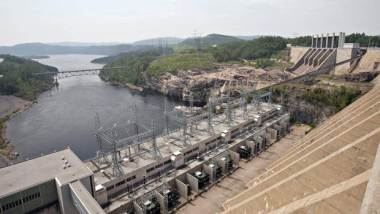 The Jean-Lesage hydro-electric dam generates power along the Manicouagan River, north of Baie-Comeau, Quebec. AP file photo
Science and Technology:
¶ One researcher from Portsmouth University in England claims that properly implemented artificial “power islands” could solve the world’s energy crisis. An artificial archipelago of power islands could provide a place for energy to be secured from wind, tides, and the sun. [The Inquisitr]
World:
¶ Scientists and conservationists fear China’s ever-increasing pressure to expand the nuclear power sector means not enough attention is being paid to safety. Within a couple of decades, Hong Kong could be in…
View original post 453 more words
1 This Month

of the week – Shut Down Drone Warfare!


Tell the Ukrainian Government to Drop Prosecution of Peace Activist Yurii Sheliazhenko

Petition to revoke the licensing of the Near Surface Nuclear Disposal Facility (NSDF) at Chalk River. https://www.ourcommons.ca/petitions/en/Petition/Details?Petition=e-7247
To see nuclear-related stories in greater depth and intensity – go to https://nuclearinformation.wordpress.com
-
Archives
- April 2026 (91)
- March 2026 (251)
- February 2026 (268)
- January 2026 (308)
- December 2025 (358)
- November 2025 (359)
- October 2025 (376)
- September 2025 (257)
- August 2025 (319)
- July 2025 (230)
- June 2025 (348)
- May 2025 (261)
-
Categories
- 1
- 1 NUCLEAR ISSUES
- business and costs
- climate change
- culture and arts
- ENERGY
- environment
- health
- history
- indigenous issues
- Legal
- marketing of nuclear
- media
- opposition to nuclear
- PERSONAL STORIES
- politics
- politics international
- Religion and ethics
- safety
- secrets,lies and civil liberties
- spinbuster
- technology
- Uranium
- wastes
- weapons and war
- Women
- 2 WORLD
- ACTION
- AFRICA
- Atrocities
- AUSTRALIA
- Christina's notes
- Christina's themes
- culture and arts
- Events
- Fuk 2022
- Fuk 2023
- Fukushima 2017
- Fukushima 2018
- fukushima 2019
- Fukushima 2020
- Fukushima 2021
- general
- global warming
- Humour (God we need it)
- Nuclear
- RARE EARTHS
- Reference
- resources – print
- Resources -audiovicual
- Weekly Newsletter
- World
- World Nuclear
- YouTube
-
RSS
Entries RSS
Comments RSS
 nuclear-news