America’s secret plutonium experiments on humans
Then there is the horrifying reality that these experiments were taking place in the shadow of Nazi Germany; some of the scientists involved in the radiation experiments were the very men whose earlier experimental designs had tormented prisoners of concentration camps. Welsome describes Operation Paperclip, conducted under the auspices of the U.S. government. Paperclip imported Nazi scientists and supported their work, helping to confer, in the words of scientist Joseph G. Hamilton, “a little of the Buchenwald touch” on American medicine.
This valuable work represents an elegy to lost ideals, lost health, and lost trust. One can only hope it will serve as a cautionary tale.
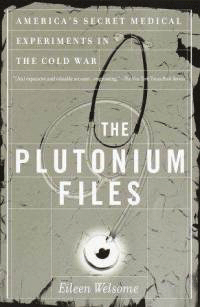 The Plutonium Files: America’s secret medical experiments in the Cold War N Engl J Med 1999; 341:1941-1942 December 16, 1999 Harriet A. Washington
The Plutonium Files: America’s secret medical experiments in the Cold WarBy Eileen Welsome. 580 pp. New York, Dial Press, 1999. $26.95. ISBN: 0-385-31402-7
Amid the embarrassments of Monicamania and of multiple public mea culpas, the past few years have not been exemplary ones for American journalism. This fact makes the triumph of The Plutonium Files all the sweeter, because this superlative book is a reminder of the purpose of investigative journalism.
This richly detailed, subtly nuanced history of government-engineered radiation experiments on unwitting Americans is based on the Pulitzer-prize–winning series Eileen Welsome wrote for the Albuquerque Tribune. Welsome’s tenacious and resourceful detective work has unveiled the saga of a sordid, tragic, yet fascinating chapter in the history of American medical science. The book succeeds on many levels. It is a gripping exposé of governmental exploitation and of medicine’s moral failures in an era in which blind trust defined the normal relationship between physicians and patients.
Between April 1945, scant months before the bombing of Hiroshima, and July 1947, the scientists of the Manhattan Project followed the construction of the atomic bomb with a chilling second act: medical experimentation on hundreds of unsuspecting Americans. Continue reading
Secret radiation experiments carried out on people
Some of the classified government experiments included:
 * Exposing more than 100 Alaskan villagers to radioactive iodine during the 1960s.
* Feeding 49 retarded and institutionalised teenagers radioactive iron and calcium in their cereal during the years 1946-1954.
* Exposing about 800 pregnant women in the late 1940s to radioactive iron to determine the effect on the fetus.
* Injecting 7 newborns (six were Black) with radioactive iodine.
* Exposing the testicles of more than 100 prisoners to cancer-causing doses of radiation. This experimentation continued into the early 1970s.
* Exposing almost 200 cancer patients to high levels of radiation from cesium and cobalt. The AEC finally stopped this experiment in 1974.
* Administering radioactive material to psychiatric patients in San Francisco and to prisoners in San Quentin.
* Administering massive doses of full body radiation to cancer patients hospitalised at the General Hospital in Cincinnati, Baylor College in Houston, Memorial Sloan-Kettering in New York City, and the US Naval Hospital in Bethesda, during the 1950s and 1960s. The experiment provided data to the military concerning how a nuclear attack might affect its troops.
* Exposing 29 patients, some with rheumatoid arthritis, to total body irradiation (100-300 rad dose) to obtain data for the military. This was conducted at the University of California Hospital in San Francisco.

—In preparing America for nuclear attack during the Cold War years following World War II, thousands of US citizens became the innocent victims of over 4,000 secret and classified radiation experiments conducted by the Atomic Energy Commission (AEC) and other government agencies, such as the Department of Defense, the Department of Health, Education and Welfare, the Public Health Service (now the CDC), the National Institutes of Health, the Veterans Administration (VA), the CIA, and NASA.
Millions of people were exposed to radioactive fallout from the continental testing of more than 200 atmospheric and underground nuclear weapons, and from the hundreds of secret releases of radiation into the environment. Over 200,000 “atomic vets” who worked closely with nuclear detonations at the Nevada test site during the 1950s and 1960s were especially vulnerable to radiation fallout.
Also affected were the thousands of so-called “downwinders”, who lived in nearby small towns in Nevada, Utah, Colorado and New Mexico. These downwinders (along with the animal populations) suffered the worst cumulative radioactive effects of fallout, along with a contaminated environment teeming with radioactive food and farm products. The plight of these poor country people exposed to government-induced radiation sickness has been recorded in Carole Gallagher’s remarkable photo-essay American Ground Zero: The Secret Nuclear War (The Free Press, 1993).
In reviewing declassified AEC records (now the Department of Energy) from the 1950s, Gallagher was shocked to discover one document that described the people downwind of the Nevada Test Site as “a low use segment of the population.” Her shock at such callous bigotry caused her to eventually move West to research, investigate and document those who lived closest to the Test Site, as well as workers at the site, and soldiers repeatedly exposed to nuclear bombs during the military tests.
Disinformation and Nuclear Fallout
In the nuclear arms race, government doctors and scientists brainwashed the public into believing low dose radiation was not harmful. Some officials even tried to convince people that “a little radiation is good for you.” Totally ignored was the knowledge that the radiation from nuclear fallout could lead to an increased risk of cancer, heart disease, neurological disorders, immune system disease, reproductive abnormalities, sterility, birth defects, and genetic mutations which could be passed on from generation to generation. The full extent of this radiation damage to the American public during the Cold War years will never be known. Continue reading
Cold war fears of Nuclear Armageddon ( that risk remains now)
 Memories of Whistling Past Nuclear Armageddon, NYT By FRANCIS X. CLINESJAN. 2, 2016 No one called it terrorism back then, but the angst of day-to-day existence during the Cold War was chillingly recalled with the release last month of the government’s top-secret nuclear target list for 1959. “Population” was the obscenely brief title of target category No. 275 — population, as in the citizens of major cities who war planners estimated would necessarily die by the millions……..
“Duck and cover” jokes and tight-lipped laughter became the real civil defense in the Cold War. It felt smarter to seek survival in satire like Stanley Kubrick’s “Dr. Strangelove.” Or in Mort Sahl’s stand-up skewering of Dr. Wernher von Braun, the captured German rocket scientist, who metamorphosed into an American space-age hero. Mr. von Braun said in his best-selling autobiography that “I aim at the stars.” “But,” Mr. Sahl amended, “sometimes hit London,”……..

the notion of nuclear Armageddon reappeared with the discovery by the New York State Assembly during a routine session that the state, in 1963, had actually constructed a bomb shelter with 4½-foot-thick walls and drawn up a list of 700 or so people who would be privileged to survive in it.
The long-forgotten shelter was a quiet, pet project of Gov. Nelson Rockefeller, who was also one of the era’s chief promoters of bunkers. Immediately, questions arose among the lawmakers: Why didn’t I know about this until now? More urgently: How do I get on the list?…….http://www.nytimes.com/2016/01/03/opinion/sunday/memories-of-whistling-past-nuclear-armageddon.html?_r=0
Radiation Risk : Linear No Threshold (LNT) Model Tested
Radiation Risk: Linear No Threshold (LNT) Model Tested
Fukushima Diary. Prime Minister Abe says that Fukushima nuclear station is ‘not settled’
 JP PM Abe “It is not proper to say Fukushima is settled” http://fukushima-diary.com/2015/02/jp-pm-abe-proper-say-fukushima-settled/ Iori Mochizuki The Prime Minister of Japan, Abe commented Fukushima is not settled.
This is the statement made in the Budget Committee of the House of Representatives on 1/30/2015.
Abe stated variety of problems are remaining unresolved in Fukushima plant, such as decommissioning, compensation, contaminated water etc.. Problems are piled up. Numbers of people are still forced to live outside of the hometown. It is not proper to say Fukushima is settled.
Related to this article.. Tepco inquired JP Gov about PM Abe’s statement to IOC “Contaminated water is entirely blocked” [URL]
http://www.shugiin.go.jp/internet/itdb_kaigiroku.nsf/html/kaigiroku/001818920150130003.htm
http://search.shugiin.go.jp/ja/search.x?q=%97%5C%8EZ%88%CF%88%F5%89%EF&ie=Shift_JIS
Are governments still allowing secret medical radiation experiments?
For over twenty years the law allowed the US Department of Defense (DoD) to use Americans as “guinea pigs.” This law (the US code annotated Title 50, Chapter 32, Section 1520, dated 30 July, 1977) remained on the books until it was repealed under public pressure in 1998. The new and revised bill prohibits the DoD from conducting tests and experiments on humans, but allows “exceptions.”
Unethical and dangerous experimentation undoubtedly continues in secret up to the present time, ostensibly under the guise of “national security.”
 The Human Radiation Experiments By ALAN R. CANTWELL Jr., M.D.October 8, 2001 By davidjones “……. Does Secret Medical Experimentation Continue? To this day there are no adequate safeguards to protect people from secret government experimentation. ……. What is clear from studying the Committee’s Final Report is that the medical and scientific professions collaborated with the government and the military to abuse and harm US citizens. In the process, the nuclear establishment literally got away with murder. And there is simply no end to the secrets that still emerge from the Cold War years that began 58 years ago with the Manhattan Project.
In January 2000, the government presented the results of a statistical study showing that atomic workers employed in the nuclear weapons industry during the Cold War were more likely to suffer a higher rate of cancer, due to their exposure to cancer-causing radiation and chemicals.
From the 1940s up to the present time, government lawyers and scientists have repeatedly rejected the claims of workers who became sick as result of nuclear radiation and exposure to deadly uranium, plutonium, and fluorine. As many as 600,000 workers in 14 nuclear weapons plants are now affected by the government’s final admission of wrongdoing in exposing these people to cancer and other chronic illnesses.
According to a Los Angeles Times report, “workers told of spending years trying to get compensation payments from the state, of having to hire attorneys to get disability pay, of going to clinics that forced them to sign away rights to a portion of any future disability payment before they could be treated.”
Kay Sutherland, a worker at the Hanford plutonium plant in central Washington State, told a hearing that “the people in this area have been forced into poverty because they’ve had to retire in their 30s, 40s, and 50s, too young to get a retirement, and too young to get Social Security. They fall through the cracks and they die.” Sutherland has lost four of her five family members to disease, and has an enlarged liver and multiple tumours. She considers herself “a Holocaust survivor for the American Cold War.”
How can we stop these nuclear and biological horrors, which have condemned thousands of innocent people to disease and death? Why must decades of government-sanctioned medical abuse be kept secret and covered-up by scientists and physicians who claim to be concerned about the health of the public?
One way to prevent abuse might be to bring the physician-scientist perpetrators of these experiments to justice in a court of law. However, unless the public is aroused, this is unlikely to happen.
Writing in the Columbia Journalism Review, Geoffrey Sea notes: “A startling fact about the experiments is that, despite the documentation of hundreds of cases of unethical conduct resulting in lasting damage to thousands of people, not a single physician or nurse, scientist or technician, policy maker or administrator has yet come forward to admit wrongdoing.”
For over twenty years the law allowed the US Department of Defense (DoD) to use Americans as “guinea pigs.” This law (the US code annotated Title 50, Chapter 32, Section 1520, dated 30 July, 1977) remained on the books until it was repealed under public pressure in 1998. The new and revised bill prohibits the DoD from conducting tests and experiments on humans, but allows “exceptions.” One of the exceptions is that a test or experiment can be carried out for “any peaceful purpose that is related to a medical, therapeutic, pharmaceutical, agricultural, industrial, or research activity.” Thus, the 1998 law has obvious loopholes which allow secret testing to continue. For details on the restrictions (and exceptions) for human testing for chemical and biological agents, consult the Gulf War Vets website at http//www.gulfwarvets.com/1520a.htm.
Unethical and dangerous experimentation undoubtedly continues in secret up to the present time, ostensibly under the guise of “national security.” Thus, it would seem prudent for patients to think twice before signing-up for government-sponsored medical studies, particularly at leading medical institutions. Enlightened patients might also view doctors (and scientists) with a healthy dose of skepticism, and a touch of paranoia. As weird as all this sounds, it could save your life! http://www.newdawnmagazine.com/articles/the-human-radiation-experiments
Documents reveal sloppy unsafe radiation management at San Onofre Nuclear Station
“My general impression from what I have seen in that report is San Onofre was very very sloppy, very very careless in handling radioactive material,” he told NBC 7 Investigates. “You basically had hundreds of pieces of contaminated equipment.”
The radiation levels around the concrete cubicle were so elevated “the inspector did not perform a survey inside,” according to the document
 Documents Detail How Nuclear Material Was Handled at San Onofre Nuclear Generating Station, 7 San Diego
Expert tells NBC 7 Investigates handling of nuclear material was “sloppy”
By JW August and Lynn Walsh Documents newly obtained by NBC 7 Investigates during secret talks about the condition of the land where the San Onofre Nuclear Generating Station (SONGS) sits detail how nuclear material was handled at the plant since the 1980s.
The documents were released to individuals involved with the secret negotiations about the current condition and future handling of the 25-acre property. According to a source familiar with the negotiations, the secret meetings have been going on for about 20 months and involve all the players with a stake in the prime coastal property.
Those players include the U.S. Navy, which owns the property; the U.S. Marines, whose base surrounds the property; and Southern California Edison (SCE) and San Diego Gas and Electric (SDG&E), both of which hold the lease to the property. Continue reading
How plutonium infiltrates the body’s cells
 Plutonium Trojan Horse in the Body , Mining Awareness Plus, 26 Feb 15 Plutonium shares some important similarities with biologically important trivalent transition metals, especially iron. This could have importance from a material science point of view, as well.
“Plutonium tricks cells by ‘pretending’ to be iron
By Jared Sagoff July 8, 2011
Plutonium gets taken up by our cells much as iron does,…
Researchers at the U.S. Department of Energy’s Argonne National Laboratory and Northwestern University have identified a new biological pathway by which plutonium finds its way into mammalian cells. The researchers learned that, to get into cells, plutonium acts like a ‘Trojan horse,’ duping a special membrane protein that is typically responsible for taking up iron.
This discovery may help enhance the safety of workers who deal with plutonium, as well as show the way to new ‘bio-inspired’ approaches for separating radioactive elements from other metals in used nuclear fuel.
Because the bodies of mammals have evolved no natural ability to recognize plutonium—the element was first produced in 1941—scientists were curious to know the cellular mechanisms responsible for its retention in the body. The researchers exposed adrenal cells from rats to minute quantities of plutonium to see how the cells accumulated the radioactive material.
Using the high-energy X-rays provided by Argonne’s Advanced Photon Source, the researchers were able to characterize a particular protein known as “transferrin,” which is responsible for bringing iron into cells. Each transferrin is made up of two subunits, known as N and C, that normally bind iron. When another protein—the transferrin receptor—recognizes both the N and C subunits, it admits the molecule to the cell. However, when both the N and C subunits contain plutonium, the transferrin receptor doesn’t recognize the protein and keeps it out.
Contrary to their expectations, the researchers discovered that in one of the mixed states—when an iron-containing N-subunit is combined with a plutonium-containing C-subunit—the resulting hybrid so closely resembles the normal iron protein that the uptake pathway is ‘tricked’ into allowing plutonium to enter the cell.
‘Although the interaction between plutonium and bodily tissues has been studied for a long time, this is the first conclusive identification of a specific pathway that allows for the introduction of plutonium into cells,’ said Mark Jensen, an Argonne chemist who led the research.
… The research was funded by the U.S. Department of Energy’s Office of Science as well as by the National Institutes of Health.”http://www.anl.gov/articles/plutonium-tricks-cells-pretending-be-iron Author manuscript found here: “An iron-dependent and transferrin-mediated cellular uptake pathway for plutonium“, Mark P. Jensen et. al. (http://www.ncbi.nlm.nih.gov/pmc/articles/PMC3462652/)
From the Jensen et. al. author manuscript: “… Pu is radiotoxic and is strongly retained by organisms1, Pu uptake from an accident, environmental contamination, or a nuclear or radiological attack can pose significant health risks. Plutonium localizes principally in the liver and skeleton in humans where it remains for decades2. It associates in vivo with the iron-containing proteins serum transferrin and ferritin3,4, but despite the danger of plutonium poisoning, the specific molecular-level pathways Pu travels to enter and localize in cells have never been identified2,5…”………. https://miningawareness.wordpress.com/2015/02/26/plutonium-trojan-horse-in-the-body/
Report of India’s Integrated Regulatory Review Services (IRRS) on Atomic Energy Board
India’s nuclear regulators have been audited, THE HINDU, MP RAM MOHAN ELS REYNAERS KINI , 3 JAN 16 But what’s the point? Parliament hasn’t passed the Nuclear Safety Regulatory Authority Bill 2015 as yet
Now, the full IRRS report has been made public and can be viewed on the AERB’s website. This is certainly one of the most significant transparency efforts initiated by the AERB in recent times. The authors believe this signals an important commitment to adopt a new public engagement model. At a substantive level, the IRRS team identified several good practices, but also areas warranting attention or in need of improvement, to enhance the overall performance of the regulatory system in India………
Many in civil society and the AERB itself in private communication maintain that its “de facto” independence should be cemented in a law “de jure” as well. That said, the IRRS mission observed that the “professionalism and integrity of the AEC, NPCIL and AERB senior staff towards ensuring the regulatory decision making processes/arrangements were completed independently and did not notice instances in which de facto AERB independence was compromised”.
Another important aspect that would need to be addressed is the grievance redress system or appeal procedure against decisions by the AERB. Currently, the constitution of the AERB states that appeals against decisions of the AERB shall be with the Atomic Energy Commission (AEC) whose decision shall be final. Here, the IRRS mission remained rather timid by merely referring to and not fully suggesting a more coherent appeal procedure which would be more in tune with a fully independent mechanism.
Addressing grievances
This is regrettable because one of the most important functions in any democratic system is the redressal of grievances, whether sought by an operator, a service provider, the public or anyone who has a role in an NPP activity. Moreover, the AERB constitution remains vague as to precisely who can appeal. These are aspects that also would need to be addressed more comprehensively to ensure that the public has faith in the nuclear regulatory system. The current redressal system also explains why people so far have generally opted to approach the courts with their grievances, rather than the AEC.
The DAE and the AERB should consider the IRRS mission review and many such suggestions of civil society in all earnestness, and thereby acknowledge that it is in the interest of the nation to make the regulatory system better, efficient and people-centric. It is important to remember what the Fukushima Nuclear Accident Independent Investigation Commission of Japan concluded: “The TEPCO Fukushima Nuclear Power Plant accident was the result of collusion between the government, the regulators and TEPCO, and the lack of governance by said parties. They effectively betrayed the nation’s right to be safe from nuclear accidents.”
The winter session of Parliament had in its agenda to consider the NSRA Bill 2015, but it didn’t see legislative light. The Bill going into hibernation again is a missed opportunity when the expansion of nuclear power is going ahead. …..
Mohan is an associate professor at TERI University; Kini is a partner at MV Kini & Co, Mumbai. The writers are members of the Nuclear Law Association, India. http://www.thehindubusinessline.com/opinion/indias-nuclear-regulators-have-been-audited/article8061473.ece
Wisconsin Republicans’ outrageous lies about nuclear power and renewable energy
These are the same Republicans who publicly deny the overwhelming scientific evidence of global warming, threaten to fire any state employee who even breathes the words, and vow to legally battle EPA clean energy standards to the death.
As soon as Walker and Republicans gained control of state government, they began blocking wind farms around Wisconsin.
 Joel McNally: They’re still lying about nuclear power, The CAP Times, Madison, Wisconsin JOEL McNALLY | state columnist Jan 2, 2016 I still remember the party that night in 1983 when Wisconsin voters passed a statewide referendum banning construction of new nuclear power plants until the nation created someplace to safely store deadly, radioactive nuclear waste. It was a victory for ordinary citizens over just about every powerful force in government, and industry united in condemning us as totally unreasonable and irresponsible.
Three decades later, we now know that was an outrageous lie.
Wisconsin was one of the first of 13 states to pass a moratorium. But even in states that ignored the threat to public safety, soaring costs soon brought new construction to a halt anyway.
And during those three decades, our political system still has failed to create a safe storage repository for radioactive nuclear waste that remains deadly for hundreds of thousands of years.
As a result, dangerous waste remains spread all over this country at nuclear sites that were abandoned years ago. Who knows how long we’ll even remember what went on there. Future archeologists uncovering our so-called civilization in, let’s say, just tens of thousands of years may be in for a deadly surprise.
There was nothing unreasonable or irresponsible about the Wisconsin anti-nuclear movement………
here’s the good news for Wisconsin. All those elected officials who kept pushing nuclear power weren’t telling the truth. We’ve never needed it. Continue reading
Days after restart, Belgium’s Doel nuclear reactor went offline again
Belgian nuclear plant’s reactor shuts down days after reboot ,Rt.com 3 Jan, 2016 Belgium’s Doel nuclear reactor went offline on Saturday, after it was restarted just three days ago, the plant’s spokesperson said. Meanwhile, Germany has stepped up criticism on operational safety of its neighbor’s aging nuclear facilities.
Doel 1 nuclear reactor, located in northern Belgium, was taken offline automatically, RTL broadcaster quoted the communications manager Els De Clercq as saying……..
Meanwhile, Germany, which is also eliminating the use of nuclear power, has been raising red flags over possible environmental consequences, arguing that it is too dangerous to keep the Doel reactors going.
The German government said it is preparing “critical questions” to the Belgian authorities on operational safety at the nation’s two active nuclear power plants. German Environment Minister Barbara Hendricks has demanded Brussels scrap its nuclear energy program altogether. https://www.rt.com/news/327763-belgium-nuclear-reactor-offline/
A nuclear expert has serious concerns about safety, in South Africa’s nuclear project

 Serious Nuclear oversight concerns, News 24, Desmund Bernardo , 3 Jan 16 I started my career within the South African Nuclear industry at Koeberg Nuclear Power Station in 1992. The country was going through a serious transition at the time that brought with it excitement as well as trepidation. I had a bright future ahead of me with continuous growth and opportunity. ………
I now ask myself if the NNR is in itself, as an independent government body, skilled enough and have the qualified staff to license current and future licensed staff at Koeberg and future Nuclear Power stations?
To answer this question I had to use common sense and world-best practice. In the USA the NRC is their equivalent of the South African National Nuclear regulator. Within the NRC you find experts and highly skilled professionals that have reached the highest echelons of the American Nuclear industry. These people are accomplished and the Licensees in the industry treat them with utmost respect. The people that oversee and administer exams have at some stage also received a license to manipulate reactor controls. They know what to look out for…….
Today however the invaluable industry experience is sorely lacking within the NNR. Most of the staff in the NNR has never worked within the Nuclear industry at all. Very few have spent time at a Nuclear Power station never mind holding a license to operate from a control room……
Is the Government honest with us when they say that SA is ready to build more Nuclear power stations? Do the Government and the NNR understand their true duty to public safety? Can the President of South Africa assure the public that the employees within the NNR are capable and skilled? Can the NNR assure the public that they will ensure their safety as a watch-dog?
If you are concerned about the oversight issues in the Nuclear industry, the nuclear new build public participation process is a great opportunity for you to raise your concerns and hold the government accountable. Make your voice heard. http://www.news24.com/MyNews24/serious-nuclear-oversight-concerns-20160103
The message of Mahatma Ghandi is relevant today
 Ecological Meltdown And Nuclear Conflict: The Relevance Of Gandhi In The Modern World By Colin Todhunter Global Research, January 03, 2016 ………. Gandhi was ahead of his time. Although he might not have used today’s terms, ideas pertaining to environmentalism, agroecology, sustainable living, fair trade, local self-sufficiency, food sovereignty and so on were all present in his writings. He was committed to inflicting minimal damage on the environment and was concerned that humans should use only those resources they require and not amass wealth beyond their requirements. People have the right to attain certain comforts but a perceived right to unbridled luxuries would result in damaging the environment and impinge on the species that we share the planet with. His own lifestyle was a highly sustainable one, focusing on simplicity, austerity and need rather than want…………. government after government aggravates the problems by creating an impression that the villagers are a backward, inefficient and unproductive lot who can survive only on relief. With proper investment and appropriate policies, India’s rural economy could once again thrive.
T N Khoshoo argued that Gandhi’s advocacy of an ‘non-interventionist lifestyle’ provides the answer to the present day problems. The phrase ‘health of the environment’ is not just a literary coinage, he argues. It makes real biological sense because, as Gandhi argued, our planet is like a living organism. Without the innumerable and varied forms of life that the earth inhabits, without respecting the species we share this place with, our world will become lifeless.
Alternatively, before that happens, humans will become extinct and the planet will shake us off like a bad case of fleas. But, in the meantime, how much damage will have done by then and how much suffering will we have caused by a system that thrives on turning people into slaves to their desires and allowing imperialism to reign free?
Gandhi was “an apostle of applied human ecology,” according to T N Khoshoo. He offered a vision for a world without meaningless consumption which depleted its finite resources and destroyed habitats and the environment. Given the problems facing humanity, his ideas should serve as an inspiration to us all, whether we live in India or elsewhere.
Unfortunately, his message seems to have been lost on many of today’s leaders who have capitulated to an out-of-control ‘capitalism’ that is driving the world towards resource-driven conflicts with the ultimate spectre of nuclear war hanging over humanity’s head. http://www.globalresearch.ca/ecological-meltdown-and-nuclear-conflict-the-relevance-of-gandhi-in-the-modern-world/5499007
1 This Month

of the week – Shut Down Drone Warfare!


Tell the Ukrainian Government to Drop Prosecution of Peace Activist Yurii Sheliazhenko

Petition to revoke the licensing of the Near Surface Nuclear Disposal Facility (NSDF) at Chalk River. https://www.ourcommons.ca/petitions/en/Petition/Details?Petition=e-7247
To see nuclear-related stories in greater depth and intensity – go to https://nuclearinformation.wordpress.com
-
Archives
- April 2026 (91)
- March 2026 (251)
- February 2026 (268)
- January 2026 (308)
- December 2025 (358)
- November 2025 (359)
- October 2025 (376)
- September 2025 (257)
- August 2025 (319)
- July 2025 (230)
- June 2025 (348)
- May 2025 (261)
-
Categories
- 1
- 1 NUCLEAR ISSUES
- business and costs
- climate change
- culture and arts
- ENERGY
- environment
- health
- history
- indigenous issues
- Legal
- marketing of nuclear
- media
- opposition to nuclear
- PERSONAL STORIES
- politics
- politics international
- Religion and ethics
- safety
- secrets,lies and civil liberties
- spinbuster
- technology
- Uranium
- wastes
- weapons and war
- Women
- 2 WORLD
- ACTION
- AFRICA
- Atrocities
- AUSTRALIA
- Christina's notes
- Christina's themes
- culture and arts
- Events
- Fuk 2022
- Fuk 2023
- Fukushima 2017
- Fukushima 2018
- fukushima 2019
- Fukushima 2020
- Fukushima 2021
- general
- global warming
- Humour (God we need it)
- Nuclear
- RARE EARTHS
- Reference
- resources – print
- Resources -audiovicual
- Weekly Newsletter
- World
- World Nuclear
- YouTube
-
RSS
Entries RSS
Comments RSS
 nuclear-news