Radioactive matter travels faster than expected through carbonate rock
Radioactive matter migrates more quickly through fractured carbonate rock, Science Daily December 18, 2015
- Source:
- American Associates, Ben-Gurion University of the Negev
- Summary:
- A new study has determined the impact of intrinsic colloid formation on increased migration of leaked radioactive materials in the environment. Colloids are microscopic inorganic or organic solids that remain suspended in water. Intrinsic colloids are formed when radioactive waste mixes with other dissolved components in the groundwater, such as bicarbonate.
- Researchers at Ben-Gurion University of the Negev (BGU) have found that radioactive matter migrates more quickly in carbonate bedrock formations once it has leaked from a tank from near surface waste sites and geological repositories.
Corroded stored waste containers can lead to radionuclide (radioactive) leakage, which may reach groundwater.
The study, published in the online journal Environmental Science & Technology (ACS Publications), determined the impact of intrinsic colloid formation on increased migration of leaked radioactive materials in the environment. Colloids are microscopic inorganic or organic solids that remain suspended in water. Intrinsic colloids are formed when radioactive waste mixes with other dissolved components in the groundwater, such as bicarbonate.
“This study showed that intrinsic colloids formed by interactions between soluble Cerium (Ce) and carbonates significantly increase the mobility of Ce injected into a carbonate rock fracture,” explains BGU Zuckerberg Institute for Water Research Director Prof. Noam Weisbrod, Ph.D. “The formation of intrinsic colloids, if not accounted for, could result in the under prediction of radionuclide migration through fractures in fine-grained carbonate bedrock, such as chalk.”……..http://www.sciencedaily.com/releases/2015/12/151218110259.htm
India’s PM Narendra Modi off to Russia to negotiate nuclear reactor purchases
 India, Russia eye nuclear, helicopter deals prior to Modi visit, Hindustan Times, Reuters, New Delhi Dec 18, 2015 Prime Minister Narendra Modi is expected to promote deals for Russian nuclear reactors and military helicopters worth billions of dollars on a trip to Moscow next week, attracted by promises to transfer technology that Western nations have been slow to make…….
Modi, who heads for Moscow on December 23, will also offer Russia a site in Andhra Pradesh to build six nuclear reactors of 1,200 megawatts (MW) each, the same sources added.
That is in addition to the six Russia is constructing in neighbouring Tamil Nadu, said the officials, who spoke on condition of anonymity because they were not authorised to speak to the press.
New Delhi has turned to Russia as US firm General Electric and Westinghouse, a US-based unit of Japan’s Toshiba, are still weighing an entry into India’s nuclear energy sector because of a law that makes reactor suppliers liable in case of an accident………
Russian President Vladimir Putin is banking on India’s drive to manufacture at home to regain market share…….http://www.hindustantimes.com/india/india-russia-eye-nuclear-helicopter-deals-prior-to-modi-visit/story-wdxOqkpbmKbbi8hu8QxHjM.html
China should not be supplying nuclear reactors to Pakistan – says India
India red flags fresh nuclear reactors in Pakistan with China’s help By Dipanjan Roy Chaudhury, ET Bureau | 18 Dec, 2015 NEW DELHI: India has red flagged fresh nuclear reactors that are being set up in Pakistan with Chinese assistance and asserted that it is taking adequate steps to safeguard any challenge to the country’s security due to these developments.
“The government remains committed to taking all necessary steps to safeguard India’s national security interests,” he said.
Earlier this year a Chinese official publicly confirmed that Beijing is involved in at least six nuclear power projects in Pakistan and is likely to export more to the country. …….
Revelations about the growing Sino-Pakistan nuclear partnership comes amid continuing concerns in some quarters that ongoing cooperation is happening without the sanction of the Nuclear Suppliers Group (NSG) which helps supervise the export of global civilian nuclear technology. China is a member of the NSG and existing regulations prohibit members from exporting such technology to nations such as Pakistan which does not have full-fledged safeguard mechanism……
http://economictimes.indiatimes.com/articleshow/50227479.cms?utm_source=contentofinterest&utm_medium=text&utm_campaign=cppst
Study: Environmental Exposures-Behaviors Account for Vast Majority of Cancers

“A team of researchers from Stony Brook University, led by Yusuf Hannun, MD, the Joel Strum Kenny Professor in Cancer Research and Director of the Stony Brook University Cancer Center, have found quantitative evidence proving that extrinsic risk factors, such as environmental exposures and behaviors weigh heavily on the development of a vast majority (approximately 70 to 90 percent) of cancers.“[See Press Release below]
Press Release from Stony Brook University:
“STUDY REVEALS ENVIRONMENT, BEHAVIOR CONTRIBUTE TO SOME 80 PERCENT OF CANCERS
“Substantial contribution of extrinsic risk factors to cancer development” publishes December 16 in Nature
Stony Brook, NY, December 16, 2015 – A team of researchers from Stony Brook University, led by Yusuf Hannun, MD, the Joel Strum Kenny Professor in Cancer Research and Director of the Stony Brook University Cancer Center, have found quantitative evidence proving that extrinsic risk factors, such as environmental exposures and behaviors…
View original post 1,447 more words
December 18 Energy News

Opinion:
¶ In a few places around the world, humans have achieved a feat that seemed impossible just a few years ago, and still seems inconceivable nearly everywhere else: They’ve stopped burning fossil fuels for electricity. There are cities, regions, and now entire countries that have ended dependence on fossil fuels. [Quartz]
 Bright forecast. AP Photo/Paul Sancya
¶ Can we really generate most of our power from renewables in a few decades? In a word, yes. But to understand further, we must understand how we produce and distribute power today. Part of the difficulty lies in the concepts we use to understand the electrical power system. A simple model is insufficient. [CleanTechnica]
World:
¶ The Department of Energy and Climate Change, Government of the UK, decided to cut solar domestic tariff by 64% to 4.39p/kWh instead of the original proposal of cuts of up to 87%…
View original post 530 more words
The new climate denialism – that renewable energy “doesn’t work”
 There is a new form of climate denialism to look out for – so don’t celebrate yet, Guardian, Naomi Oreskes, 17 Dec 15 At the exact moment in which we need to reduce our reliance on fossil fuel, we’re being told that renewable sources can’t meet our energy needs.
fter the signing of a historic climate pact in Paris, we might now hope that the merchants of doubt – who for two decades have denied the science and dismissed the threat – are officially irrelevant.
But not so fast. There is also a new, strange form of denial that has appeared on the landscape of late, one that says that renewable sources can’t meet our energy needs.
Oddly, some of these voices include climate scientists, who insist that we must now turn to wholesale expansion of nuclear power. Just this past week, as negotiators were closing in on the Paris agreement, four climate scientists held an off-site session insisting that the only way we can solve the coupled climate/energy problem is with a massive and immediate expansion of nuclear power. More than that, they are blaming environmentalists, suggesting that the opposition to nuclear power stands between all of us and a two-degree world.
That would have troubling consequences for climate change if it were true, but it is not. Numerous high quality studies, including one recently published by Mark Jacobson of Stanford University, show that this isn’t so. We can transition to a decarbonized economy without expanded nuclear power, by focusing on wind, water and solar, coupled with grid integration, energy efficiency and demand management. In fact, our best studies show that we can do it faster, and more cheaply.
The reason is simple: experience shows that nuclear power is slow to build, expensive to run and carries the spectre of catastrophic risk. It requires technical expertise and organization that is lacking in many parts of the developing world (and in some part of the developed world as well). As one of my scientific colleagues once put it, nuclear power is an extraordinarily elaborate and expensive way to boil water.
The only country in the world that has ever produced the lion’s share of its electricity from nuclear is France, and they’ve done it in a fully nationalized industry – a model that is unlikely to be transferable to the US, particularly in our current political climate.
Even in the US, where nuclear power is generated in the private sector, it has been hugely subsidized by the federal government, which invested billions in its development in order to prove that the destructive power unleashed at Hiroshima and Nagasaki could be put to good use. The government also indemnified the industry from accidents, and took on the task of waste disposal – a task it has yet to complete.
We also have to pay attention to the problem of continued fossil fuel development. Climate activists have focused attention on divestment as a means to remind the world that continued investment in new fossil fuel infrastructure is inconsistent with the decarbonized economy that we need…….
we probably won’t get very far if the alternatives to fossil fuel – such as renewable energy – are disparaged by a new generation of myths. If we want to see real solutions implemented, we need to be on the lookout for this new form of denial……The key to decarbonizing our economy is to build a new energy system that does not rely on carbon-based fuels. Scientific studies show that that can be done, it can be done soon and it does not require nuclear power. http://www.theguardian.com/commentisfree/2015/dec/16/new-form-climate-denialism-dont-celebrate-yet-cop-21
McClatchy reportreveals the staggering death toll from radiation, among nuclear workers

 More US fatalities from radiation exposure than in the wars in Afghanistan and Iraq, McClatchy report reveals, Fukushima Watch, December 15th, 2015, by Greg White The reverberations of nuclear power are most often reported on during the occasional nuclear meltdown, like the 1986 Chernobyl disaster and the 2011 Fukushima disaster. But, the consequences of nuclear power are far more persistent and prevalent than the mainstream media has often led the public to believe, even in the US. According to a yearlong investigation, a staggering 33,480 US nuclear workers have died from radiation exposure in the last seven decades.(1,2)The death count was published and disclosed for the first time by American publishing company McClatchy. The report revealed that the number of US workers who died from nuclear radiation exposure was four times greater than the number of American casualties in the wars in Afghanistan and Iraq. The count involves all workers who died after they or their survivors were compensated by a special fund established in 2001, which aided workers who helped build the US nuclear stockpile.
Approximately 107,394 workers were diagnosed with cancer or other maladies after building the country’s nuclear stockpile over the last seven decades. The researchers extrapolated information using a database obtained from the US Department of Labor under the Freedom of Information Act. In addition, the investigation involved over 100 interviews with nuclear workers, scholars, government authorities and environmental activists.
US GOVERNMENT VASTLY UNDERESTIMATES HEALTH RISKS OF NUCLEAR PRODUCTION The report underlined the fact that the federal government underestimated how sick the US nuclear workforce would become. At the beginning, the government expected a compensation program that would serve 3,000 people at an annual cost of $120 million. Fourteen years later, however, the government has spent $12 billion of taxpayer money to reimburse more than 53,000 nuclear workers.(1)
“I think that, when this program was created in 2001, there had been some awareness in Congress leading up to, and it was created through the efforts of the Clinton administration to compensate workers who had become ill,” explained Lindsay Wise, a reporter involved in the investigation.(3)
“It started to become apparent that many of these workers had been exposed to dangerous subjects, radioactivity and other toxins, without realizing it or without knowing the full extent of the health hazards that they were facing.”(3)
“And so once that started to come to light through some research of some reporters, The Washington Post and other places, there was pressure in Congress to pass a fund to compensate the workers.”(3)
Although the costs vastly exceeded government expectations, federal records reveal fewer than half of the nuclear workers who sought compensation have had their claims approved by the US Department of Labor.(3)…… http://www.fukushimawatch.com/2015-12-15-more-us-fatalities-from-radiation-exposure-than-in-the-wars-in-afghanistan-and-iraq-mcclatchy-report-reveals.html
SO FAR, nuclear lobbyists have not managed to hijack climate action funding
Is the nuclear industry having any success winning over environmentalists? Around the margins, perhaps, but the ranks of‘pro-nuclear environmentalists’ (PNEs – an acronym previous used to describe ‘peaceful nuclear explosions’) are very thin.Nuclear lobbyists’ epic COP21 fail. Our next job? Keep their hands off climate funds.

Nuclear lobbyists’ epic COP21 fail. Our next job? Keep their hands off climate funds, Ecologist Jim Green 16th December 2015
nuclear industry has had a disappointing COP21, writes Jim Green. Lobbyists were there en masse desperately trying to get pro-nuclear wording into the Paris Agreement, and they failed. The word does not occur even once in the entire document. But we must prepare for the next battle: keeping nuclear power out of the $100 billion a year Green Climate Fund.
The nuclear industry and its supporters were busily promoting nuclear power – and attacking environmentalists – before and during the COP21 UN climate conference in Paris.
All the usual suspects were promoting nuclear power as a climate-friendly energy source: the World Nuclear Association, the International Atomic Energy Agency, the International Energy Agency, the OECD’s Nuclear Energy Agency, the US Nuclear Energy Institute, and so on.
The Breakthrough Institute has been promoting its pro-nuclear “paradigm-shifting advocacy for an ecomodernist future” and arguing against the “reactionary apocalyptic pastoralism” of anyone who disagrees with them. Continue reading
Endless delays – that’s the system for Hanford nuclear waste clean-up
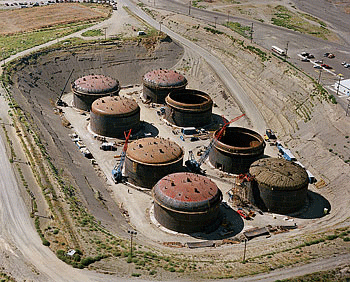 Will Hanford’s Big Clean-Up Ever Begin? Fifteen years past its originally scheduled start-up date, the nuclear facility’s glassification plant is way over budget and no one seems able to nail down a deadline. At fault, say critics, are mismanagement, frequent turnover in the top brass, and a culture that doesn’t take kindly to criticism. Seattle News Weekly, By John Stang , Dec 15 2015 “……….The story of Tamosaitis’ unheralded warnings is not the exception in the ongoing struggle to contain Hanford’s waste. Rather, this episode is just the latest in a litany of setbacks that has put the project over budget and off schedule again and again.
Officially, the reasons are that this is a first-of-its-kind project with difficult-to-perfect new technology.
In reality, the glassification project—like most of Hanford—resembles a giant Dilbert comic book. The culture is the culprit. There are immense corporate and social pressures to look good now and hope someone else is in charge when things go wrong later. These pressures include high turnover in upper management, bonuses to corporations, individual career advancement, and retaliation against those who rock the boat at inconvenient times. Continue reading
Kentucky history illustrates the real disaster of nuclear energy
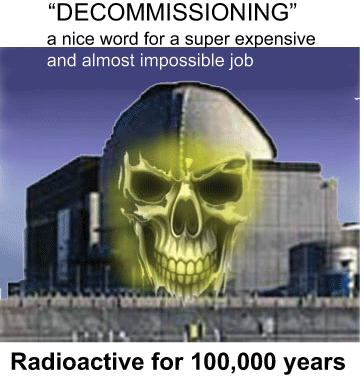 And then there are the power plants themselves after they have completed their 30-40-year life. Do you build a lead mausoleum around it and then another one around it? You certainly can’t dismantle it and take it off to nowhere.
Be wary, Kentucky legislators, when thinking about entering the nuclear field.
KY should stay far from nuclear power http://www.courier-journal.com/story/opinion/2015/12/17/commentary-nuclear-power-waste/77473024/ David Ross Stevens Kentucky history tells us that the commonwealth should stay as far away as possible from nuclear power. Yet the recently past Energy Secretary Len Peters was proposing to the Kentucky legislature that it consider allowing uranium-powered electricity plants. Now there is a new Energy and Environment Cabinet secretary in Charles Snavely, who represented the coal company that was justfined $500,000 to $6 million for water pollution violations. (But that’s another story.) Will Snavely include nuclear energy with a mix of energy in Kentucky’s future?
As coal continues to decline mainly because of natural gas prices and as solar/wind power flex their muscles, nuclear energy always seems to hover on the horizon like an enticing siren.
Here is why Kentucky and every other state should avoid nukes like the plague. Most of the negatives happen in the uranium enrichment cycle before making electricity and in the storage (or non-storage) of radioactive wastes after electrical generation. Both have been disasters for the state: at the uranium enrichment plant at Paducah and at the radioactive waste deposit site at Maxey Flats near Morehead. Continue reading
Global trend towards bankruptcy for the nuclear industry
 Here is yet another reason why Solar (of all flavors) is starting to look better and better: ‘Nuclear power is risky and unprofitable’ Mycle Schneider, an expert on nuclear energy, expects bankruptcy in the nuclear industry and “substantial security risks.”
http://www.dw.de/nuclear-power-is-risky-and-unprofitable/a-18299318
DW: Mycle Schneider, every year you publish the World Nuclear Industry Status Report. What are the global trends?
The production costs for nuclear energy have increased over the last couple of years. It’s a dramatic development as the costs of all the other technologies, especially renewable energies, are decreasing. Renewable energies are, therefore, now in real competition. Furthermore, power demand in Europe is shrinking, and for operators of nuclear power stations, these are real problems.
So if nuclear power isn’t economically viable, why then are some governments – such as the British government – planning to build new nuclear power stations?
Energie- und Atomexperte Mycle Schneider
Sees nuclear power as too risky and expensive: Mycle Schneider, expert on nuclear energy.
For years, the British government has counted on nuclear power and not put forward a reasonable energy policy. Well, nuclear energy has become more expensive now but other, more intelligent scenarios have not been developed. It’s also not certain yet, whether or not the new Hinkley Point nuclear power plant will be built as planned. There are no signed contracts yet. But the estimated cost to generate power from these plants is about twice as high as the average price of electricity today.
Former Clinton Defense Secretary offers dire warning
 Two decades later, Perry has written a new book, “My Journey at the Nuclear Brink,” in which he offers a dire warning: “Far from continuing the nuclear disarmament that has been underway for the last two decades, we are starting a new nuclear arms race.”
This is not hyperbole. The United States and Russia are acting with increasing belligerence toward each other while actively pursuing monstrous weapons. As Joe Cirincione described in the Huffington Post, the Pentagon plans to spend $1 trillion over 30 years on “an entire new generation of nuclear bombs, bombers, missiles and submarines,” including a dozen submarines carrying more than 1,000 warheads, capable of decimating any country anywhere. In the meantime, President Obama has ordered 200 new nuclear bombs deployed in Europe.
Read the full text of Katrina’s column here. http://www.thenation.com/article/the-new-nuclear-arms-race/
Sea level rise threatens nuclear stations and nuclear waste dumps
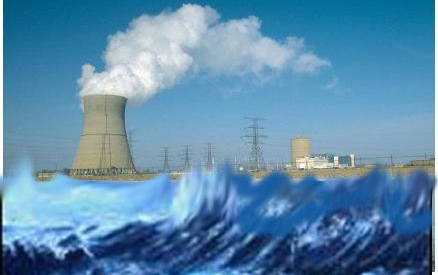 As Sea Levels Rise, Are Coastal Nuclear Plants Ready? National Geographic, By Christina Nunez, 16 Dec 15 [EXCELLENT MAPS] National Geographic Just east of the Homestead-Miami Speedway, off Florida’s Biscayne Bay, two nuclear reactors churn out enough electricity to power nearly a million homes. The Turkey Point plant is licensed to continue doing so until at least 2032.
At some point after that, if you believe the direst government projections, a good part of the low-lying site could be underwater. So could at least 13 other U.S. nuclear plants, as the world’s seas continue to rise. Their vulnerability, and that of many others, raises serious questions for the future……. safety concerns have stoked opposition to nuclear. Reactors can’t operate safely without uninterrupted power and vast amounts of cool water, which is why they’re often located near coastlines, rivers, and lakes. Even when a plant isn’t running, its fuel continues to generate heat that needs to be controlled to prevent explosions or radioactive leaks.
The disaster at Japan’s Fukushima Daiichi showed what can happen when a massive surge of water hits a nuclear plant……
Storms and Warming
The United States has 100 operational nuclear reactors, and another 17 that are being decommissioned. In the past, historical data about storms and flooding would inform the licensing requirements for a unit.
“We generally thought that backward look was sufficient,” says Dave Lochbaum, director of the Nuclear Safety Project at the nonprofit Union of Concerned Scientists. Fukushima and big storms like Hurricane Sandy in 2012 showed “that’s a tenuous assumption at best.”………
“The Nuclear Regulatory Commission has been slow to implement those Fukushima lessons learned,” says Matthew McKinzie, nuclear program director at the environmental group Natural Resources Defense Council. “Nuclear safety is a work in progress.”
Researchers at Stanford University echoed that concern in 2013, flagging four East Coast plants (the Salem and Hope Creek plants in New Jersey; Millstone in Connecticut; and Seabrook in New Hampshire) as especially vulnerable to storm surges and arguing for, among other measures, more and taller seawalls. A more recent analysis from the Union of Concerned Scientists found that at least four nuclear plants are vulnerable to storm surges by 2050.
The NRC is considering two new rules, one based on post-Fukushima safety orders issued in 2012, and another that would create new standards related to decommissioning.
The former rule, to be finalized at the end of next year, requires “an extra level of defense for a plant to deal with events that could interfere with ability to keep the core cool,” says Nuclear Regulatory Commission spokesperson Scott Burnell. That defense includes portable backup power generators, battery banks, and additional supplies if needed……..
 The more immediate concern from climate change, says Dominion spokesperson Ken Holt, is the water near Millstone getting too warm. One of its units had to shut down temporarily in 2012, because its intake from the Niantic Bay exceeded 75 degrees. It’s a problem that has affected other plants, too…….
Even if the plants aren’t running, though, the industry will need to address the radioactive waste left behind.
The question of what happens with spent fuel left at shuttered nuclear plants is, Lochbaum says, “the biggest wild card.”
He adds: “We do have a number of plants around the country where the spent fuel may remain there for decades, and nature may not give us that much time.”
The concern is that the shorter-term pools used to cool spent fuel rods require continuously circulated water. Loss of power at Fukushima, for example, led to urgent efforts to keep the water in the spent fuel pools from boiling away.
After a few years, fuel can be moved from pools to dry casks made of steel reinforced with concrete. Though the safety risk for casks is much lower—all of Fukushima’s emerged unscathed—some are concerned about how long those casks can remain safe at vulnerable sites, especially those buffeted by salty sea air. At the decommissioned San Onofre plant in California, for example, local activists tried but failed to stop plans to store nuclear waste 100 feet from the coast…….. http://news.nationalgeographic.com/energy/2015/12/151215-as-sea-levels-rise-are-coastal-nuclear-plants-ready/
“Culture of quiet” about India’s Top-Secret Nuclear City to Produce Thermonuclear Weapons
The nuclear city would, in short, be ringed by a security perimeter of thousands of military and paramilitary guards.
in choosing to remain publicly silent, the United States was taking a risk, evidently to try and reap financial and strategic rewards.
 India Is Building a Top-Secret Nuclear City to Produce Thermonuclear Weapons, Experts Say The weapons could upgrade India as a nuclear power — and deeply unsettle Pakistan and China. Foreign Policy.com BY ADRIAN LEVY DECEMBER 16, 2015 “………A culture of quiet
Like the villagers in Challakere, some key members of the Indian Parliament say they know little about the project.
One veteran lawmaker, who has twice been a cabinet minister, and who asked not to be named due to the sensitivity of the topic, said his colleagues are rarely briefed about nuclear weapons-related issues. “Frankly, we in Parliament discover little,” he said, “and what we do find out is normally from Western newspapers.” And in an interview with Indian reporters in 2003, Jayanthi Natarajan, a former lawmaker who later served as minister for environment and forests, said that she and other members of Parliament had “tried time and again to raise [nuclear-related] issues … and have achieved precious little.” Continue reading
The importance of understanding USA’s nuclear triad
What the nuclear triad is, why it matters By Kingston Reif December 16, 2015 Kingston Reif is the director for Disarmament and Threat Reduction Policy at the Arms Control Association. @KingstonAReif.(CNN)National security issues dominated Tuesday night’s Republican presidential candidate debate. And while the recent terrorist attacks in Paris and San Bernardino — and the conflict with ISIS — took center stage, the candidates also sparred on the under-the-radar issue of nuclear weapons policy. The question is whether any of the candidates fully understand quite how critical this subject is to America’s security.
As former Defense Secretary William Perry recently warned, the United States and Russia are on the verge of a new nuclear arms race, and Washington is currently planning to spend roughly $1 trillion dollars on nuclear weapons over the next 30 years without any real national debate.
How did the candidates do on the issue Tuesday?
Debate panelist Hugh Hewitt asked Donald Trump and Sen. Marco Rubio how they would approach the stewardship of America’s aging nuclear arsenal. Trump clearly had not done his homework on the subject, ending a rambling answer with “nuclear is just the power, the devastation is very important to me.”
Rubio, meanwhile, said that all three legs of America’s nuclear triad — submarines, land-based missiles, and bombers –“are critical” and in need of modernization. Ironically, he recommended the same course of action that President Barack Obama is pursuing: namely, a multi-hundred-billion-dollar plan to rebuild all three legs of the triad and their associated warheads and supporting infrastructure.
While many Republicans believe that the Obama administration has allowed America’s nuclear weapons to atrophy, the reality is that the administration has requested huge increases for nuclear weapons programs at the Defense and Energy Departments to sustain and modernize the arsenal.
For example, the administration’s fiscal year 2016 request for nuclear weapons programs at the Energy Department is roughly $3.5 billion more than the Bush administration’s final budget request. In fact, the GOP-led Congress has provided less funding for this program than requested by President Obama.
The reality is that the key issue is not so much that the Obama administration has spent too little on nuclear weapons, but that its current plans are unrealistic and would sustain an arsenal that U.S. military leaders have concluded is larger than necessary to deter a nuclear attack against America and its allies.
According to a Congressional Budget Office report in January, the direct costs of the administration’s plans for nuclear forces will total about $350 billion between fiscal 2015 and fiscal 2024. And this is just the tip of the spending iceberg, as most of these modernization programs are still in the research and development phase. Over the next 30 years, the bill could add up to $1 trillion, according to three separate independent estimates.
Meanwhile, U.S. military leaders continue to warn that the United States faces a cash crunch in the near future when it comes to sustaining and modernizing nuclear forces………
Ultimately, though, no matter what one’s perspective is on the role of nuclear weapons in U.S. national strategy — and whether the current plan to rebuild a bloated U.S. arsenal is necessary or affordable — the GOP candidates for president should at least be able to explain to the American people how the they propose to pay for the current modernization plans. And they should also be prepared to tell taxpayers why they should pay for more nuclear weapons than is required for deterrence, and how they would seek to reduce the danger to the United States posed by Russia’s nuclear arsenal. http://edition.cnn.com/2015/12/16/opinions/reif-nuclear-weapons-policy/
1 This Month
Chernobyl: The Lost Tapes – A good documentary on Chernobyl on SBS available On Demand for the next 3 weeks– https://www.sbs.com.au/ondemand/tv-program/chernobyl-the-lost-tapes/2352741955560

of the week–London Campaign for Nuclear Disarmament

Tell the Ukrainian Government to Drop Prosecution of Peace Activist Yurii Sheliazhenko
To see nuclear-related stories in greater depth and intensity – go to https://nuclearinformation.wordpress.com
-
Archives
- April 2026 (126)
- March 2026 (251)
- February 2026 (268)
- January 2026 (308)
- December 2025 (358)
- November 2025 (359)
- October 2025 (376)
- September 2025 (257)
- August 2025 (319)
- July 2025 (230)
- June 2025 (348)
- May 2025 (261)
-
Categories
- 1
- 1 NUCLEAR ISSUES
- business and costs
- climate change
- culture and arts
- ENERGY
- environment
- health
- history
- indigenous issues
- Legal
- marketing of nuclear
- media
- opposition to nuclear
- PERSONAL STORIES
- politics
- politics international
- Religion and ethics
- safety
- secrets,lies and civil liberties
- spinbuster
- technology
- Uranium
- wastes
- weapons and war
- Women
- 2 WORLD
- ACTION
- AFRICA
- Atrocities
- AUSTRALIA
- Christina's notes
- Christina's themes
- culture and arts
- Events
- Fuk 2022
- Fuk 2023
- Fukushima 2017
- Fukushima 2018
- fukushima 2019
- Fukushima 2020
- Fukushima 2021
- general
- global warming
- Humour (God we need it)
- Nuclear
- RARE EARTHS
- Reference
- resources – print
- Resources -audiovicual
- Weekly Newsletter
- World
- World Nuclear
- YouTube
-
RSS
Entries RSS
Comments RSS
 nuclear-news