Worst nuclear contamination is former plutonium plant in Hanford, USA
 HANFORD NUCLEAR RESERVATION: America’s Fukushima December 30, 2015 by State of the Nation America’s Atomic Time Bomb: Hanford Nuclear Waste Still Poses Serious Risks By Marc Pitzke in New York Spiegel Online International
The disaster at Fukushima has raised questions around the world about nuclear safety. But contamination is much worse in the Pacific Northwest of the United States. The former plutonium plant in Hanford, Washington is one of the most contaminated places on earth, and still decades from being cleaned up.
The lambs were born without eyes or mouths. Some had legs that had grotesquely grown together; others had no legs at all. Many were stillborn. Thirty-one were lost in a single night.
On a pasture nearby, a cow was found dead, stiff and with its hooves bizarrely stretched up into the whispering wind. Down by the river, men of the Yakama tribe pulled three-eyed salmon from the Columbia. Trout were covered in cancerous ulcers.
And then the babies started getting sick.
It was in the spring of 1962 that farmer Nels Allison first noticed something was ominously wrong. “Son of a bitch,” he said to his wife. Sheep were always “the first to lie down and die” when something was amiss on Allison’s farm near Basin City, a rural town near the Columbia River in the far northwestern corner of the continental United States. He started referring to that deadly night “the Night of the Little Demons.”
Although the Allisons have long since passed away, the shock endures. As chronicled by journalist Michael D’Antonio in his 1993 book Atomic Harvest, their tale is one of thousands of horror stories that took place in the area surrounding Hanford, Washington, the site of America’s first full-scale plutonium production facility. The site haunts the locals to this day — and imperils them.
Hanford is America’s original atomic sin. At this giant facility sprawled over 586 square miles (1,517 square kilometers), a four-hour drive southeast of Seattle into the vast emptiness of Eastern Washington, the United States once produced most of its nuclear raw materials for the Cold War. Though it was decommissioned in 1988, it remains the most contaminated location in the entire Western Hemisphere.
The US Department of Energy (DOE) recently revised its timetable for Hanford’s decontamination, the biggest environmental cleanup in American history. The end date was moved back, once again. It now hopes to finally wrap up this Herculean task by September 2052 — more than 108 years after Hanford was opened……..http://stateofthenation2012.com/?p=28115
US Chamber of Commerce backs the weakening of radiation safety standards
 US Chamber of Commerce Nov 19 15
 radiation hormesis is a phenomenon in which low doses of ionizing radiation can be beneficial, stimulating the activation of repair mechanisms and other adaptive responses that protect against adverse effects not activated in the absence of ionizing radiation…….
Cancer cases increase in area of radioactive material spreading from St. Louis landfill
Pollution from the landfill has already been blamed for a sharp increase in the number of cancer cases in the surrounding areas.

 Radioactive materials spreading from St. Louis landfill – report https://www.rt.com/usa/327593-nuclear-waste-stlouis-runoff/#.VoWKJnujHaY.twitter 31 Dec, 2015 Dangerous radioactive materials from a nuclear waste dump near St. Louis, Missouri have spread to neighboring areas, a new study shows. Storm water runoff from the site has also raised concerns and is being tested for radioactive pollution.
According to a peer-reviewed study just published in the Journal of Environmental Radioactivity, there is “strong evidence” that radon gas and water emanating from the West Lake Landfill are responsible for the anomalous levels of a lead isotope (210Pb), created by radioactive decay, in the surrounding area.
Just northwest of the St. Louis International Airport, the West Lake Landfill is a repository of nuclear waste from the Manhattan Project, the WW2 effort to create the atomic bomb. The area was declared an Environmental Protection Agency (EPA) Superfund site in 1990, but the federal government is still deciding how to clean up the waste.
After analyzing nearly 300 soil samples from a 200-square-kilometer zone surrounding West Lake, the report’s authors concluded that “offsite migration of radiological contaminants from Manhattan Project-era uranium processing wastes has occurred in this populated area.”
The stuff we’re talking about at West Lake is hotter than what you would find in a typical uranium mill tailings operation,” said Bob Alvarez, one of the authors, in an interview on Tuesday. Continue reading
The nuclear lobby failed its goal for Paris climate agreement
 Paris Fails to Revive the Nuclear Dream, Ecowatch Paul Brown,
  Climate News Network | December 31, 2015 In Paris, in early December, the advocates of nuclear power made yet another appeal to world leaders to adopt their technology as central to saving the planet from dangerous climate change.
Yet analysis of the plans of 195 governments that signed up to the Paris agreement, each with their own individual schemes on how to reduce national carbon emissions, show that nearly all of them exclude nuclear power.
Only a few big players—China, Russia, India, South Korea and the United Kingdom—still want an extensive program of new–build reactors.
To try to understand why this is so the U.S.-based Bulletin of the Atomic Scientists asked eight experts in the field to look at the future of nuclear power in the context of climate change.
One believed that large-scale new-build nuclear power “could and should” be used to combat climate change and another thought nuclear could play a role, although a small one. The rest thought new nuclear stations were too expensive, too slow to construct and had too many inherent disadvantages to compete with renewables.
Industry in Distress
Amory Lovins, co-founder and chief scientist of the Rocky Mountain Institute, produced a devastating analysis saying that the slow-motion decline of the nuclear industry was simply down to the lack of a business case.
The average nuclear reactor, he wrote, was now 29 years old and the percentage of global electricity generated continued to fall from a peak of 17.6 percent in 1996 to 10.8 percent in 2014. “Financial distress stalks the industry,” wrote Lovins.
Lovins says nuclear power now costs several times more than wind or solar energy and is so far behind in cost and building time that it could never catch up.
The full details of what he and other experts said are on the Bulletin’s site, with some of their comments below……..
M.V. Ramana, of the Nuclear Futures Laboratory and the Program on Science and Global Security at Princeton University, was dismissive. “There are still some who hope that nuclear power will magically undergo a massive expansion within a relatively short period of time.”
”The evidence so far suggests that this is a false hope, one that is best abandoned if we are to deal with climate change with the seriousness the problem demands.”
Peter Bradford, adjunct professor at Vermont Law School and former Nuclear Regulatory Commission member, agreed: “Climate change, so urgent and so seemingly intractable, has become the last refuge of nuclear charlatans throughout the Western world.”
He said James Hansen, perhaps the most visible of the climate scientists who advocate heavy reliance on breeder or other innovative reactor designs, did so without paying any attention to their track record of long and costly failure…… http://ecowatch.com/2015/12/31/paris-fails-nuclear-dream/
Weakening of nuclear radiation standards would certainly suit Nuclear Medicine Industry

 Demystifying Nuclear Power: Problem: In a post-Fukushima-triple-meltdown world, do the numbers work for atomic power? Fairewinds,November 17, 2015 by Sue Prent “…..Nuclear medicine interests share some of the existential angst experienced by their atomic energy sector colleagues. So it is not surprising that Carol Marcus Ph.D., M.D. is a professor of Nuclear Medicine at U.C.L.A is one of the petitioners to the NRC to demand that it relax radiation illness standards. Nuclear medicine is where expansion of the development and application of new radiology treatments and specialized equipment represent a huge corporate industrial growth opportunity.
Ms. Marcus and her colleagues have a special interest in countering many medical evaluations and admonitions that are routinely raised by doctors and hospitals around the world about the over-use of radiation for diagnosis and treatment.
Adoption of the hormesis theory of benign radiation would really help the nuclear medicine industry as much as it will help the atomic reactor power industry. In fact, Dr. Marcus’ petition to the NRC seems to equate the fact that radiation can be useful in diagnosis and treatment of cancer with evidence that low-dose radiation is indeed beneficial, in spite of years of data proving that is not true, including the lengthy German study.
To that, one must counter that the benefits brought to cancer treatment by radiation have a very specific tissue-destroying capacity rather than any positive health function. There is no scientifically corroborated benefit for even an extremely low-dose of radiation. Rather than providing any actual proof for her hypothesis, the balance of Dr. Marcus’ petition seems to be filled with complaints detailing how existing radiation protection guidelines hamstring her profession.
The second petition to end LNT, submitted by Certified Health Physicist Mark L. Miller relies heavily on language identical to that of Dr. Marcus, suggesting a collaborative relationship.
The third petition was submitted by a group lead by one of the principle voices supporting the hormesis theory, Mohan Doss Ph.D. His cosigner’s predictably represent atomic corporate interests that have heavily financially invested in the success and expansion of atomic industries.
According to the Fox Chase Cancer Center website, Mr. Doss, who is an MCCPM (Member of the Canadian College of Physicists in Medicine) radiology practice includes
Mr. Doss, who has found a well-spring of opportunity in the convenient meme of hormesis, is quoted along with the other two petitioners in a New York Times article that uses the number of deaths from suicide and accident that have occurred among evacuees from Fukushima evacuation zone as a rallying call……… http://www.fairewinds.org/nuclear-energy-education/demystifying-nuclear-power-problem-in-a-post-fukushima-triple-meltdown-world-do-the-numbers-work-for-atomic-power
Resist nuclear trash dumping! – League of Women Voters of South Carolina
Because this waste would be traveling through our state’s ports and on our roads with no option for a final repository, citizens and elected officials can no longer hope that others are thinking about nuclear waste. All South Carolinians must ask their elected leaders why the DOE and the NRC want to fiercely ignore public policies and laws to send commercial waste to SRS.
Don’t let South Carolina become a nuclear dumping ground, Statehouse Report· 12/31/2015 By Julie Hussey and JoAnne Day | Nuclear waste is one of those things most people hope someone else is thinking about. The good news is that for 40 years, members of the League of Women Voters of South Carolina (LWVSC) have been following waste issues at the Savannah River Site (SRS). Recent national and international proposals require all South Carolinians to become informed and take action.
Nuclear waste is usually from commercial power production and weapons facilities. All forms of U.S. nuclear waste are the responsibility of the U.S. government. Although the Department of Energy (DOE) and its predecessor agencies have been generically charged with this responsibility, Congress establishes national policies and appropriates funds……..
Frustrated by the lack of congressional responsibility to take care of commercial spent fuel, nuclear industry leaders have proposed reprocessing of nuclear waste at “temporary” storage sites. While these proposals suggest local jobs, they present other problems and do not solve the issue of a permanent repository. Such plans also fail to acknowledge that “high burnup” spent fuel is about four times as hot, both thermally and radioactively as old spent fuel and comes with unknown technical, environmental and human challenges.
LWVSC and other SRS watchers noted that SRS, a weapons site, was proposed by industry as one of these “temporary” storage sites, despite decades-old U.S. policy of separating commercial and defense activities. We believed this wise policy would keep spent commercial fuels out of the SRS defense waste site. We also know agencies are required by law to provide public notice before moving waste. What we did not know is that DOE has been making secret plans to bring German commercial fuel and NRC has been making secret plans to bring Illinois/Exelon commercial fuel to SRS. This news is disturbing to say the least.
Rather than following the processes and policies established to protect the human and physical environment, DOE is focused on the money it plans to charge Germany for waste treatment. While we recognize that SRS may be the only well-managed site, SRS should not be “rewarded” with the responsibility to accept international commercial waste just because DOE wants the income. Other labs such as Hanford and Los Alamos are not expected to generate income, and neither should SRS. German nuclear waste should stay in Germany.
Industrial nuclear waste should be the responsibility of the company that managed it. According to its website, Exelon operates the largest fleet of nuclear plants in the nation — 23 reactors at 14 locations. Duke Energy keeps its spent fuel at its own sites, and Exelon should do the same.
Because this waste would be traveling through our state’s ports and on our roads with no option for a final repository, citizens and elected officials can no longer hope that others are thinking about nuclear waste. All South Carolinians must ask their elected leaders why the DOE and the NRC want to fiercely ignore public policies and laws to send commercial waste to SRS. SRS should be rewarded for its efforts by sharing our knowledge and experiences with other facilities, not by allowing others to share their waste and problems with us.
Politicians love to make bold statements about not accepting prisoners from Guantanamo or refugees from Syria into our state. Why are they silent about accepting nuclear waste?
- For more information on nuclear waste in South Carolina check out the League of Women Voter’sissue brief, on the subject.
Julie Hussey and JoAnne Day are co-presidents of the League of Women Voters of South Carolina. http://www.statehousereport.com/2015/12/31/my-turn-dont-let-south-carolina-become-a-nuclear-dumping-ground/
India’s race for nuclear weapons, promoted by US government policies
Indian Nuclear Program – A global migraine , The Nation Muhammad Umar December 30, 2015 American experts have been incessantly warning their government of the dire consequences of exempting India from the Nuclear Suppliers Group (NSG) requirements. On December 8, while testifying in front of the United States House Committee on Foreign Affairs, the Executive Director of the Nonproliferation Policy Education Center, Henry D. Sokolski said, “The US persuaded the NSG to allow India to import uranium for its civilian nuclear program but, as predicted, this has only allowed India to dedicate more of its meager domestic uranium production to military purposes. India, in short, with the deal now can make more bombs.”
Since last December, Putin, Obama, and Xi Jinping have all visited India, and with each one Modi has made promises that contradict the commitments he has made to the others. Modi thinks he can pull the wool over everyone’s eyes – yes, he does, but cannot fool them any longer. He used President Xi Jinping’s visit to leverage Russia and the visit by Vladimir Putin to force Barack Obama into his arms. This is the real face of the so-called incredible India.
The construction of this new top-secret nuclear city, as detailed in Levy’s report is clear evidence that America’s attempt to offer India a civil nuclear incentive has failed to reign in their nuclear weapons program, instead it has helped the weapons program grow to unthinkable new heights. The city when completed in 2017 would be “the subcontinent’s largest military-run complex of nuclear centrifuges, atomic-research laboratories, and weapons- and aircraft-testing facilities”, the report said.
Regional stability is essential to avoid war, the NSG exemption secured by the America for India has freed up un-safeguarded Indian uranium for weapons use, and as revealed by Levy for an entire city dedicated to building nuclear bombs. After all this, America still choses to continue with backing India’s bid for full membership to the NSG, ironically the very organization created to prevent future proliferation after India exploded their first bomb.
The Americans must know that if India is allowed to build such a huge facility for the sole purpose of enriching uranium, it will create instability in the region. It will further aggravate Pakistan’s security dilemma, and at the same time enrage the Chinese.
According to the report, the construction began three years ago, and it is hard to imagine that strategic thinkers in the United States did not raise any red flags……… http://nation.com.pk/columns/30-Dec-2015/indian-nuclear-program-a-global-migraine
China keen to market nuclear expertise, but in the UK scrutiny is increasing

 Nuclear energy: Beijing’s power play, Ft.com Christopher Adams and Lucy Hornby, December 29, 2015 China is intent on exporting its nuclear expertise but in the UK scrutiny is increasing. “………. The French-designed plant, which after five years of construction is about to undergo testing, will serve as the prototype for a huge power station planned by the UK in south-west England. It is set to cost £18bn according to the latest estimates by French energy group EDF, which is leading the project.
Hinkley Point, in Somerset, is home to a working nuclear plant and twin disused Magnox reactors. Now David Cameron, UK prime minister, wants the site to host the first of a new generation of reactors that he envisages will replace Britain’s ageing nuclear fleet by 2030.
Under a commercial pact struck during October’s state visit to London by Chinese president Xi Jinping, CGN will take a one-third stake in Hinkley. Its state-owned rival, China National Nuclear Corporation, may also participate. A decade from now, assuming all goes to plan, Taishan’s distinctive egg-shaped reactor domes, double-hulled walls and monster turbines will dominate the shoreline of the Severn estuary. Hinkley Point C will supply 7 per cent of the UK’s electricity……….
CGN can ill-afford errors at Taishan, one of three unfinished projects using a third-generation technology called the European pressurised reactor. Designed by Areva of France, these reactors are being touted as a revolution in nuclear power. But they have had a troubled start on projects at Flamanville in France and Olkiluoto in Finland.
Taishan, too, has suffered delays, albeit not as bad as those in Europe. As a result, CGN is treading carefully. The Chinese plant’s targeted completion date, originally late 2013, has already been put back once, in part because of safety rules after Fukushima. Now it will probably come online in 2017 — though CGN will not say exactly when. Says Mr Zheng: “We must perform a lot of tests, and since it’s now a first of a kind, we need to do more tests than we planned. Those tests should have been done already in Finland or France, but we must do them now.”
The construction problems highlight the complexity of the EPR projects. There are questions over whether there really is demand for these larger reactors, given their cost and size. Mr Guo, though, is bullish. Standing under an 80-tonne door that will one day seal off the reactor hall, he lists the EPR’s credentials…….
He Zuoxiu, a retired physicist who helped develop China’s nuclear programme in the 1960s, questions whether nuclear power will ever truly be safe, even with safeguards to prevent disasters such as Fukushima. He cites a statistic: the US, Russia and Japan each had more than 50 reactors when they suffered accidents. In other words, the more a country has, the greater the chance of something going wrong……..
UK concerns
There are worries, too, that Britain’s tilt towards China — and chancellor George Osborne’s embrace of its investment — will open the door to security risks. The UK shift has caused consternation in the US, which accuses China’s state-owned industry of benefiting from military-linked corporate espionage.
Patrick Cronin, an Asia expert at the Center for a New American Security, says Britain should take care to balance its economic needs against those of national security, particularly on critical infrastructure such as nuclear plants. “Let’s say that 10 years from now there is a major conflict with China. This would give China, effectively, a veto over UK participation, for example, over the Taiwan issue in the next decade,” says Mr Cronin.
“Just understanding the most vulnerable parts of reactors in Britain is a vulnerability. A Chinese state-owned enterprise may show that information to people who have ill intentions to the UK, especially if there’s a crisis.”
Concerns have also been raised in Whitehall over the prospect of China being able to build digital loopholes into hardware it supplies, allowing Beijing to exploit vulnerabilities at nuclear plants. CNNC’s background as China’s nuclear weapons developer before it built the country’s civilian reactors has added to those fears……… http://www.ft.com/cms/s/0/789e5070-974a-11e5-9228-87e603d47bdc.html#axzz3vvmo6esp
As Wylfa nuclear plant closes in Wales, delays continue for UK’s new nuclear stations
Wylfa nuclear plant closes in Wales Station in Anglesey, Wylfa the oldest in the UK, shuts as focus is on energy provider EDF over its plans for new facilities at Hinkley Point, Guardian, Terry Macalister, 31 Dec 15 Britain’s oldest nuclear plant closed on Wednesday, leaving in its wake a £700m decommissioning bill and further questions about the UK’s ability to keep the lights on.
The closure of the Wylfa plant in Wales after 44 years of service puts more pressure on EDF Energy to take a final investment decision for new reactors at Hinkley in Somerset.
The station on the island of Anglesey generated enough electricity to power 1m homes, and with a capacity of 1,000MW was once the largest facility of its kind in the world. But after an earlier life extension scheme expired, the last of the 26 British-designed Magnox reactors was switched off by the private consortium that manages the plant for the Nuclear Decommissioning Authority (NDA)…….
 It will take another 10 years for the basic decommissioning to be undertaken at a cost of about £700m but the site cannot be redeveloped before the end of the century. High-level waste from Wylfa will remain on Anglesey until a national nuclear waste disposal facility is finally developed.
Britain still has a fleet of advanced cooled atomic reactors run by EDF but most of these will be retired by 2023 just as the government has also promised to halt all coal-fired power stations.
Hitachi of Japan is leading a Horizon Nuclear Power project to construct a new power plant at Wylfa, with a second earmarked for Oldbury in south Gloucestershire alongside a third facility planned in Cumbria. But the atomic industry’s revived fortunes ride primarily on the Hinkley C plant, which is expected to be the first new site since the Sizewell B station was completed in 1995.
The £18bn Somerset project has been repeatedly delayed but Chinese investors finally gave their support in the autumn while thegovernment promised the latest in a series of subsidies. EDF signalled in October that it would start work at Hinkley and it is expected to give the formal investment the go ahead within weeks before later saying it may not come until after Christmas.
Hinkley Point C, intended to provide about 7% of the UK’s total electricity, was originally scheduled for completion by 2018 but the latest date is 2025. Sceptics still question whether it will make that later date given the experiences of delays and cost overruns with a similar power project at Flamanville in Normandy, northern France.
There have also been problems at the new Olkiluoto nuclear plant in Finlandwhich is using the same plant design provided by EDF’s engineering partner Areva at Flamanville and planned for Hinkley………http://www.theguardian.com/environment/2015/dec/30/wylfa-nuclear-plant-closes-in-wales
US spying reveals Israeli bids to block Iran nuclear deal
 US spying reveals Israeli bids to block Iran nuclear deal, France 24 2015-12-30 The U.S. National Security Agency’s foreign eavesdropping included phone conversations between top Israeli officials and U.S. lawmakers and American-Jewish groups, the Wall Street Journal reported on Tuesday.
White House officials believed the intercepted information could be valuable to counter Israel Prime Minister Benjamin Netanyahu‘s campaign against the nuclear deal with Iran, according to the unnamed officials, the Journal said.
NSA eavesdropping revealed to the White House how Netanyahu and his advisers had leaked details of the U.S.-Iran negotiations, which they learned through Israeli spying
operations, the newspaper reported.
The NSA reports allowed Obama administration officials to peer inside Israeli efforts to turn Congress against the deal, according to the Journal.
Israel’s ambassador to the United States, Ron Dermer, was described as coaching unnamed Jewish-American groups on lines of argument to use with U.S. lawmakers, and Israeli officials were reported pressing lawmakers to oppose the deal, the newspaper said.
Asked for comment on the Journal report, a White House National Security Council spokesman said: “We do not conduct any foreign intelligence surveillance activities unless there is a specific and validated national security purpose. This applies to ordinary citizens and world leaders alike.”……. http://www.france24.com/en/20151230-usa-nsa-israel-netanyahu-iran-nuclear
Japan’s Nuclear Regulation Authority is by no means confident of nuclear energy safety
No endorsement of nuclear safety, Japan Times, DEC 30, 2015 Power companies and the government should not be under the illusion that the safety of nuclear power plants under the new standards of the Nuclear Regulation Authority has been endorsed by the judiciary. While last week’s decision by the Fukui District Court paves the way for Kansai Electric Power Co. to restart reactors No. 3 and 4 at its Takahama Nuclear Power Plant as early as next month, the court urged the utility and the NRA to make constant efforts to aim higher for safety in the operation of nuclear plants.
The Fukui court reversed the decision given by the same court eight months ago under a different judge, who has since been transferred to another court. In April, the court ordered an injunction banning the restart of the Takahama plant on the Sea of Japan coast in Fukui Prefecture on the grounds that the NRA’s plant safety regulations, tightened after the Tepco plant meltdowns to make nuclear power plants resilient against bigger quakes and tsunami as well as severe accidents, were too lax to secure the plant’s safety. If the logic behind the decision was to be upheld, it would have dealt a crushing blow to the restart bid by the power industry and the administration because it negates the validity of the NRA regulation itself.
In its Dec. 24 decision on a complaint filed by Kepco against the April decision, the Fukui court said the NRA’s regulations are based on the latest scientific and technological knowledge and therefore rational. There’s nothing irrational in the NRA’s approval of Kepco’s plans to restart the Takahama plant, the court said in lifting the ban on reactivating the reactors that have cleared the NRA’s safety screening.
The two opposite decisions by the same court appear to symbolize the shakiness of legal judgments on the safety of nuclear power plant operation just four years after the nation experienced the world’s worst nuclear disaster since Chernobyl. Residents in areas around the Takahama plant who sought the injunction banning its restart plan to take the case to a higher court, but Kepco, which started loading nuclear fuel to the No. 3 Takahama reactor the day after the court decision, is ready to reactivate it as early as next month……..
public concern over the safety of nuclear power remains strong. ………In lifting the ban on the Takahama plant’s restart, the Fukui court urged the utility, the national and local governments involved to take multi-layered measures to protect against severe accidents at nuclear power plants, including more effective evacuation plans. The court decision should serve as a reminder that merely clearing the NRA standard does not vouch for the safety of a nuclear power plant. http://www.japantimes.co.jp/opinion/2015/12/30/editorials/no-endorsement-nuclear-safety/#.VoWP0LZ97Gh
South Africa, India, and the nuclear terrorism risk
The Center for Public Integrity traced where the Islamic State’s ammo comes from in 2014 and this year wrote about a grave setback in the U.S. military’s effort to take on the group. Through a series of investigative and revelatory articles, it also brought new attention to the possibility that terrorists might get ahold of nuclear explosive materials, due to lax security controls in a handful of key nations.
From South Africa to Iraq and from Moldova to India, here are some of the most alarming stories we published about terrorism and nuclear-related risks in 2015…….
South African facilities present a ripe target for nuclear terrorists The Obama administration has twice asked South African President Jacob Zuma to hand over the country’s supply of weapons-grade uranium. He did not agree.
South Africa’s nuclear stockpile is among the most vulnerable to theft in the world, U.S. officials say.Lieutenant Farhan al-Jassem signed up to join a U.S.-backed force against the Islamic State. He was captured in July by the Nusra Front, another anti-ISIS group.
It’s a cautionary, close-up tale about the long war against the Islamic State, which has been undermined by conflicting goals and wary allegiances.
Experts say someone is looking for a buyer for this nuclear material
Material seized in separate arrests by police in three countries, spanning more than a decade, has led experts and intelligence officials to conclude that a significant quantity of Soviet-era nuclear materials are on the loose.
India’s push for nuclear power has its residents, close neighbors and the West worried.
If India continues to power itself with coal, it could be the world’s No. 1 polluter by 2050. But the country’s answer to this global concern — to build dozens of new nuclear reactors over the next two decades — is beset by serious problems.
Toxic and radioactive pollution from India’s uranium mining and processing are harming citizens, according to Indian and Japanese experts. The country’s explansion of its military nuclear program has displaced tribal communities and alarmed Western analysts. And India’s security precautions for nuclear explosive materials are considered far too lax by U.S. government officials, who say they have been unable to persuade India to take the issue more seriously.
India’s Atomic Energy Regulatory Board (AERB) in bed with the nuclear industry
The problems with India’s atomic energy expansion: A critique by a nuclear energy evangelist , First Post India Jaideep Prabhu Dec 31, 2015 “……. In the United States, the complaint of the nuclear industry is that the process for the approval of new reactor designs is laborious, expensive, and sometimes done with criteria that reflects older knowledge than the latest developments in the industry.
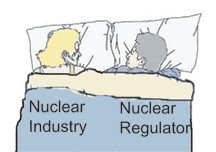 In India, the hurdles start sooner — in that the Atomic Energy Regulatory Board (AERB) is not a body independent of the chain of command of those it regulates. Several members of the DAE have stressed on previous occasions that this administrative quibble does not in any way impinge upon the working of the regulatory authority, but in a country like India where command influence and the flouting of laws is not at all uncommon, even the appearance of impropriety is reason to worry.
Over decades of governmental misconduct, citizens have lost faith in government institutions and in areas like nuclear energy where the scope for damage is enormous, unflattering reports from the Comptroller and Auditor General (CAG) such as in 2012 are damning….”
Are USA and Russia careering towards nuclear war?
Investigation into the California Public Utilities Commission’s San Onofre response
 Criminal probe focuses on San Onofre response Warrant examines utilities commission, Edison meetings and UCLA grant funds San Diego Tribune, By Jeff McDonald and Ricky Young Dec. 29, 2015 A state criminal investigation into the California Public Utilities Commission centers around former President Michael Peevey’s persistent intervention into the process to assign costs for the failure of the San Onofre nuclear plant, newly released court documents show.
A sworn affidavit by an investigator for Attorney General Kamala Harris, unsealed last month, lays out the developing criminal case in detail for the first time.
The 18-page document says improper meetings were held, which might bring misdemeanor charges, but that a conspiracy to commit those misdemeanors could be considered a felony……..
The court document details Peevey’s efforts to win funding for UCLA and researcher Stephanie Pincetl, starting with an undisclosed March 2013 meeting in Warsaw, Poland, with an Edison executive. The affidavit argues that there was probable cause to believe that the executive, Stephen Pickett, conspired to engage in prohibited backchannel communications……..
According to the document, the investigator interviewed Edison International President Ted Craver about Peevey’s efforts to secure Edison grants for UCLA.
Diaz said he “interviewed Ted Craver, who confirmed that Peevey ‘went at him hard,’ telling him that they (SCE) did not get the importance of combatting climate change and this was an opportunity to do something, and if they were smart, they would figure out how to ‘wrap this in a cloak’ and it would be good for public relations.”
The document goes on to describe how Edison never agreed to pay for the research, but it was built in as a requirement in the utilities commission approval process for the San Onofre settlement……..
There is probable cause to believe that Michael Peevey, former President of the California Public Utilities Commission, utilized his position to influence SCE’s commitment of millions of dollars to UCLA to fund a research program,” the affidavit states………
No charges have been filed as a result of the investigation, which is proceeding separately from a federal review of commission practices……. http://www.sandiegouniontribune.com/news/2015/dec/29/diaz-affidavit-cpuc-probe/
1 This Month

of the week – Shut Down Drone Warfare!


Tell the Ukrainian Government to Drop Prosecution of Peace Activist Yurii Sheliazhenko

Petition to revoke the licensing of the Near Surface Nuclear Disposal Facility (NSDF) at Chalk River. https://www.ourcommons.ca/petitions/en/Petition/Details?Petition=e-7247
To see nuclear-related stories in greater depth and intensity – go to https://nuclearinformation.wordpress.com
-
Archives
- April 2026 (79)
- March 2026 (251)
- February 2026 (268)
- January 2026 (308)
- December 2025 (358)
- November 2025 (359)
- October 2025 (376)
- September 2025 (257)
- August 2025 (319)
- July 2025 (230)
- June 2025 (348)
- May 2025 (261)
-
Categories
- 1
- 1 NUCLEAR ISSUES
- business and costs
- climate change
- culture and arts
- ENERGY
- environment
- health
- history
- indigenous issues
- Legal
- marketing of nuclear
- media
- opposition to nuclear
- PERSONAL STORIES
- politics
- politics international
- Religion and ethics
- safety
- secrets,lies and civil liberties
- spinbuster
- technology
- Uranium
- wastes
- weapons and war
- Women
- 2 WORLD
- ACTION
- AFRICA
- Atrocities
- AUSTRALIA
- Christina's notes
- Christina's themes
- culture and arts
- Events
- Fuk 2022
- Fuk 2023
- Fukushima 2017
- Fukushima 2018
- fukushima 2019
- Fukushima 2020
- Fukushima 2021
- general
- global warming
- Humour (God we need it)
- Nuclear
- RARE EARTHS
- Reference
- resources – print
- Resources -audiovicual
- Weekly Newsletter
- World
- World Nuclear
- YouTube
-
RSS
Entries RSS
Comments RSS
 nuclear-news