Underwater drones becoming a threat to UK’s Trident nuclear submarines
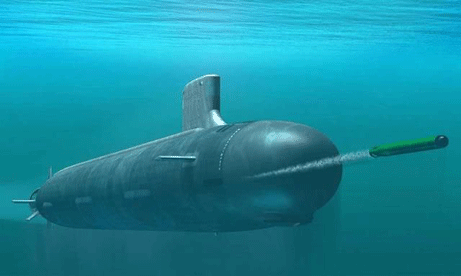
 Trident: Nuclear deterrent under threat from underwater drones, expert warns, The Independent 27 Dec 15 Advances in technology may turn Britain’s £31bn nuclear submarine programme into an expensive liability. Britain’s independent nuclear deterrent could be torpedoed by an increasingly sophisticated breed of underwater drone, a leading defence expert has warned.
Rapid advances in underwater drone technology – autonomous underwater vehicles that can be controlled by ship- or land-based operators – threaten to make the controversial Trident nuclear submarines vulnerable, according to Paul Ingram, the chief executive of the British American Security Information Council (Basic).
Submarines have traditionally been seen as capable of providing stealth and invulnerability to pre-emptive attacks. The current requirement for Trident replacement subs is for them to operate as near to silently as possible.
However, a revolution in underwater drones, as well as advances in sonar, satellite and other anti-submarine warfare systems, mean that even totally silent submarines are likely to become detectable. Some sensor technologies can detect large submerged objects by monitoring small movements of surface water.
Experts warn that as the capabilities of detecting systems improve and their cost falls, large-scale remote and potentially autonomous sensor deployments become possible. The result is that the world’s oceans will become increasingly transparent, seriously calling into question the UK’s heavy reliance upon the Trident submarine programme for its nuclear deterrence………
In January, Carol Naughton, of the non-proliferation group British Pugwash, will launch a research project into the appropriateness of Trident as a platform for the UK’s nuclear weapons capability.
“We are in danger of embarking on a major spend that will not only fail to deliver the invulnerability required of the proposed deterrent system, but is also likely to add a worrying degree of instability into the nuclear weapons situation,” she said.
Last month the Prime Minister revealed that the strategic defence and security review (SDSR) had put the cost of the four subs at £31bn, up from £25bn nine years ago. The review said a contingency fund of £10bn would be set aside, suggesting the MoD anticipates the costs could rise still further.
The first sub is not due to come into service until the early 2030s. http://www.independent.co.uk/life-style/gadgets-and-tech/news/trident-nuclear-deterrent-under-threat-from-underwater-drones-expert-warns-a6786946.html
No comments yet.
1 This Month

of the week – Shut Down Drone Warfare!


Tell the Ukrainian Government to Drop Prosecution of Peace Activist Yurii Sheliazhenko

Petition to revoke the licensing of the Near Surface Nuclear Disposal Facility (NSDF) at Chalk River. https://www.ourcommons.ca/petitions/en/Petition/Details?Petition=e-7247
To see nuclear-related stories in greater depth and intensity – go to https://nuclearinformation.wordpress.com
-
Archives
- April 2026 (79)
- March 2026 (251)
- February 2026 (268)
- January 2026 (308)
- December 2025 (358)
- November 2025 (359)
- October 2025 (376)
- September 2025 (257)
- August 2025 (319)
- July 2025 (230)
- June 2025 (348)
- May 2025 (261)
-
Categories
- 1
- 1 NUCLEAR ISSUES
- business and costs
- climate change
- culture and arts
- ENERGY
- environment
- health
- history
- indigenous issues
- Legal
- marketing of nuclear
- media
- opposition to nuclear
- PERSONAL STORIES
- politics
- politics international
- Religion and ethics
- safety
- secrets,lies and civil liberties
- spinbuster
- technology
- Uranium
- wastes
- weapons and war
- Women
- 2 WORLD
- ACTION
- AFRICA
- Atrocities
- AUSTRALIA
- Christina's notes
- Christina's themes
- culture and arts
- Events
- Fuk 2022
- Fuk 2023
- Fukushima 2017
- Fukushima 2018
- fukushima 2019
- Fukushima 2020
- Fukushima 2021
- general
- global warming
- Humour (God we need it)
- Nuclear
- RARE EARTHS
- Reference
- resources – print
- Resources -audiovicual
- Weekly Newsletter
- World
- World Nuclear
- YouTube
-
RSS
Entries RSS
Comments RSS
 nuclear-news
Leave a comment